
Table of Contents
- Why Trade Show Sponsor Photography Matters More Than Ever in 2026
- 1. Build a Trade Show Photography Shot List That Sponsors Actually Want
- 2. How to Photograph a Trade Show Booth for Maximum Visual Impact
- 3. Measuring Event Photography ROI for Sponsors: Metrics That Matter
- 4. Navigating Show Floor Rules, Model Releases, and Legal Compliance
- 5. Post-Show Image Distribution and Content Repurposing for Sponsors
- Conclusion: Turning Trade Show Sponsor Photography Into a Competitive Advantage
- Frequently Asked Questions
Last Updated: September 10, 2026
Why Trade Show Sponsor Photography Matters More Than Ever in 2026
Companies report an average ROI of $20.98 for every $1 spent on trade shows, according to [Kande Photo Booths’ 2026 Trade Show(/trade-show-photographer-washington-dc/) Statistics | kandephotobooths.com]. That number explains why exhibitor marketing spend keeps climbing, and why trade show sponsor photography has moved from afterthought to line item. At Event Photojournalism, we’ve watched sponsors realize that the images captured on the floor do more selling after the event than the booth did during it.
The stakes are higher because attendee intent is sharper. Booth Experiences’ 2026 attendee data found that 92% of attendees visit trade shows specifically to see new products, which means every product shot, demo, and candid interaction is potential proof for your next campaign.
Below, we’ll show you exactly how to plan, shoot, and distribute sponsor imagery that earns its budget. But first, here’s what most guides get wrong: they treat photography as a vendor task instead of a strategy.
1. Build a Trade Show Photography Shot List That Sponsors Actually Want
A trade show photography shot list is a pre-approved inventory of every image a sponsor needs, mapped to the deliverables in their contract. Sponsors don’t want a gallery of 800 random frames; they want ten images they can use tomorrow.
Start by working backward from each sponsor’s contract. If the agreement promises logo visibility, speaking slots, or lead-gen reporting, every promise needs a corresponding shot.
Ask sponsors for their brand guidelines before the show. Knowing their exact colors and logo lockups lets your photographer frame shots that pass sponsor review on the first submission, not the third.
Must-Have Shots for Sponsor Deliverables
- Wide shot of the booth with sponsor branding fully legible
- Logo close-up on signage, lanyards, or step-and-repeat walls
- Candid staff-visitor handshake or demo moment
- Sponsored speaker mid-presentation with audience visible
- Product close-up with attendee hands interacting
- Group shot of the sponsor’s team at the booth
- Attendee-generated content moment, such as a photo booth or hashtag wall

2. How to Photograph a Trade Show Booth for Maximum Visual Impact
To photograph a trade show booth well, shoot at eye level or slightly below, use the booth’s own lighting plus a diffused flash, and capture during the first and last 90 minutes of the day when crowds thin. Those three choices separate usable images from blurry floor snapshots. But the difference between a competent booth photo and a sponsor-ready one comes down to camera settings, lens choice, and knowing when to put the phone down and hire a pro.
Lighting, Angles, and Timing on the Show Floor
Convention center lighting is unforgiving. Overhead halogens cast harsh shadows and wash out backlit graphics. The fix is a speedlight bounced off a ceiling panel or a nearby white wall, which fills faces without flattening the scene. Wide-angle lenses (24-35mm on a full-frame body) let you include booth branding without backing into a neighboring exhibit.
A starting exposure for booth candids: ISO 800-1600, f/2.8-f/4, 1/125s or faster to freeze handshakes and demo gestures. Push ISO higher before you drop shutter speed, a slightly grainy sharp frame beats a clean blurry one every time. If the booth has LED walls or video displays, meter for the screen and let the ambient fall where it may, or you’ll blow out the sponsor’s own graphics.
Timing matters just as much. Arrive before doors open for clean booth shots with no attendee clutter, then shoot again in the final hour when traffic slows and staff have time for relaxed candids. The middle of the day belongs to candid photography: tactile demos, handshakes, and the small moments that make visual storytelling work.
Smartphone or Professional Camera? A 2026 Decision Framework
Most competitors treat this as an either/or question. It isn’t. The right call depends on the deliverable, not the budget.
- Hire a pro when: the images will appear in press releases, sponsor annual reports, paid social, or print. These need consistent color, controlled lighting, and release paperwork you can defend.
- Use in-house mobile when: you need fast, authentic-feeling content for Stories, Reels, or TikTok within the hour. Modern flagship phones handle convention-center lighting surprisingly well, and the looser framing often reads as more genuine to social audiences.
- Run both when: your sponsor contract promises “social-ready content” and “press-ready highlights.” These are different deliverables with different quality bars, and one photographer with one camera rarely satisfies both.
A common pattern among exhibitors is a single pro shooter covering the booth during peak hours, paired with a trained staff member capturing vertical video and phone stills throughout the day. The pro handles the hero shots; the staffer feeds the social calendar in real time.
Skipping professional photography to cut costs is a common mistake. The resulting images often need heavy editing or can’t be used at all, which limits the polish of your entire trade show presence and wastes the booth investment behind it. The reverse mistake is just as costly: hiring a pro for every frame when half your deliverables only ever appear on social.
3. Measuring Event Photography ROI for Sponsors: Metrics That Matter
Event photography ROI for sponsors is measured by image usage, not image count. Track how many sponsor-approved photos get published, how many downloads each sponsor requests, and how those assets perform in social media engagement and press coverage.
A simple framework: assign every image a purpose tag (press release, social, annual report, sales deck), then count how many tags get fulfilled within 30 days. Sponsors who receive 20 on-brief images they actually use see more value than sponsors who receive 500 they never open. promotional items for trade shows.
| Metric | What It Measures | Target Benchmark |
|---|---|---|
| Image approval rate | First-pass sponsor acceptance | 80%+ |
| Usage rate within 30 days | Assets actually published | 50%+ |
| Social engagement lift | Likes, shares on sponsor posts | Track vs. prior event |
| Press pickup | Media placements using your images | 2+ placements |
For a deeper look at how B2B trade shows are evolving, ScienceDirect’s research on B2B trade show transformation examines the process drivers behind exhibitor decisions.
4. Navigating Show Floor Rules, Model Releases, and Legal Compliance
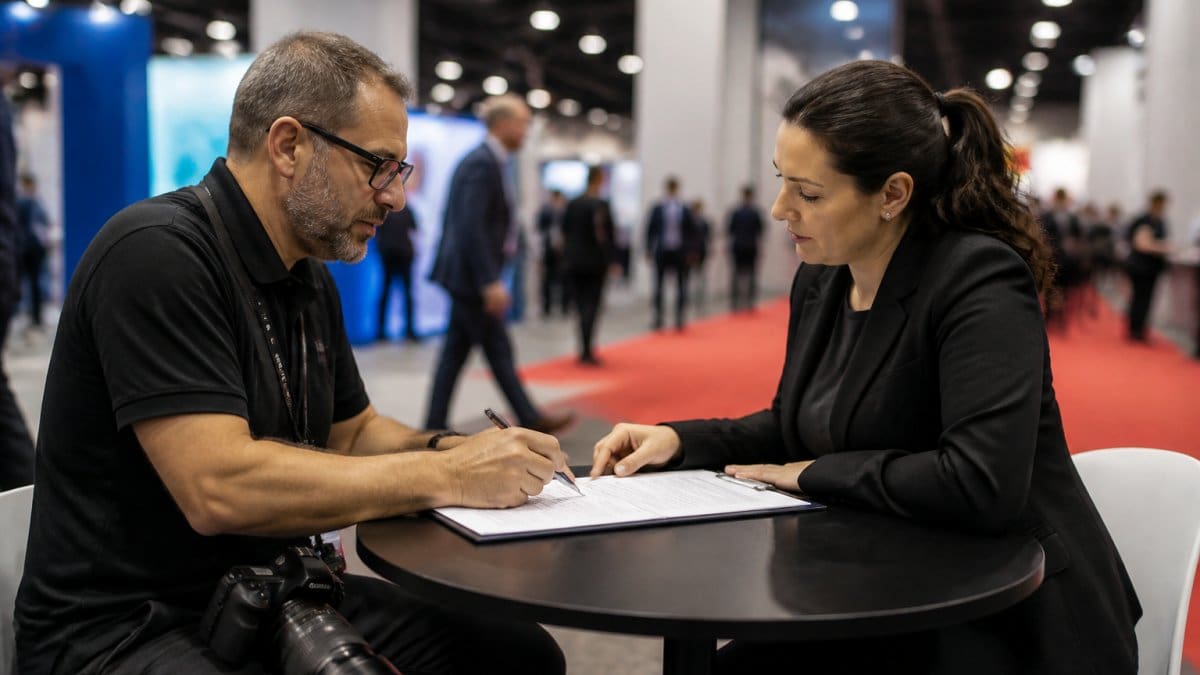
Model releases are the most overlooked piece of trade show sponsor photography. Any recognizable person in a photo you plan to publish commercially needs a signed release, and show management rules often add their own restrictions on where and when you can shoot. Most guides stop there. The exhibitors who avoid legal headaches go further: they treat releases, accessibility, and image metadata as one workflow, not three separate chores.
What a Valid Model Release Actually Contains
A release that holds up needs more than a signature. At minimum, it should identify the person, describe the permitted uses (commercial, promotional, editorial), state the term, and include a signature and date. For minors, you need a parent or guardian signature. For international attendees, a plain-language English release is standard, but a translated version reduces confusion and disputes.
Three compliance steps protect your program:
- Check show floor rules before the event. Many organizers restrict photography near competitor booths or in designated quiet zones, and some require advance press credentials for any commercial capture.
- Carry digital release forms. A QR code linking to a mobile-friendly release takes 30 seconds to complete and covers you for future content repurposing. Store signed releases alongside the image files so a future campaign can verify coverage without a scavenger hunt.
- Document sponsor permissions. If a sponsor’s logo appears in a photo, confirm their brand team approves the usage context. A verbal okay at the booth is not documentation.
Accessibility and Metadata: The Compliance Layer Nobody Talks About
Accessibility is now part of publishing any image, not an afterthought. Write descriptive alt text on every published photo, who is in it, what they’re doing, and the context, so screen readers and search engines can interpret the visual content. WCAG 2.2, the current Web Content Accessibility Guidelines from the W3C, treats meaningful alt text as a baseline requirement for non-text content, and it applies to event galleries the same way it applies to any other web page.
Metadata is the other half. Every image you deliver should carry embedded IPTC fields: event name, date, booth number, sponsor name, photographer credit, and usage rights. This does two things. First, it lets your team find the right asset in seconds instead of scrolling a shared drive. Second, it feeds digital asset management (DAM) systems and search engines, so a photo tagged “2026 expo, Booth 1420, sponsor logo” surfaces when someone searches for it months later. Untagged images are effectively invisible after the show ends.
The most expensive photo is the one you can’t legally use. A 30-second release process on-site prevents six-figure legal exposure and sponsor relationship damage later, and the same discipline that captures the release should capture the alt text and metadata that make the image findable and usable.
5. Post-Show Image Distribution and Content Repurposing for Sponsors
Post-show distribution determines whether your images become digital assets or sit in a folder. The best programs deliver a curated, sponsor-specific gallery within 48 hours, then repurpose the strongest frames across social, email, and sales materials for months.
Build a delivery calendar: press-ready highlights within 24 hours, full sponsor galleries within one week, and a repurposed content batch within 30 days. Event Marketer’s coverage of AI-powered event experiences notes that exhibitors increasingly use AI tools to turn attendee photos into creative assets, which speeds up repurposing but doesn’t replace the original capture.
Metadata matters here too. Tag every image with sponsor name, booth number, event, and year so your team can find the right asset in seconds, not hours. Accessibility counts as well: write descriptive alt text on every published image so screen readers and search engines can interpret the visual content.
Conclusion: Turning Trade Show Sponsor Photography Into a Competitive Advantage
Most sponsors treat photography as a checkbox. The ones who win treat it as a compounding asset, where every approved image feeds next year’s pitch deck, press release, and booth design. That shift requires planning, legal discipline, and a photographer who understands sponsor deliverables before the doors open.
Event Photojournalism delivers award-winning, high-resolution photography across the DMV area from our Washington DC and Northern Virginia locations, with customized services built around your sponsors’ actual deliverables. Our team captures conferences, corporate events, and galas with a candid, photojournalistic approach that produces images ready for press, social, and donor relations. Get started with Event Photojournalism and turn your next event into a visual asset library that works all year.
Frequently Asked Questions
What are the most important shots to capture for trade show sponsors?
Sponsor-focused trade show photography should prioritize candid interactions between booth staff and attendees, branded signage with visible logos, product demo moments, speaker sessions featuring sponsor mentions, and VIP meet-and-greets. A trade show photography shot list built around sponsor deliverables ensures every image serves a purpose for post-event reports, social media, and renewal conversations. Companies report an average ROI of $20.98 for every $1 spent on trade shows, so images that document that value are essential.
How can professional photography improve event photography ROI for sponsors?
High-quality images extend a sponsor’s visibility long after the show floor closes. They fuel post-event promotion, social media engagement, and renewal decks that justify sponsorship spend. With 92% of attendees visiting trade shows specifically to see new products, photos that capture product launches and booth traffic give sponsors measurable proof their investment reached the right audience. Tracking engagement metrics like downloads, shares, and press pickups ties photography directly to ROI measurement.
What should be included in a trade show photography shot list?
A strong shot list covers booth exteriors with clear branding, candid staff-visitor interactions, product demos and tactile experiences, speaker sessions, sponsor logo placements, VIP and executive moments, and crowd shots showing booth traffic. Include specific names, times, and locations for key people so the photographer knows exactly what matters. Build in flexibility for unscripted moments, since candid photography often produces the most shareable assets for post-event promotion.
How do you coordinate photography with trade show event organizers?
Contact show management early to confirm show floor rules on camera equipment, lighting, and tripod use. Some venues restrict flash or large setups during peak hours. Secure any needed press credentials or photography passes before arrival. Share your shot list with booth staff and sponsors so everyone knows when and where key moments will happen. On-site logistics run smoother when the photographer has a floor map, schedule, and a single point of contact.
How can sponsors use event photography for post-show marketing?
Sponsors can repurpose high-resolution event images across LinkedIn posts, email campaigns, annual reports, press releases, and next-year sponsorship proposals. Content repurposing stretches the value of every photo beyond the event itself. Add metadata and alt text to images for SEO, and deliver them quickly so sponsors can capitalize on post-event momentum. Fast turnaround matters: highlights ready the morning after a gala or conference keep the story fresh for media and donor outreach.