Last Updated: October 31, 2026
Quick Summary
Ethical flash use at formal events means checking venue rules, the event format and the people present before shooting, and keeping flash off during speeches, vows and other sensitive moments. Confirm the flash policy with the planner in advance, then use bounce flash or available light wherever possible.
- Check venue rules, event format and the people present before every shot.
- Keep flash off during speeches, toasts, presentations, prayers and moments of silence.
- Ask the planner about flash policy during the pre-event briefing.
- Bounce flash off a ceiling or wall to soften light and reduce startling glare.
- Get any flash policy confirmation in writing, since verbal permission may not be enforced.
Table of Contents
- Event Photography Flash Etiquette for Guests and Speakers
- When to Use Flash at a Wedding and When to Hold Back
- How to Read a No Flash Photography Policy for Events
- Discreet Flash Photography Techniques That Lower Disruption
- A Decision Checklist: Use Flash, Reduce It or Stop
- Booking Event Photojournalism for Discreet, Professional Coverage
- Frequently Asked Questions
Ethical flash use at formal events starts with one question: should you fire a flash at all?
Flash is a tool, and like any tool it works best when used with permission and care. Many formal events, such as galas, board meetings, and ceremonies, have unwritten expectations about how cameras behave. Others have written rules.
Ethical flash use means checking three things before you shoot:
- Venue rules: Does the space allow flash, or restrict it?
- Event format: Is this a quiet, formal moment or an active program?
- People present: Who could be distracted, startled, or put at risk?
We recommend asking the planner about flash policy during the pre-event briefing. A two-minute conversation prevents most problems on the night.
Watch out: Assuming that flash is always allowed because other photographers used it is a common mistake. Venue policies change, and a rule you never checked can get you removed from the room.
Event Photography Flash Etiquette for Guests and Speakers
Event photography flash etiquette is about respecting the room. Guests came to network, listen, or celebrate, not to be blinded by repeated bursts. Speakers, in particular, need steady visual conditions to focus and deliver their remarks.
Good etiquette follows a few simple habits:
- Keep flash off during speeches, toasts, and presentations.
- Never fire flash directly into a speaker’s face.
- Stay at the back or side of the room during sensitive moments.
- Avoid flash during prayers, moments of silence, or award presentations.
- Shoot quietly, with the shutter sound kept low, when possible.
Performers and speakers should be told in advance how photography will work. If you plan to use flash, let the event team know where you will stand and when.
Guests deserve the same courtesy. Ask before you photograph a small group up close, and move on if someone signals they would rather not be captured. Ethical flash use means treating each guest’s attention as valuable.
When to Use Flash at a Wedding and When to Hold Back
Weddings concentrate every flash dilemma into a single day: a quiet ceremony, a loud reception, a mix of formal and candid moments, and a couple who hired you to capture all of it without becoming part of the story. Venue-specific considerations are covered in event photography at Gallery Place. The honest answer is that flash belongs in some moments and not others, and the decision should be made before the ceremony starts, not in the moment.
Start with the three-way conversation: couple, officiant, and venue. Officiants at churches, synagogues, and courthouses often have their own rules that override the venue’s general policy. Ask specifically whether flash is allowed during each part of the ceremony, and get the answer in writing if you can.
Moment-by-moment guidance:
- Getting ready: Flash is usually fine. Bounce it off a white ceiling or use a large diffuser to keep skin tones even in hotel rooms with mixed tungsten and window light.
- First look and portraits: Flash is acceptable and often necessary indoors. Use off-camera flash in a softbox or bounce card for portraits; avoid direct on-camera flash that flattens faces and casts hard shadows.
- Processional: Flash is often permitted, but fire it before the subject enters the frame or use a single low-power burst rather than a rapid sequence. Continuous bursts read as a strobe to guests and can ruin video.
- Vows, rings, readings, and the kiss: Hold back. These are the moments guests and videographers are most focused on, and a burst here is the single most common complaint venues report.
- Recessional: Flash is usually acceptable again once the couple turns to leave.
- Cocktail hour: Flash is generally fine, but ask before photographing small groups up close.
- Toasts and speeches: No flash. Speakers are reading notes and looking at the room; a burst in their eyes breaks concentration and shows up on every phone video in the room.
- Dinner service: Soft fill or bounce only, and never directly at a guest mid-bite.
- Dancing and reception: Flash can work for energy shots, but keep it off the couple’s eyes and avoid strobing.
- Send-off and exit: Flash is usually welcome, but check whether the couple planned sparklers, candles, or other flame-based exits where a burst can be a safety issue.
A common mistake is treating the ceremony as one moment. It is a sequence of moments with different rules. Confirm each one with the officiant, and if you cannot get a clear answer, default to available light for the entire ceremony. No image is worth being asked to leave the sanctuary.
When in doubt, shift to available light. Many venues have enough ambient light for beautiful, natural images, especially near windows or under warm chandeliers. Available light can often cover ceremony lighting without flash, especially near windows or under warm light. Shooting without flash, with a wide aperture and steady technique, is generally less disruptive.
How to Read a No Flash Photography Policy for Events
A no flash photography policy for events is rarely a single sign on the wall.
Step 1: Collect every written source. Before the event, request the venue’s photography policy, the client’s vendor agreement, and any program or invitation language about photography. Look for these phrases:
- “No flash photography permitted”
- “Photography allowed for personal use only”
- “Professional photographers must register in advance”
- “Flash restricted during programs or performances”
- “No photography during the ceremony”
- “Camera and flash use at the discretion of the officiant”
Step 2: Ask the planner and the venue separately. The planner knows the client’s wishes; the venue knows its own rules and its security team’s enforcement. Ask both the same three questions:
- Is flash allowed during the full event, or only certain parts?
- Are there areas where cameras are restricted, and who enforces that?
- Who has final say if a guest, speaker, or officiant objects in the moment?
Step 3: Get it in writing. Send a short email summarizing what you were told and ask for confirmation.
Step 4: Brief the people who will enforce it. Security staff, ushers, and venue coordinators often have not read the same policy you did. A thirty-second conversation at the door prevents a tap on the shoulder mid-ceremony.
Step 5: Know the escalation path. If a guest or speaker objects in the moment, stop immediately and defer to the planner or venue coordinator. Do not argue with a guest.
A policy that bans flash in the main hall may still allow it in a reception area, a pre-function space, or an outdoor terrace. Confirm each space separately rather than assuming one rule covers everything. Venues with multiple rooms often have different rules for each.
Verbal permission from a well-meaning staff member is not the same as venue policy. If the written policy says no flash and a coordinator says it is fine, ask the coordinator to confirm in writing or to clear it with their manager. The person who tells you yes at 6 p.m. may not be the person enforcing the rule at 9 p.m.
Discreet Flash Photography Techniques That Lower Disruption
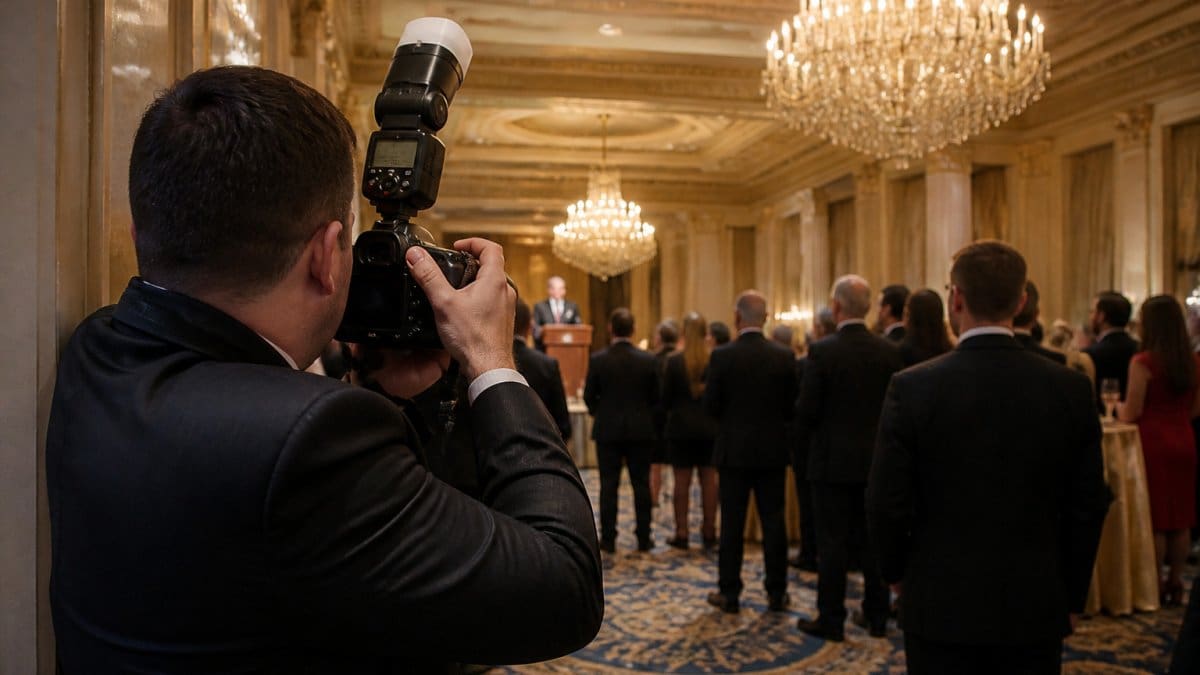
When flash is permitted, discreet flash photography techniques reduce the impact on everyone in the room. The goal is to add light that looks natural, not harsh.
Bounce Flash and Ceiling Bounce
Bounce flash aims the light at a ceiling or wall instead of directly at the subject. The reflected light is softer and more even, which lowers glare and reduces the sudden, startling quality of direct flash.
Practical tips for bounce flash:
- Point the flash head upward at a white or light ceiling.
- Use a bounce card or diffuser when the ceiling is high or colored.
- Lower your flash power to avoid overexposing nearby faces.
- Test a shot before the event starts to check the result.
Low-Light Settings Without Flash
Many moments do not need flash at all. Raising your camera’s ISO, opening your aperture, and slowing the shutter speed can capture a scene in available light. Modern cameras handle higher ISO values well, and steady hands or a monopod help with slower shutter speeds.
Helpful low-light settings include:
- Wide aperture lenses for more light reaching the sensor
- ISO values adjusted until the image is clean enough for your use
- Image stabilization turned on for handheld shooting
- Continuous shooting mode to capture moments without repeated flashes
A Decision Checklist: Use Flash, Reduce It or Stop
Use this checklist before each shot or moment:
- Has the venue or planner approved flash for this part of the event?
- Is a speaker, performer, or officiant speaking right now?
- Could the light startle or distract guests nearby?
- Is ambient light good enough for a clean image?
- Can I bounce the flash off a ceiling or wall instead?
- Would stepping closer, moving to the side, or waiting for a pause solve the problem?
If you answer “no” to the first question, stop. For a sense of how these limits apply at a specific venue, see event and gala photography at the National Air and Space Museum. If you answer “yes” to the second or third, reduce flash power or wait. Use available light whenever it produces a good result.
Booking Event Photojournalism for Discreet, Professional Coverage
Ethical flash use is one part of professional event coverage. Event Photojournalism provides discreet photojournalistic coverage for conferences, galas, weddings, and corporate events across the DMV area, with two locations in Washington, DC and Northern Virginia. Our photojournalistic approach focuses on candid moments that tell the story of your event.
Pricing depends on the details of your event, so please contact us for a quote. Contact Event Photojournalism today to plan coverage that respects your guests and your program.
Frequently Asked Questions
Is it rude to use flash at a formal event?
It can be, depending on the moment and the room. Flash is rarely rude during cocktail hours or open networking, but it becomes disruptive during speeches, toasts, award presentations and ceremonies, where sudden bursts pull attention away from the speaker and can startle guests seated close to the stage. The safest approach is to ask the event host or venue what they expect, watch the room before shooting, and switch to a quieter technique when the program is in a sensitive segment. Ethical flash use at events is mostly about timing and restraint, not avoiding the tool entirely.
How can photographers use flash without distracting guests?
Shoot from the side or back of the room rather than facing the audience, and use bounce flash off a ceiling or wall to soften the light so it does not look like a direct burst. Lower the flash power and raise ISO or open the aperture so the flash only fills in shadows rather than overpowering the scene. Keep your movements slow and quiet, avoid repeated rapid firing, and never use flash on stage-facing subjects during a live performance or ceremony. Ethical flash use at events depends on keeping the light source as unobtrusive as the situation allows.
When should photographers avoid using flash at an event?
Avoid flash during religious ceremonies, live speeches, moments of silence, and any segment where the host has asked for no interruptions. Also avoid it when guests are seated close to the subject, when the venue prohibits it, or when the room is already well lit by ambient light. In these cases, use a higher ISO, a wider aperture, or a steady stance to hold the shot without adding light. If the moment would be ruined by a flash, the photograph is rarely worth taking at all.
How can event organizers communicate a no-flash policy to photographers?
Put the policy in writing in the vendor contract and the event program, and name the specific segments where flash is prohibited, such as the ceremony, speeches or award presentations. Brief your photographers before the event and confirm the policy in the run-of-show document so everyone knows the timing. Clear communication lets photographers plan lighting in advance and reduces the risk of guest complaints during the event.