Table of Contents
- Candid Conference Photography: The Unseen Observer Method
- Step 1: Scout the Venue and Pre-Visualize Your Shots
- Step 2: Best Camera Lenses for Event Photography That Keep You Distant
- Step 3: Camera Settings for Fast, Silent Candid Shooting
- Step 4: Blending In and Reading Social Cues
- Candid Photography Techniques for Corporate Events: The Story Arc
- Legal, Privacy, and Post-Production Ethics
- Conclusion: Master the Art of Presence
- Frequently Asked Questions
Last Updated: September 4, 2026
Candid Conference Photography: The Unseen Observer Method
Research into how people behave in front of cameras reveals a stubborn truth: the moment a subject notices a lens, their posture tightens and their conversation shifts. One 2018 study proposed replacing dedicated photographers with daily mobile devices specifically to sidestep this problem, noting that candid moments dissolve when subjects become aware of being filmed Capturing Candid Moments using Daily Device without Dedicated Human Resource. That instinct is correct, but the solution misses the mark. You do not need to abandon professional gear; you need to master the art of being unseen.
Candid conference photography is the practice of documenting authentic interactions and unscripted reactions at professional events without disrupting the natural flow of the room. This guide from Event Photojournalism walks through the practical techniques our documentary-style team uses across Washington DC and Northern Virginia venues to capture genuine storytelling rather than stiff, forced poses. Below, we will show you exactly how to position yourself, what gear keeps you distant, and which settings let you shoot fast and silently.
The core tension every event photographer faces is the observer effect: attendee behavior changes the instant a camera becomes obvious QuirkoHub. The fix is not invisibility. It is strategic presence. By mastering five techniques, you can deliver the authentic, high-resolution imagery that builds brand identity while your subjects forget you are there.
Step 1: Scout the Venue and Pre-Visualize Your Shots
Preparation separates professional coverage from amateur snapshotting. Arrive early and walk every corner of the space, noting where natural light pools, where bottlenecks form, and which sightlines give you clean backgrounds.
Pre-visualization means deciding in advance what moments matter. For a corporate conference, those are typically the keynote reactions, the handshake at the booth, and the unguarded laugh during a networking break.
A common mistake is trying to document everything. Decide which three or four stories matter most, then dedicate your attention to capturing them well.
Ask the event organizer for a run-of-show in advance. Knowing when the award ceremony hits the stage or when the CEO steps to the podium lets you pre-position 60 seconds early instead of arriving late and forcing your way through the crowd.
Step 2: Best Camera Lenses for Event Photography That Keep You Distant
The single most effective way to avoid intruding is physical distance, and that is a lens decision. A longer focal length of 85mm or above, or a full telephoto lens, is the industry standard for capturing natural moments because it removes you from the subject’s immediate personal space RaffertyWeiss Media on professional conference photography.
For best camera lenses for event photography, consider what each focal length buys you:
- 85mm f/1.4 or f/1.8: Ideal for tight head-and-shoulders candids from 10 to 15 feet away. The wide aperture blurs busy conference backgrounds into soft color.
- 70-200mm f/2.8: The workhorse zoom. It covers everything from a full-stage keynote to a close-up reaction shot without you moving a step.
- 24-70mm f/2.8: Use this only for wide environmental shots where you are already part of the scenery, such as capturing the scale of a ballroom.
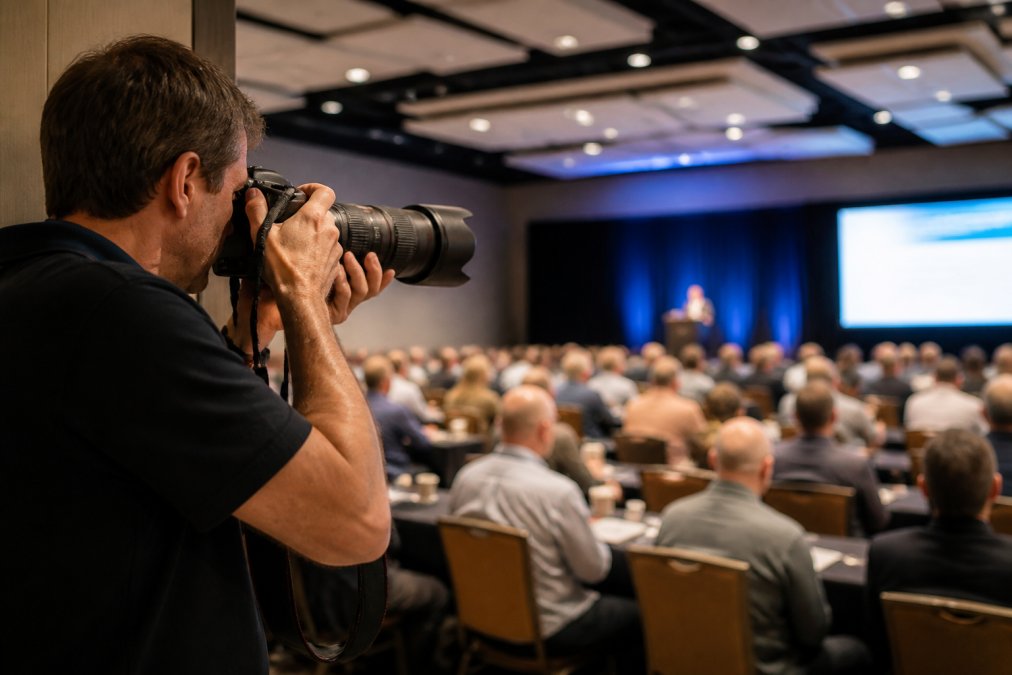
The trade-off is low-light performance. Conference halls are rarely bright, so a fast lens with a wide maximum aperture is non-negotiable for keeping shutter speeds high without pushing ISO into unusable noise.
Step 3: Camera Settings for Fast, Silent Candid Shooting
Your camera settings determine whether you capture the moment or miss it while fiddling with dials. Mastery of settings before the event reduces the time spent adjusting equipment, which lets you move fluidly and less intrusively through the venue Event Photojournalism: How to Capture Candid Corporate Event Photos.
Start with these baseline settings for a typical indoor conference:
- Shutter speed: 1/250th of a second or faster to freeze movement. Drop to 1/125th only when subjects are seated and still.
- Aperture: f/2.8 to f/4. This balances subject isolation with enough depth of field to keep the scene readable.
- ISO: Set to auto with a ceiling of 3200 or 6400, depending on your camera’s sensor. Modern bodies handle high ISO far better than most photographers expect.
- Autofocus: Use continuous autofocus (AF-C or AI Servo) with back button focus. This tracks moving subjects without the shutter button accidentally locking focus.
Silent shooting matters more than most guides admit. If your camera has an electronic or silent shutter mode, use it. The mechanical click of a shutter is a verbal announcement that you are taking a picture.
Do not rely on burst mode as a substitute for timing. Spraying 10 frames per second guarantees you capture the moment, but it also means you are holding the camera to your eye for extended periods, which makes you far more visible and disruptive to attendees trying to network.
Step 4: Blending In and Reading Social Cues
Event photography etiquette begins with wardrobe and body language. Wear dark, neutral clothing that does not draw the eye. Keep your camera at your side when you are not shooting, and raise it only when you are ready to take the frame.
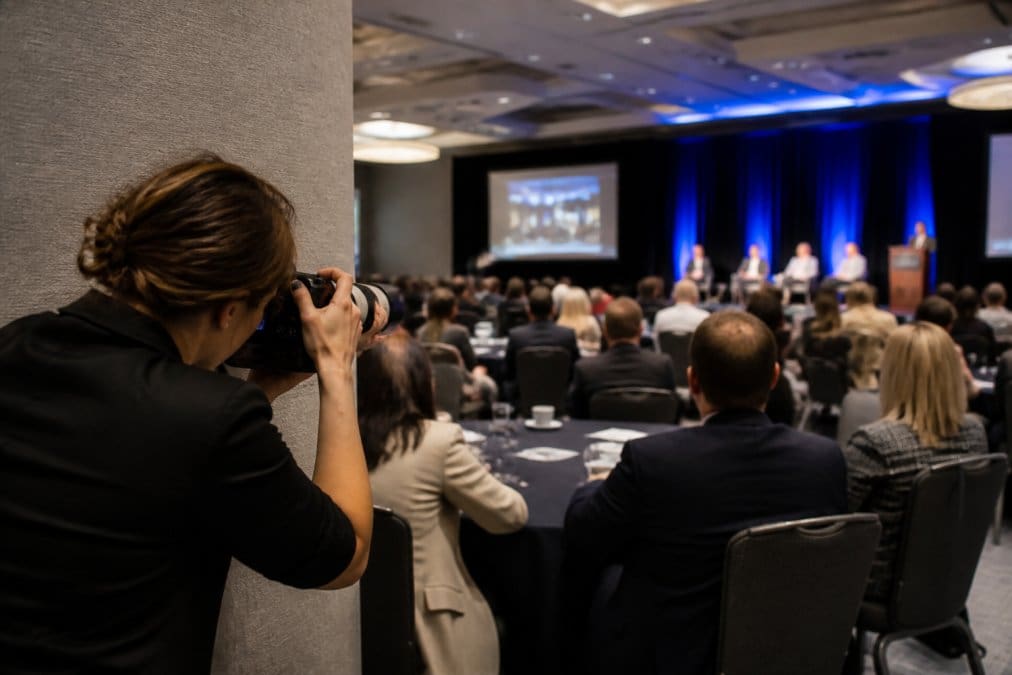
Positioning is a strategic choice. Shooting from the edges of the room rather than the center, or positioning yourself behind the audience, captures the atmosphere without disrupting the flow of the event Event Photojournalism: How to Capture Candid Corporate Event Photos. From the perimeter, you can observe the room’s social geography: where groups form, who is engaged in deep conversation, and where laughter is most likely to break out.
Reading social cues is the skill that keeps you welcome. When a subject makes eye contact, lower your camera and nod. When two people lean in for a private exchange, look away. When someone stiffens at your presence, move on.
The Psychology of the Notice: A Script for Diffusing Tension
Most guides stop at “nod and move on,” but the moment of eye contact is where the interaction is won or lost. The goal is not to be invisible but to be perceived as a non-threat.
A common pattern among professional event photographers is to use a three-step acknowledgment sequence that takes less than two seconds:
-
The Acknowledgment: The instant you make eye contact, offer a slight, friendly smile. Do not grin broadly, which can feel mocking. Do not look away quickly, which signals guilt or evasiveness.
-
The Gesture: Lower the camera from your eye to your chest in a single, fluid motion. This is the physical equivalent of saying, “I am not a threat.” Holding the camera up while smiling creates cognitive dissonance for the subject.
-
The Verbal Diffuser (if needed): If the subject’s expression remains tense or questioning, use a low, calm, and specific phrase. Avoid generic apologies like “Sorry!” which can make the situation awkward. Instead, use a compliment or a contextual anchor:
- “That was a great point the speaker just made, I wanted to capture the reaction.”
- “The lighting in this corner is perfect for the candid shots we’re doing for the event recap.”
- “I’m just grabbing a few shots for the company’s internal newsletter.”
These scripts work because they provide a reason for your presence, transforming you from an interloper into a person with a legitimate purpose.
Body Language That Signals ‘I Belong Here’
Your posture before you raise the camera dictates how you are perceived. A photographer who constantly scans the room looks like a predator; one who moves with purpose looks like a guest.
- The ‘At Ease’ Stance: When not shooting, stand with your weight on one leg, camera hanging from a strap at your side, and your gaze directed toward the speaker or the general room, not at any single person. This mimics the posture of an attendee listening to a presentation.
- The ‘Slow Pan’: When you do raise the camera, move it slowly and deliberately toward your eye. A sudden, jerky motion draws attention. A slow, smooth motion is less noticeable in peripheral vision.
- The ‘Conversational Pause’: If you are walking through a networking area and need to pass between two people in deep conversation, do not stop to take a photo. Instead, pause a few feet away, look at your camera’s screen as if reviewing a shot, and wait for a natural gap in their body language before moving through. This signals that you are aware of their space and are not trying to eavesdrop.
The ‘Look-Away’ Protocol for Private Moments
A key skill is distinguishing between a public moment and a private one. A loud laugh during a keynote is public; a hushed conversation with a hand on a forearm is private. When you see the latter, do not raise your camera. If the moment turns intimate while you are shooting, lower the camera and look away.
The difference between a photographer who captures candids and one who disrupts events is not just where you stand, but how you respond when you are seen. A simple, practiced script and a respectful posture can turn a moment of tension into a moment of permission, allowing you to continue your work without breaking the room’s natural flow.
::: building trust without visibility.
Candid Photography Techniques for Corporate Events: The Story Arc
Documentary-style coverage is not a collection of random moments. It is a narrative. The shift toward this approach is driven by its ability to build brand identity through authentic storytelling rather than staged imagery Event Photojournalism.
Think of the event as a three-act structure. Act one is arrival and anticipation. Act two is the core content: the keynote, the panel, the moments of focused attention. Act three is connection and departure: the networking, the handshakes, the genuine smiles as people exchange contact information.
For candid photography techniques for corporate events, your job is to find the emotional beats within each act: the board member laughing at a private joke, the sponsor’s genuine enthusiasm when a prospect stops at their booth, the relieved exhale of the event planner as the final speaker finishes.
Natural light is your ally. Available light preserves the true atmosphere of the room; flash announces your presence, flattens faces, and destroys the ambient mood. Reserve it for moments when there is no other option.
Legal, Privacy, and Post-Production Ethics
Capturing candids carries a responsibility that extends beyond the event itself. In the United States, the legal landscape for photography at private corporate events is a patchwork of common law, state statutes, and contractual agreements.
The Legal Baseline: Where You Can and Cannot Shoot
- Public vs. Private Spaces: In a truly public space (a public sidewalk, a public park), you have broad latitude to photograph people without their consent under the First Amendment. However, a conference venue is almost always private property. The property owner and the event organizer have the right to set terms for photography. If a venue’s standard terms prohibit photography, or if the organizer has a specific policy for a session, that policy is a binding condition of your access.
- The ‘Reasonable Expectation of Privacy’: This is a key legal concept. An attendee in a keynote hall has no reasonable expectation of privacy. An attendee in a restroom, a private meeting room, or a hotel room clearly does. The gray area is the networking floor. A conservative professional approach is to treat any huddled or hushed conversation as a private moment and avoid shooting it.
- State-Specific Wiretapping Laws (The Audio Trap): This is a critical and often-overlooked point. Many states, including California, Connecticut, Florida, Illinois, Maryland, Massachusetts, Michigan, Montana, Nevada, New Hampshire, Pennsylvania, and Washington, have two-party consent laws for recording conversations. While these laws primarily target audio recording, your camera’s video mode is a direct trigger. If you are shooting video and your camera’s microphone picks up a private conversation, you could be violating state law. For still photography, the risk is lower, but the safest practice is to disable audio recording on any camera or second device when shooting candids in close quarters.
- Contractual Obligations: Your contract with the event organizer should explicitly state your rights and limitations. A best practice is to have the organizer provide a written list of any attendees who have opted out of photography (often VIPs, government officials, or attendees in witness protection programs).
Post-Production Ethics: The Line Between Enhancement and Deception
The authentic value of candid imagery lies in its honesty. Color correction, exposure adjustments, and cropping to improve composition are standard practice; manipulating the content of the image is not. A useful rule of thumb is the ‘Newspaper Standard’: if a major daily newspaper would not run the image without a caption noting the alteration, you should not deliver it as a candid.
The Consent Protocol for Publishing and Marketing
Privacy extends to delivery. When you share highlight galleries from a private gala or board meeting, consider who can access them. Password-protected galleries and clear usage agreements protect both the subjects and your reputation.
:::warning
Never use a candid image of an attendee in your own marketing portfolio without written permission. A private individual at a corporate event has not consented to becoming a model for your promotional materials, and using their likeness without approval can damage your client relationships and your standing in the industry. This is not just an ethical issue; in some states, using a person’s likeness for commercial purposes (which includes promoting your own business) without consent can be a violation of their right of publicity. A model release is not just for studio shoots; it is a legal necessity for any image you intend to use to sell your services.
A Practical Pre-Event Checklist for Legal and Ethical Compliance
To ensure you are protected, adopt this checklist before every assignment:
- Review the contract: Confirm the organizer has granted you the rights to shoot and that you understand the usage rights you are granting them.
- Request the ‘no-photo’ list: Ask the organizer for a list of attendees who have requested privacy.
- Disable audio recording: Turn off audio on all devices to avoid triggering state wiretapping laws.
- Define the ‘private zone’: Identify areas like green rooms, private meeting suites, and restroom corridors that are off-limits.
- Set your editing policy: Agree with the client in advance on the level of retouching that is acceptable for the final delivery.
By treating legal compliance and ethical editing as core parts of your workflow, you protect yourself from liability and position yourself as a trusted professional who can be invited back year after year.
Conclusion: Master the Art of Presence
The challenge of candid conference photography is not technical but psychological. You are asking attendees to forget you exist while you document their most unguarded moments, which requires distance, preparation, and deep respect.
When you master these techniques, you stop being a disruption and become part of the environment. The result is imagery that feels true and captures the energy of the event.
Get started with Event Photojournalism and ensure your next conference is remembered through photographs that feel as alive as the moments they captured.
Frequently Asked Questions
How do you take candid photos without being noticed at a conference?
Position yourself at the edges of the room and use a telephoto lens (85mm or longer). This lets you capture expressions from a distance without entering the subject’s personal space. Shoot from behind the audience to capture the speaker’s reactions and the crowd’s engagement without disrupting the flow. Avoid direct eye contact and keep your camera down when you are not shooting.
What is the best camera lens for discreet event photography?
A 70-200mm f/2.8 zoom lens is a common choice for event photography. The long focal length allows you to fill the frame from across the room. The wide f/2.8 aperture is essential for low-light performance in conference halls. If you prefer a prime lens, an 85mm f/1.4 is lighter and offers excellent subject isolation, but you must move more to frame your shots.
Is it legal to take candid photos of people at conferences?
In the United States, you can photograph people in public spaces without their consent. However, a conference is often private property. The legal standard depends on whether attendees have a reasonable expectation of privacy. Always respect speaker requests and event policies regarding photography.
How do you capture authentic moments without interrupting conversations?
Master your camera settings before the event starts to avoid fiddling with dials near guests. Use a silent shutter mode and continuous autofocus to track moving subjects. When you are not taking photos, lower your camera to signal that you are not recording. This helps attendees relax and forget you are there, which is a core aspect of event photography etiquette.
This article was written using GrandRanker