
Table of Contents
- Why a Hiring Checklist Saves Your Event Budget
- Step 1: Define Your Photography Goals and Brand Style
- Step 2: Build Your Event Photography Shot List
- Step 3: Questions to Ask an Event Photographer Before Booking
- Step 4: Event Photography Pricing Guide and Package Evaluation
- Step 5: Verify Insurance, Permits, and Venue Access
- Step 6: Confirm Deliverables, Turnaround, and Usage Rights
- Conclusion
- Frequently Asked Questions
Last Updated: September 30, 2026
Why a Hiring Checklist Saves Your Event Budget
The U.S. Bureau of Labor Statistics projects photographer employment will decline 1 percent from 2025 to 2035, yet roughly 10,700 openings still appear each year as workers leave the field (Occupational Outlook Handbook, Photographers(https://www.bls.gov/ooh/media-and-communication/photographers.htm)). That churn matters when you book: the person you hire this month may not be the person answering your emails next quarter. A checklist for hiring a DC event photographer is your protection against that instability. This guide from Event Photojournalism walks through the six steps that separate a smooth gala from a scramble for usable images.
The checklist exists to lock in decisions before the event, when you still have use. After the event, you have none.
Step 1: Define Your Photography Goals and Brand Style
Your photography brief starts with one question: what is this imagery for? A fundraising gala needs donor-relations photos that show warmth and scale. A conference needs speaker coverage and sponsor visibility. A product launch needs clean, brand-aligned frames.
Write down three things before you contact anyone:
- Primary use: annual report, press release, social media, or all three
- Style: candid photojournalism, posed portraits, or a mix
- Non-negotiables: VIP coverage, sponsor signage, specific backdrops
Vague briefs produce generic images. Specific briefs produce assets you can actually deploy.
Step 2: Build Your Event Photography Shot List
An event photography shot list is a written inventory of every image you cannot leave without. Build it from the run of show, not from memory.
Start with the anchors: arrival, keynote, award presentation, group photo, closing. Then layer in the specifics your stakeholders will ask for.
| Shot Category | Examples | Priority |
|---|---|---|
| VIP and board | Handshakes, table candids, portraits | Must-have |
| Sponsor visibility | Signage, branded step-and-repeat | Must-have |
| Program moments | Speaker at podium, audience reaction | Must-have |
| Atmosphere | Room wide shots, décor, catering | Nice-to-have |
| Candid photography | Laughter, conversation, dancing | Nice-to-have |
Send the list to your photographer at least a week ahead. They will flag gaps you missed.
Step 3: Questions to Ask an Event Photographer Before Booking
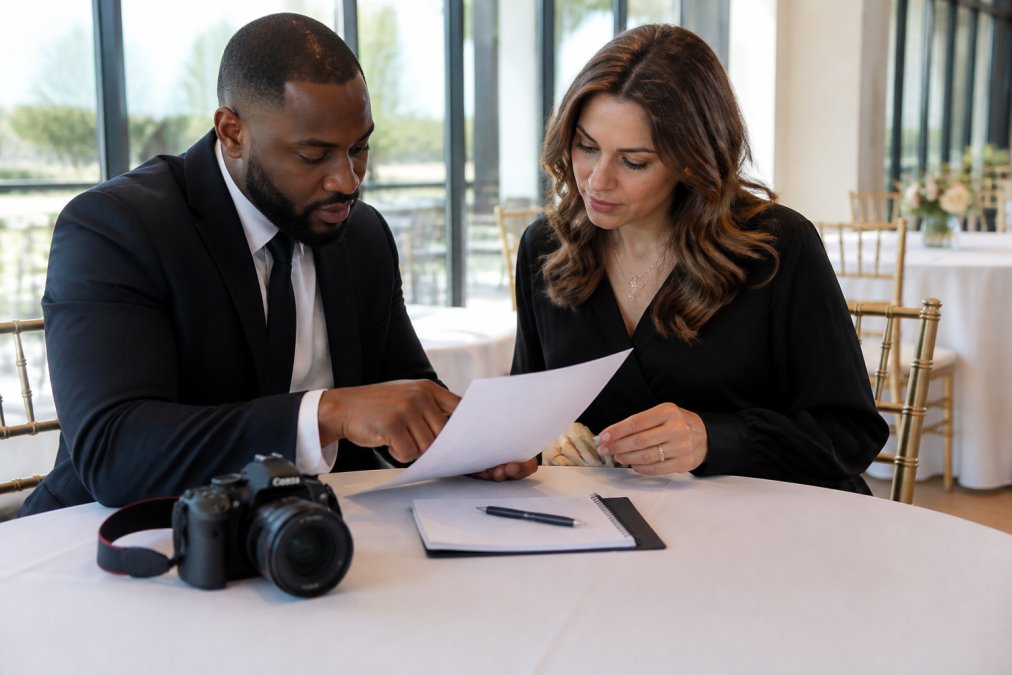
The right questions to ask an event photographer reveal whether they have covered your event type before, how they handle low-light venues, and what happens if equipment fails. Ask them in a scheduled call, not by email.
Work through these:
- Can I see a full gallery from a comparable event, not just highlights?
- Do you carry backup bodies, lenses, and flash units?
- How do you handle a venue with mixed or dim lighting conditions?
- Who is the on-site contact if something changes mid-event?
- What is your certificate of insurance status, and can you name our venue as additional insured?
That last question stops more problems than any other.
Step 4: Event Photography Pricing Guide and Package Evaluation
Event photography pricing depends on coverage hours, number of photographers, deliverable volume, and usage rights. No two quotes are structured identically, so compare line by line rather than on the headline number.
Most quotes you receive will be built from the same five variables. Ask every photographer to price them separately so you can see what you are actually buying:
| Cost Variable | What It Covers | How It Usually Scales |
|---|---|---|
| Coverage hours | On-site shooting time | Priced in blocks, often with an overtime rate past the block |
| Number of photographers | Lead plus second shooter or assistant | Second shooter is typically a flat add-on, not a percentage |
| Deliverable volume | Edited high-resolution images | Often a floor (e.g., a minimum gallery size) plus per-image overage |
| Usage rights | Print, web, paid social, advertising | Broader or longer licenses cost more; exclusivity costs the most |
| Turnaround | Standard vs. expedited delivery | Rush delivery is usually a surcharge on the base fee |
A common pattern is a base package that covers a set number of hours and a set gallery size, with everything else itemized. That structure is fine, what matters is that the itemization is written down before you sign.
Watch for these pricing traps:
- Editing billed separately. Some quotes cover shooting only. Confirm whether culling, color correction, and retouching are included or billed per image.
- Gallery hosting fees. Annual hosting or download-portal fees can appear months after the event.
- Travel and parking. For venues inside the Beltway, parking, tolls, and travel time are frequently added as line items.
- Raw file requests. Many photographers will not release raw files at any price. If you need them, negotiate before booking.
- Usage-rights renewals. A license may cover one year. Extending it later is often more expensive than buying the longer term up front.
Contact us for a quote built around your run of show.
The cheapest quote often excludes editing, gallery hosting, or commercial usage rights. Those add-ons can double the real cost after the fact.
Ask for a written, itemized quote with the five variables above broken out. A photographer who will not itemize is a photographer you cannot compare.
Step 5: Verify Insurance, Permits, and Venue Access
Insurance verification is the step most planners skip, and it is the one that creates the most risk. Most corporate venues, hotels, museums, and government buildings will not let a photographer through the loading dock without a certificate of insurance on file, and many will not release a signed contract until they have it.
The Certificate of Insurance, Explained
A certificate of insurance (COI) is a one-page document your photographer’s insurer issues that proves coverage is active. It is not the policy itself; it is proof the policy exists. Two details matter more than the rest:
- General liability limits. Venues commonly require a minimum per-occurrence limit. If your photographer’s limit is lower, the venue may reject the COI.
- Additional insured endorsement. Naming your venue or your organization as an additional insured is a separate endorsement, not a checkbox on the standard certificate. It can take the photographer’s insurer several business days to issue, so request it early.
Ask for the COI at least two weeks before the event. If the photographer cannot produce one, that is a signal about how they run their business, not just their paperwork.
Permits for Public and Federal Spaces
Public and federal locations operate under their own rules, and those rules are not the same as a private venue’s. Before you assume a permit is or is not required:
- Confirm which agency manages the space and whether commercial photography needs prior approval.
- Ask whether the permit is filed by the photographer or by your organization, the answer changes who carries the liability.
- Confirm whether the permit covers the date, the time window, and the specific area you plan to use.
- Get the approval in writing and carry a copy on event day.
For private venues, the equivalent step is a written access agreement. Do not rely on a verbal okay from a venue contact who may not be working your event.
Venue Access Details to Document
Venue access needs to be documented too:
- Load-in time and service entrance location
- Restrictions on flash, tripods, or drone use
- Where the photographer can and cannot stand during the program
- Whether the photographer counts toward the room’s occupancy limit
- Power access for lighting or charging
Build a one-page access sheet with the COI, permit status, load-in time, and on-site contact. Send it to both the photographer and the venue manager so everyone is working from the same document.
A missing COI or permit is not a paperwork problem, it is an access problem. Without it, your photographer may be turned away at the door with no time to fix it.
Step 6: Confirm Deliverables, Turnaround, and Usage Rights
Turnaround time and usage rights belong in the contract, not in a verbal promise. Specify how many edited high-resolution images you receive, whether raw files are included, and how the gallery is hosted.
Ask for a small batch of edited highlights within 24 hours of the event. Many photographers will agree to this for press and social needs if you request it before booking, not after.
Copyright ownership typically stays with the photographer, while usage rights are licensed to you. Confirm the license covers print, web, and paid social for the period you need.
Conclusion
The gap between a well-covered event and a missed one comes down to preparation, not luck. Event Photojournalism brings award-winning photography, customized coverage for conferences, galas, and weddings, and high-resolution delivery across the DMV area from our Washington DC and Northern Virginia locations. Get started with Event Photojournalism and turn your next event into lasting visual assets.
Frequently Asked Questions
What should I ask before hiring an event photographer?
Ask about their experience with your specific event type, their backup equipment plan, liability insurance coverage, and how they handle low-light venues. Request a portfolio review of similar events, confirm turnaround time for edited images, and clarify who owns the copyright. Also ask whether they carry a certificate of insurance, since many venues require one before granting access.
How far in advance should I book an event photographer?
For galas, conferences, and weddings, book three to six months ahead. Peak seasons fill quickly, and popular photographers in the area often have limited weekend availability. If your event falls during a busy period, start your search even earlier. Short-notice coverage is sometimes possible, but your options narrow and pricing may reflect the rush.
How much should a photographer charge for one hour?
Pricing depends on coverage length, number of edited images, and turnaround speed, so request a custom quote based on your event details. A one-hour corporate headshot session and a one-hour gala coverage slot are very different jobs with different pricing structures.
What should be included in an event photography contract?
A solid contract covers the event date, location, hours of coverage, number of photographers, deliverable format, and turnaround timeline. It should also address copyright ownership, usage rights, cancellation policy, and liability insurance. Confirm whether raw files are included or only edited images, and clarify any additional fees for travel, overtime, or extended licensing.

