Table of Contents
- Candid vs Posed Gala Photos: Key Differences
- Why Candid Photos Feel More Authentic at Galas
- The Case for Posed Portraiture at Formal Events
- Candid vs Prompted Photography: Understanding the Middle Ground
- Candid Event Photography Tips for Gala Coverage
- Balancing Candid and Posed Shots for Complete Event Coverage
- Post-Production Workflow: Candid vs Posed Images
- Conclusion
Last Updated: August 14, 2026
Candid vs Posed Gala Photos: Key Differences
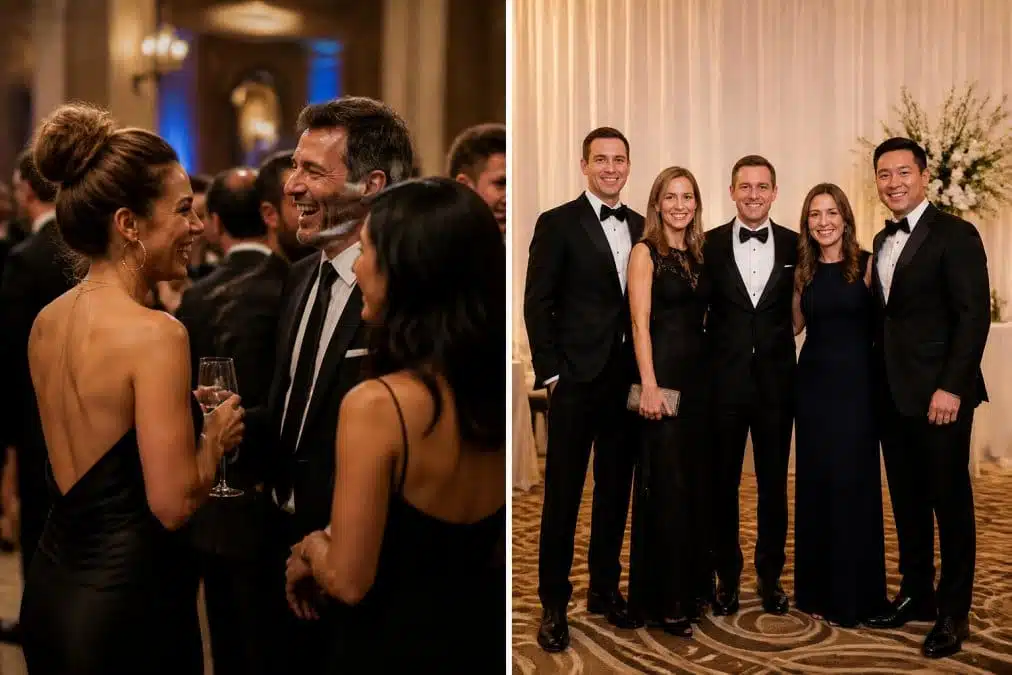
The photography approach you choose shapes how your event will be remembered. Candid photography captures unscripted moments as they unfold naturally, a guest laughs at a table, someone raises a glass in celebration, a sponsor leans in for conversation. The photographer remains observant and responsive, documenting authentic interactions without directing behavior. Posed photography involves deliberate direction: the photographer positions subjects, adjusts lighting, frames the shot with intention, and requests specific expressions or body language. This approach prioritizes technical precision, flattering angles, and consistent aesthetic across the gallery.
The choice between these approaches has real implications. Candid work captures the energy and authenticity of your event. Posed work delivers polished, professional imagery suitable for annual reports and donor relations. Most galas benefit from both.
What Defines Candid Photography
Candid photography is documentary-style work. The photographer observes and captures moments as they happen, not creating them. In gala settings, this means capturing the raw emotion of a successful fundraising moment, the authentic laughter at a table, the spontaneous interaction between donors, without interrupting the event’s natural rhythm.
Candid shots rely on fast shutter speeds (typically 1/250th of a second or faster) to freeze motion, and aperture settings that balance depth of field with available light. The photographer works with available light rather than introducing flash, which would disrupt the atmosphere. Composition happens in real-time, requiring the photographer to anticipate where moments will unfold and position themselves accordingly.
What Defines Posed Photography
Posed photography is formal portraiture where the photographer controls the subject, framing, lighting, and timing. In a gala context, this means arranging board members for formal group portraits or positioning major donors with organizational leadership. The photographer directs posture, suggests expressions, and often uses supplementary lighting to achieve desired results.
Posed work excels at flattering presentation. The photographer can adjust body angles to minimize unflattering profiles, position subjects to create visual hierarchy, and use lighting strategically to enhance features. Lighting in posed work is often controlled, introducing supplementary light sources to ensure consistent exposure and reduce unflattering shadows.
Why Candid Photos Feel More Authentic at Galas
Authenticity in gala photography comes from capturing genuine moments, the spontaneous interaction, the unguarded expression, the real emotion of the event. Candid work delivers this because it documents what actually happened, not what the photographer directed.
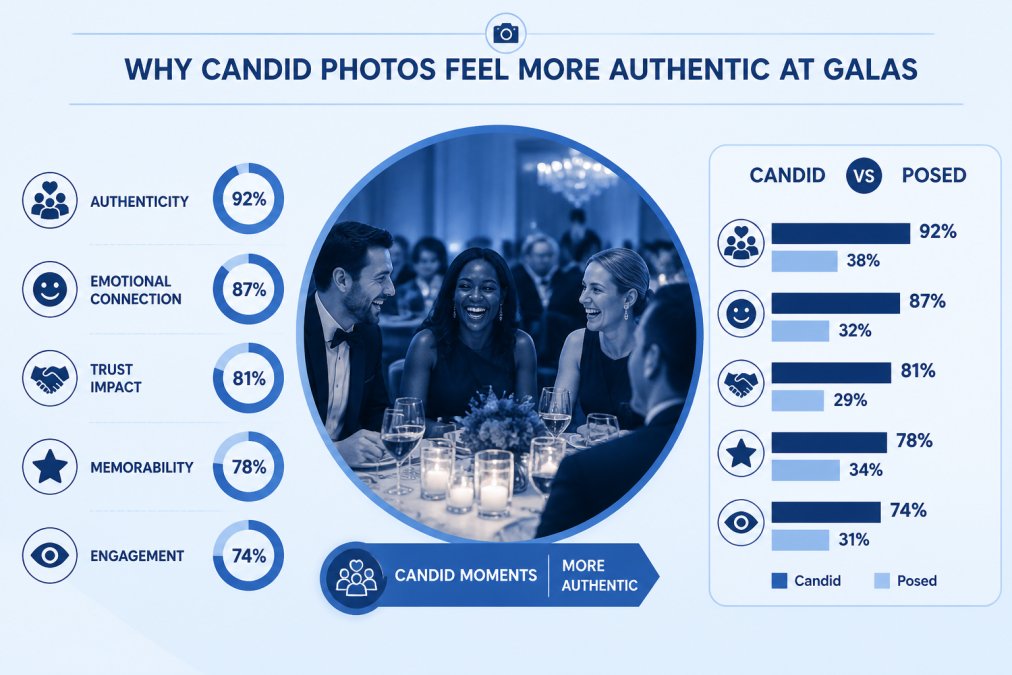
When viewers see posed images, they recognize the artifice. Candid work bypasses this recognition. The subject’s genuine emotion, body language, and interaction feel real because they are real. This authenticity resonates with viewers, especially in fundraising contexts where authentic connection matters.
Candid photography also captures the actual narrative of your event. Rather than a series of formal portraits that could have been taken at any gala, candid work tells the story of your event, the specific interactions, the energy, the moments that made it memorable. This narrative value is especially important for donor relations, grant applications, or mission communication.
The challenge with candid work is that it requires patience and positioning. The photographer must anticipate where moments will unfold, remain unobtrusive, and shoot continuously to capture the right instant.
The most authentic candid shots happen when the photographer has a clear understanding of your event’s flow and key moments. Brief your photographer on the schedule, highlight important people, and identify moments you want documented, this helps them position themselves strategically without needing to direct subjects.
The Case for Posed Portraiture at Formal Events
Posed photography serves a different purpose: delivering polished, professional imagery that represents your organization well. In formal gala contexts, posed work is often essential for board portraits, sponsor recognition, or annual report imagery.
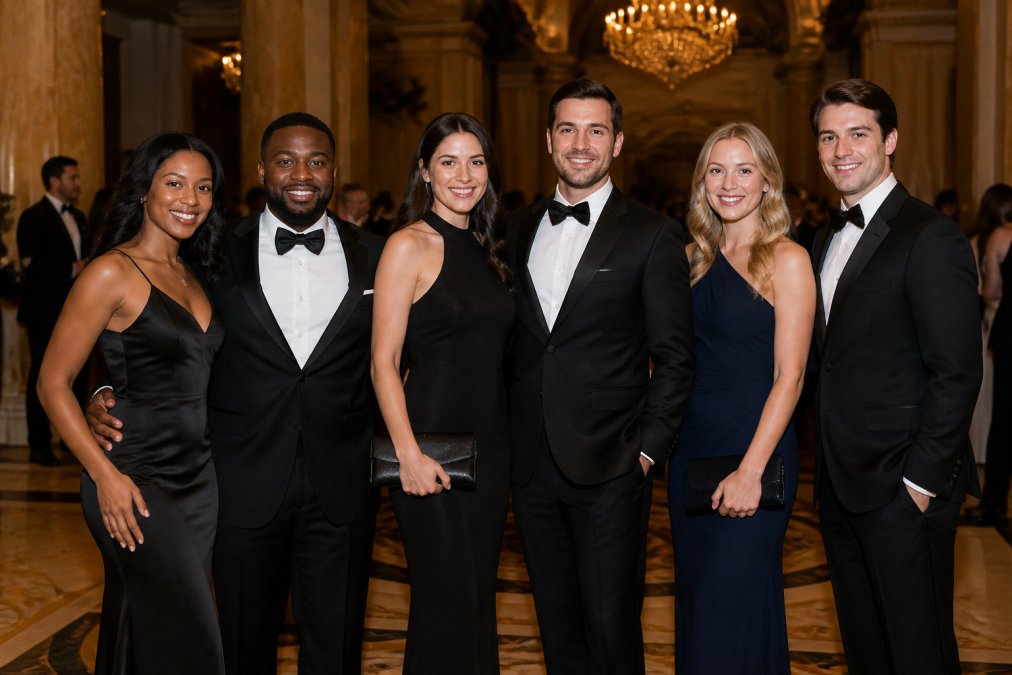
Posed work offers control. When you need specific people photographed together, you can guarantee it happens. When you need images suitable for publication or formal documentation, posed work delivers technically consistent results. This consistency matters for organizational use, annual reports, donor communications, and grant applications often require professional portraiture that looks polished and intentional.
Posed photography also ensures you capture key people and moments. In a large gala, candid photographers might miss important attendees simply because they weren’t positioned correctly when the moment occurred. Posed work eliminates this risk by creating a shot list in advance.
The downside is that posed work can feel stiff or artificial. When subjects are aware they’re being photographed and directed, their expressions often become more formal, less natural. Additionally, posed work requires time during your event, extracting subjects for formal portraits takes them away from the event’s natural flow.
Candid vs Prompted Photography: Understanding the Middle Ground
Between purely candid and fully posed work exists a third approach: prompted photography. This hybrid method captures authentic moments while giving the photographer some direction and control.
In prompted photography, the photographer might suggest a moment without fully directing it. Instead of "stand here and smile," it’s "talk to each other about the organization’s mission" or "walk together toward the window." The photographer directs the general scenario but lets subjects’ authentic reactions unfold naturally.
Prompted photography is particularly effective at galas because it acknowledges that some people are more comfortable with gentle direction, and some moments benefit from strategic positioning. A photographer might position two donors near interesting background elements and suggest they chat, capturing genuine conversation with intentional framing.
This middle ground also addresses a practical challenge in gala environments. Lighting is often unpredictable and dim. Prompted photography allows the photographer to position subjects in better-lit areas while still capturing authentic interaction.
Prompted photography works best when your photographer has experience reading social situations and directing subjects with confidence and warmth. This approach requires more skill than either pure candid or pure posed work.
Candid Event Photography Tips for Gala Coverage
Capturing authentic candid moments at a gala requires specific technical and strategic approaches.
Positioning and Framing
Position yourself where interaction naturally occurs, at tables where guests are seated, the bar, the entrance, and spaces where people gather during transitions. Framing in candid work must account for movement and unpredictability. Rather than composing a perfect shot and waiting for subjects to fill it, compose loosely and adjust as moments unfold.
Watch for the decisive moment, the peak instant of genuine laughter, emotion, or expression. Candid photographers shoot continuously in burst mode, capturing multiple frames per second, so they can select the single best moment afterward.
Knowing key people, important moments, and organizational priorities helps you position yourself strategically. Rather than shooting randomly, you understand what moments matter and position yourself to capture them when they occur naturally.
Lighting Challenges in Gala Environments
Gala lighting presents specific challenges for candid work. Ambient lighting is often dim, designed for atmosphere rather than photography. Many candid photographers avoid flash entirely because it’s intrusive and disrupts authentic moments. Instead, they use high ISO and wide apertures to gather available light. Modern camera sensors handle ISO 3200 or 6400 reasonably well, especially if shooting in RAW format.
Understand the color temperature of gala lighting. Rather than fighting these conditions, embrace them. Warm lighting creates intimate, atmospheric images. Position yourself where lighting is better, near windows, under well-lit areas, or near decorative lighting.
Working with Your Event Photography Shot List
A shot list is your roadmap for candid coverage. It identifies key people, important moments, and specific images your organization needs. Rather than constraining your candid work, a good shot list enables it by helping you anticipate where moments will occur.
Your shot list might include: "Board chair greeting major donors," "Executive director speaking with grant officer," "Group shot of scholarship recipients," "Auction moment," "Dessert service and toasts." For each item, understand when it will happen, where it will occur, and who will be involved. This lets you position yourself strategically to capture these moments as they happen naturally.
Communicate your shot list to your photographer in advance. This helps them understand what matters and position themselves accordingly.
Balancing Candid and Posed Shots for Complete Event Coverage
Most successful gala photography combines both approaches. A balanced approach might allocate roughly 70% of shooting time to candid work and 30% to posed work. The candid work captures your event’s actual story; the posed work delivers specific images you need.
Timing matters. Early in the event, when people are arriving and mingling, candid work thrives. Later, during formal moments like speeches or awards, candid work captures genuine reactions. Between these natural moments, schedule brief posed sessions, 10-15 minutes of formal portraiture doesn’t significantly disrupt a multi-hour event.
Communication between photographer and event organizer is critical for balanced coverage. The photographer needs to understand which moments are essential for posed work and what the organization’s priorities are.
A common mistake is treating candid and posed work as competing approaches rather than complementary ones. Plan for both from the start.
Post-Production Workflow: Candid vs Posed Images
How you process candid and posed images differs significantly.
Candid images require more selective culling. Because candid photographers shoot continuously, often hundreds of frames, post-production begins with culling: identifying the best frames, removing duplicates, and selecting images that meet technical and compositional standards. Many event photographers now use AI-powered culling tools like Aftershoot to accelerate this process.
Posed images require different post-processing. Because there are fewer total frames, culling is simpler. But retouching often plays a larger role. Posed portraits frequently benefit from skin retouching, background cleanup, and lighting adjustments.
The post-production timeline differs between styles. Candid work can be delivered relatively quickly once culled and basic color correction is applied. Posed work, especially if retouching is involved, takes longer. If your organization needs fast turnaround for a press release the morning after your event, candid-heavy coverage is more realistic than posed-heavy coverage.
Many photographers use consistent editing presets to maintain aesthetic cohesion across large galleries, significantly reducing post-processing time.
Gala photography succeeds when it captures both the authenticity of your event and the professional imagery your organization needs. Candid work documents what actually happened, the genuine moments, the real energy, the authentic connections that made your event meaningful. Posed work delivers polished, intentional imagery suitable for formal documentation and donor communications.
Event Photojournalism specializes in this balanced approach, capturing the documentary-style storytelling of candid work while delivering the professional portraiture galas require. Our award-winning team understands gala environments, the lighting challenges, the social dynamics, and the moments that matter to your organization. We work with your event photography shot list to ensure we capture essential images while remaining unobtrusive enough to document authentic moments. Contact Event Photojournalism to discuss your gala coverage and learn how we can deliver the complete visual record your event deserves.
| Approach | Best For | Delivery Speed | Technical Control | Authenticity |
|---|---|---|---|---|
| Candid | Capturing genuine moments and event energy | Fast (48-72 hours) | Low (photographer responds to moments) | High |
| Posed | Formal portraits and consistent imagery | Slower (includes retouching) | High (photographer directs everything) | Medium |
| Balanced | Complete event coverage with both styles | Medium (3-5 days) | Medium (strategic mix) | High |
Frequently Asked Questions
What is the main difference between candid and posed gala photos?
Candid photos capture unscripted, spontaneous moments as they happen naturally at your event, while posed photos involve deliberate subject direction and composition. Candid shots emphasize raw emotion and authenticity, showing genuine interactions and body language. Posed photos offer controlled framing and consistent technical quality, ideal for formal portraits of VIPs and sponsors. Most professional gala photographers use both styles to tell a complete visual story of your event.
Why are candid photos often preferred for gala events?
Candid photos create stronger visual storytelling and emotional connection because they document genuine moments rather than staged ones. Guests feel more comfortable and natural when a photographer works discreetly, capturing authentic interactions between attendees. For fundraising and donor relations, candid shots demonstrate real engagement and energy at your event, which resonates more powerfully in annual reports and marketing materials than formal poses. However, candid work requires a skilled photographer who understands gala lighting constraints and can position themselves without being intrusive.
How do you balance posed portraits and candid shots at a formal event?
Effective gala coverage uses a hybrid approach: dedicate specific time for formal portraits of board members, sponsors, and honorees, then spend the remainder of the event capturing candid moments during cocktails, dinner, and speeches. Work from an event photography shot list that identifies key people and moments to ensure you don't miss critical VIP portraits while maintaining the freedom to capture spontaneous interaction. The balance depends on your event's purpose, fundraising galas benefit from 40% posed portraits and 60% candid coverage, while some corporate events may skew toward 50/50 or even more candid-heavy depending on your goals.
What does prompted photography mean for gala events?
Prompted photography is a middle ground between fully candid and posed shots. The photographer suggests a moment or interaction without fully controlling it, for example, asking two sponsors to chat while the photographer captures their genuine conversation. This approach gives you some direction and ensures key people are photographed together, while maintaining the natural, unscripted feel of candid work. Prompted photography works well for gala coverage because it respects guest privacy and comfort while guaranteeing you capture important relationships and moments that might otherwise be missed.
This article was written using GrandRanker