Table of Contents
- Why Portfolio Quality Matters for Your Event
- Technical Competence: Image Clarity and Exposure
- Consistency in Style, Color Grading, and Editing
- Event Coverage Flow and Storytelling
- Questions to Ask Event Photographers Before Hiring
- Red Flags and Verification Techniques
- Event Photography Shot List Checklist and Portfolio Examples
- Frequently Asked Questions
Last Updated: September 24, 2026
Why Portfolio Quality Matters for Your Event
Choosing the right event photographer can make or break how your event is remembered, which is why you need to evaluate event photography portfolio quality carefully. A strong portfolio tells you everything about a photographer’s technical skills, creative vision, and ability to deliver under pressure. According to Event Photojournalism’s portfolio analysis, quality images generate 94% more views than text-only content, and professional photography reduces sales cycle times by up to 30%.
Your portfolio review tests whether a photographer can handle your specific event and deliver the results your organization needs.
The best portfolios show a photographer’s ability to capture moments across an entire event, not just highlight reels. Look for consistency in technical execution and storytelling across multiple events, not just their best-of-the-best single images.
A weak portfolio signals deeper problems: rushed turnarounds, excessive retouching needs, or missed key moments. The portfolio is your insurance policy.
Technical Competence: Image Clarity and Exposure
Technical competence separates professionals from amateurs. A photographer with strong editing skills can mask weak in-camera execution. Identify what they do in-camera versus what they fix in post-production.
What to Look for in Raw Technical Execution:
- Consistent sharpness across all images, not just a few standouts, this indicates reliable focus technique, not luck
- Proper exposure in both bright and dark areas of the same shot, showing mastery of metering modes
- Minimal noise in low-light photos, demonstrating competence with ISO settings and understanding of sensor limitations
- Dynamic range that captures detail in shadows and highlights simultaneously without excessive recovery in post
- White balance that looks natural across different lighting environments, not color-cast or requiring heavy correction
The Critical Verification Step: Ask for Unedited Samples
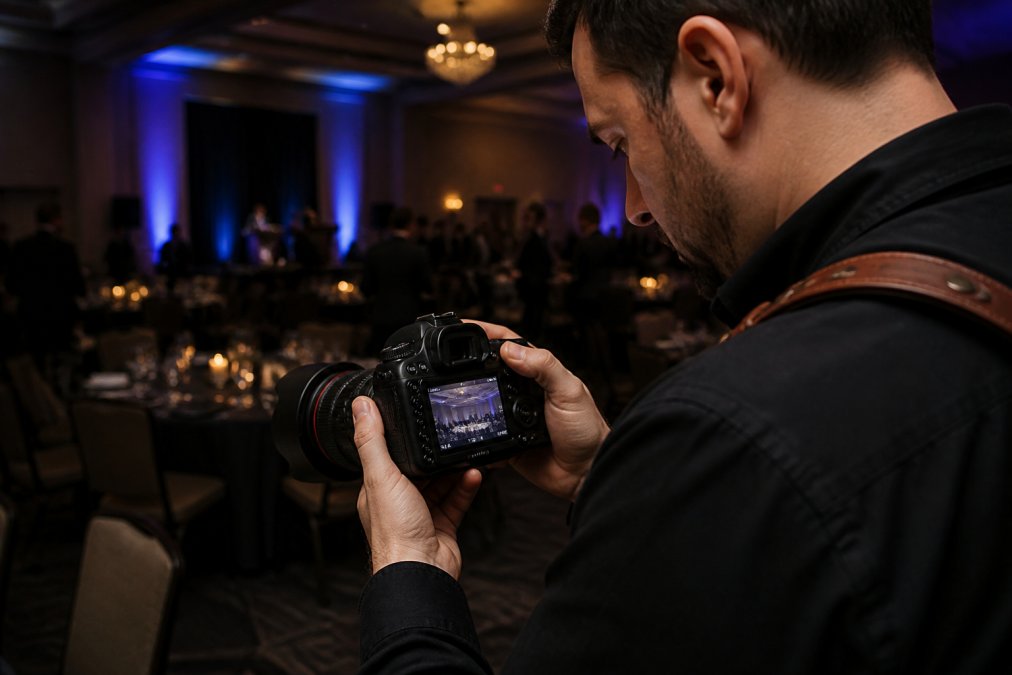
Request RAW files or unedited JPEGs from challenging lighting scenarios (indoor galas, mixed tungsten and LED). A photographer with strong technical fundamentals shows acceptable exposure and color balance before editing, minimal blown highlights or crushed shadows, and usable detail in both bright and dark zones. If unedited versions look dramatically different from their portfolio (washed out, color-shifted, underexposed), they’re relying on post-production to compensate for weak in-camera technique.
Modern editing software can salvage poorly exposed images, but your coverage quality depends on their in-the-moment technical skill, not editing skill. Ask: “What ISO range do you use for low-light receptions? How do you meter for mixed lighting?” Photographers with strong fundamentals articulate their process; vague answers suggest they’re relying on post-production rescue.
Red Flags in Technical Execution:
- Heavy noise reduction on low-light images (suggests ISO struggles)
- Exposure varies wildly between consecutive shots (metering inconsistency)
- Blown highlights requiring aggressive recovery (exposure mismanagement)
- Portfolio images look dramatically different from unedited samples (post-production dependency)
Don’t accept the excuse that “we’ll fix it in post-production.” If a photographer’s unedited images require heavy correction to look acceptable, you’re paying for editing skill, not technical photography skill. During your event, they won’t have time for extensive post-production rescue on every image.
Professional event photographers shoot with manual or aperture-priority modes, custom white balance presets, and tested ISO ranges. Unedited images should look 80-90% finished. If portfolio images impress but unedited samples don’t, you’re evaluating editing skill, not technical photography skill.
Consistency in Style, Color Grading, and Editing
A photographer’s editing style should feel intentional and consistent, showing a clear vision. Review for cohesive color palette, consistent contrast, natural saturation, and tone matching your brand’s aesthetic. Modern event photography favors clean, professional imagery that looks natural, not heavily stylized. Ask: “Would I want this exact editing style on all my photos?” A photographer’s editing style is their signature, you’re committing to it for your entire event.
Event Coverage Flow and Storytelling
When you evaluate event photography portfolio examples, assess how the photographer captures event flow and storytelling. A strong portfolio shows progression through an event: arrival, key activities, candid interactions, and conclusions. Look for narrative arc, authentic emotion, environmental context, and compositional variety.
According to The Sports Consultancy’s 2026 portfolio analysis, evaluating event photography requires shifting from one-off impact studies to assessing entire portfolios across multiple event editions to determine true value. This means looking at how a photographer covers the full event, not just cherry-picking their best shots.
A portfolio that shows environmental portraits alongside action shots demonstrates attention to detail and awareness of what makes an event memorable.
The best event photographers tell a complete story. Their portfolios show the beginning, middle, and end of events with natural transitions and authentic moments, not just isolated highlights.
Questions to Ask Event Photographers Before Hiring
Ask these questions before hiring:
- “Walk me through how you covered [similar event type]. What was your shot list strategy?”
- “How do you handle low-light situations?”
- “What’s your editing timeline and color grading consistency?”
- “How do you balance candid moments with posed shots?”
- “Do you provide RAW files or only edited finals?”
- “What’s your backup plan if images don’t meet expectations?”
These questions reveal whether the photographer understands your event type and has a deliberate process. Vague answers or reluctance to discuss their workflow are warning signs.
Red Flags and Verification Techniques
Not all portfolios are created equal. Develop a verification system to confirm a portfolio represents consistent, reliable output, not just best-of-the-best highlights.
Portfolio Red Flags (Initial Screening):
- Heavy filter/preset reliance masking technical weakness
- Dramatically different styles (no coherent vision or multiple photographers)
- Only 10-15 images shown (limited experience or aggressive cherry-picking)
- No images from events similar to yours
- Inconsistent technical execution (blurry mixed with sharp)
- No environmental context shots (incomplete coverage)
- Repeated poses/angles across events (formulaic, not adaptable)
The Verification Framework: Moving Beyond the Portfolio
Step 1: Request Full-Event Galleries (Not Highlight Reels)
Step 2: Verify Technical Metadata (EXIF Data)
- Consistency in camera settings: Do they use consistent ISO ranges, aperture choices, and shutter speeds for similar lighting conditions? Wildly varying settings suggest they’re experimenting rather than executing a deliberate strategy.
- Lens choices: Do they use appropriate lenses for event coverage (typically 24-70mm and 70-200mm for most events)? Unusual lens choices might indicate limited equipment or specialized techniques that may not suit your event.
- Shooting ratio: How many shots did they take to deliver the final images? A ratio of 3:1 or 4:1 (three shots for every one delivered) is typical; much higher ratios suggest they’re heavily culling to hide technical issues.
Step 3: Contact Recent Clients Directly
- “Did the final images match what you saw in the photographer’s portfolio?”
- “Were there any surprises, either positive or negative, in the final delivery?”
- “How was the photographer’s communication and professionalism during the event?”
- “Did they deliver on time? Were there any issues with the editing or final files?”
- “Would you hire them again?”
Red Flags in the Verification Process:
- Photographer refuses to provide full-event galleries or EXIF data
- Provided galleries show dramatic quality variation (sharp, well-exposed images mixed with blurry or poorly exposed ones)
- Client references are vague, evasive, or unavailable
- Photographer can’t articulate their shooting strategy or settings choices
- Full galleries reveal heavy cropping or composition issues that suggest in-camera framing problems
- EXIF data shows inconsistent settings for similar lighting conditions (suggests reactive rather than deliberate technique)
- Photographer provides different editing styles for different events without explanation (inconsistent brand)
Be especially cautious if a photographer’s portfolio shows dramatically different editing styles across events. While photographers can adapt to client preferences, a professional should have a recognizable signature style. Extreme variation suggests either multiple photographers, experimentation without mastery, or portfolio curation that doesn’t represent their typical work.
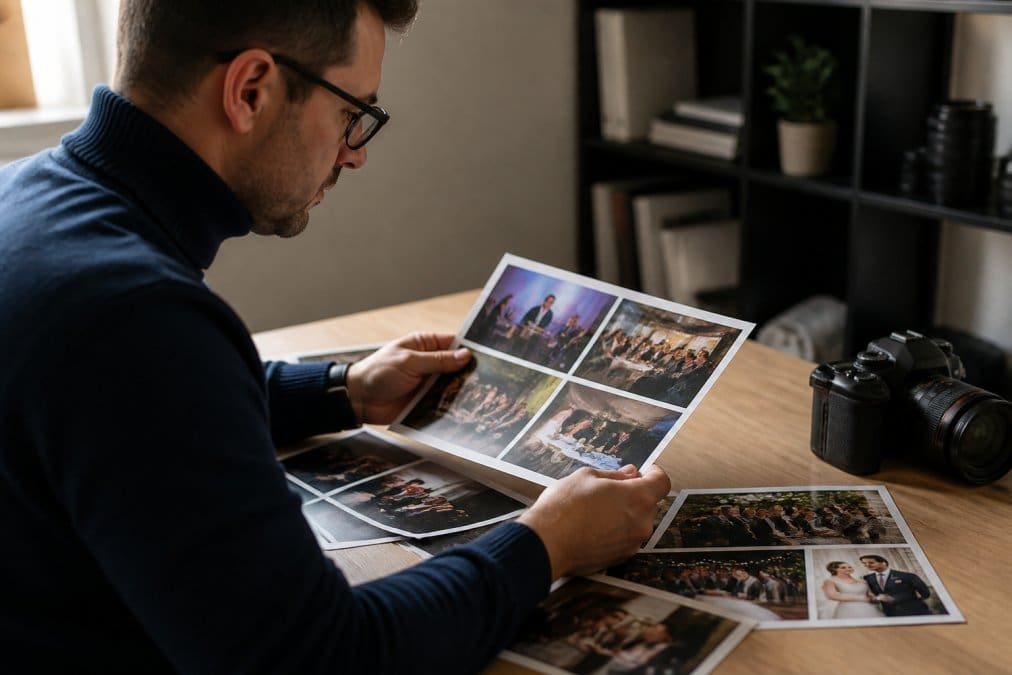
The Consistency Test: Side-by-Side Comparison
What This Verification Reveals:
Event Photography Shot List Checklist and Portfolio Examples
Before hiring, confirm the photographer understands what needs to be covered. Use this checklist to evaluate whether their portfolio demonstrates experience with these essential shot types:
| Shot Type | Why It Matters | Red Flag |
|---|---|---|
| Arrival/Registration | Documents attendees and sets event tone | Missing or blurry |
| Keynote/Speakers | Captures important moments and key people | Only wide shots, no detail |
| Networking/Candids | Shows authentic interaction and energy | Posed or staged feeling |
| Detail Shots | Highlights décor, signage, and branding | Absent entirely |
| Group Photos | Documents attendees and sponsors | Stiff or poorly lit |
| Closing Moments | Captures energy at event conclusion | Rushed or out of focus |
Frequently Asked Questions
What specific technical skills should be evident in an event photography portfolio?
Look for sharp, well-exposed images across varying lighting conditions, proper white balance, and controlled depth of field. The photographer should demonstrate mastery of dynamic range, especially in low-light environments where many events occur. Check for consistent sharpness throughout candid moments, not just posed shots. Technical competence means the images appear professional without relying on heavy post-production filters or aggressive color grading to mask exposure problems.
How can you tell the difference between a curated portfolio and a consistent photographer?
Request full event galleries, not just highlight reels. A consistent photographer’s complete gallery should maintain the same quality, composition, and storytelling standards as their portfolio samples. Look for 20-30 portfolio images that represent their actual work across multiple events. Inconsistent photographers often show their five best shots from each event while hiding weaker images. Ask about their editing style and whether they deliver raw files or post-production versions; consistent photographers can justify their choices.
What are the red flags to look for when reviewing an event photography portfolio?
Watch for heavy stylistic filters, moody desaturation, or vintage film emulations that mask technical issues. Avoid portfolios with very few images or those dominated by posed shots rather than candid moments. Red flags include inconsistent color grading across images, blurry or poorly exposed shots, lack of environmental context, and portfolios that don’t show event flow or sequence. Also be cautious if the photographer cannot explain their editing choices or refuses to show full event coverage.
How do you evaluate a photographer’s ability to handle low-light event conditions?
Review portfolio images shot in challenging indoor or evening lighting without excessive noise or blur. Look for proper exposure control, accurate white balance under artificial lighting, and sharp focus on moving subjects. Modern professional portfolios should demonstrate technical competence in low-light resilience rather than relying on heavy filters. Ask the photographer about their equipment, ISO handling, and lighting techniques. Request samples from actual indoor galas or evening events to verify their real-world capability in conditions your event will face.