Last Updated: October 30, 2026
Quick Summary
Choose between volunteer and professional nonprofit photographers by deciding what each image must do: use volunteers for casual, internal content and paid professionals for galas, campaigns, and press. A hybrid model, with professionals for high-stakes events and volunteers for smaller moments, spreads your budget while protecting the images that drive donations.
- Copyright stays with the photographer unless a written agreement transfers it, and that applies to volunteers too.
- Send a one-page photography brief at least a week before the event.
- Confirm releases are on file before any image leaves your office.
- A release signed for one campaign does not automatically cover a new campaign years later.
- Track images delivered, turnaround time, and how many were used in campaigns.
Table of Contents
- Volunteer vs Professional Nonprofit Photographers: A Side-by-Side Comparison
- Why Nonprofits Need Strong Photography for Storytelling and Fundraising
- Building a Realistic Nonprofit Photography Budget
- Photography Rights for Nonprofits: Ownership, Licensing, and Releases
- How to Recruit Volunteer Photographers Without Guesswork
- A Photography Brief Template for Nonprofits: What to Send Before the Shoot
- Hybrid Staffing, Safeguarding, and Measuring Photo Outcomes
- Booking Professional Coverage for Your Next Gala or Summit
- Frequently Asked Questions
Volunteer vs Professional Nonprofit Photographers: A Side-by-Side Comparison
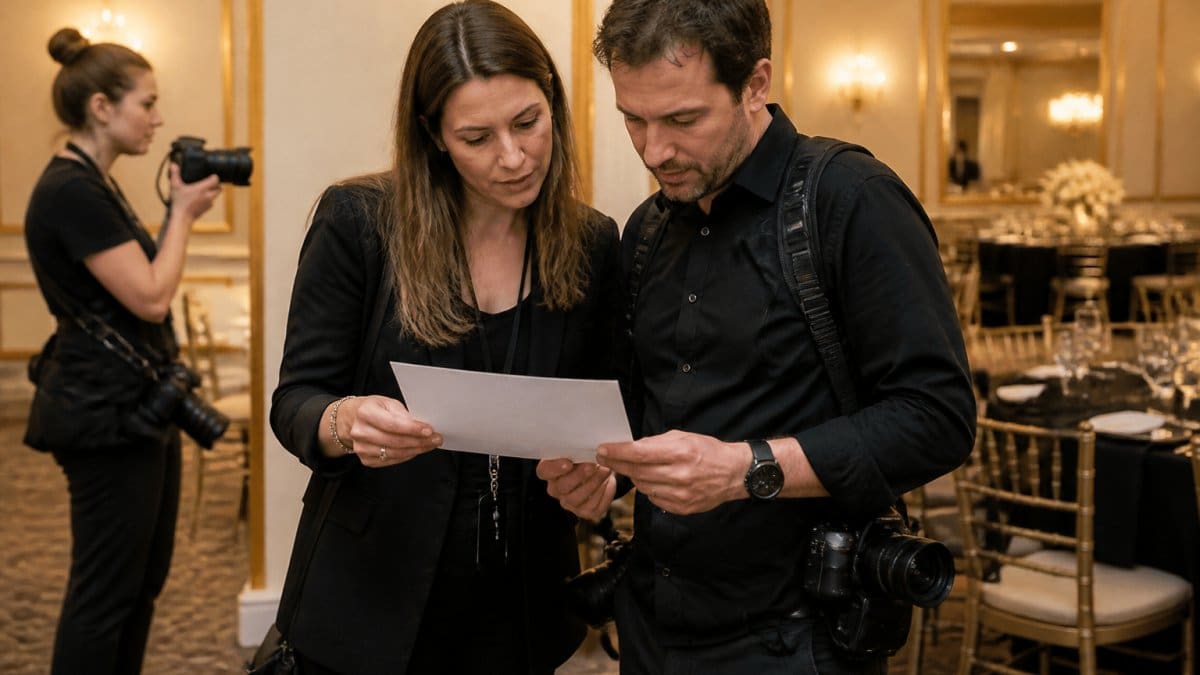
Deciding between hiring volunteer vs professional photographers for non-profits comes down to one question: what does the image need to do? A quick social post and a gala fundraising appeal place very different demands on a camera. The answer to this choice is rarely all-or-nothing. Below, we break down cost, quality, and reliability so you can staff each shoot with the right person.
Cost, Quality, and Reliability at a Glance
The table below summarizes how the two options typically differ. Treat it as a starting frame, not a verdict.
| Factor | Volunteer Photographer | Professional Photographer |
|---|---|---|
| Upfront cost | Low or donated | Paid, scoped to coverage |
| Scheduling reliability | Variable | Contracted |
| Editing and delivery | Often inconsistent | Defined turnaround |
| Usage rights | Photographer retains copyright | Negotiated in writing |
| Best for | Casual, internal content | Galas, campaigns, press |
A common mistake is assuming “free” means zero cost. Coordinating schedules, chasing files, and re-shooting weak images all consume staff time.
Why Nonprofits Need Strong Photography for Storytelling and Fundraising
Strong photography is the fastest way to make a mission tangible to people who were not in the room. A donor who sees a genuine moment from your gala understands your work in a way a paragraph cannot deliver. Visual storytelling carries fundraising appeals, annual reports, and outreach campaigns, and it feeds every channel your communications team runs.
Consistency matters as much as quality. A donor scrolling your feed should recognize your organization instantly, and mixed lighting, awkward crops, and inconsistent editing undercut that recognition.
Building a Realistic Nonprofit Photography Budget
A workable nonprofit photography budget starts with the images you actually need, not a flat line item. List the events, headshots, campaign shoots, and program portraits on your calendar, then rank them by how much they support fundraising and donor relations. That ranking tells you where paid coverage earns its place and where volunteer help is enough.
Three line items belong in every budget:
- Coverage hours, including setup and candid moments
- Editing and delivery time
- Licensing or usage terms for print and digital
Pricing depends on quantity, dates, and delivery, so request a quote rather than guessing. For real pricing benchmarks, see the average cost of professional event photography. Watch out: budgeting only for the shoot day and forgetting editing and licensing is the mistake that blows up mid-campaign.
Photography Rights for Nonprofits: Ownership, Licensing, and Releases
Copyright stays with the photographer unless a written agreement transfers it. For a deeper look, read the guide to photography image licensing rights. That rule applies to volunteers too. A photographer who donates time still owns the images, and your nonprofit receives permission to use them only to the extent the agreement says. The U.S. Copyright Office guidance on photography confirms that transfer of ownership must be in writing.
So put it in writing. A simple usage agreement should state:
- Which images the nonprofit may use
- Where they can appear, print and digital
- How long the permission lasts
- Whether credit is required
That list is the floor, not the ceiling. The checklist below is what a usable agreement actually needs.
Licensing Checklist for Nonprofit Image Use
Before any image is published, confirm the agreement covers:
- Scope of use: named channels (website, social, email, print, press, grant reports) rather than a vague “marketing purposes.”
- Duration: a start and end date, or a perpetual license if the nonprofit needs long-term archive use.
- Territory: where the images may be distributed, especially for print and paid media.
- Exclusivity: whether the photographer may license the same images to other organizations.
- Modifications: whether the nonprofit may crop, color-correct, or overlay text.
- Attribution: the exact credit line and where it must appear.
- Deliverables and archive: file formats, resolution, and how long the photographer retains the originals.
- Expenses: travel, parking, equipment rental, and any pass-through costs.
- Termination: what happens to images already published if the relationship ends.
A one-page agreement that names channels, duration, credit, and deliverables prevents most disputes. If a term is not in the document, assume the nonprofit does not have that right.
Consent and Releases: Who Needs to Sign
Consent is the other half of rights. Staff, volunteers, and the people you serve may appear in photos, so secure a signed release before publishing. The complete guide to model releases for event photography explains how. The workflow that holds up:
- Adults: a signed model release for identifiable individuals, collected on site or in advance.
- Minors: a parent or guardian signature, plus a clear explanation of where the image may appear.
- Program participants and vulnerable people: confirm with program staff who cannot be identified publicly, and flag those individuals to the photographer before the shoot.
- Crowd scenes: a visible sign at the entrance and a line in the event program can cover incidental attendees, but they do not replace releases for featured subjects.
- Withdrawal: give people a way to ask that an image be removed, and honor it where feasible.
Respectful Representation and Image Storage
Rights are not only legal. How you depict the people you serve affects trust and future fundraising.
- Avoid poverty framing: choose images that show dignity, agency, and context rather than only need.
- Match the caption to the story: confirm names, roles, and details with the people pictured before publishing.
- Store releases with the images: keep signed releases in the same folder or asset system as the files, so staff can confirm permission before reuse.
- Set retention rules: decide how long images and releases are kept, who can access them, and how they are backed up.
- Audit before campaigns: before a major appeal, re-check that every featured image still has a valid release and an unexpired license.
A release signed for one campaign does not automatically cover a new campaign years later. Check the scope and duration before reusing an image in a fresh appeal.
How to Recruit Volunteer Photographers Without Guesswork
Start with your own network: board members, donors, and staff often know capable hobbyists. Local camera clubs and university photography programs are reliable sources of emerging talent. Be specific about the event, the deliverables, and the credit you can offer.
A short screening checklist keeps quality predictable:
- Ask for a portfolio of event work, not just landscapes
- Confirm they own suitable equipment and backup gear
- Agree on a shot list and delivery deadline in writing
- Confirm they carry their own insurance
- Sign the usage agreement and release forms before the event
A Photography Brief Template for Nonprofits: What to Send Before the Shoot
A photography brief is a one-page document that tells the photographer what to capture, who matters, and when images are due. Send it at least a week before the event. Copy this template:
Event: [name, date, venue]
Primary goal: [fundraising appeal / annual report / press]
Must-have shots: [VIP arrivals, sponsor signage, keynote, candid donor moments, group photo]
Key people: [names and roles of board members, sponsors, honorees]
Style: [candid and photojournalistic / formal portraits]
Deliverables: [number of edited images, formats, resolution]
Deadline: [date and time, e.g., next-morning press highlights]
Usage: [channels, duration, credit line]
On-site contact: [name and mobile number]
The “key people” line is the one teams skip and regret. Give the photographer faces and names, and they will find the right moments without hovering.
Hybrid Staffing, Safeguarding, and Measuring Photo Outcomes
The strongest model for most organizations is hybrid: paid professionals for high-stakes events and volunteers for smaller internal moments. This spreads budget while protecting the images that drive donations. Safeguarding belongs in the plan too. When photographing program participants or beneficiaries, brief the photographer on who cannot be identified publicly and confirm releases are on file before any image leaves your office.
Measure outcomes with simple numbers: images delivered, turnaround time, and how many were actually used in campaigns. For a fuller framework, see the strategic guide to planning corporate event photography for nonprofits. Track which photos appeared in fundraising appeals and note the response.
Booking Professional Coverage for Your Next Gala or Summit
When the images carry your fundraising message, professional coverage removes the guesswork. Gala, fundraiser, and nonprofit event photography in Washington DC is available for organizations ready to book coverage. Event Photojournalism provides award-winning, high-resolution photography for galas, fundraisers, conferences, and summits, with customized coverage built around your shot list and key people. Our team serves organizations across the DMV area from two locations.
Frequently Asked Questions
Should a nonprofit hire a professional photographer or use a volunteer?
It depends on the stakes of the images. For a donor-facing gala, annual report, or press release, professional nonprofit photographers deliver consistent quality, fast turnaround, and clear usage rights. For low-stakes community events or behind-the-scenes content, a skilled volunteer can work well. Many organizations use a hybrid model: paid coverage for anchor events and volunteers for supplementary images.
Who owns the photos taken by a volunteer photographer?
The volunteer generally retains copyright unless a written agreement transfers it. Photography rights for nonprofits should be spelled out in a signed document covering usage scope, duration, credit, and whether the images can be used in fundraising campaigns. Get the release before the event, not after.
How much should a nonprofit budget for event photography?
Pricing depends on event length, deliverables, turnaround, and licensing. Build your nonprofit photography budget around three lines: coverage hours, edited image count, and usage rights. Request quotes from two or three photographers and compare what is included, not just the headline rate. Avoid choosing on price alone; a cheap shoot that misses your VIPs or needs heavy re-editing costs more in staff time.
When is professional event photography worth the cost for a nonprofit?
It is worth it when the images feed revenue or reputation: galas, donor cultivation events, board summits, press-worthy announcements, and annual report covers. If a single image can support a fundraising appeal or media story, the cost per usable asset often drops below what volunteer reshoots require.
If your next gala or summit needs images that hold up in a donor appeal and a press release, don’t leave them to chance. Get started with Event Photojournalism and put award-winning, high-resolution coverage behind your mission.