
Table of Contents
- How to Use This Corporate Event Photography Pricing Guide
- Corporate Event Photography Rates: What to Expect in 2026
- Event Photography Hourly vs Flat Rate: Which Model Works Best?
- Hidden Costs Most Corporate Clients Overlook
- Corporate Event Photography Deliverables: What You Should Receive
- What to Include in an Event Photography Contract
- How Photographer Experience Affects Your Corporate Event Photography Pricing
- How to Choose the Right Corporate Event Photographer
Last Updated: June 4, 2026
Budgeting for professional photography is one of the most misunderstood line items in corporate event planning. This corporate event photography pricing guide from Event Photojournalism breaks down what drives costs, what you should expect to receive, and where most corporate clients leave money on the table. The difference between a well-negotiated photography contract and a poorly scoped one can mean thousands of dollars and a library of images you can’t legally use for marketing.
Most guides list hourly rates and stop there. Commercial usage rights, certificate of insurance requirements, turnaround time guarantees, and deliverable formats all affect the true cost. This guide covers all of it.
How to Use This Corporate Event Photography Pricing Guide
Corporate event photography pricing is the total cost structure for hiring a professional photographer, encompassing the shooting fee, post-production, licensing, and deliverables. Most organizations budget only for the shooting fee and get surprised by everything else.
Start by identifying your event type and duration, a half-day trade show has a fundamentally different scope than a three-day executive conference. Then work through each section in sequence: rates by event type, pricing model, hidden costs, deliverables, contract terms, and photographer experience. Bring this guide into your vendor selection process and share the sections on usage rights and insurance directly with candidates. The ones who respond clearly are the ones worth hiring.
Before you request a quote, document your event’s key parameters: total hours of coverage, number of simultaneous rooms, expected deliverable count, and whether images will be used in paid advertising. Having these ready shortens the quoting process significantly.
Corporate Event Photography Rates: What to Expect in 2026
Professional corporate event photography rates vary based on market, experience level, and scope. Entry-level photographers in mid-sized markets charge less than established commercial photographers in major metro areas like Washington DC, where demand from government agencies, associations, and Fortune 500 companies keeps rates competitive.
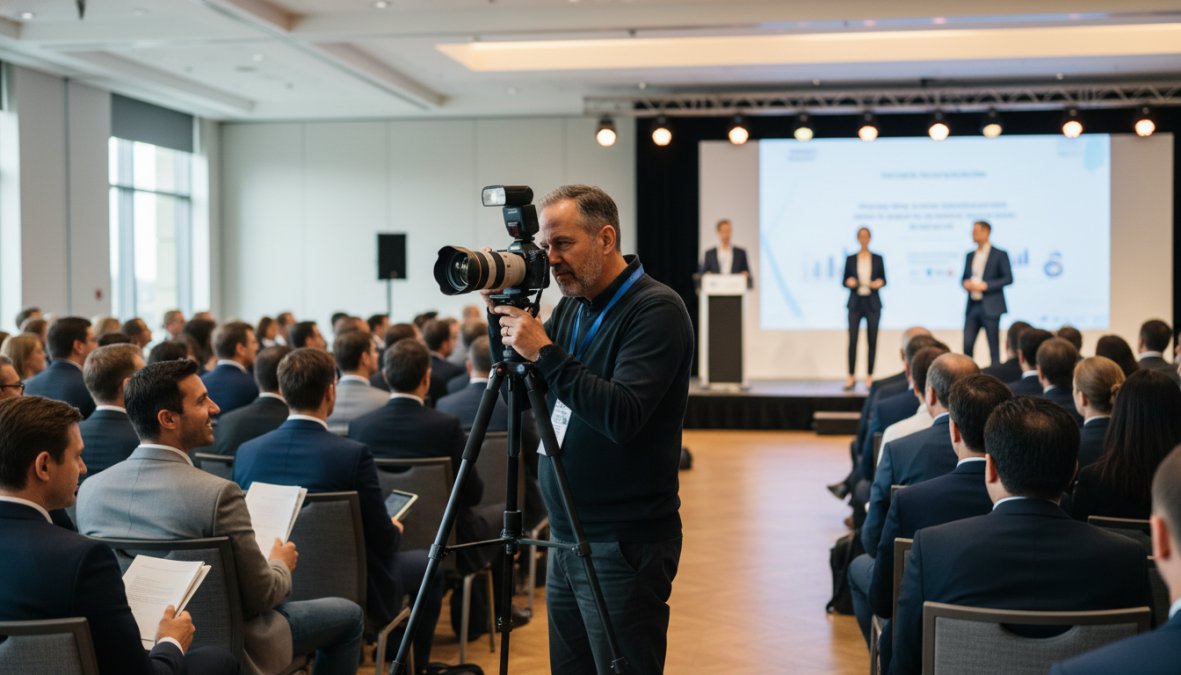
The table below outlines typical rate structures by event type, reflecting professional-level photographers with commercial portfolios.
Pricing Tiers by Event Type
| Event Type | Typical Duration | Rate Range (per day) | Notes |
|---|---|---|---|
| Corporate conference | 8-10 hours | Mid-to-high tier | Multi-session coverage |
| Product launch | 4-6 hours | Mid tier | Brand-critical deliverables |
| Gala / awards dinner | 4-5 hours | Mid tier | Evening lighting complexity |
| Trade show | Full day | Mid-to-high tier | High volume, varied locations |
| Executive headshots at event | 2-4 hours | Lower-mid tier | Controlled lighting setup |
| Annual general meeting | 3-5 hours | Mid tier | Formal documentation focus |
Rates in the DMV region (Washington DC, Maryland, Virginia) tend to sit at the higher end of national ranges, driven by the density of associations, lobbying organizations, and federal contractors requiring frequent professional coverage.
Factors That Influence Your Final Cost
Several variables move the final number significantly:
- Event complexity: Multiple simultaneous sessions require second shooters, which adds cost
- Lighting conditions: Poor ambient light requires additional equipment rental
- Turnaround time: Rush delivery (24-48 hours) commands a premium over standard timelines
- Deliverable volume: Requesting 500 edited images versus 150 changes post-production scope
- Usage rights: Commercial licensing for advertising use costs more than internal-use-only packages
- Travel: Events outside the photographer’s base area add transportation and potentially lodging
Event Photography Hourly vs Flat Rate: Which Model Works Best?
The pricing model you negotiate shapes how the entire engagement works. Hourly rates give flexibility for events with uncertain timelines; flat fees give budget certainty for well-defined scopes.
Hourly rates work when your schedule is fluid or you need partial-day coverage. The risk: if your keynote runs long, costs climb without warning, a real problem for clients with fixed budgets. Flat fees, structured as half-day or full-day rates, protect your budget and align the photographer’s incentives with quality rather than clock-watching.
According to guidance from the American Society of Media Photographers on pricing structures, flat-fee project pricing has become the dominant model for commercial event work because it clarifies scope for both parties upfront.
When a Day Rate Makes More Sense
A day rate is right when your event runs eight or more hours, involves multiple sessions across different rooms, or requires the photographer on-site throughout. It also simplifies invoicing for corporate accounting teams. An hourly rate on a ten-hour event creates incentive misalignment; a day rate keeps everyone focused on coverage quality. For corporate conferences, galas, and trade shows, a day rate is almost always the cleaner choice.
Avoid agreeing to an hourly rate without a clearly defined cap. Without a maximum hours clause, an event that runs long can push your final invoice well above your approved budget. Always negotiate a not-to-exceed figure when using hourly pricing.
Hidden Costs Most Corporate Clients Overlook
The shooting fee is the visible part of corporate event photography pricing. The hidden costs are where budgets get damaged.
Commercial Usage Rights and Licensing Fees
Usage rights are the most consistently misunderstood cost in corporate event photography. A photographer’s base fee typically covers internal use. The moment you use images in paid advertising, on a public website, in a press release, or in a brochure, you’ve entered commercial licensing territory.
Commercial usage rights are the legal permissions granted by the photographer (as copyright holder) defining how, where, and for how long the client may use the images. Without explicit licensing language, the photographer retains all rights and can restrict your ability to use the images.
Negotiate a broad commercial license upfront covering digital use, print collateral, and social media for a defined period, this is almost always cheaper than licensing specific images after the fact. As documented in U.S. Copyright Office guidance on photographic works, photographers automatically hold copyright the moment images are created. Clients own nothing by default without a written license or work-for-hire agreement.
Travel Expenses and Equipment Rental
Travel expenses are standard for events outside the photographer’s local area. Expect to cover mileage, parking, and for events more than 60-90 miles away, transportation and lodging, typically billed at cost with receipts. Equipment rental is relevant for challenging lighting conditions; some photographers include this in their day rate, others itemize it separately. Ask directly during quoting.
Corporate Event Photography Deliverables: What You Should Receive
Corporate event photography deliverables are the final edited, high-resolution digital files delivered in agreed formats through an agreed channel. A professional package should include:
- High-resolution JPEG files (minimum 300 DPI for print use)
- Web-optimized versions for digital and social media use
- Access to an online gallery for client review and download
- A defined number of fully edited images (color correction, exposure, cropping)
- Organized file naming or tagging for easy asset management

What you should NOT expect in a standard package: raw files. Most professional photographers do not deliver unedited RAW files by default. If your organization requires them, negotiate this explicitly and expect a higher fee.
Turnaround Time Expectations
Standard turnaround for corporate event photography runs five to fourteen business days. Rush delivery (24-72 hours) is available from most professionals but carries a surcharge. For time-sensitive communications, post-event press releases or same-week social media campaigns, negotiate turnaround time before signing. Verbal agreements about delivery speed are not enforceable. Get the timeline in writing.
Deliverable Formats: High-Resolution Files, Online Galleries, and More
The standard delivery channel is a private online gallery with download access. Beyond that, consider whether you need:
- Branded USB drive delivery for board-level presentations
- Metadata-tagged files for integration with a digital asset management system
- Print-ready files separated from web-optimized versions
- Vertical and horizontal crops of key images for different platform formats
These are not expensive additions, but they must be requested upfront.
What to Include in an Event Photography Contract
A photography contract defines the scope of work, deliverables, usage rights, payment terms, and liability provisions. Every corporate engagement should be governed by a signed contract before any work begins.
Key elements to include:
- Event details: Date, location, start time, end time, and expected coverage hours
- Deliverable specifications: Number of edited images, file formats, delivery method, and turnaround time
- Usage rights: Explicit license terms covering digital, print, advertising, and geographic scope
- Payment terms: Deposit amount, final payment due date, and late payment provisions
- Cancellation and rescheduling policy: What happens if the event is postponed or cancelled
- Secondary shooter provisions: If a second photographer is needed, who sources and pays for them
- Force majeure clause: Coverage for events outside both parties’ control
The usage rights clause is the single most important section of a photography contract for corporate clients. A vague clause like “client may use images for business purposes” will create disputes when you want to run paid advertising. Require specific language: medium, duration, geography, and exclusivity (or lack thereof).
Insurance, Liability, and COI Requirements
Many corporate venues require vendors, including photographers, to carry general liability insurance and provide a Certificate of Insurance (COI) naming the client or venue as an additional insured. Before signing, confirm the photographer carries general liability coverage (commonly $1M per occurrence), can provide a COI within your required lead time, and that their policy covers equipment and on-site liability.
A photographer who cannot provide a COI is a risk to your event logistics and potentially your venue contract. According to event industry risk management guidance from PCMA, vendor insurance verification is a standard procurement requirement. Do not waive it.
How Photographer Experience Affects Your Corporate Event Photography Pricing
Photographer experience is the most reliable predictor of both price and outcome. Entry-level photographers charge less but may struggle with challenging lighting, fast-moving conference environments, or capturing brand-consistent imagery without detailed direction. Mid-level photographers with two to five years of corporate experience have solved most of those problems. Senior photographers with decade-plus portfolios command the highest rates because they deliver consistent results with minimal supervision.
For brand-critical events, executive summits, product launches, or galas where images will appear in annual reports or major campaigns, experience is not a place to economize. The cost of reshooting an event is always higher than the premium for an experienced photographer.
Event Photojournalism’s award-winning photography team brings senior-level consistency to corporate conferences, galas, and special events across the DMV area: clean exposure in mixed lighting, decisive framing during fast-moving sessions, and a final gallery that reflects your brand.
How to Choose the Right Corporate Event Photographer
Choosing the right corporate event photographer comes down to four criteria: portfolio relevance, communication quality, contract clarity, and operational reliability.
Portfolio relevance means reviewing their corporate event work specifically, do they capture speakers authentically, reflect the energy of the room, and match your brand’s visual language? Communication quality is a leading indicator of how the engagement will go; a photographer who responds slowly or resists putting terms in writing will create problems on event day. Contract clarity is non-negotiable, a one-paragraph agreement is not ready for corporate procurement standards. Operational reliability covers backup equipment, venue familiarity, and contingency plans. For a conference with 400 attendees and no reshoot option, reliability is everything.
A practical checklist for evaluating candidates:
- Reviewed corporate event portfolio (not just wedding or portrait work)
- Confirmed availability for your event date and full coverage hours
- Received itemized quote covering shooting fee, post-production, and licensing
- Verified COI availability and coverage limits
- Confirmed turnaround time in writing
- Reviewed contract for usage rights, deliverable specs, and cancellation terms
- Checked references from comparable corporate events
The Professional Photographers of America’s guide to hiring commercial photographers recommends verifying professional membership and reviewing client references as baseline steps before signing any commercial photography contract.
Ask to see the photographer’s backup plan. What happens if their primary camera fails mid-event? Professionals carry redundant bodies and lenses. Anyone without a clear answer is not ready for high-stakes corporate work.
Corporate event photography is an investment in your organization’s visual identity, and getting the pricing structure right protects that investment. Event Photojournalism provides award-winning, high-resolution photography services across the DMV area, with customized solutions built for corporate conferences, galas, product launches, and executive events. Our team delivers reliable on-site coverage with the turnaround times and deliverable formats that corporate communications teams actually need. Contact Event Photojournalism to discuss your upcoming event and receive a detailed, transparent quote.
Frequently Asked Questions
How much does a corporate event photographer cost per hour?
Corporate event photography hourly rates vary widely based on experience, location, and event type. Entry-level photographers may charge less than mid-tier professionals, while seasoned photographers with commercial portfolios command premium hourly rates. For events in major metro areas like Washington DC, expect rates to reflect higher demand and cost of living. Always clarify whether the hourly rate includes post-production and image editing, or if those are billed separately, as this significantly affects your total photography budget.
Should I pay a flat fee or hourly rate for event photography?
The best model depends on your event structure. A flat fee or day rate works well for corporate conferences, galas, and trade shows with predictable schedules, giving you budget certainty. An hourly rate suits shorter events or product launches where coverage time is limited. When comparing event photography hourly vs flat rate options, factor in post-production time, some flat-fee packages include editing, while hourly arrangements may bill it separately. Always confirm scope in writing before signing a photography contract.
What is included in a standard corporate event photography package?
A typical corporate event photography package includes on-site photography coverage for a set number of hours, professional image editing and post-production, high-resolution digital assets delivered via an online gallery, and a usage license for internal or commercial purposes. Some packages also include a second photographer, same-day previews, or expedited turnaround time. Corporate event photography deliverables should be clearly itemized in the contract, including file formats, image count, and whether raw files are available.
Do corporate event photographers charge extra for image editing?
Yes, post-production and image editing are sometimes priced separately, especially when photographers quote a base hourly rate. Editing can be time-intensive, culling, color correction, and retouching for a full-day corporate conference may take as long as the shoot itself. When reviewing proposals, ask whether the quoted price covers full post-production or only delivery of lightly edited selects. Understanding this upfront prevents budget surprises and ensures your client deliverables meet brand consistency standards.
How far in advance should I book a corporate event photographer?
For large corporate events like annual conferences, galas, or multi-day trade shows, booking four to six months in advance is advisable, especially in competitive markets like the DMV area. Smaller events such as a product launch or team event may be bookable with four to eight weeks' notice. Early booking also gives you time to align on event logistics, review the photography contract, confirm liability insurance and COI requirements, and discuss deliverable formats before the event date.
What should a corporate event photography contract include?
A solid event photography contract should clearly outline the scope of coverage, hourly or flat-fee rate, payment schedule, turnaround time for deliverables, image formats and resolution, commercial usage rights and any licensing fees, travel expenses, and cancellation terms. It should also specify whether the photographer carries liability insurance and can provide a Certificate of Insurance (COI), which many corporate venues and event organizers require before granting access. Skipping any of these terms is one of the most common and costly mistakes clients make.
This article was written using GrandRanker