
Table of Contents
- What to Look for in Event Photographers: Core Qualities That Matter
- How to Review Portfolios and Evaluate Past Work
- Questions to Ask an Event Photographer Before You Hire
- How to Create an Event Shot List That Gets Results
- Event Photography Pricing Guide: What to Expect and Budget For
- What to Look for in an Event Photography Contract Template
- Post-Production Workflow, AI Tools, and Deliverables to Expect
- Event Logistics, Timelines, and Vendor Collaboration
- Conclusion
Last Updated: May 21, 2026
Knowing what to look for in event photographers separates a memorable occasion from a collection of blurry, poorly lit disappointments. At Event Photojournalism, we’ve covered hundreds of corporate conferences, galas, and special events across the DMV area, and the questions clients ask before hiring almost always follow the same pattern: they focus on price first and miss the factors that actually determine quality. This guide flips that order. Below, we’ll walk through every dimension that matters, from reviewing portfolios to understanding post-production workflows, so you can hire with confidence rather than hope.
Most people assume any photographer with a professional camera can handle a corporate event. That assumption is wrong. Event photography is a specialized niche that demands split-second timing, technical fluency in low-light environments, and the social intelligence to move through a crowd without disrupting the energy of the room. A wedding photographer and a corporate event photographer may use identical equipment and still produce completely different results.
Here’s what most guides get wrong: they treat event photography as a commodity decision, reducible to price per hour and number of images delivered. The real differentiator is whether the photographer understands your event’s purpose and can translate that purpose into a coherent visual story.
What to Look for in Event Photographers: Core Qualities That Matter
Strong event photographers share a specific set of qualities that go beyond technical skill. The best candidates combine photographic expertise with event-floor intelligence, an understanding of brand photography, and the professional conduct to represent your organization well in front of guests, executives, and keynote speakers.
Start by evaluating these core qualities:
- Specialization in event documentation: A photographer who primarily shoots portraits or landscapes will struggle with the unpredictability of live events. Look for someone whose portfolio is dominated by corporate events, galas, or conferences.
- Adaptability under pressure: Events run late, lighting changes, and schedules shift. Your photographer needs to adjust without prompting.
- Unobtrusive presence: The best event photographers are nearly invisible. Guests should feel comfortable, not surveilled.
- Brand awareness: Corporate event photography isn’t just about capturing candid moments. It’s about producing images that align with your organization’s visual identity and communication goals.
- Reliability and professional standards: Showing up on time, dressed appropriately, and prepared with backup equipment isn’t optional. It’s the baseline.
Photography Style: Candid Moments vs. Posed Shots
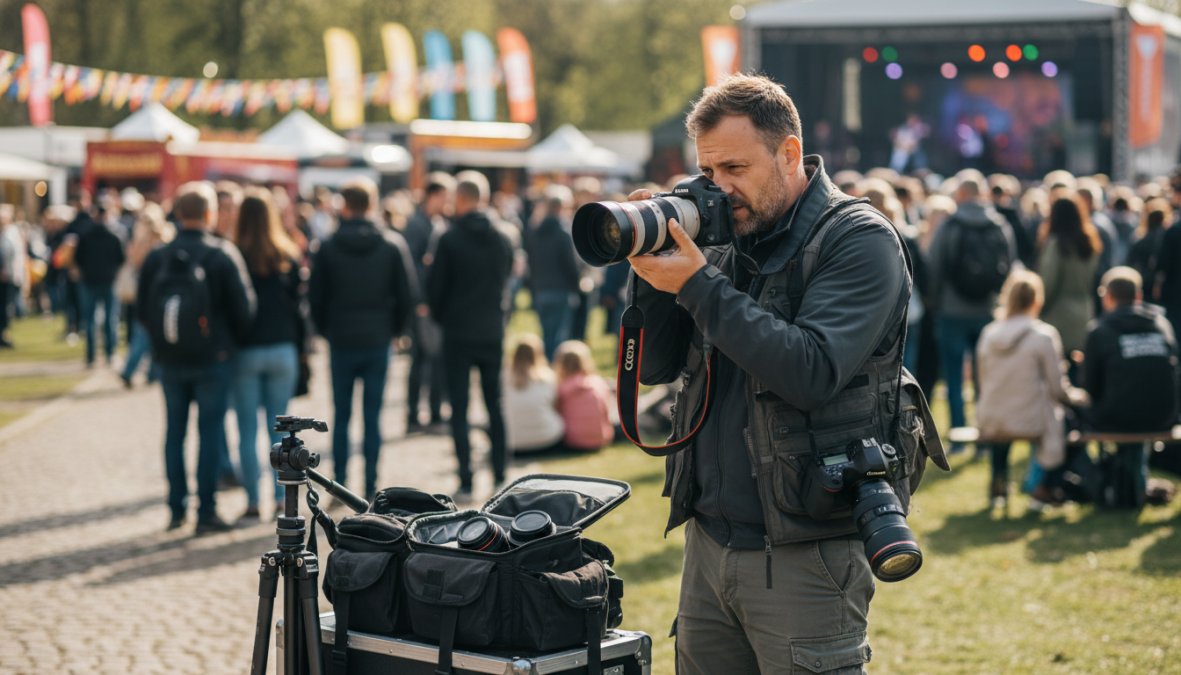
Event photography style falls on a spectrum between fully candid and fully posed, and most events require a deliberate blend of both. Candid moments capture authentic emotion, genuine reactions, and the energy of a room in ways that posed shots simply cannot replicate. Posed shots, on the other hand, deliver the formal group portraits, executive headshots, and sponsor recognition images that organizations use in press releases and annual reports.
The right balance depends on your event type. A corporate conference benefits from roughly 70% candid coverage and 30% posed, ensuring you capture the atmosphere while still getting the formal documentation your communications team needs. A gala or awards ceremony may flip that ratio during the presentation segments.
Ask any photographer you’re evaluating to show you examples of both styles from the same event. Photographers who excel at only one tend to produce lopsided coverage.
Low Light Performance and Lighting Equipment
Low light performance is one of the most reliable indicators of a photographer’s technical competence. Most corporate venues, hotel ballrooms, and conference centers are not designed for photography. Overhead lighting is inconsistent, stage lighting creates harsh shadows, and ambient light levels are often far below what a smartphone camera can handle gracefully.
A qualified event photographer should own and know how to use:
- Fast prime lenses (f/1.4 to f/2.8) that allow more light to reach the sensor
- Full-frame camera bodies with strong high-ISO performance
- Off-camera flash or portable lighting setups for formal portraits
- Diffusers and bounce cards to soften artificial light
Ask to see unedited samples from a dimly lit venue. Excessive grain, motion blur from slow shutter speeds, or blown-out highlights from poorly managed flash are all red flags.
Never hire an event photographer based solely on outdoor or studio portfolio samples. Low-light venue performance requires entirely different skills and equipment. A photographer who looks excellent in natural light may produce unusable images in a ballroom.
How to Review Portfolios and Evaluate Past Work
Portfolio review is where most clients make their biggest mistake: they look at images they find aesthetically pleasing without asking whether those images actually document an event effectively. A beautiful portrait of a single attendee tells you almost nothing about a photographer’s ability to cover a 400-person conference.
When reviewing portfolios, ask yourself these questions:
- Does the portfolio include images from events similar in scale and type to yours?
- Are there images of signage, event branding, and environmental details that tell the full story of the event?
- Do the candid shots look genuinely spontaneous, or do they feel staged?
- Is the editing style consistent across images from the same event?
- Are there images from challenging lighting conditions, not just well-lit moments?
According to Professional Photographers of America’s industry guidelines, a professional photographer’s portfolio should demonstrate technical consistency across varied conditions, not just highlight a handful of exceptional shots.
Spotting Consistency Across Corporate Events and Galas
Consistency is the word that separates professionals from talented amateurs. A single stunning image proves someone got lucky once. A full gallery of 300 images where 85% are technically sound and editorially coherent proves competence.
Ask photographers for a complete gallery from a past event, not a curated selection. Most professionals will share a client-facing gallery or a representative sample of 50-100 images. Look for consistent exposure, color temperature, and sharpness across images taken in the same space. If the first 20 images look polished and the next 30 look rushed and underexposed, that tells you exactly what your event coverage will look like once the easy shots are done.
Request galleries from events that took place after 6 PM in hotel or convention center venues. These settings expose technical weaknesses that outdoor or daytime portfolios will never reveal.
Questions to Ask an Event Photographer Before You Hire
The questions to ask an event photographer before signing a contract fall into three categories: technical, logistical, and legal. Most clients only ask logistical questions and miss the others entirely.
Technical questions:
- What camera bodies and lenses will you bring to this event?
- Do you carry backup equipment in case of gear failure?
- How do you handle mixed lighting environments (stage lighting plus ambient)?
Logistical questions:
- Have you photographed events at this venue before?
- How many events do you typically shoot per weekend?
- Will you be the primary photographer, or will you bring a second shooter?
Legal and business questions:
- Are you fully insured with general liability coverage?
- Who owns the copyright to the images after delivery?
- What is your cancellation and rescheduling policy?
Delivery and workflow questions:
- What is your standard turnaround time for a digital gallery?
- Do you deliver raw files, edited files, or both?
- How many final images should we expect from a six-hour event?
A photographer who hesitates or gives vague answers to the technical and legal questions is telling you something important. Professionals have clear, practiced answers to all of these.
How to Create an Event Shot List That Gets Results
An event shot list is a document you provide to your photographer before the event that specifies the images you need. A well-constructed shot list is one of the most underused tools in event planning, and it’s the single best way to ensure your photographer captures what matters to your organization rather than what they personally find interesting.
A practical shot list includes:
- Venue exterior and entrance signage before guests arrive
- Registration table and early arrivals
- Keynote speakers at the podium (both wide establishing shots and tight portrait-style shots)
- Audience reaction shots during key presentations
- VIP and executive portraits (list names and titles)
- Sponsor signage and branded elements
- Networking moments and group interactions
- Award presentations or recognition moments
- Catering, decor, and environmental details
- Group photos (list specific groups and who to coordinate with)
- Event closing and any final remarks
The shot list should also include logistical notes: who to contact for VIP access, which areas are off-limits, and any schedule-specific moments that require the photographer to be in a specific location at a specific time.
According to Event Industry Council’s event management standards, pre-event briefing documents that include photography direction are associated with significantly higher client satisfaction in post-event reviews.
A shot list isn’t a creative constraint on the photographer. It’s a communication tool that ensures your organization’s priorities are captured alongside the photographer’s own editorial instincts.
Event Photography Pricing Guide: What to Expect and Budget For
Event photography pricing is one of the most searched and least honestly answered topics in this space. Most guides either refuse to publish numbers or cite ranges so wide they are useless. This section gives you a realistic framework anchored to how professional photographers actually structure their pricing, so you can evaluate quotes with context rather than guesswork.
How Event Photographers Structure Their Fees
Professional event photographers typically price in one of three structures:
- Hourly rate with a minimum booking: Common for smaller events. A minimum of three or four hours is standard, even if your event runs two. The hourly rate covers the photographer’s time on-site only; post-production is billed separately or bundled at a flat rate.
- Half-day and full-day packages: The most common structure for corporate events. A half-day is typically defined as four to five hours; a full day as eight to ten. Packages usually include a set number of edited images and a defined turnaround window.
- Project-based flat fee: Used for high-stakes events where the scope is fully defined in advance, a product launch, an annual gala, a multi-day conference. The flat fee covers everything from pre-event consultation through final gallery delivery.
Understanding which structure a photographer uses tells you something about how they work. Hourly-rate photographers are often more flexible but may rush post-production to keep their effective hourly rate competitive. Package-based photographers have usually optimized their workflow to deliver consistent quality within a defined scope.
The Real Cost Drivers (And the Trade-Offs at Each Level)
The primary cost drivers in event photography are:
- Coverage hours: On-site time is the largest single variable. Events requiring early setup access, a cocktail hour before the main program, and a late breakdown all extend billable time beyond what the agenda suggests.
- Second shooter: For events with simultaneous sessions, breakout rooms, or guest counts above roughly 150-200 people, a single photographer cannot cover everything. A second shooter typically adds a meaningful percentage to the base rate, budget for it as a near-certainty for large-scale corporate events rather than an optional upgrade.
- Post-production scope: This is where the most significant hidden cost differences live. Basic color correction and cropping is standard in almost every package. Full retouching on executive portraits, composite group shots, or background cleanup is not, and it takes substantially more time. Same-day or next-day turnaround, increasingly requested for social media use, commands a premium because it requires the photographer to edit through the night after the event.
- Licensing and usage rights: Images licensed for internal use only (intranet, internal presentations, employee communications) are priced differently from images licensed for external commercial use (advertising, press materials, paid social campaigns). If your organization plans to use event images in any paid media, discuss licensing explicitly before signing. Discovering this gap after delivery is expensive.
- Travel and logistics: Events outside the photographer’s primary market typically include travel fees. For events requiring overnight stays, budget for accommodation and per diem in addition to the travel fee itself.
What the Tiers Actually Mean in Practice
Rather than publishing dollar figures that vary by market, experience level, and event type, the more useful framework is understanding what you are actually trading off at each budget level:
| Cost Factor | Entry-Level | Mid-Market | Specialist/Senior |
|---|---|---|---|
| Experience with corporate events | Limited; may have strong general portfolio | Solid track record; 3-5+ years of event work | Deep specialization; recognizable client roster |
| Equipment | Consumer or prosumer bodies; limited backup | Professional bodies; one backup body | Full professional kit; dedicated backup for every critical piece |
| Second shooter | Rarely included; often unavailable | Available as add-on | Frequently included or easily arranged |
| Turnaround time | 3-4 weeks standard | 1-2 weeks standard | Under 1 week; rush options available |
| Post-production | Basic color correction; limited selection | Color correction + careful selection + basic retouching | Full editing suite; executive portrait retouching included |
| Usage rights | Personal/internal only by default | Limited commercial included; broader use negotiable | Broad commercial licensing available; clearly documented |
| Contract and insurance | Variable; may lack formal contract or insurance | Standard contract; general liability insurance typical | Comprehensive contract; certificate of insurance provided on request |
The most common budgeting mistake is optimizing for the lowest hourly rate without accounting for deliverable volume, turnaround time, or usage rights. A photographer charging less per hour but delivering 40% fewer usable images, a three-week turnaround, and no commercial licensing is not the better value for a corporate client who needs images for a press release the following week.
The Second Shooter Question
The decision about whether to hire a photographer with a second shooter is worth treating as a separate budget line rather than an afterthought. A single photographer covering a 300-person conference across multiple rooms will make constant triage decisions about what to miss. A two-person team eliminates most of those trade-offs.
When evaluating whether you need a second shooter, ask:
- Are there simultaneous sessions or breakout rooms that both need coverage?
- Is there a VIP or executive meet-and-greet happening at the same time as the main program?
- Does your event have both a formal program and a networking component that overlap?
- Is the guest count large enough that candid coverage of the room requires two sets of eyes?
If the answer to any of these is yes, budget for a second shooter from the start rather than discovering mid-event that critical moments were missed.
Be cautious of photographers who offer unusually low rates without explaining what is excluded. The most common omissions are: second shooter, commercial licensing, retouching beyond basic color correction, and same-day or rush delivery. Always ask for an itemized scope of what the quoted price includes before comparing rates across candidates.
The right question is not “what is the cheapest photographer available?” but “what is the minimum investment required to get images that serve our organization’s actual communication needs?” Define those needs first, internal use only vs. press distribution, standard turnaround vs. same-day delivery, single room vs. multi-track conference, and then evaluate pricing against that defined scope.
What to Look for in an Event Photography Contract Template
An event photography contract template is a legally binding document that defines the scope of work, deliverables, payment terms, and rights for both parties. Reviewing contracts carefully is one of the most important steps in hiring an event photographer, and it’s where many clients discover misalignments they assumed were already understood.
Every contract should clearly address:
- Scope of coverage: Date, start time, end time, location, and any specific sessions or moments included
- Deliverable specifications: Number of edited images, file format, resolution, and delivery method
- Turnaround timeline: The exact date by which the digital gallery will be delivered
- Payment schedule: Deposit amount, balance due date, and accepted payment methods
- Cancellation terms: What happens if the client cancels, what happens if the photographer cancels
- Copyright and licensing: Who owns the images and what uses are permitted
- Model releases: Who is responsible for obtaining releases from photographed individuals, if required
Legal Requirements, Liability Insurance, and Venue Permissions
Legal and insurance requirements are the areas most clients overlook and most photographers hope you won’t ask about. This is a mistake.
A professional event photographer should carry general liability insurance, typically with coverage limits of at least $1 million per occurrence. Many corporate venues and event spaces require vendors to provide proof of insurance before they’re permitted on-site. If your photographer cannot provide a certificate of insurance, that is a disqualifying factor for any professional event.
Venue permissions are a separate issue. Some venues have restrictions on commercial photography, flash photography in certain areas, or access to specific spaces. A professional photographer will ask about these restrictions during the pre-event walkthrough rather than discovering them during the event itself.
Copyright ownership is frequently misunderstood. In most jurisdictions, the photographer retains copyright to images unless the contract explicitly transfers ownership to the client. What you’re typically purchasing is a license to use the images for specified purposes. Make sure the contract’s licensing language matches your intended uses, particularly if you plan to use images in advertising, press materials, or social media campaigns.
As documented in U.S. Copyright Office guidance on photography and intellectual property, the creator of a photograph automatically holds copyright at the moment of creation unless a written work-for-hire agreement specifies otherwise.
Post-Production Workflow, AI Tools, and Deliverables to Expect
Post-production is where event photography either comes together or falls apart, and it is also the area where the gap between photographers who have modernized their workflow and those who have not is widest. Understanding what happens after the shutter clicks helps you set realistic expectations, ask better questions during the hiring process, and avoid the most common deliverable disappointments.
The Four Stages of a Professional Post-Production Workflow
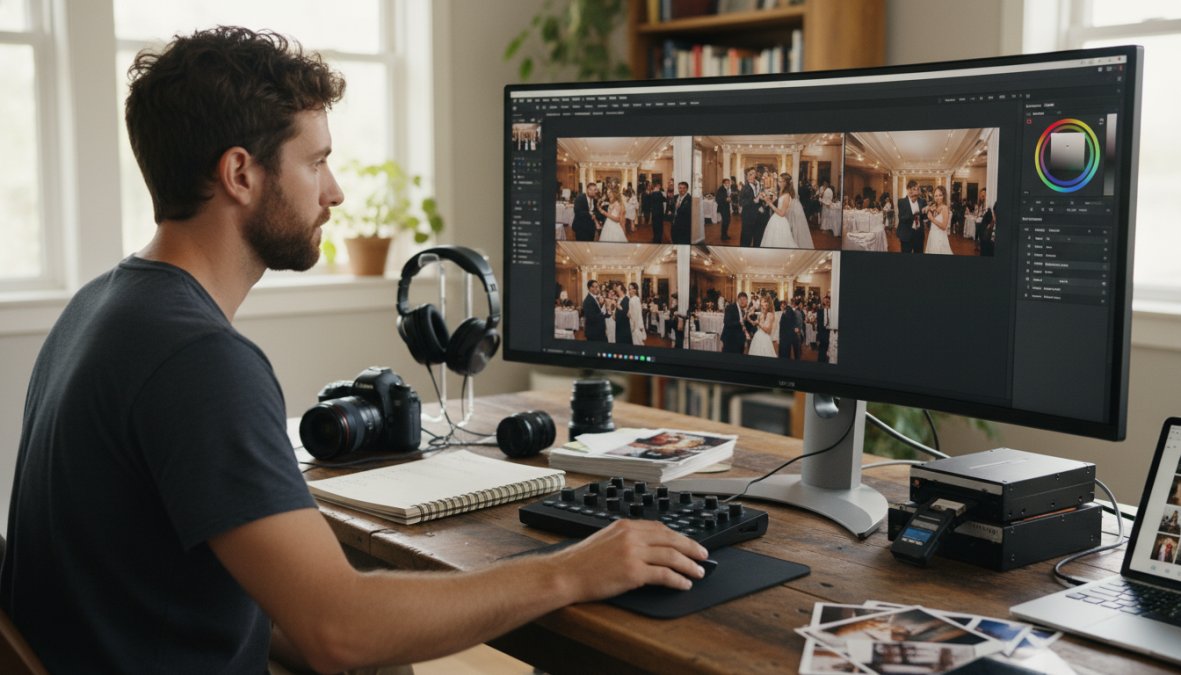
A standard post-production workflow for event photography moves through four distinct stages, and the quality and speed of each stage directly affects what you receive:
Stage 1, Ingestion and Backup
Immediately after the event, a professional photographer transfers all raw files to at least two separate storage locations before any editing begins. This is not optional. A photographer who edits directly from a single card or drive without creating a backup first is one hardware failure away from losing your entire event. Ask any candidate you’re evaluating what their backup protocol is. The answer should involve redundant storage, not a single external drive.
Stage 2, Culling
Culling is the process of reviewing every frame captured and selecting the best images for editing. For a six-hour corporate event, a photographer might capture 1,500 to 2,500 frames and deliver 300 to 500 edited images. The culling stage is where a significant portion of the photographer’s judgment is applied: identifying the sharpest frame from a burst sequence, selecting the expression that reads best at small sizes, and removing technically deficient images before they reach the client.
Stage 3, Color Correction and Editing
Color correction establishes consistent white balance, exposure, and contrast across the entire gallery. This is the baseline that every professional package should include. Beyond color correction, editing may include:
- Cropping and straightening for compositional consistency
- Noise reduction on images captured at high ISO in low-light conditions
- Highlight and shadow recovery to manage high-contrast scenes
- Selective adjustments to specific areas of an image (brightening a face in a dark background, for example)
Retouching is a separate service from color correction and should be explicitly defined in the contract. Retouching typically refers to work done on individual images: removing a distracting object from the background, smoothing skin tones on executive portraits, or correcting a wardrobe issue. Retouching takes significantly more time per image than color correction and is priced accordingly.
Stage 4, Export and Delivery
Final images are exported at the agreed resolution and delivered via a digital gallery platform. Most professional photographers use platforms that allow clients to download full-resolution files, share the gallery with stakeholders, and flag favorites for additional retouching. The delivery platform matters: a gallery that expires after 30 days or limits downloads creates problems for organizations that need to access images months later for annual reports or retrospective communications.
How AI Has Changed the Editing Process, And What It Means for You
AI-assisted editing tools have materially changed the speed and consistency of professional post-production over the past several years. Understanding how these tools work helps you evaluate photographer claims about turnaround time and ask the right questions about quality control.
AI-assisted culling tools analyze every frame in a shoot and score images based on technical quality, sharpness, exposure, whether eyes are open and in focus, facial expression quality. Tools in this category can reduce the time a photographer spends on initial culling by a substantial margin. For clients, this translates to faster turnaround without the quality degradation that comes from a photographer rushing manual selection. The important caveat: AI culling tools score technical quality, not editorial judgment. A technically sharp image of the wrong moment still needs a human editor to catch. Photographers who rely entirely on AI culling without editorial review will deliver technically clean but editorially incomplete galleries.
AI-assisted color correction tools can batch-apply consistent color grading across hundreds of images from the same lighting environment, dramatically reducing the time required to achieve gallery-wide consistency. This is a genuine quality improvement for clients: manual batch correction introduces subtle inconsistencies that AI tools largely eliminate.
AI-powered background replacement and object removal tools have become fast enough to use in production workflows. For corporate event photography, this is most relevant for executive portraits taken in imperfect environments, a cluttered conference room background can be replaced with a clean, brand-consistent backdrop in post-production without a studio setup. Ask photographers whether this capability is available if your event includes portrait sessions in non-ideal spaces.
Instant social media delivery is an emerging service that some event photographers now offer using AI-assisted on-site editing workflows. With this approach, a selection of images is lightly edited and delivered to a designated contact within one to two hours of capture, sometimes while the event is still in progress. This is particularly valuable for conferences, product launches, and galas where social media coverage during the event is part of the communications strategy. Not all photographers offer this service, and it typically requires a dedicated editing workstation or a second team member handling post-production on-site. If same-event social delivery is a priority, ask about it explicitly during the hiring process.
When evaluating photographers who mention AI tools in their workflow, ask one follow-up question: “What does your manual quality control step look like after AI culling?” Photographers who have a clear answer, reviewing AI selections against the shot list, checking for editorial completeness, manually reviewing any moment-critical sequences, are using AI as a tool. Photographers who describe AI culling as the final step are using it as a shortcut.
Turnaround Time, Digital Gallery Delivery, and Raw Files
Turnaround time expectations vary by photographer and event type. A reasonable standard for a corporate event is 7 to 14 business days for a fully edited gallery. Rush delivery within 48 to 72 hours is available from some photographers at an additional cost, which is worth considering if you need images for a press release or social media campaign immediately after the event. Same-day or next-morning delivery of a curated selection, distinct from the full edited gallery, is increasingly available from photographers using AI-assisted workflows.
Digital gallery delivery is now the standard method for image delivery. When evaluating gallery platforms, ask:
- How long does the gallery remain accessible? (Permanent access is preferable to a 30 or 60-day expiration.)
- Can you download full-resolution files directly, or only web-optimized versions?
- Can you share the gallery with stakeholders who were not part of the original contract?
- Is there a mechanism for flagging images for additional retouching after initial delivery?
Raw files are a separate and frequently misunderstood deliverable. Raw files are unprocessed image files that contain the full data captured by the camera sensor, they are not viewable without specialized software and represent the photographer’s unfinished work product. Most photographers do not include raw files in standard packages for two reasons: raw files require software like Adobe Lightroom or Capture One to open, and delivering raw files is professionally analogous to a writer delivering an unedited first draft as the final manuscript.
If raw files are important to your organization, for archival purposes, for in-house editing capability, or for brand consistency across a large image library, negotiate this explicitly in the contract before signing. Expect it to affect pricing, and confirm that the contract language specifies the file format, color profile, and any metadata included with the raw files.
Do not assume that requesting raw files gives you higher-quality images than edited JPEGs or TIFFs. Raw files require skilled post-processing to look their best. An unedited raw file from a challenging lighting environment will often look worse than a properly color-corrected JPEG from the same moment. Raw file delivery is an archival and workflow consideration, not a quality upgrade.
The post-production workflow is where the difference between a photographer who charges a premium and one who does not becomes most visible. Ask every candidate to describe their culling process, their color correction approach, their AI tool usage and quality control steps, and their gallery delivery platform. Photographers who can answer these questions in specific, practiced terms have a professional workflow. Photographers who give vague answers about “editing in Lightroom” and “delivering a gallery” have not thought carefully about the client experience after the event ends.
Event Logistics, Timelines, and Vendor Collaboration
The most technically skilled photographer will underperform if they arrive unprepared for your event’s specific logistics. Event logistics and timelines are the operational layer that determines whether great photography is actually possible on the day.
A pre-event walkthrough is non-negotiable for any event above a certain scale. The photographer should visit the venue in advance to assess lighting conditions, identify optimal shooting positions for key moments, and coordinate with the event planner and other vendors. This walkthrough also surfaces logistical conflicts before they become day-of problems: a stage positioned in front of a window, a cocktail hour in a space with no ambient light, or a venue restriction on flash photography.
Vendor collaboration is equally important. Event photographers who work well with lighting technicians, AV teams, and event coordinators consistently produce better results than those who operate in isolation. A good photographer will ask the lighting director about planned changes during the program, communicate with the AV team about screen content that might create exposure challenges, and coordinate with the event planner on the schedule for key moments.
The practical checklist for event logistics preparation includes:
- Confirm event timeline and schedule of key moments with the event planner
- Conduct a venue walkthrough at least one week before the event
- Identify parking, vendor entrance, and equipment staging areas
- Confirm all access permissions and any restricted areas
- Exchange contact information with the event planner and day-of coordinator
- Confirm backup plan if primary equipment fails
- Verify any venue-specific insurance or permit requirements
According to International Live Events Association’s professional standards for event vendors, pre-event coordination between photographers and event production teams is one of the strongest predictors of post-event client satisfaction in professional event documentation.
Send your photographer a detailed run-of-show document at least 72 hours before the event. Include exact times for award presentations, group photos, and any VIP moments. Photographers who know what’s coming can position themselves correctly rather than chasing moments after they’ve already happened.
Hiring the right event photographer requires evaluating a specific combination of technical skill, professional conduct, legal preparedness, and logistical discipline. Most organizations get this wrong by treating photography as an afterthought and evaluating candidates on price alone. Event Photojournalism brings award-winning photography expertise, high-resolution image delivery, and customized coverage solutions to corporate conferences, galas, and special events across the DMV area. Our team handles everything from the initial shot list consultation to final digital gallery delivery, ensuring your event is documented with the quality it deserves. Contact Event Photojournalism to discuss your upcoming event and see how professional photography transforms your occasions into lasting visual assets.
Frequently Asked Questions
How do I choose a photographer for an event?
When choosing a photographer for your event, start by reviewing their portfolio for experience in your specific event type, corporate conferences, galas, or weddings require different skills. Confirm they understand your photography style preferences (candid vs. posed), ask about their equipment and low light performance, review their contract terms, and verify they carry liability insurance. Booking early and providing a detailed photography brief ensures alignment before the event day.
What questions should I ask an event photographer before hiring?
Key questions to ask an event photographer include: How many similar events have you covered? What is your turnaround time for delivering the digital gallery? Do you carry liability insurance? Will you provide a second shooter if needed? What is included in your editing process, color correction, retouching, raw files? How do you handle low light or challenging venue conditions? These questions help you assess professionalism, technical skill, and whether they align with your event documentation needs.
Do I need to provide a shot list for my event photographer?
Yes, providing a shot list is strongly recommended. A well-prepared shot list ensures your photographer captures must-have moments, keynote speakers, award presentations, brand signage, group photos, and candid moments. It also helps with event logistics and timeline planning. Share the shot list at least a week before the event so your photographer can ask clarifying questions and plan their positioning and lighting equipment accordingly.
How much should I pay for an event photographer?
Event photography pricing varies based on event type, duration, location, and deliverables. Rates typically reflect the photographer's experience, whether a second shooter is included, the editing process scope, and turnaround time expectations. Corporate event and brand photography often command higher rates than casual gatherings due to professional standards and post-production requirements. Always request a detailed quote that outlines all deliverables, usage rights, and any additional fees before signing a photography contract.
How far in advance should I book an event photographer?
For corporate events, galas, and conferences, booking an event photographer at least 4 to 8 weeks in advance is advisable, and for large or high-profile events, 3 to 6 months ahead is better. Popular photographers in competitive markets like the DMV area fill their calendars quickly. Early booking also gives you time to finalize your photography brief, shot list, and contract terms without last-minute pressure.
This article was written using GrandRanker