Table of Contents
- Why Hiring a Photographer for Your Board Meeting Matters
- What to Include in a Corporate Photography Brief
- Board Meeting Photography NDA Template and Confidentiality Protocols
- Tips for Photographing Board Meetings: Equipment and Technique
- How to Hire a Photographer for a Board Meeting: Step-by-Step
- Corporate Event Photography Rates for Board Meetings
- Videography Services and Post-Production for Corporate Governance
- Conclusion
Last Updated: June 5, 2026
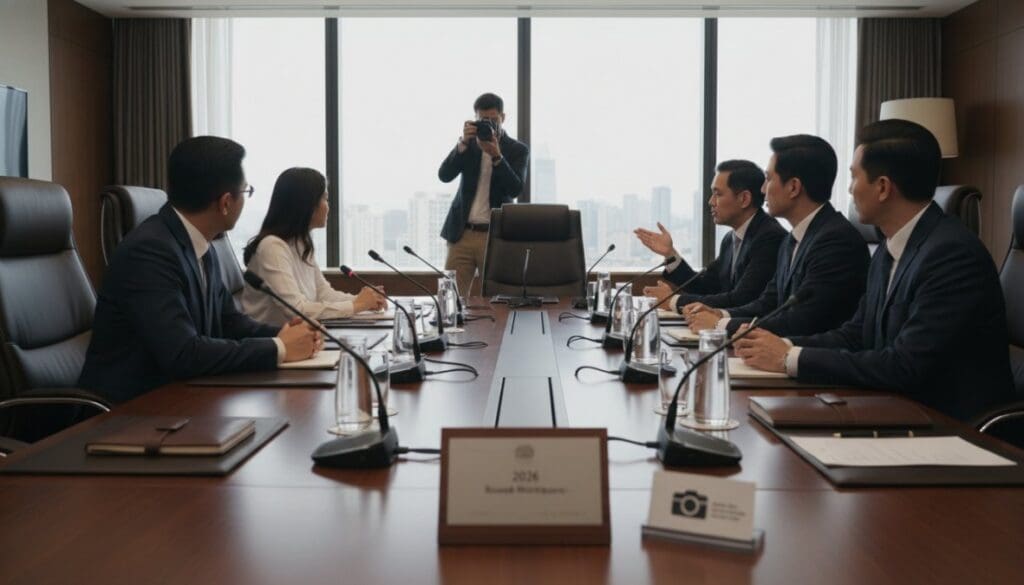
Deciding to hire photographer for board meeting coverage is more consequential than most executives realize. The images produced become governance assets, stakeholder communication tools, and brand credibility signals that circulate long after the session ends. At Event Photojournalism, we’ve worked with corporate clients across the DMV area who underestimated this decision, then watched a single well-photographed board session reshape how their organization presents itself externally. Below, we’ll show you exactly how to brief, vet, and book the right corporate photographer for your next board meeting, including the confidentiality protocols most guides skip entirely.
Board meeting photography is the specialized practice of documenting executive leadership sessions through professional imagery that serves both internal governance records and external stakeholder communication. Unlike general event photography, it demands discretion, silent equipment, and an understanding of corporate dynamics that most photographers simply don’t have. The constraints are different, the stakes are higher, and the wrong photographer in the room can disrupt the very proceedings they’re supposed to document.
Why Hiring a Photographer for Your Board Meeting Matters
Meeting documentation functions as a governance asset, not just a memory aid. Many organizations discover this too late, after a pivotal strategy session produces no visual record usable in annual reports, investor decks, or board communications.
Meeting Documentation as a Governance Asset
Professional visuals from board meetings serve a concrete governance function. Boards that maintain consistent photographic records create a visual history of leadership continuity, strategic milestones, and organizational evolution, images that appear in annual reports, proxy statements, and regulatory filings. According to Harvard Law School Forum on Corporate Governance, visual presentation quality in governance communications directly affects how institutional investors perceive organizational professionalism. A single board meeting shoot, done well, produces assets that circulate for 12-18 months across multiple communication channels.
Brand Credibility and Stakeholder Communication
Corporate photography from board sessions signals organizational maturity to external audiences. Investors, partners, and media contacts who receive communications featuring polished visuals form stronger impressions of organizational stability than those receiving text-heavy documents with no imagery. Candid photography of executives engaged in discussion communicates a different story than formal headshots alone, and the combination gives stakeholder materials depth that stock photography cannot replicate.
Board meeting photography isn’t a luxury line item. For organizations that communicate regularly with investors, regulators, or the press, it’s a recurring operational need that pays dividends across multiple content channels.
What to Include in a Corporate Photography Brief
A corporate photography brief aligns your photographer’s scope with your organization’s specific needs before a single shot is taken. Most booking failures trace back to a missing or vague brief.
Defining Your Event Needs and Shot List
What to include in a corporate photography brief starts with a precise shot list. A board meeting shot list should specify:
- Full board group portrait (formal, pre-meeting or post-meeting)
- Individual executive portraits at the table
- Candid photography of active discussion moments
- Presentation clips showing speakers at the podium or screen
- Action shots of document review or collaborative work
- Room establishing shots showing the full boardroom setup
- Any specific agenda items requiring visual documentation
Beyond the shot list, the brief should define deliverable format, turnaround time, and usage rights. Many organizations need images within 24-48 hours for communications that go out immediately after the meeting.
Build your shot list by working backwards from where the images will be used. If the primary destination is an annual report, you need formal portraits and wide establishing shots. If it’s a press release, you need action shots and candid photography that conveys energy and engagement.
Logistics: Venue, Schedule, and Access Levels
Event logistics determine what photography is physically possible. Share the venue layout, lighting conditions, and meeting schedule with your photographer in advance, boardrooms vary dramatically, from floor-to-ceiling windows producing harsh backlighting to overhead fluorescents that create unflattering color casts. Clarify which portions of the meeting are open to photography, which are closed, and whether the photographer will be present throughout or brought in for specific segments, as this affects both the shot list and the equipment they bring.
Board Meeting Photography NDA Template and Confidentiality Protocols
Confidentiality is the non-negotiable dimension of board meeting photography that generic event contracts don’t address. Any photographer working in a boardroom will be present during discussions that may include material non-public information, strategic plans, personnel matters, or financial data.
Key Clauses Every Board Meeting NDA Should Cover
A board meeting photography NDA template should include these specific provisions:
Scope of Confidential Information: Define what constitutes confidential information, verbal discussions, documents visible in photographs, whiteboard content, presentation slides, and anything the photographer overhears.
Image Usage Restrictions: Specify that all images are the exclusive property of the organization. The photographer may not use, share, license, or display any images without written authorization.
Device and Storage Security: Require that all images be transferred to approved storage and that no copies remain on the photographer’s personal devices or cloud accounts.
Duration of Confidentiality: Board meeting NDAs should extend obligations for a minimum of 3-5 years, not the 12-month terms common in standard photography contracts.
Return or Destruction of Materials: Include a clause requiring the photographer to confirm destruction of all working files once final deliverables are transferred.
According to Society of Corporate Secretaries and Governance Professionals, organizations that formalize vendor confidentiality agreements reduce governance risk exposure significantly compared to those relying on verbal agreements alone.
Never rely on a standard photography contract for board meeting work. Standard contracts protect the photographer’s interests, not yours. A purpose-built NDA is the minimum requirement before any photographer enters your boardroom.
Tips for Photographing Board Meetings: Equipment and Technique
The technical constraints of boardroom photography are more demanding than most corporate environments. Getting this wrong produces images that are technically unusable or visually distracting to participants.
Technical Equipment for Low-Light Boardrooms
Tips for photographing board meetings always start with equipment, because boardroom lighting is notoriously difficult. Most conference rooms combine overhead fluorescents with window light, creating mixed color temperatures that produce unnatural skin tones.
The right equipment setup includes:
- Mirrorless cameras with silent shutter modes: Fully electronic silent shutters produce zero audible sound, essential in quiet meeting environments.
- Fast prime lenses (f/1.4-f/2.8): Wide-aperture lenses allow shooting at lower ISO values, reducing digital noise in dimly lit rooms.
- High-ISO capable sensors: Contemporary full-frame sensors perform well at ISO 3200-6400, often necessary where flash is prohibited.
- Portable LED panels: When permitted, small continuous light sources supplement existing room lighting without the disruption of flash.
Capturing Candid Photography and Executive Portraits
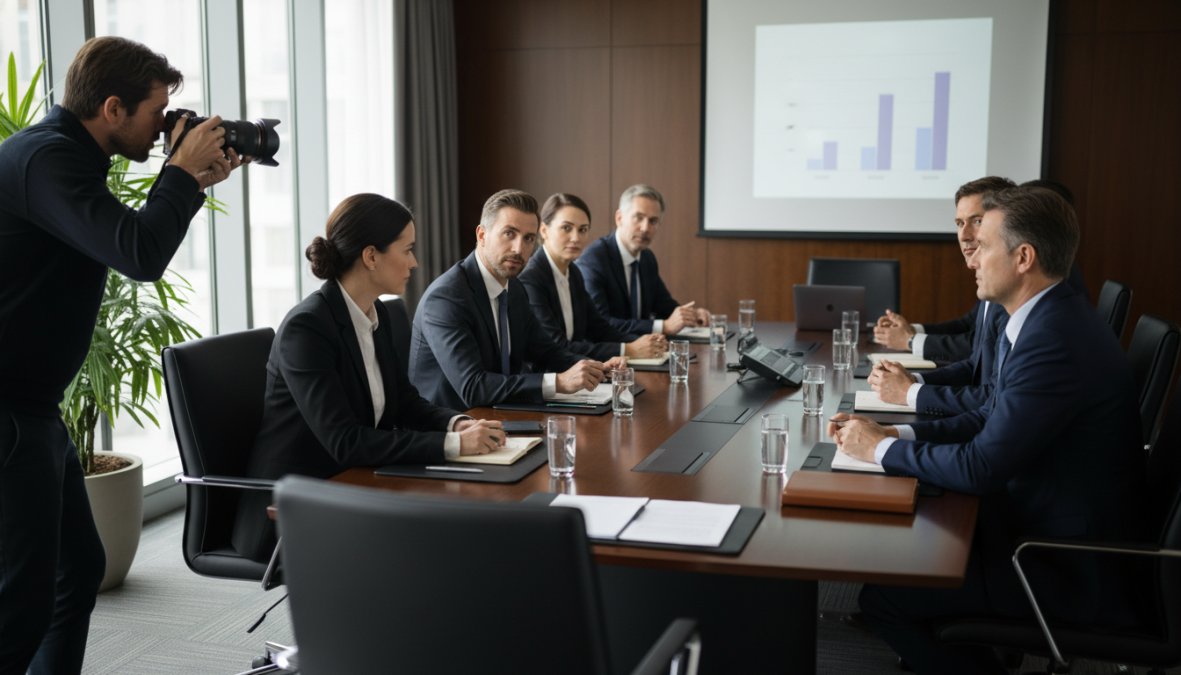
The two most valuable image categories from any board meeting are candid photography and executive portraits, and they require different approaches. Candid photography captures authentic engagement, executives in discussion, reviewing materials, reacting to presentations, and requires the photographer to anticipate moments rather than direct them. Positioning at the room’s periphery with a telephoto lens allows natural capture without becoming part of the scene. Executive portraits at the table require brief, directed setups of 2-3 minutes per subject, best scheduled during natural breaks rather than interrupting proceedings.
How to Hire a Photographer for a Board Meeting: Step-by-Step
The process to hire photographer for board meeting work follows a specific sequence that protects your organization and produces better results than a last-minute vendor search.
Step 1: Define scope and deliverables. Complete your shot list and brief before contacting any photographers so you can evaluate proposals against a consistent standard.
Step 2: Research photographers with corporate event experience. General event and wedding photographers rarely have the discretion, equipment, or corporate understanding board meetings require. Search specifically for corporate photography specialists with documented board or executive session experience.
Step 3: Review portfolios for relevant work. Look for evidence of low-light boardroom capability, executive portrait quality, and candid photography that feels natural rather than staged.
Step 4: Conduct a pre-booking consultation. Discuss logistics, confidentiality requirements, and equipment before committing. A photographer who pushes back on NDA requirements or seems unfamiliar with silent shooting modes is the wrong choice.
Step 5: Execute the NDA and contract. Finalize confidentiality agreements before sharing any meeting details, venue information, or attendee lists.
Step 6: Conduct a venue walkthrough. Have your photographer visit the boardroom in advance to assess lighting and plan positioning.
Reviewing Portfolio Work and Researching Photographer Style
Portfolio review for board meeting photography requires a specific lens. Look for: low-light indoor images with clean, noise-free results; executive portraits that feel authoritative without being stiff; candid photography capturing genuine engagement; and evidence of discretion, images where the photographer’s presence clearly didn’t disrupt the room. Photographer personality matters as much as technical skill; someone comfortable in a quiet, high-stakes environment will produce different results than someone accustomed to loud events.
Questions to Ask Before Booking
Direct questions reveal whether a photographer is genuinely equipped for board meeting work:
- Do you use a silent shutter mode? Which camera system?
- Have you signed NDAs for previous corporate clients?
- How do you handle image storage and security post-shoot?
- What is your turnaround time for high-resolution delivery?
- Do you carry professional liability insurance?
- How do you manage positioning to avoid disrupting meeting flow?
Confident, specific answers indicate real experience. Vague or hesitant answers are a signal to keep searching.
Corporate Event Photography Rates for Board Meetings
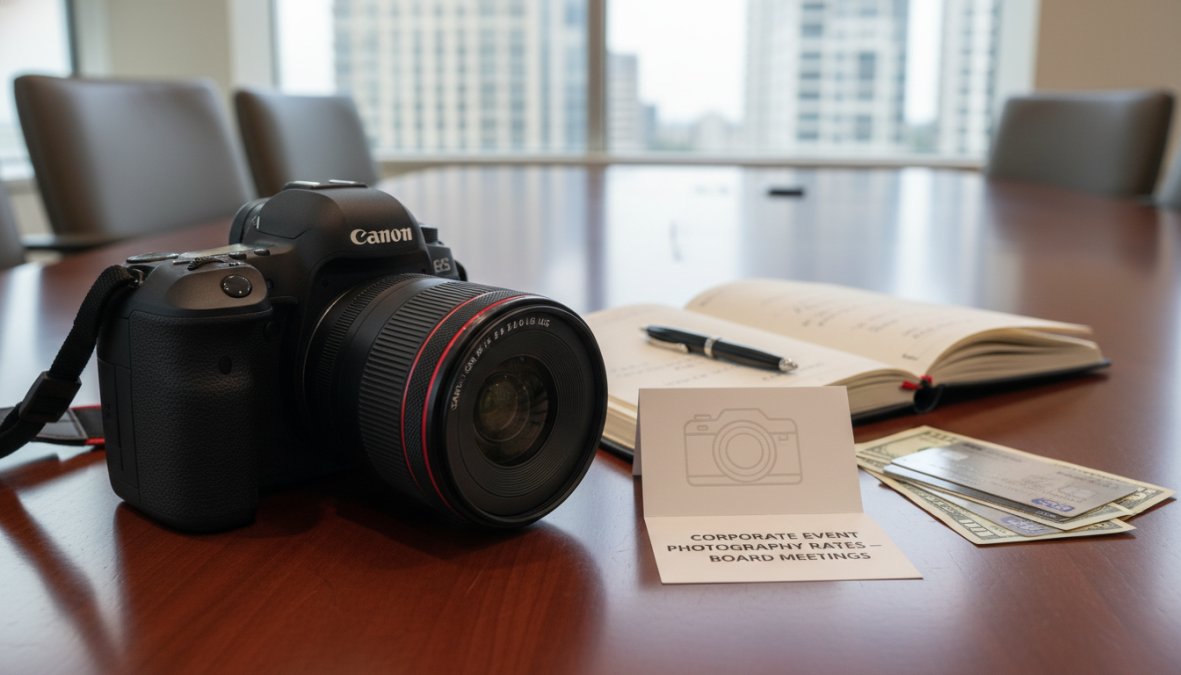
Corporate event photography rates for board meetings sit above standard event photography pricing. The specialization, equipment requirements, and confidentiality obligations command a premium.
Hourly Rates vs. Half-Day and Full-Day Packages
Most corporate photographers structure board meeting pricing in one of three ways:
| Package Type | Typical Duration | What’s Included |
|---|---|---|
| Hourly rate | 1-3 hours | Shooting only, limited edits |
| Half-day package | 3-5 hours | Shooting, basic post-production |
| Full-day package | 6-8 hours | Shooting, full editing, portrait sessions |
Half-day and full-day packages typically offer better value when the meeting includes multiple segments, pre-meeting portrait sessions, and post-meeting group photography. Budgeting should account for the full scope: shooting time, travel, post-production, and licensing. Organizations that budget only for shooting time often face unexpected costs when they need expedited turnaround or extended usage rights.
Post-Production and Turnaround Time Costs
Post-production for board meeting photography involves more than basic color correction. Images destined for annual reports, press releases, or investor communications require careful retouching, consistent color grading, and format optimization for multiple use cases. Standard delivery (5-7 business days) is typically included in package pricing; rush delivery (24-48 hours) carries a premium. Organizations with time-sensitive communications should negotiate turnaround time explicitly before booking.
Request a split delivery when possible: a smaller set of hero images within 24 hours for immediate communications, with the full gallery delivered on the standard timeline. Many photographers accommodate this without additional cost if asked upfront.
Videography Services and Post-Production for Corporate Governance
Video highlights from board meetings serve a distinct function from photography. Where still images capture individual moments, video documents the arc of a session, opening remarks, key discussion points, closing statements, in a format that translates directly into stakeholder communications and governance archives. According to Deloitte’s Center for Board Effectiveness, boards that invest in professional documentation of their governance activities demonstrate stronger accountability practices to institutional investors and regulators.
Videography services for board meetings require the same confidentiality protocols as photography, with additional considerations: video captures audio, meaning verbal discussions and strategic deliberations become part of the record. Video NDAs should explicitly address audio recording, storage, and editing access. Post-production typically includes editing to remove off-record segments, color grading to match brand standards, lower-thirds for speaker identification, and export in formats suitable for secure internal distribution.
The combination of photography and videography from a single vendor simplifies logistics, ensures visual consistency, and reduces the number of NDAs and vetting cycles required. For organizations holding quarterly board meetings, an ongoing relationship with a trusted corporate photographer compounds in value, the photographer learns the room, the executives, and the organization’s visual communication style over time. Event Photojournalism serves the DMV area with the infrastructure to handle multi-location corporate clients, delivering high-resolution photography and video assets that meet institutional communication standards.
Corporate governance documentation is only as strong as the visual record behind it. Organizations that treat board meeting photography as an afterthought produce inconsistent, low-quality archives that undermine their stakeholder communication efforts. Event Photojournalism delivers award-winning, high-resolution corporate photography across the DMV area, with customized solutions built specifically for the confidentiality, discretion, and professional standards that board-level work demands. Our team transforms executive sessions into lasting visual assets that elevate your brand and amplify your message across every governance communication channel. CONTACT US to discuss your next board meeting and receive a tailored photography brief.
Frequently Asked Questions
Why do companies hire photographers for board meetings?
Companies hire photographers for board meetings to create professional documentation of governance activities, support stakeholder communication, and build brand credibility. High-resolution images of strategy sessions, executive portraits, and group dynamics can be used in annual reports, internal communications, and press releases. Professional visuals also signal organizational professionalism and help preserve a visual record of important corporate moments for future reference.
How much does it cost to hire a corporate photographer for a board meeting?
Corporate event photography rates for board meetings typically range from $150 to $400 per hour, depending on the photographer's experience, location, and deliverables. Half-day packages commonly run $600 to $1,200, while full-day coverage can reach $1,500 to $3,000 or more. Additional costs may include post-production editing, expedited turnaround time, travel fees, and videography services. Always request an itemized quote when budgeting for event photography.
Do board meeting photographers need to sign an NDA?
Yes, it is strongly recommended that any photographer hired for a board meeting sign a non-disclosure agreement before the event. A board meeting photography NDA template should cover image ownership, permitted usage, restrictions on sharing sensitive materials, data retention policies, and penalties for breach. Because board meetings often involve confidential strategy sessions and proprietary governance discussions, confidentiality and discretion are non-negotiable elements of vendor selection.
What should I look for in a corporate event photographer for a board meeting?
When hiring a photographer for a board meeting, prioritize experience with corporate photography and low-light indoor environments. Review their portfolio for executive portraits, candid photography, and group dynamics shots. Ask about their equipment, specifically whether they use silent-shutter mirrorless cameras suitable for quiet boardrooms. Confirm their turnaround time, post-production process, and willingness to sign an NDA. Professionalism, discretion, and nationwide or local coverage are also key factors in vendor vetting.
What should be included in a corporate photography brief for a board meeting?
A strong corporate photography brief should include the event schedule, venue layout, a detailed shot list covering action shots, candid photography, and executive portraits, access restrictions, confidentiality requirements, preferred image style, and final deliverable format. Including post-production preferences and turnaround time expectations upfront helps the photographer align with your goals and ensures the resulting professional visuals serve your meeting documentation and stakeholder communication needs effectively.
This article was written using GrandRanker