
Table of Contents
- Why the Benefits of Professional Event Photography Go Beyond Great Photos
- 10 Core Benefits of Professional Event Photography for Your Brand
- 1. Elevating Brand Credibility with High-Quality Images
- 2. Creating Publication-Ready Marketing Assets
- 3. Capturing Candid and Posed Moments That Tell Your Story
- 4. Documenting Company Culture and Brand Identity
- 5. Delivering Technical Superiority Over Smartphone Photography
- 6. Maximizing Social Media Engagement with Event Highlights
- 7. Supporting Lead Conversion Through Visual Storytelling
- 8. Building Long-Term Digital Assets for Future Campaigns
- 9. Enhancing Attendee Experience and Event Recap Value
- 10. Delivering Measurable ROI on Your Photography Investment
- How to Build an Event Photography Shot List That Covers Every Moment
- Using Event Photos for Social Media: A Post-Event Content Strategy
- Legal and Usage Rights: What You Must Know Before Signing a Contract
- How to Choose an Event Photographer: Beyond the Portfolio
- Conclusion: Make Every Event Count with Professional Photography
Last Updated: May 29, 2026
The difference between a forgettable event and one that generates marketing value for years comes down to one decision made before the first guest arrives. The benefits of professional event photography extend far beyond a folder of nice-looking images. At Event Photojournalism, we’ve seen this firsthand across hundreds of corporate conferences, galas, and special events throughout the DMV area: organizations that invest in professional photography walk away with brand assets, marketing fuel, and documented proof of their mission that smartphone snapshots simply cannot replicate.
Here’s what most guides get wrong: they treat event photography as a line item, not a strategy. The real argument for hiring a professional isn’t the quality of a single image. It’s the compounding value of a library of publication-ready visual assets that works across social media, sales decks, annual reports, and future campaigns. Below, we’ll show you exactly how each benefit builds on the next, plus practical tools like shot lists, contract guidance, and budgeting breakdowns that most guides skip entirely.
Why the Benefits of Professional Event Photography Go Beyond Great Photos
Professional event photography is the practice of capturing planned and candid moments at corporate or special events using trained photographers, professional equipment, and deliberate visual storytelling techniques to produce high-quality images that serve long-term business objectives.
Most people think they’re hiring a photographer. They’re actually acquiring a visual content engine.
A smartphone captures a moment. A professional photographer captures a narrative. The difference is technical, yes, but it’s also strategic. According to Content Marketing Institute’s B2B research, visual content is consistently among the highest-performing formats for brand engagement across digital channels. Events are one of the few moments when a brand’s culture, people, and mission are physically present in the same room. Missing that with subpar documentation is a real cost, even if it doesn’t appear on any invoice.
The benefits of professional event photography compound over time. A single well-shot corporate gala can generate social media content, press materials, website imagery, internal communications assets, and recruitment visuals, all from one evening of professional coverage.
10 Core Benefits of Professional Event Photography for Your Brand
The ten benefits below aren’t ranked by importance equally. The first few are immediate and obvious. The later ones are where most organizations leave serious value on the table.

1. Elevating Brand Credibility with High-Quality Images
Brand credibility is built through consistency and quality. High-quality images signal professionalism before a single word is read. When stakeholders, prospective clients, or media contacts see blurry, poorly lit event photos, the implicit message is that the organization doesn’t take its own presentation seriously. Publication-ready imagery communicates the opposite.
2. Creating Publication-Ready Marketing Assets
A common mistake is treating event photography as documentation rather than content production. Professional photographers deliver images that can go directly into press releases, sponsorship reports, email campaigns, and paid advertising without additional editing. That’s a meaningful operational advantage.
3. Capturing Candid and Posed Moments That Tell Your Story
Visual storytelling requires both types of shots. Posed portraits establish authority and professionalism. Candid photography captures energy, emotion, and authentic interaction. The best event coverage blends both deliberately, not accidentally.
4. Documenting Company Culture and Brand Identity
Events are rare windows into who an organization actually is. The way your team interacts, the environments you create, the speakers you platform, the causes you celebrate: these are brand identity in action. Professional photographers know how to frame and capture these moments with intention.
5. Delivering Technical Superiority Over Smartphone Photography
This is where the gap is most concrete. Professional photographers bring fast prime lenses, full-frame sensors, off-camera flash systems, and years of experience reading challenging lighting conditions. A ballroom with mixed ambient and stage lighting will defeat a smartphone camera every time. A professional handles it without a second thought.
6. Maximizing Social Media Engagement with Event Highlights
Using event photos for social media is one of the highest-ROI applications of your photography investment. According to Hootsuite’s social media trends research, posts featuring real people and authentic moments consistently outperform stock imagery in engagement metrics. Event photography delivers exactly that.
7. Supporting Lead Conversion Through Visual Storytelling
Prospects who see evidence of a well-run, well-attended event are more likely to trust the organization behind it. Visual proof of credibility, expertise, and community directly supports sales conversations and lead conversion.
8. Building Long-Term Digital Assets for Future Campaigns
Event images don’t expire after the recap email. Many organizations use photography from a single event across twelve or more months of content: blog headers, LinkedIn posts, award submissions, board presentations, and recruitment materials. The long-term value of event images far exceeds the one-time cost of capturing them.
9. Enhancing Attendee Experience and Event Recap Value
A professional photographer documents the event for people who were there and for people who weren’t. Attendees share images that extend the event’s reach organically. Event recap content drives engagement from audiences who couldn’t attend, expanding the event’s impact well beyond the room.
10. Delivering Measurable ROI on Your Photography Investment
The photography investment pays dividends across multiple budget lines. Content creation costs go down. Social media performance goes up. Sponsorship reports look more compelling. Brand recognition strengthens with each published image. Teams that track content production costs before and after investing in professional event photography tend to find the math straightforward.
Professional event photography isn’t a single-use expense. A well-documented event generates marketing assets that serve sales, HR, PR, and social media teams for twelve months or more after the event ends.
How to Build an Event Photography Shot List That Covers Every Moment
An event photography shot list is a pre-planned document that specifies the exact moments, subjects, and compositions a photographer should capture during an event, ensuring no critical shot is missed amid the pace of a live environment.
Most photographers will ask for one. If yours doesn’t, that’s worth noting.
Must-Have Shots for Corporate Events and Galas
Every corporate event shot list should include these categories:
- Venue establishing shots: exterior signage, room setup before guests arrive, branded elements and stage design
- Speaker and presenter coverage: wide shots of the full stage, medium shots of the speaker in action, close-ups of key moments and reactions from the audience
- VIP and executive portraits: both candid and posed, in context with the event environment
- Audience and attendee candids: genuine reactions, networking moments, group conversations
- Award presentations and ceremonies: the handshake, the reaction, the group photo
- Branded materials: signage, step-and-repeat banners, centerpieces, registration areas
- Sponsor recognition: sponsor logos in context, sponsor representatives in attendance
- Event documentation: registration flow, catering, entertainment, overall room energy
Pre-Event Planning Checklist for Photographers and Organizers
Use this checklist before every event to ensure full coverage and zero surprises:
- Share the event timeline and agenda with the photographer at least one week out
- Walk the venue together (in person or via video call) to identify lighting challenges
- Confirm the shot list is finalized and approved by all stakeholders
- Identify VIPs, executives, and speakers who require priority coverage
- Clarify the image delivery timeline and file format requirements
- Confirm whether a second shooter is needed for simultaneous sessions
- Discuss the client’s social media needs: vertical crops, square crops, or both
- Confirm usage rights and licensing terms in writing before the event
- Exchange direct contact numbers for day-of communication
- Identify restricted areas or moments that should not be photographed
Schedule a 15-minute walkthrough call with your photographer 48 hours before the event. Last-minute venue changes, added VIPs, and schedule shifts are common. A quick sync prevents coverage gaps that can’t be fixed after the fact.
Using Event Photos for Social Media: A Post-Event Content Strategy
Using event photos for social media effectively requires a distribution plan, not just a photo dump. The organizations that extract the most value from their event photography treat the image library as a content calendar, not an archive. The difference between a brand that gets three days of engagement from an event and one that gets three months comes down to how deliberately they sequence and format their image releases.
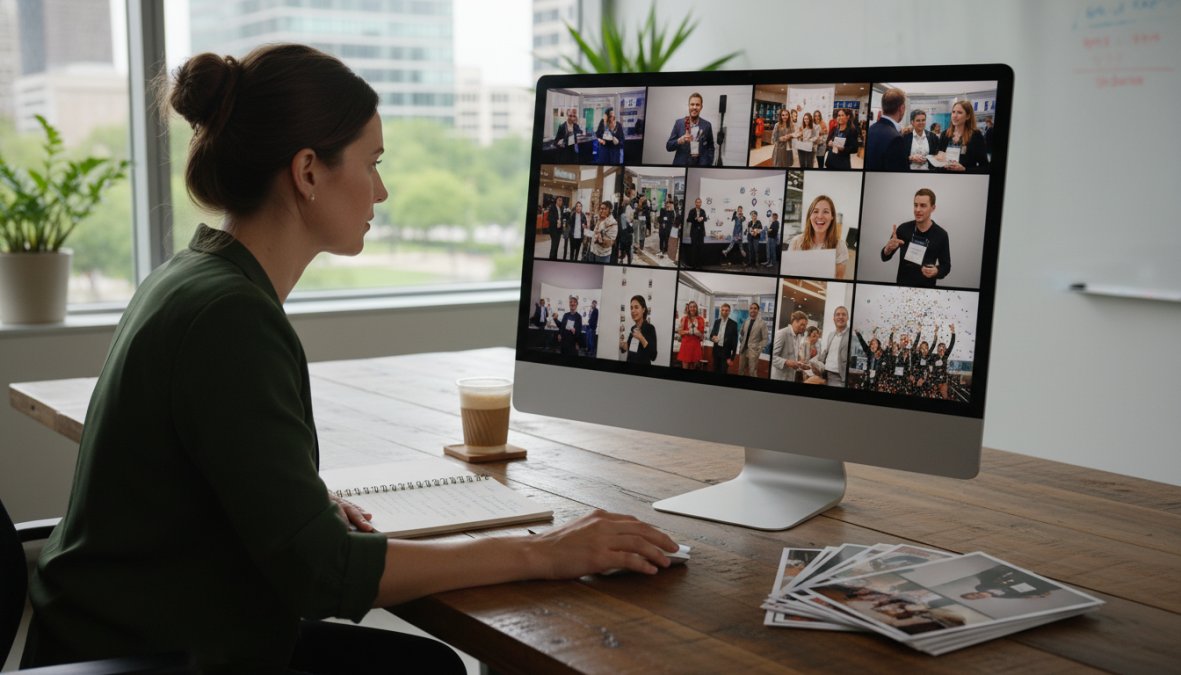
Phase 1, Day of Event: Real-Time Coverage (2-5 Images)
Real-time social content does not need to be fully edited. A quick crop, a minor exposure adjustment, and a clean caption are sufficient. The goal is presence and momentum, not perfection. Coordinate with your photographer in advance to identify two or three moments they will prioritize for fast turnaround: the keynote speaker at the podium, the room at full capacity, and one strong candid of attendee energy. These three images, posted within the first hour of the event, signal to your audience that something worth paying attention to is happening right now.
Platform priority for day-of content:
- LinkedIn: Best for B2B events. Speaker images and room-wide establishing shots perform well. Tag speakers and sponsors directly in the post, not just in the caption, to trigger their networks.
- Instagram Stories: Use vertical crops (9:16 ratio) for Stories. Ask your photographer to flag any shots captured in portrait orientation during the event, these are rare at corporate events and worth requesting explicitly on your shot list.
- X (formerly Twitter): Short-form commentary paired with a single strong image. Works best for conferences where a speaker quote can anchor the post.
Phase 2, Days 1-7: Primary Recap Window (Your Highest-Engagement Period)
This is the window where most of your engagement will concentrate. Attendees are still processing the event, non-attendees are experiencing FOMO, and the algorithm recency signal is still working in your favor. Publish your strongest images here, not your safest ones.
Content formats that consistently outperform in this window:
- Carousel posts (LinkedIn and Instagram): A 6-10 image carousel covering the arc of the event, venue setup, registration, keynote, networking, awards, closing, performs significantly better than a single image post. Carousels reward viewers who swipe through, and platforms reward posts that generate extended dwell time.
- Speaker highlight posts: A close-up of a speaker mid-presentation paired with a pull quote from their session. Tag the speaker. Their network will do distribution work you don’t have to pay for.
- Attendee recognition posts: Candid images of attendees networking or receiving awards. People share images of themselves. Every share extends your organic reach without additional spend.
- Behind-the-scenes content: Setup shots, backstage moments, and pre-event details that attendees never saw. These perform well because they offer something the audience couldn’t have gotten by attending.
Request a small batch of 10-15 lightly edited “social-first” images from your photographer within 24-48 hours of the event, separate from the full edited gallery. Many photographers offer this as an add-on. It costs less than a rush edit on the full library and gives you exactly what you need for the high-engagement window without waiting two weeks for final delivery.
Phase 3, Days 8-90: Long-Tail Deployment
This is where most organizations leave the most value unclaimed. The full edited image library arrives, gets downloaded, and sits in a shared drive. A deliberate long-tail strategy prevents that.
Map your event images to upcoming content needs before the event happens, not after. Common long-tail applications include:
| Content Type | Best Image Categories | Typical Timeline |
|---|---|---|
| Blog post header images | Wide room shots, speaker candids | Weeks 2-4 |
| Email newsletter headers | Tight candids, branded moments | Ongoing, monthly |
| LinkedIn company page updates | Team photos, award moments | Weeks 3-8 |
| Recruitment and HR materials | Culture candids, team interactions | Months 2-6 |
| Sales deck visuals | Credibility shots, large-audience images | Months 1-12 |
| Sponsor recap reports | Sponsor logo visibility, sponsor rep photos | Within 2 weeks |
| Annual report imagery | Executive portraits, mission-aligned moments | Months 3-12 |
Post-Production Workflow: From Raw Files to Ready-to-Publish Images
The post-production workflow is where professional event photography proves its value over amateur alternatives. Understanding this workflow helps you set realistic expectations, ask the right questions when hiring, and avoid the most common delivery disputes.
A professional post-event workflow typically follows this sequence:
- Culling: The photographer reviews all raw files and selects the strongest images. For a four-hour corporate event, a professional might capture 1,500-2,500 frames and deliver 200-400 final images, roughly 10-15% of total shots taken. Higher cull ratios are not a sign of a better photographer; they are a sign of a more selective one.
- Color correction: White balance, exposure, and contrast are corrected for consistency across the full image set. This is especially important for events with mixed lighting, ballroom chandeliers, stage wash, and window daylight all read differently on a camera sensor, and a professional edit makes the full gallery look cohesive.
- Retouching: Minor corrections to skin tones, background distractions, and lens distortion are addressed. Full retouching (blemish removal, background replacement) is typically scoped separately and should be discussed before the event if needed.
- Export and delivery: Images are exported in multiple formats. Web-optimized JPEGs (typically 2,000-3,000 pixels on the long edge, under 1MB) for digital use. High-resolution TIFFs or full-size JPEGs for print. Confirm which formats you need before delivery, re-exporting after the fact may incur additional fees.
- Archiving: Raw files are retained by the photographer for a defined period per the contract terms. Industry practice varies widely, some photographers retain raws for 30 days, others for a year. If you anticipate needing additional edits or selects from the raw library later, negotiate this retention period in your contract.
Delivery timelines vary by photographer and event size. A reasonable standard for corporate events is a first gallery of social-ready images within 5-7 business days, with the full edited library within 2-3 weeks. Rush delivery, 24 to 48 hours, is available from most professional photographers but typically carries an additional fee. Confirm all timelines in writing before the event.
Never publish event images before confirming usage rights. If your contract doesn’t specify who owns the images and where they can be used, you may be violating copyright by posting them on social media or using them in paid advertising. Get this in writing before the event, not after.
Legal and Usage Rights: What You Must Know Before Signing a Contract
This is the section most event planners skip. It’s also the one that generates the most expensive surprises.
Photography contracts govern who owns the images, how they can be used, and for how long. Without clear terms, organizations routinely discover they can’t use images in paid advertising, can’t grant sublicenses to sponsors, or can’t archive images for more than a defined period.
Key contract terms to review before signing:
Copyright ownership: In most jurisdictions, the photographer retains copyright by default unless the contract explicitly transfers it. Many clients assume they own the images outright. They don’t, unless the contract says so. As noted by U.S. Copyright Office guidance on works made for hire, work-for-hire arrangements require specific contractual language to be valid.
Usage license: Even without a full copyright transfer, a broad usage license can give you everything you need. Confirm the license covers: digital publication, print, paid advertising, internal use, and sublicensing to event sponsors.
Exclusivity: Some contracts prohibit the photographer from publishing event images without client approval. Others allow the photographer to use images in their portfolio. Clarify this upfront, especially for confidential corporate events.
Model releases: If your event images will be used in advertising or marketing materials, attendees may need to sign model releases. This is a legal requirement in many commercial contexts, not a formality.
Delivery timeline and file retention: Confirm when images will be delivered, in what formats, and how long the photographer retains the raw files.
How to Choose an Event Photographer: Beyond the Portfolio
The portfolio tells you what a photographer can do under ideal conditions. The real question is how they perform under pressure, how they communicate before the event, and whether the contract they hand you protects your organization or theirs. Most hiring guides stop at the portfolio. This one doesn’t.
What the Portfolio Cannot Tell You
A strong portfolio confirms technical competence and aesthetic range. It does not tell you:
- Whether the photographer has experience navigating the specific lighting conditions in your venue
- How they handle schedule changes, late-running speakers, or a keynote that moves to a different room without notice
- Whether their standard contract gives you the usage rights you actually need
- What happens if their primary camera body fails mid-event
- Whether their delivery timeline matches your content calendar
These are operational questions. Ask them directly before signing anything.
Questions to Ask Before Hiring Any Event Photographer
- Have you shot in this venue, or a venue with similar lighting conditions, before? If yes, can you share examples from that environment specifically?
- What is your backup plan if your primary camera body fails during the event? Do you carry a second body on your person, or is it in your bag?
- How do you handle a schedule that runs significantly behind? Which moments do you prioritize if you lose 45 minutes of coverage time?
- How many events of this size and format have you covered in the past 12 months?
- Can you provide references from corporate clients, not wedding or portrait clients, who can speak to your communication and delivery process?
- What does your standard contract say about copyright ownership and usage rights? Does it cover paid advertising and sponsor sublicensing?
The answers reveal operational experience, not just artistic skill. A photographer who has covered large galas knows how to navigate a crowded room, anticipate key moments, and stay invisible while capturing everything. That skill set doesn’t show up in a portfolio.
According to Professional Photographers of America industry standards, professional event photographers should carry liability insurance, maintain backup equipment, and provide written contracts covering all deliverables. Confirm all three before signing.
Budgeting Beyond the Fee: Hidden Costs to Plan For
This is the section most event planners skip, and it’s the one that generates the most budget surprises. The photographer’s day rate or session fee is the starting point, not the total cost. Organizations that budget only for the headline fee routinely encounter additional line items they didn’t anticipate, and by the time they appear on an invoice, the event is already over.
The table below maps the most common additional costs, what triggers them, and how to handle each one proactively.
| Cost Category | What It Covers | Typical Trigger | How to Handle It |
|---|---|---|---|
| Second shooter | A second photographer for simultaneous sessions or additional room coverage | Events over 150-200 guests, multi-room formats, or events with concurrent programming | Discuss at the quote stage; include in the original contract if needed |
| Rush delivery | Faster turnaround than the photographer’s standard timeline | Same-day social media needs, sponsor reports due within 48 hours | Negotiate a tiered delivery schedule upfront: social-first batch vs. full gallery |
| Licensing upgrades | Expanded usage rights beyond the standard license | Paid digital advertising, out-of-home print, or sublicensing images to event sponsors | Request a broad commercial license in the original contract rather than upgrading after delivery |
| Print-ready file exports | High-resolution exports formatted for large-format print or offset printing | Annual reports, large-format signage, trade show displays | Specify required file formats and minimum resolution in the contract |
| Extended raw file archive | Retention of raw files beyond the photographer’s standard period | Long-term campaign planning, anticipated need for additional selects or re-edits | Negotiate a defined retention period (e.g., 12 months) and confirm whether there is a storage fee |
| Travel, parking, and logistics | Transportation to and from the venue, parking fees, tolls | Events outside the photographer’s base area, venues with paid parking or valet-only access | Ask for a travel estimate at the quote stage; some photographers build this into their rate, others invoice separately |
| Additional editing rounds | Retouching or adjustments beyond the standard post-production scope | Requests for background removal, composite images, or individual portrait retouching | Define the number of included revision rounds in the contract; scope additional retouching separately |
| Equipment rental | Specialized gear not in the photographer’s standard kit | Events requiring aerial coverage, large-format lighting rigs, or underwater housing | Identify any non-standard coverage needs before the quote; rental costs should appear as a line item, not a surprise |
A photographer who quotes a lower day rate but charges separately for each of the categories above can end up costing significantly more than a higher upfront quote that bundles them. When comparing quotes, ask each photographer to itemize what is and is not included. The comparison becomes much clearer when you’re looking at total cost of coverage, not just the session fee.
How to Structure the Conversation About Budget
Most photographers are accustomed to clients who ask only about the day rate. The ones who have covered large corporate events are accustomed to clients who ask about the full scope. Framing the conversation around total deliverables, not just hours on-site, signals that you’re an informed buyer and typically results in a more accurate quote.
A useful framing: "We need coverage from setup through the final award presentation, a social-first batch of 15 images within 24 hours, a full edited gallery within 10 business days, and a broad commercial license that includes paid advertising and sponsor use. What does that scope look like as a total investment?"
That question, asked before the quote is issued, eliminates most of the hidden cost surprises that appear after the event.
Event Photojournalism brings award-winning expertise to corporate conferences, galas, weddings, and special events across the DMV area, with two physical locations in Washington DC and Northern Virginia. The team delivers customized coverage designed around each client’s specific brand objectives, including clear licensing terms, defined delivery timelines, and transparent scoping, not a generic package.
Conclusion: Make Every Event Count with Professional Photography
Many organizations invest significantly in planning and executing events, then underinvest in documenting them. The result is a missed opportunity to generate months of marketing content, strengthen brand credibility, and build a library of digital assets that compound in value over time.
Frequently Asked Questions
Why is professional event photography important for businesses?
Professional event photography delivers high-quality images that reinforce brand credibility, document key moments, and produce reusable marketing assets. Unlike smartphone snapshots, a professional photographer brings technical expertise, professional equipment, and an eye for visual storytelling that transforms your event into publication-ready content. These images support social media engagement, internal communications, press coverage, and future marketing campaigns, making them a long-term investment rather than a one-time expense.
How can event photos be used for social media after the event?
Event photos can fuel weeks of post-event content across LinkedIn, Instagram, Facebook, and email newsletters. Using event photos for social media works best when you plan ahead: identify key moments to capture, request both landscape and portrait orientations, and establish a post-production workflow that delivers edited images quickly. An event recap post, speaker highlight series, attendee spotlight, and behind-the-scenes content are all proven formats that extend your event's reach and reinforce brand recognition.
What should I look for when choosing an event photographer?
When deciding how to choose an event photographer, look beyond the portfolio. Evaluate their experience with your specific event type, corporate conferences differ greatly from galas or product launches. Ask about their equipment backup plan, turnaround time, image delivery format, and post-production workflow. Review their contract carefully for usage rights, licensing terms, and cancellation policies. A strong event photographer also collaborates on a shot list in advance, ensuring no key moment is missed.
Is professional event photography worth the cost?
Yes, when measured against the ROI of reusable digital assets, the photography investment typically pays for itself. High-quality images drive social media engagement, support lead conversion on landing pages, and reduce future content production costs. Consider the cost of not having a professional: blurry smartphone photos that undermine brand credibility, missed candid moments, and zero publication-ready content for press or sponsors. The benefits of professional event photography compound over time as images are repurposed across campaigns.
What is an event photography shot list and why do I need one?
An event photography shot list is a pre-planned document that outlines every photo that must be captured during your event, from posed executive portraits and sponsor signage to candid networking moments and keynote speakers. It ensures image consistency, prevents missed opportunities, and helps the photographer work efficiently within your event logistics. Sharing the shot list with your photographer before the event is one of the most practical steps you can take to maximize the value of your professional photography investment.
Event Photojournalism serves organizations across the DMV area that understand what professional documentation is actually worth. With award-winning photography, high-resolution image delivery, and customized coverage designed to elevate your brand and amplify your message, the team ensures every important moment becomes a lasting visual asset. CONTACT US to discuss your next corporate event, gala, or conference.
This article was written using GrandRanker