Table of Contents
- Pre-Event Planning: The Foundation of Your Event Photography Checklist
- Questions to Ask Your Event Photographer Before Booking
- Venue Scouting and Technical Walkthrough
- Building Your Event Photography Shot List Template
- Event Photography Best Practices for Planners
- Legal Rights, Usage Permissions, and Post-Production Workflow
- Essential Gear Checklist and Equipment Coordination
- Client Communication and Event Brief Documentation
Event Photography Checklist for Planners: Complete Guide
Last Updated: July 13, 2026
Planning a corporate event, gala, or conference requires precision across dozens of moving pieces. Quality event photography separates memorable events from forgettable ones. An event photography checklist for planners ensures every important moment gets captured, sponsors receive their branding shots, and your team walks away with assets that tell your event’s story. Teams that invest time upfront in planning shot lists, scouting venues, and communicating with photographers see 40% fewer missed moments and faster image delivery. This guide walks you through every stage: pre-event planning, photographer selection, venue assessment, shot list development, and post-production delivery.
Pre-Event Planning: The Foundation of Your Event Photography Checklist
Photography planning should happen alongside venue selection and vendor coordination, not after. Start by defining what success looks like: Are you documenting for internal records? Creating social media content? Building marketing assets? Capturing VIP moments? Each objective changes how a photographer should approach the day.
Define Event Goals and Photography Objectives
Write down your top three photography goals. A photographer who understands that 60% of images will be used on LinkedIn will shoot differently than one thinking photos are just for archival purposes.
Common objectives include:
- Documenting event flow for internal records
- Creating social media content (Instagram, LinkedIn, Twitter)
- Capturing executive and VIP moments
- Recording speaker presentations and key moments
- Documenting sponsor activations
- Building attendee engagement libraries for marketing
Establish Your Event Timeline and Key Moments
Create a detailed timeline listing every major moment from start to finish. This is your photography roadmap.
Your timeline should include:
- Guest arrival and check-in
- Opening remarks
- Keynote presentations
- Sponsor activations
- Meal service or networking breaks
- Awards presentations
- Group photos
- Closing remarks
For each major moment, note the expected duration and key people or activities to capture. If your CEO gives opening remarks at 9:15 AM, your photographer needs advance notice to set up positioning and lighting.
Questions to Ask Your Event Photographer Before Booking
Before booking, ask these specific questions to assess whether a photographer understands your needs.
1. How many events have you photographed in our venue (or similar venues)?
Experience with your specific space matters. A photographer who has worked there before knows the lighting challenges and best positions for key moments.
2. What’s your backup plan if an emergency comes up?
Professional photographers have contingency plans. They should mention a backup photographer or specific rescheduling protocol.
3. How do you handle low-light situations?
Ask about equipment, willingness to use flash, and experience shooting in challenging lighting. A photographer who only shoots in natural light may struggle at your indoor gala.
4. What’s included in your deliverables, and what’s the timeline?
Get specifics: How many edited images? In what formats? When will you receive them? Some photographers deliver within one week; others take a month.
5. Do you have experience with corporate events (or your specific event type)?
Wedding photographers and corporate event photographers work very differently. Confirm your photographer has specific experience with your event type.
6. How do you handle sponsor branding and product shots?
If sponsors are paying for coverage, they expect their logos, products, and activations photographed well. Ask how your photographer approaches sponsor coverage.
Venue Scouting and Technical Walkthrough
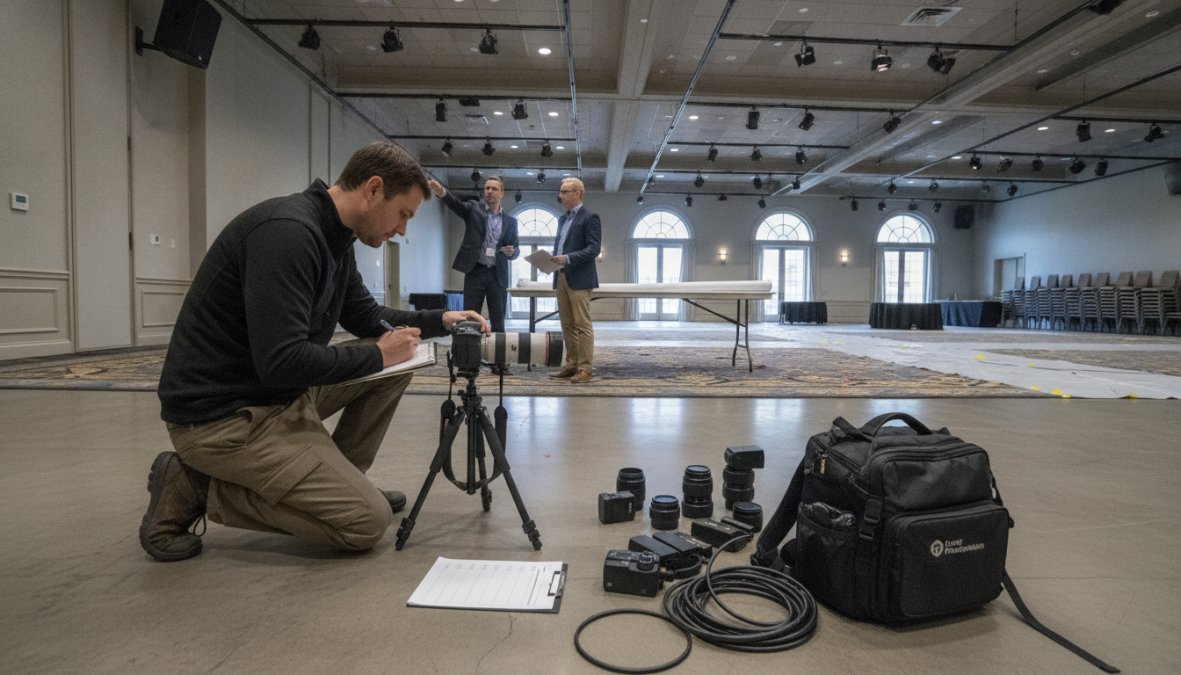
You cannot plan effective photography coverage without understanding your venue. A walkthrough with your photographer is essential for identifying lighting challenges, planning camera positions, and spotting potential problems.
Lighting Assessment and Equipment Planning
Lighting is the foundation of good photography. Walk through the venue at the same time of day your event will take place. If your gala starts at 6 PM, do your walkthrough at 6 PM to see exactly what the lighting will look like.
Note:
- Which areas get natural light from windows?
- What artificial lighting is in place?
- Are there dark corners where important moments might happen?
- Does the venue allow you to adjust lighting?
- Are there reflective surfaces creating unwanted glare?
Based on what you observe, discuss with your photographer what additional equipment they’ll need. Professional photographers typically bring supplemental lighting, reflectors, or portable flash systems to ensure consistent image quality. Confirm any venue restrictions on lighting during your walkthrough.
Building Your Event Photography Shot List Template
A shot list is your insurance policy against missed moments. It’s a detailed list of specific images you want captured, organized by moment or subject. Without a shot list, your photographer guesses what matters most, and important shots get missed.
Your shot list template should include:
- Establishing shots (wide views of venue, entrance, setup)
- Candid coverage (guests mingling, networking)
- Posed group photos (team photos, VIP groups, sponsor groups)
- Speaker and presentation coverage
- Sponsor activation shots
- Detail shots (signage, decorations, food, table settings)
- Closing moments and departures
Be specific: Instead of "candid shots of guests," write "candid shots of guests at cocktail hour, focus on networking interactions." Instead of "group photos," write "group photo of all department heads, group photo with each sponsor representative."
Essential Shot Categories for Corporate Events
Establishing and arrival shots: Wide shots showing venue setup, entrance, and guests arriving. Photograph before guests arrive, during arrival, and at various moments to show how the space fills.
Speaker and presentation coverage: Document speakers at the podium, audience reactions, and key moments. Get tight shots of speakers’ faces and wider shots showing audience engagement.
VIP and executive moments: Photograph executives both in formal moments and candid interactions. These images are often used for internal communications.
Networking and candid moments: Capture guests in genuine conversation and engagement. These authentic shots work exceptionally well for social media.
Sponsor and activation coverage: Each sponsor should get dedicated coverage of their booth, activation, or branded moment. Get clear shots of signage, products, and representatives.
Group photos: Formal group photos of teams, departments, or sponsor groups provide valuable documentation.
Candid vs. Posed Photography: What Your Brand Needs
Candid photography captures authentic moments and genuine engagement. These images feel natural and work exceptionally well for social media. Posed photography gives you control and consistency for group photos and executive portraits.
The best approach is a mix: 70% candid coverage and 30% posed/structured moments. This gives you authentic images for marketing while ensuring formal documentation of key moments.
| Shot Category | Candid vs. Posed | Best For | Typical Quantity |
|---|---|---|---|
| Guest arrivals | Candid | Social media, showing energy | 20-30 shots |
| Speaker presentations | Mix | Documentation, social content | 40-60 shots |
| Networking moments | Candid | LinkedIn, internal comms | 60-100 shots |
| Group photos | Posed | Formal records, team documentation | 10-20 shots |
| Sponsor coverage | Posed | Sponsor satisfaction, marketing | 15-30 shots |
| Closing moments | Candid | Storytelling, event recap | 15-25 shots |
Event Photography Best Practices for Planners
Communicate your shot list to your photographer at least two weeks before the event. Schedule a brief call to walk through the list and answer questions.
On the day of the event, assign one person as the photographer’s point of contact. This person should be familiar with the shot list, know where key moments are happening, and can guide the photographer if plans change.
VIP and Speaker Coverage Protocol
Brief your VIP attendees beforehand that a photographer will be present. For speakers, coordinate before they take the stage. Let them know the photographer will be positioned at specific angles and ask if they have preferences about how they’re photographed.
Position your photographer strategically for VIP moments. For a CEO giving remarks, position the photographer at a 45-degree angle to capture the CEO’s expression, audience reaction, and overall moment.
Sponsor Branding and Marketing Asset Shots
Sponsors expect their logos, products, and representatives photographed prominently. Coordinate with each sponsor representative to understand what they want photographed.
Schedule dedicated time for sponsor shots. Rather than capturing sponsor coverage during event chaos, allocate 15-30 minutes before or after the main event for clean, well-lit sponsor photos.
Create a simple sponsor shot checklist: logo visible, product visible, representative present, attendee interaction, and overall booth aesthetic. Use this checklist to verify each sponsor got adequate coverage.
Legal Rights, Usage Permissions, and Post-Production Workflow
Clarify image ownership and usage rights with your photographer before your event. Do you own the images outright? Can you use them for social media and marketing? Can you share them with sponsors?
For attendees, include a note in your event invitation stating that photography will occur and images may be used for marketing and communications. For employees, get written permission before using their images in external marketing materials.
Image Delivery Formats and Timeline
Establish clear expectations about image delivery. Standard practice is for photographers to deliver:
- All edited images in high-resolution JPEG format
- Organized by moment or time
- With metadata and keywords for easy searching
- Delivered within 1-2 weeks of the event
Discuss file organization upfront. Ask how the photographer will organize and label images so you can easily find what you need.
AI-Assisted Post-Processing and Workflow Optimization
Modern event photography increasingly uses AI tools for post-processing efficiency. AI-powered software batch-edits images, adjusts exposure and color consistently, and automatically tags and organizes images based on content.
A typical modern workflow uses AI for heavy lifting and human judgment for refinement. For your event, expect:
- Delivery of 300-500 edited images from a 6-8 hour event
- Consistent color and exposure across all images
- Professional quality suitable for marketing and social media
- Delivery within 1-2 weeks
Ask your photographer about their specific workflow and timeline.
Essential Gear Checklist and Equipment Coordination
Professional event photographers typically bring:
- Two or more camera bodies (backup in case of malfunction)
- Multiple lenses (wide-angle, telephoto, 50mm)
- Lighting equipment (flash, reflectors, possibly continuous lighting)
- Memory cards and backup storage
- Batteries and charging equipment
- Tripod or monopod
For your venue, confirm:
- Can tripods be used?
- Is flash photography allowed during presentations?
- Are electrical outlets available for charging?
- Are there restricted areas where the photographer cannot access?
- What’s the best place to store equipment between shots?
Client Communication and Event Brief Documentation
Create a simple event brief document covering all key details.
Your event brief should include:
- Event name, date, time, and location
- Event type
- Expected number of attendees
- Your top three photography goals
- Detailed timeline with key moments
- Shot list and coverage priorities
- VIP attendees or speakers needing specific coverage
- Sponsor activation details
- Venue details (address, parking, check-in procedures)
- Contact information for day-of coordination
- Image delivery expectations
- Any special requests
Share this brief with your photographer at least two weeks before the event. Schedule a brief call to walk through it and answer questions.
On the day of the event, designate one person as the photographer’s point of contact. This person should have a copy of the shot list and timeline and be available to answer questions or adjust plans.
The most common cause of missed shots is poor communication on the day of the event. If your photographer doesn’t know when and where key moments are happening, they can’t position themselves to capture them. Assign a clear point of contact and ensure they stay in communication with the photographer throughout the day.
Planning comprehensive event photography coverage requires attention to detail across multiple stages, from defining your goals and scouting venues to coordinating with your photographer and managing permissions. The event photography checklist for planners you’ve learned here transforms photography from an afterthought into a strategic asset. When you’re ready to transform your next event into lasting visual assets, contact Event Photojournalism for a consultation on your specific event needs and coverage requirements.
Frequently Asked Questions
What should be included in an event photography shot list?
Your event photography shot list should include establishing shots of the venue, group portraits of key attendees, candid moments during presentations, VIP and speaker coverage, sponsor branding opportunities, detail shots of signage and décor, and candid photography of attendee engagement. Prioritize shots that align with your event goals and marketing objectives. A comprehensive shot list ensures your professional photographer captures high-resolution images suitable for social media content, marketing assets, and brand awareness initiatives.
How do I create an effective event photography timeline?
Work backwards from your event's start time to map each phase: pre-event setup (30-60 minutes), opening remarks and VIP arrivals, main presentations, networking moments, and closing activities. Assign specific time blocks for candid photography, group portraits, and sponsor branding shots. Share this event timeline with your photographer during the technical brief so they understand when key moments occur. Include buffer time for transitions and unexpected delays to ensure comprehensive event coverage throughout the entire day.
What questions should I ask a professional photographer before hiring?
Ask about their experience with corporate events and similar venues, their backup equipment and contingency plans, image delivery timelines and formats (high-resolution files), post-production workflow, usage rights for your event photos, insurance coverage, and pricing structure. Inquire how they handle challenging lighting conditions, whether they provide a shot list template or accept yours, and their approach to both candid and posed photography. Request references and a portfolio review to assess their style and reliability.
What are the best practices for ensuring legal usage rights of event photos?
Establish clear written agreements before the event specifying ownership, usage rights, and any exclusivity clauses. Define whether photos are for internal use only, social media content, or marketing assets. Clarify rights to raw files versus edited images and any AI-assisted post-processing or retouching. Ensure attendee consent for using their likenesses in marketing materials. Discuss credit requirements and platform restrictions. Document all permissions in your event brief and confirm with your professional photographer that your usage aligns with their licensing terms.
This article was written using GrandRanker