Table of Contents
- Understanding Candid vs. Posed Photography at Corporate Events
- Essential Tips for Capturing Authentic Moments at Conferences
- Technical Camera Settings for Low-Light Conference Environments
- Corporate Event Photography Shot List: Planning Your Coverage
- Corporate Event Photography Tips: Preparing Your Venue Strategy
- How to Hire a Corporate Event Photographer: What to Brief Them On
- Integrating Candid Photography Into Your Corporate Marketing Strategy
- Conclusion: Making Candid Photography Work for Your Conference
Last Updated: July 11, 2026
Capturing candid photography for corporate conferences requires a fundamentally different approach than traditional posed event photography. Documentary-style coverage reveals authentic moments, genuine connections, and the true energy of your event by observing what’s actually happening rather than orchestrating scenes.
This guide covers everything you need to understand, plan, and execute candid photography that elevates your corporate event coverage.
Understanding Candid vs. Posed Photography at Corporate Events
When a photographer blends into the crowd rather than directing poses, people relax and their expressions become genuine. Posed photography requires setup time and feels transactional. Candid work is about presence and being in the right place when something real happens.
Why Documentary-Style Photography Matters for Brand Storytelling
Your brand story isn’t told through staged photos of executives shaking hands. It’s the moment when a professional’s face lights up during a keynote, or two attendees who just met are already collaborating. Documentary-style photography captures these unscripted moments that pose photography cannot replicate.
Authentic images resonate far more powerfully than traditional corporate photography for marketing materials, social content, and internal communications. Candid shots also create a visual narrative arc across your event: arrival and networking, keynote engagement, breakout session intensity, informal conversations, and departures.
The best candid moments happen when photographers position themselves as observers, not directors. A photographer who never asks someone to “look natural” captures moments that actually are natural.
The Difference in Delivery and Post-Production Workflow
Candid photography demands a different post-production approach. You’re delivering hundreds of images from which the best moments emerge through careful curation.
The workflow typically looks like this: shoot extensively throughout the event (500-1000+ images), cull to the strongest 200-300 images during initial review, then refine to a final delivery set of 100-150 high-resolution images. High-resolution delivery is critical for corporate use, files need to work across digital channels and print materials at 300 DPI minimum.
Post-production also includes color grading for consistency. When shooting across different lighting environments (fluorescent in breakout rooms, natural light in lobbies, stage lighting during keynotes), professional post-production ensures all images feel cohesive.
Essential Tips for Capturing Authentic Moments at Conferences
Authentic moments happen when a photographer understands how to position themselves, read situations, and anticipate the peak of an interaction.
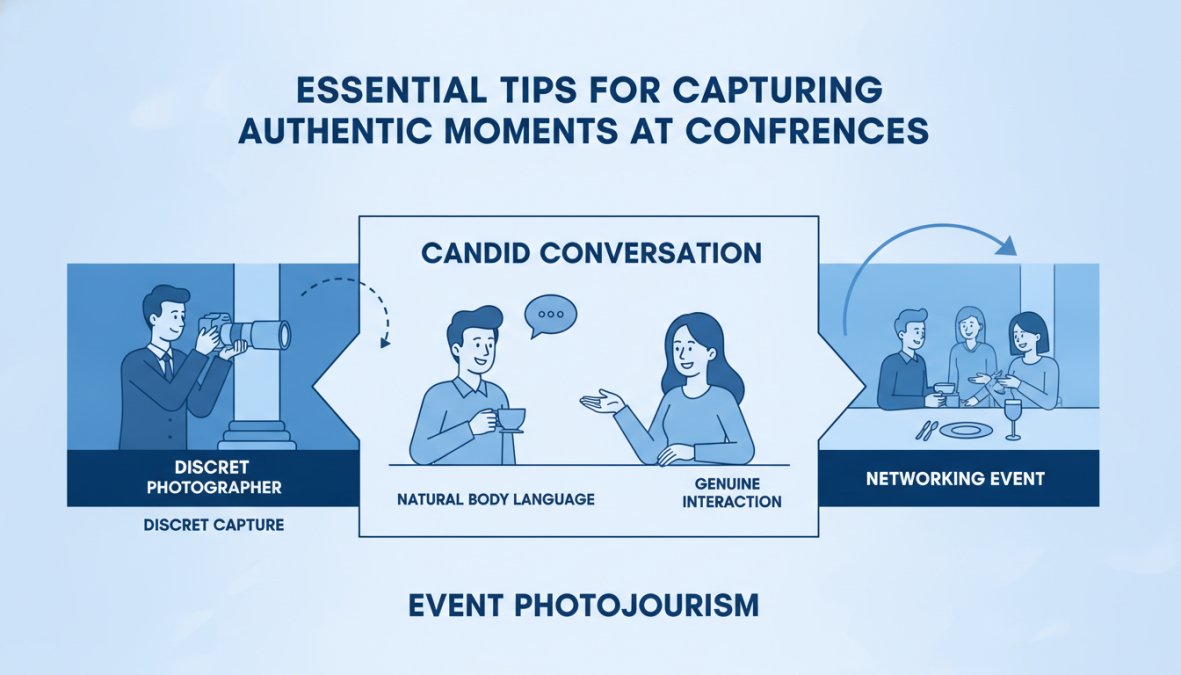
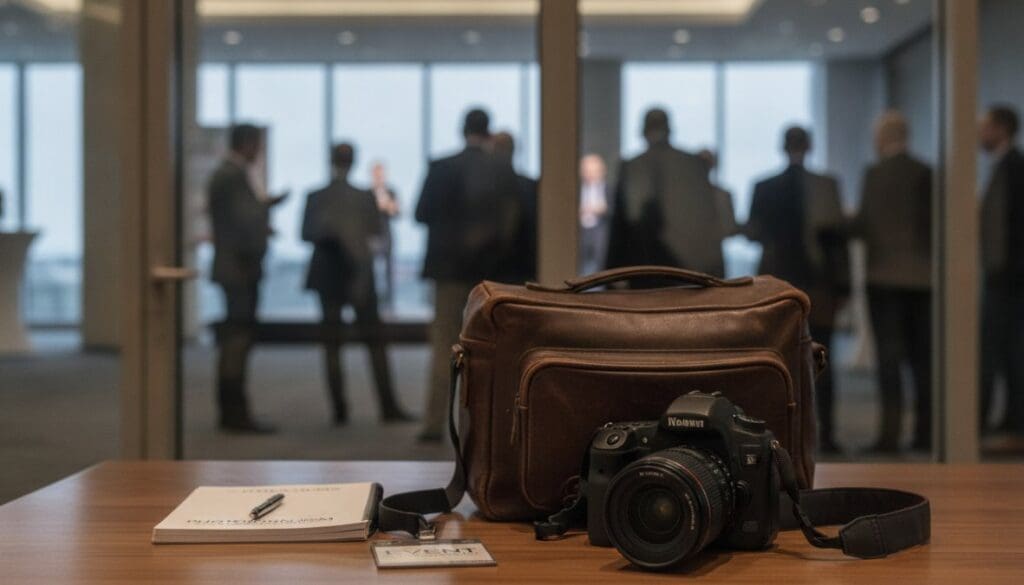
The first essential principle is invisibility. Your goal is to document what would happen whether you were there or not. Dress appropriately for the venue, move quietly, and position yourself at the edges of interactions rather than at the center.
The second principle is anticipation. Experienced candid photographers develop an instinctive sense for when something interesting is about to happen. A speaker’s expression changes just before they make a key point. Two people’s body language shifts just before they lean in for a serious conversation.
The third principle is volume. Professional candid photographers shoot continuously, capturing hundreds of images per hour. From this volume, the strongest moments emerge.
Building Rapport with Attendees Without Disrupting the Flow
Building rapport means being present in a way that feels natural and non-threatening. A brief nod or smile establishes that you’re a friendly presence rather than an intrusive observer.
When you do interact with attendees, keep it minimal. A simple "mind if I grab a few shots?" is far better than elaborate explanations. Most people are comfortable being photographed if they understand what’s happening and feel respected.
The biggest mistake is over-explaining what you’re doing. Long conversations about your role immediately make people self-conscious. Keep interactions brief and move on.
Blending In and Staying Invisible While Present
Invisibility is a skill that develops through practice. Wear neutral colors that match the event dress code. Position yourself at 45-degree angles or slightly behind conversations to capture genuine expressions without making people feel stared at.
Movement patterns affect visibility too. Find a good spot, shoot from that position for a while, then move to another location. This creates a rhythm that becomes part of the event background.
Technical choices also support invisibility. A smaller camera body draws less attention than a large professional setup. A prime lens is quieter and less visually obvious than a zoom lens. Mirrorless cameras with electronic shutters are quieter than traditional DSLR shutters.
Technical Camera Settings for Low-Light Conference Environments
Corporate conferences feature challenging lighting: fluorescent overhead lights create color casts, stage lighting is dramatic but inconsistent, and breakout rooms might be dimly lit.
The foundation is a fast lens. Lenses with wide apertures (f/1.4 to f/2.8) allow you to shoot in low light without pushing ISO to unusable levels. A 35mm f/1.4 or 50mm f/1.8 prime lens is ideal for conference work.
Your shutter speed needs to be fast enough to freeze motion without blur. For people moving around a conference, 1/125th of a second is a reasonable minimum. For more dynamic moments, aim for 1/250th or faster.
ISO is your flexibility valve. In low light, you’ll need higher ISO values. Modern professional cameras handle ISO 1600-3200 beautifully, and many handle ISO 6400 acceptably.
Choosing Fast Lenses and Prime Lenses for Ambient Light Work
Prime lenses are the gold standard for candid conference photography. They’re faster, lighter, quieter, and force you to move rather than zoom, which improves composition.
A 35mm lens is ideal for conference work because it’s wide enough to capture environmental context but not so wide that it distorts faces. A 50mm lens is more versatile but slightly narrower. Many photographers carry both.
Fast lenses matter because they let you shoot at wide apertures (f/1.4, f/1.8, f/2.0) in ambient light. This creates shallow depth of field, which isolates your subject from the background and makes candid moments feel more intimate.
Rent or borrow lenses before committing to a purchase. A 35mm f/1.4 and a 70-200mm f/2.8 cover almost every conference scenario.
Balancing Shutter Speed, Aperture, and ISO for Unscripted Moments
The exposure triangle requires constant adjustment at conferences because lighting changes constantly.
Your priority should be shutter speed. Blurry images from motion blur are unusable. Start by setting shutter speed to 1/250th or faster, then adjust aperture and ISO to achieve proper exposure.
Aperture is your second priority. You want it as wide as your lens allows to maximize light gathering and create shallow depth of field.
ISO becomes your adjustment variable. In bright areas, you might shoot at ISO 400. In dim breakout rooms, you might be at ISO 3200. This is completely acceptable with modern cameras.
Many photographers shoot in aperture priority mode, setting the aperture wide open and letting the camera adjust shutter speed and ISO automatically.
Corporate Event Photography Shot List: Planning Your Coverage
A shot list is a framework that ensures you don’t miss critical moments while staying flexible enough to capture unexpected candid opportunities.
The core moments at any corporate conference include: arrival and registration, keynote speaker and audience reaction, breakout sessions and attendee engagement, networking and conversations, and departures. During keynotes, capture the speaker from multiple angles and audience reaction. During networking, capture people in genuine conversation.
Key Moments to Capture Beyond the Podium
The moments that matter most often happen in the spaces between official program elements: conversations in hallways, informal group discussions over coffee, moments when someone has an "aha" realization.
Look for moments of genuine emotion: surprise, recognition, concentration, laughter. Capture people in small groups (2-3 people) rather than large crowds, which show actual interaction and conversation.
Capturing Atmosphere, Energy, and Attendee Engagement
Atmosphere is created through wide shots that show the overall energy of the event. A wide shot of a packed keynote room conveys energy more powerfully than a tight portrait.
Energy comes through movement and gesture. Capture people gesturing as they talk, moving between sessions, leaning forward in concentration, laughing.
Engagement is demonstrated through attention and interaction. Capture people looking at speakers, taking notes, asking questions, and talking with other attendees.
Corporate Event Photography Tips: Preparing Your Venue Strategy
Scout the venue before the event if possible. Walk through all areas where the conference will occur. Identify where natural light comes in and where fluorescent lights create unflattering color casts. Understand the flow and where informal interactions will naturally occur.
Identify your primary shooting positions. Where will you stand during keynotes? Which hallways will you use during breaks? Where are the best angles for capturing networking?
Venue Scouting and Understanding Lighting Challenges
Lighting is everything in photography, and conference venues are notoriously challenging. Fluorescent overhead lights create color casts. Stage lighting is dramatic but inconsistent. Sunlight from windows creates harsh contrasts.
During your venue scout, identify the lighting in each space. In the main keynote room, is the stage lit with warm or cool light? In breakout rooms, is the lighting primarily overhead fluorescent?
This information guides your camera settings and positioning. Understanding lighting also helps you identify the best positions for shooting.
Planning Positions for Networking and Spontaneous Moments
During a networking break, identify the high-traffic areas: the coffee station, the main lobby, seating areas near windows. Position yourself in or near these areas where you can observe and capture interactions without being intrusive.
Change positions regularly. Spend 10-15 minutes in one location, then move to another. Watch for clusters of people engaged in conversation and position yourself at an angle where you can see faces.
The best candid photographers are part photographer, part anthropologist. You’re observing human behavior and capturing the moments where genuine connection is happening.
How to Hire a Corporate Event Photographer: What to Brief Them On
When briefing a photographer, start with your actual goals. Are you looking for images for social media promotion? Marketing materials? Internal communications? Different goals require different shooting approaches.
Provide the photographer with a detailed event schedule and discuss the conference theme and key messages. A photographer who understands your conference’s purpose can make editorial decisions about what moments matter most.
Communicating Your Brand Story and Visual Narrative Goals
Articulate your brand story clearly. "Our conference brings together independent consultants who are building their first firms. We want images that show collaboration, mentorship, and the energy of people building something together." This gives the photographer a filter for making decisions about what to photograph.
Visual narrative goals are different from a shot list. Rather than "get a photo of the keynote speaker," a goal might be "show how attendees react to new ideas, capture the moment when someone realizes something important."
Discuss the style of images you want. Do you prefer bright, energetic images or more moody, documentary-style work? Do you want tight portraits or wide environmental shots?
Legal and Privacy Considerations for Corporate Coverage
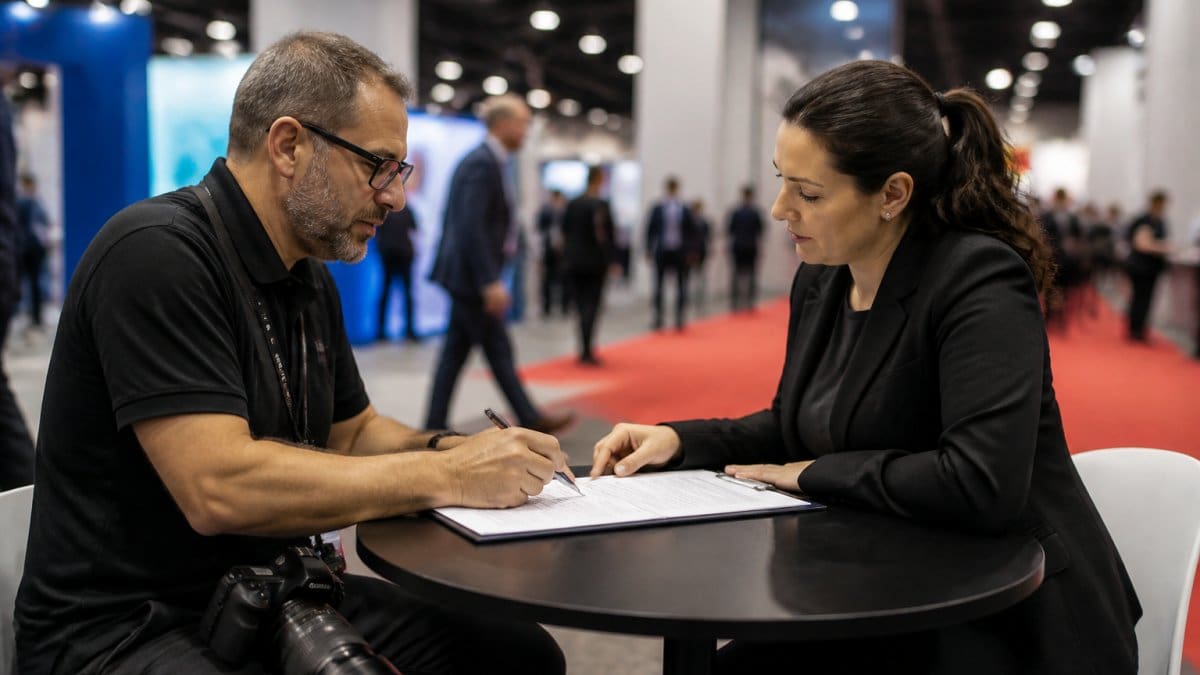
In most U.S. jurisdictions, you have the right to photograph people in public spaces without permission. However, corporate events are semi-private spaces, and there are important considerations.
Clarify with your venue whether photography is permitted. Consider your attendees and whether they understand they’ll be photographed. The safest approach is to include language in your conference registration that mentions photography and allows attendees to opt out.
For images you plan to use commercially, consider having attendees sign releases. When delivering final images, be thoughtful about which images you publish. Your photographer should exercise editorial judgment about unflattering moments or images that could be misinterpreted.
Integrating Candid Photography Into Your Corporate Marketing Strategy
Candid conference photography only has value if it’s actually used. Start by identifying where these images will be used: social media, email marketing, your website’s events page, blog posts, or printed materials.
For social media, you want variety. Mix wide shots that show energy with close-ups that show emotion. For email marketing, use images that demonstrate value, attendees engaged in conversation, learning from speakers, or connecting with peers.
High-Resolution Delivery and Post-Event Workflow
Professional-quality images require high-resolution files (minimum 300 DPI for print, 72 DPI for web) in multiple formats (JPG for web and email, TIFF for print).
Your photographer should deliver a curated final set, not raw files. The curation process is part of the professional service. Ideally, you want images delivered within 1-2 weeks of the event, while the event is still fresh in people’s minds.
Organize your final delivery logically. Create folders by topic (keynotes, breakout sessions, networking, etc.) so you can easily find images for different marketing purposes. Plan your post-event marketing calendar before the event happens to ensure candid photography becomes part of your broader marketing strategy.
Capturing authentic moments at your corporate conference requires understanding how to position yourself, anticipate genuine moments, and work with lighting and technical settings that make those moments shine. When you invest in professional candid photography, you’re investing in visual assets that tell the real story of your event.
Event Photojournalism specializes in documentary-style coverage for corporate conferences throughout the DMV area. Our photographers understand how to blend into your event, anticipate authentic moments, and deliver high-resolution images that work across your marketing channels. Contact us to discuss how we can capture your next conference.
[Professional event photography(/documentary-style-event-photography-explained/) standards and best practices | eventphotography.org]
Corporate event planning and photography integration guide
Photography lighting techniques for conference environments
Frequently Asked Questions
Why is candid photography important for corporate conferences?
Candid photography for corporate conferences captures authentic moments that posed portraits cannot, genuine attendee engagement, networking interactions, and the real energy of your event. This documentary-style approach creates a visual narrative that elevates your brand storytelling and provides valuable content for marketing, social media, and internal communications. Authentic images resonate more with audiences than staged shots and demonstrate the true impact of your conference.
What should be included in a corporate event photography shot list?
A comprehensive corporate event photography shot list should include keynote speakers, panel discussions, attendee networking moments, booth interactions, Q&A sessions, and crowd shots that capture atmosphere and energy. Beyond the obvious moments, prioritize candid interactions between attendees, moments of genuine engagement, and details that tell your brand story. Work with your professional event photographer to identify VIPs, key sessions, and specific visual narratives you want documented for post-event delivery and marketing use.
How do you get natural photos at a conference without disrupting attendees?
Build rapport by introducing yourself early and explaining your role as a documentary-style photographer capturing authentic moments. Use fast lenses and prime lenses to work from a distance in low-light environments, allowing you to blend in with the crowd. Position yourself strategically during networking sessions and panel discussions where spontaneous interactions naturally occur. Avoid constant direction; instead, observe, anticipate moments, and shoot from the periphery. This approach lets attendees focus on the conference while you capture genuine, unscripted moments.
What camera settings work best for capturing candid moments in conference venues?
Conference venues often have ambient light challenges, so use fast lenses (f/2.8 or wider) with a shutter speed of at least 1/125th second to freeze spontaneous movement. Set your aperture to f/2.8-f/4 for subject isolation while maintaining focus on candid interactions. Adjust ISO based on available light, typically 1600-3200 in dimly lit ballrooms. Prime lenses (35mm, 50mm, 85mm) excel at capturing unscripted moments with minimal distraction. Test these settings during venue scouting to ensure high-resolution, sharp delivery of authentic conference moments.
This article was written using GrandRanker