Table of Contents
- Why Corporate Headshot Outfits Matter for Employee Portraits
- Professional Headshot Outfit Examples by Industry
- Best Colors to Wear for Headshots (and What to Skip)
- What Not to Wear for Headshots: 10 Common Mistakes
- What to Wear for Company Headshots: Team Coordination Tips
- Fit, Layering, and Accessories That Photograph Well
- Inclusive Headshot Outfit Guidance for Every Employee
- Preparing for Your Corporate Headshot Session
- Frequently Asked Questions
Last Updated: October 14, 2026
Why Corporate Headshot Outfits Matter for Employee Portraits
A corporate headshot outfit shapes how clients, donors, and partners read your competence in the first second. At Event Photojournalism, we photograph corporate teams across the region, and outfit choices often matter as much as the lighting.
Here is why this deserves real attention before your next photo session:
- Your headshot often appears on LinkedIn, your website, and press materials at once
- Donor and client-facing teams get judged on polish before they speak
- A mismatched team photo set looks disorganized, even when the people are not
A few simple rules cover most situations. Below: outfit ideas by industry, the colors that photograph best, common mistakes, and how to keep a whole team consistent, including inclusive guidance so every employee feels confident.
Professional Headshot Outfit Examples by Industry
The right look depends on your field and audience. A finance team and a creative studio need different signals, and the same person may need two outfits for a client-facing bio and an internal directory.
Most corporate headshots land between business formal and business casual; the more casual you go, the more you rely on fit, fabric, and a clean neckline to keep the photo professional.
Finance, Law, and Government-Adjacent Roles
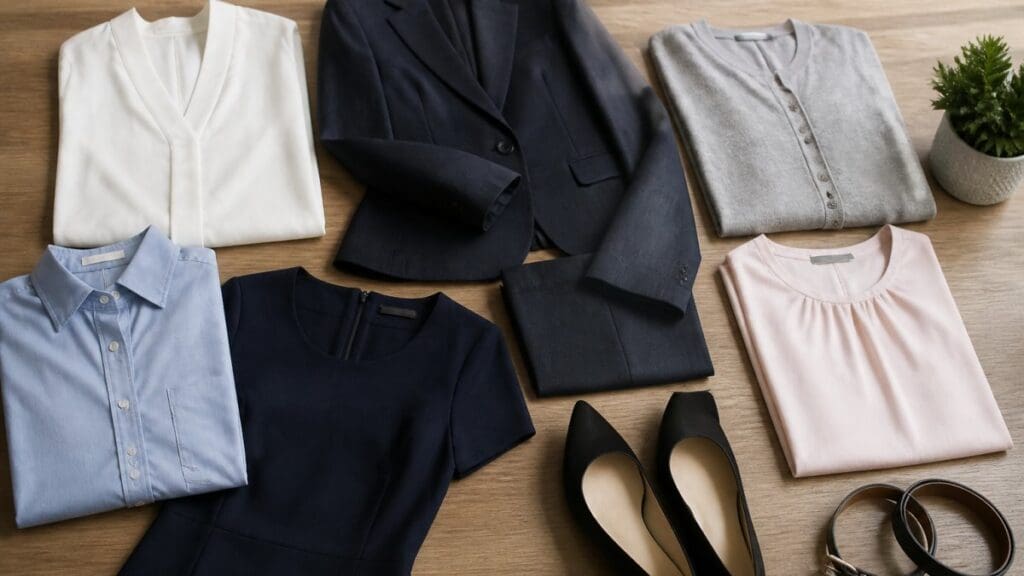
Go structured and conservative. A dark suit jacket, crisp business shirt, and simple collar photograph as authority; solid navy, charcoal, or deep grey work best. Skip loud ties and heavy patterns, a tailored look signals trust and steadiness.
- Base: suit jacket over a collared shirt; a tie is optional but should be a solid or a very subtle texture
- Fabric: matte wool or wool blend; shiny suit fabric reflects studio light and reads cheap on camera
- Colors: navy, charcoal, deep grey, and a white or light blue shirt
Creative, Tech, and Nonprofit Teams
You have more room here. A blazer over a plain tee, or a fine-knit layer in a jewel tone, reads approachable but professional. Nonprofit and mission-driven teams often want warmth, so lighter colors and softer fabrics work. Keep patterns subtle and details clean.
- Base: blazer over a plain tee, a fine-knit sweater, or a structured shirt without a tie
- Fabric: cotton, fine-gauge knit, or a soft blazer; avoid heavy chunky knits that add bulk at the shoulders
- Colors: jewel tones, soft neutrals, muted greens and blues
Healthcare, Education, and Client-Service Roles
These audiences reward approachability over authority. A light or mid-tone top with a simple neckline often works better than a dark suit, especially on a bright backdrop.
- Base: collared shirt, fine-knit top, or a soft blazer
- Colors: soft blues, greens, and warm neutrals that read calm and competent
- Avoid: heavy patterns, dangling jewelry, and anything that looks clinical or severe
Sales, Real Estate, and Relationship-Driven Roles
Warmth and approachability matter, but so does polish. A blazer with a lighter shirt or a jewel-tone top strikes the balance.
- Base: blazer or structured jacket over a light shirt or blouse
- Colors: navy, burgundy, emerald, and warm mid-tones
- Avoid: all-black looks that can read severe, and busy prints that distract from the face
| Industry | Best Base | Best Colors | Avoid |
|---|---|---|---|
| Finance, law, government-adjacent | Suit jacket, business shirt | Navy, charcoal, deep grey | Loud ties, busy prints |
| Creative, tech | Blazer over plain tee | Jewel tones, soft neutrals | Logo tees, heavy graphics |
| Nonprofit, mission-driven | Fine-knit layer, blazer | Light neutrals, muted jewel tones | Distracting accessories |
| Healthcare, education, client service | Collared shirt, fine-knit top | Soft blues, greens, warm neutrals | Heavy patterns, dangling jewelry |
| Sales, real estate | Blazer over light shirt | Navy, burgundy, emerald | All-black looks, busy prints |
If your company has a brand color, use it as an accent rather than the whole outfit. A brand-colored scarf, tie, or layer reads as on-brand without turning the headshot into an advertisement.
Matching the Outfit to Your Company Brand
Industry is only half the decision; the other half is your brand. A company that markets itself as modern and minimal looks inconsistent if every headshot is a dark suit, and a firm that sells stability looks off if everyone wears a casual tee.
Pick a formality level for the whole company, then let each employee choose within it:
- Formal: suit or structured jacket, collared shirt, dark or mid-tone colors
- Business casual: blazer or fine-knit layer, plain top, mid-tone or jewel-tone colors
- Smart casual: structured shirt or fine-knit top, no jacket, solid mid-tone colors
Share the chosen level, a short list of approved colors, and two or three example outfits. That gives employees a clear target without forcing a uniform, and keeps a directory or team page looking consistent.
Best Colors to Wear for Headshots (and What to Skip)
Solid, mid-to-dark colors photograph best. Navy, charcoal, grey, black, and jewel tones like emerald or burgundy separate cleanly from most backgrounds. Light colors wash out under bright studio lights, and pure white blows out next to a pale backdrop.
A few color rules worth remembering:
- Dark colors add definition and slim the frame
- Mid tones like grey and navy flatter almost every skin tone
- Jewel tones add life without shouting
Match your color to the background: on a white or light grey backdrop, a dark top gives contrast; on a dark backdrop, a lighter or mid-tone top keeps you from blending in.
What Not to Wear for Headshots: 10 Common Mistakes
These are the mistakes we see most often, and they are easy to fix:
- Busy patterns like tight stripes or small checks, which create a distracting shimmer on camera
- Logos and slogans that date the photo or clash with your brand
- Pure white against a light background, which washes out
- Loose, baggy clothing that hides your shape and adds bulk
- Wrinkled fabric, which the camera exaggerates
- Heavy jewelry that catches light and pulls focus
- Extreme trends that will look dated in a year
- Ill-fitting jackets that bunch at the shoulders
- Uncomfortable shoes or clothing, which shows in your posture
- Clashing team colors, which break visual consistency across a set
Wearing a busy pattern is the single most common headshot mistake. Fine stripes and small checks create a moiré shimmer on camera that no amount of editing fully removes. Choose solid colors instead.
What to Wear for Company Headshots: Team Coordination Tips
Team photos need one shared plan, not ten separate choices. Pick two or three approved colors, share them, and let each person choose what fits them best within that range, consistent without a uniform.
Most headshot guides are written for one person choosing one outfit.

Build a One-Page Outfit Guide
The highest-leverage move is a one-page guide sent two weeks before the shoot, short enough that people actually read it.
Include:
- The approved color palette, with two or three colors and a note on what to avoid
- The backdrop color, so people can choose contrast on purpose
- The formality level for the company, with one or two example outfits
Two weeks gives people time to shop, borrow, or steam what they own; a guide sent the day before gets ignored.
Keep Remote and Hybrid Headshots Consistent
Remote and hybrid employees are the hardest part of a coordinated set: different day, room, light, and sometimes photographer or phone. The outfit is the one variable you can control.
A few practical rules:
- Give remote employees the same approved palette as in-office staff
- Ask them to use a plain wall or a neutral backdrop, not a busy home office
- Ask them to avoid overhead lighting, which casts shadows under the eyes
A common pattern: collect remote headshots first, review them against the in-office set, then finalize the directory, that order lets you fix mismatches before launch.
Plan Colors for Group and Team Photos
Group portraits add a constraint single headshots do not: people stand next to each other, so clashing colors are more obvious. The goal is complementary, not identical.
- Pick a base color everyone wears, plus one or two accent colors people can choose from
- Avoid putting two people in the same bold color directly next to each other
- Keep the palette to three colors maximum, or the group starts to look busy
A simple way to run this:
- Send a one-page outfit guide two weeks before the shoot
- List the approved colors and the backdrop color
- Ask remote employees to match the same palette on their own
Make the Process Repeatable
Headshot sets get stale, people leave, get promoted, change roles, so you will run this again. Build a reusable process.
- Save the outfit guide as a template you can update, not rewrite
- Keep a shared folder of approved example outfits
- Note the backdrop color and lighting setup so future shoots match
The most common coordination failure is a set that looks fine person by person but inconsistent as a group. Review the whole directory at once, at thumbnail size, before you publish. Mismatched formality and clashing colors are much easier to spot in a grid than in a single photo.
Fit, Layering, and Accessories That Photograph Well
Fit beats fashion every time. A well-fitted jacket creates clean lines and definition; a loose one adds bulk. Structured layers like a tailored blazer give your shoulders shape and frame your face, the biggest upgrade most people can make.
Accessories should support, not steal the shot:
- Keep jewelry simple: small studs or a thin chain
- Skip reflective or jangling pieces that catch light
- Tuck in collars and straighten necklines before the camera clicks
Bring two outfit options to your session. A quick change gives you a backup if the first look reads wrong on camera, and it takes only a few minutes.
Inclusive Headshot Outfit Guidance for Every Employee
Every employee deserves to look and feel like themselves in their portrait. Build guidance around a flexible palette and a few core rules, not a rigid dress code, so people across body types, gender expressions, and cultural dress can all find a look that fits.
Some practical ways to do this:
- Offer a range of approved colors instead of one required outfit
- Let people choose the neckline and layer that feels right for them
- Respect cultural and religious dress as part of professional appearance
The goal is a consistent, polished set where each person still looks like themselves. That is better for morale, and it shows in the photos.
Preparing for Your Corporate Headshot Session
Preparation on the day matters as much as the outfit. A little planning keeps the session smooth and the results sharp.
- Confirm your outfit the night before, and steam or press it
- Bring a backup top in a second approved color
- Keep makeup and hair simple and natural
The best corporate headshot outfit is one that fits well, uses a solid mid-to-dark color, and lets your face lead the photo. Everything else is detail.
Frequently Asked Questions
What should I wear for a corporate headshot?
Choose solid, well-fitted clothing in navy, charcoal, gray, black, or jewel tones. A structured blazer or tailored jacket creates clean lines and definition. Avoid busy patterns, logos, and distracting accessories. The goal is a polished, professional appearance that keeps attention on your face. When in doubt, business formal or business casual in a dark solid color photographs reliably well.
What is the best color to wear for a professional headshot?
Navy, charcoal, gray, black, and jewel tones like emerald or burgundy are consistently recommended because they photograph well against most backgrounds and flatter a range of skin tones. Solid dark colors create contrast and definition. Light colors can work but may wash out under bright studio lighting. Avoid neon, bright orange, and busy multicolor prints that distract from your face.
What should employees avoid wearing in headshots?
Avoid busy patterns, large logos, graphic tees, wrinkled or loose clothing, and distracting jewelry. Neon colors and overly bright whites can cause exposure issues. Hats, sunglasses, and heavy statement accessories pull focus from your face. For company headshots, skip anything that clashes with the team’s agreed color palette or the background. Simple, solid, well-fitted attire always photographs best.
How should employees coordinate outfits for company headshots?
Agree on a shared color palette (for example, navy, gray, and white) and a dress code level (business formal or business casual). Ask everyone to wear solid colors within that palette. This creates visual consistency across employee portraits for the website, LinkedIn, and annual reports. Share a one-page outfit guide with examples and a checklist so remote and in-office employees prepare the same way.
Getting a whole team camera-ready is only half the job. The other half is a photographer who captures each person at their best, quickly and without fuss. At Event Photojournalism, our award-winning team delivers high-resolution images built for annual reports, LinkedIn, and press use. We offer customized coverage for corporate events and portrait sessions, and we serve the DMV area from two locations. Contact us to schedule your team’s headshot session and get images that elevate your brand.