Last Updated: October 25, 2026
Quick Summary
The best cameras for corporate event photography are full-frame mirrorless bodies like the Sony α9 III, Canon EOS R6, or Nikon Z6 II, paired with fast lenses like a 24-70mm f/2.8 and 70-200mm f/2.8. These cameras excel in low-light ballrooms, deliver fast autofocus for moving subjects, and provide the image quality corporate clients expect.
- Full-frame sensors dominate corporate event photography because they excel in dim venues and deliver expected image quality.
- A 24-70mm f/2.8 zoom and 70-200mm f/2.8 telephoto cover 95% of corporate scenarios.
- Carry two bodies with backup batteries and dual memory cards writing simultaneously to protect against equipment failure.
- Shoot in aperture priority at f/2.8, ISO 3200-6400, and minimum 1/125th shutter speed for corporate venues.
- Enable continuous autofocus with face and eye detection for speakers and moving subjects.
Table of Contents
- Top Cameras for Corporate Event Photography
- How We Evaluated These Cameras
- Professional Event Photography Gear Essentials
- Camera Settings for Event Photography Success
- Event Photography Lenses That Deliver Results
- Corporate Event Photography Examples and Real-World Scenarios
- Choosing Your Camera Setup for Your Next Event
- Frequently Asked Questions
Top Cameras for Corporate Event Photography
Selecting the right camera for corporate event photography shapes image quality, client satisfaction, and your ability to capture moments that matter.
Event Photojournalism covers corporate events across the DMV area, from intimate board dinners to large-scale conferences. The best cameras for corporate event photography balance low-light capability, autofocus speed, and build reliability.
This guide breaks down the cameras that actually work for corporate assignments in real-world conditions, where backup gear matters as much as your primary body.
Quick Comparison Table
| Camera | Type | Best For | Key Strength |
|---|---|---|---|
| Sony α9 III | Mirrorless | Professional speed | Fastest autofocus for moving subjects |
| Canon EOS R6 | Mirrorless | Balanced performance | Excellent low-light, reliable autofocus |
| Nikon Z6 II | Mirrorless | Budget-conscious professionals | Full-frame quality at lower cost |
| Sony α7 IV | Mirrorless | Hybrid photo/video | Strong all-around performer |
| Fujifilm X-T5 | APS-C | Portability priority | Compact, 40.2MP resolution |
How We Evaluated These Cameras
We assessed cameras across five criteria: autofocus performance in low light, burst shooting, battery life during long events, build durability, and image quality at high ISO.
Corporate events demand cameras that stay locked on speakers mid-sentence and capture networking moments without missing the decisive instant. We weighted autofocus heavily because a missed moment during a keynote or award presentation is irreplaceable.
Battery life matters: a corporate gala runs 4-6 hours of continuous shooting, and a camera that drains batteries by hour three leaves you scrambling. Build quality and weather sealing matter too when carrying backup gear through multiple venues.
We also considered total system cost. A body alone doesn’t work, you need lenses, backup batteries, memory cards, and ideally a second body. Budget-conscious photographers need to know where to cut costs without sacrificing image quality.
Professional Event Photography Gear Essentials
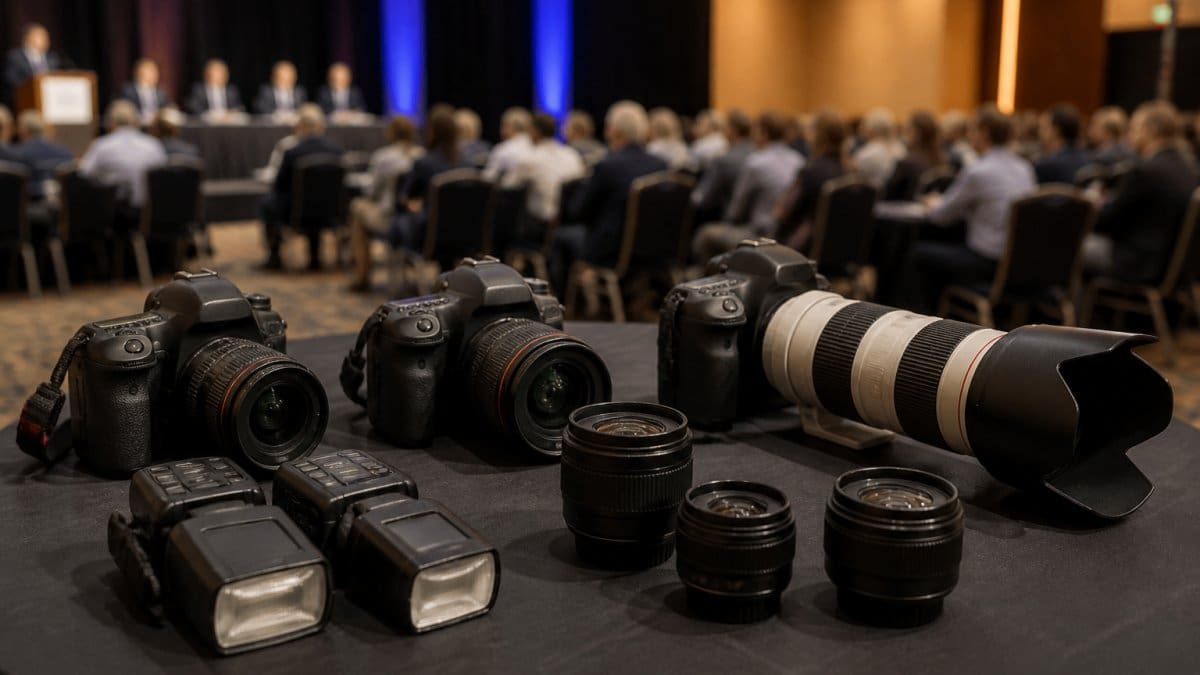
Fast primes and versatile zooms are non-negotiable. A 24-70mm f/2.8 covers most corporate scenarios: speeches from the audience, cocktail-hour candids, group photos. A 70-200mm f/2.8 lets you shoot speakers and stage action from the back of the room without being intrusive.
Backup gear isn’t optional. Carry two bodies so a malfunction doesn’t end your assignment, and keep one on a wide lens while the other handles telephoto, faster workflow, fewer lens changes, less chance of missing moments.
External flash and modifiers help when available light is truly insufficient. An on-camera flash with a diffuser softens harsh shadows, a wireless setup allows off-camera fill during receptions, and reflectors or small LED panels supplement light without being obvious.
Memory cards should be fast (UHS-II or faster) and redundant, shoot to two cards simultaneously. Clients expect delivery within 24-48 hours, so fast card-to-computer workflows matter, and a portable SSD for backup during the event protects your work if a card fails.
Camera Settings for Event Photography Success
Low-light performance is the defining technical requirement for corporate event photography, but settings alone don’t deliver a corporate assignment. The cameras that succeed are configured for reliability and fast handoff, not just a clean exposure. This section covers both the exposure settings that work in the room and the operational settings that keep you from losing an unrepeatable moment.
Exposure Settings That Work in Dim Venues
Start in aperture priority mode (A or Av).
Set ISO to auto with a ceiling that matches your camera’s performance. Full-frame cameras handle ISO 3200-6400 cleanly; in darker venues push to ISO 8000 or higher. A sharp, properly exposed photo at high ISO beats an underexposed, blurry one.
Use continuous autofocus (AF-C on Sony and Nikon, AI Servo on Canon) for speakers and moving subjects; single-shot works for posed groups and stable scenes.
Shoot in RAW. Clients often request color correction for their brand guidelines, and RAW files give maximum post-processing flexibility without losing image quality.
Operational Settings for Reliability and Redundancy
Corporate events are unrepeatable, a keynote happens once, and a client won’t accept “the card failed” as an explanation. Configure the camera for redundancy before you walk in.
- Dual card slots: Set the camera to write the same file to both cards simultaneously (backup mode) rather than overflow. If one card corrupts, you still have the assignment. Use UHS-II cards in both slots so the backup write does not slow your burst rate.
- Battery endurance: Carry at least two spare batteries per body and a dual charger. Grip-mounted batteries roughly double runtime on most bodies. Change batteries during lulls, not during the keynote.
- Silent shooting: Enable the electronic shutter for ceremonies, board meetings, and any setting where a mechanical shutter would be audible. Test for LED banding first; if the venue uses LED stage lighting, adjust shutter speed to a multiple that avoids flicker, or switch back to the mechanical shutter.
- File format and color: Shoot RAW plus a JPEG preview so you can hand off quick selects to a client or social team while you cull. Set a consistent white balance for the venue rather than auto, so a gallery does not shift color from frame to frame.
- Tethering and handoff: For executive portraits and award setups, tether to a laptop so the client can approve framing on the spot. For same-day delivery, carry a portable SSD and a card reader so you can start culling during downtime.
Do not rely on a single card slot or a single battery for a paid corporate assignment. Redundancy is the difference between a delivered gallery and a lost event.
Workflow and Client Delivery Settings
Clients expect delivery within 24-48 hours, and many want a small set of selects the same night for social or press use. Configure the camera to make that handoff fast: shoot a consistent aspect ratio and color profile so the gallery looks cohesive, and use in-camera ratings or a quick cull on the card reader to flag selects before you leave. Keep a second body set up with a different lens so you’re not swapping glass during the keynote.
A common pattern is to configure the second body identically to the primary, same settings, card backup mode, and battery state, so if the primary fails, you pick it up and keep shooting without reconfiguring mid-event.
Event Photography Lenses That Deliver Results
Lens selection shapes what you can capture and how discreetly you work, clients appreciate photographers who blend into the event rather than dominating it.
A 24-70mm f/2.8 zoom is the workhorse for corporate event photography, handling establishing shots, speaker photography from the audience, cocktail-reception candids, and group photos. The wide aperture performs in low light, and the focal range eliminates frequent lens changes.
A 70-200mm f/2.8 telephoto lets you shoot from the back of ballrooms without being intrusive, keynote speakers in detail, tight award shots, and candids from across a room. The compression at 200mm flatters faces and isolates subjects from busy backgrounds.
A fast 50mm f/1.4 or 35mm f/1.4 prime excels for intimate receptions and networking moments. Primes are sharper than zooms at wide apertures, and f/1.4 handles very dim lighting, many photographers keep a prime on a second body for this reason.
Wide-angle lenses (16-35mm) work for establishing and architectural shots but are secondary to the zoom and telephoto. Use them sparingly, wide angles distort faces and feel less intimate than the focal lengths clients expect.
Avoid ultra-telephoto lenses (300mm+) at corporate events, they’re heavy, conspicuous, and create distance. Corporate photography rewards proximity and connection, not surveillance-style telephoto work.
Corporate Event Photography Examples and Real-World Scenarios
Keynote and stage photography: Position yourself at the back of the ballroom with your 70-200mm lens. Telephoto compression isolates the speaker from background distractions, while your full-frame autofocus locks on the face and tracks movement across the stage. See concrete examples of essential shots to capture at corporate events with our 10 Essential Corporate Event Photography Shot List Items.
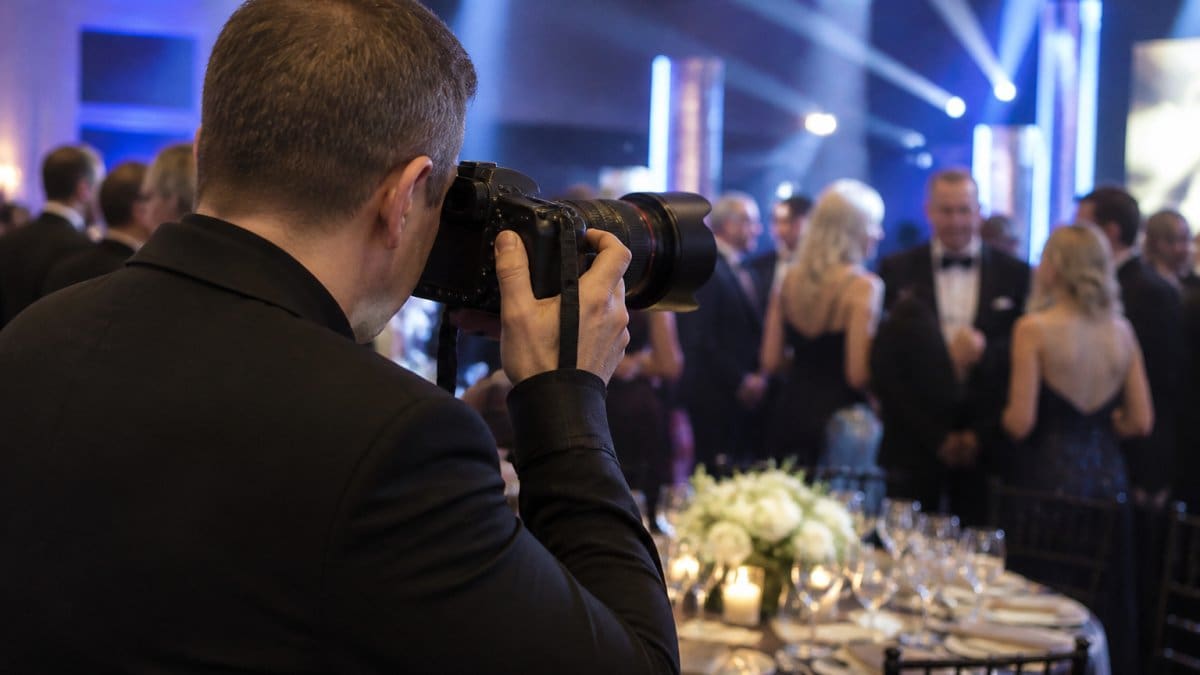
Candid moments during receptions: Switch to your 24-70mm at f/2.8, ISO 3200, and 1/160th. Move through the room capturing conversations, handshakes, and genuine laughter.
Award presentations and VIP recognition: Position yourself at a 45-degree angle to the stage with your 70-200mm ready.
Group photos: Use your 24-70mm at 35-40mm. Position the group with good depth, people at different distances from the camera, and shoot at f/4 or f/5.6 so everyone is sharp front to back.
Detail and environmental shots: Capture table settings, signage, venue architecture, and decor with your 24-70mm or 35mm prime at f/2.8 or f/4.
Choosing Your Camera Setup for Your Next Event
If you’re investing in a new system, start with a full-frame mirrorless body (Canon EOS R6, Sony α7 IV, or Nikon Z6 II) paired with a 24-70mm f/2.8 and a 70-200mm f/2.8. This covers 95% of corporate scenarios. Add a fast 35mm or 50mm prime for receptions, and budget for two bodies so you have backup and can keep different lenses mounted. Learn specific camera settings optimized for indoor gala photography situations with our best-camera-settings-for-indoor-gala-photography guide.
If you already own a DSLR or older mirrorless camera, evaluate whether it meets the low-light requirement, cameras from 2019 onward generally handle corporate event lighting acceptably.
For portability and lower total system cost, the Fujifilm X-T5 with APS-C sensor offers solid image quality at reduced weight, and its 40.2-megapixel resolution provides excellent detail.
Professional work demands redundancy and reliability: carry backup batteries, extra memory cards, and a second body, test your gear before the event, and arrive early to scout lighting and adjust settings. Understand comprehensive equipment and technique requirements for professional-level event coverage with our Professional Event Photography for Summits guide.
The right camera setup removes technical barriers so you can focus on capturing authentic moments.
The difference between good corporate event photography and forgettable images often comes down to gear reliability and low-light capability. Event Photojournalism can book professional event photography services if you decide not to shoot yourself.
Frequently Asked Questions
What features matter most in a camera for corporate event photography?
Low-light performance, autofocus speed, and burst shooting are critical. Full-frame sensors excel in dim venues where flash is unwelcome. Fast autofocus with subject tracking keeps candid moments sharp as people move. Burst shooting captures multiple frames per second, ensuring you don’t miss peak moments. Battery life and memory card capacity matter too, events run long, and you need backup power and storage.
Are mirrorless cameras good for corporate event photography?
Yes. Mirrorless cameras offer faster autofocus, real-time exposure preview through the viewfinder, and lighter weight than DSLRs. The Sony α9 III and Canon EOS R3 are built for professional event work with rapid subject tracking and high frame rates. Mirrorless technology has matured to the point where many professionals prefer it for events, though DSLRs remain viable if you already own one.
What lenses do professional event photographers use?
Event photographers typically carry two lenses: a 24-70mm f/2.8 zoom for versatility and a 70-200mm f/2.8 telephoto for distant speakers or stage action. The 24-70mm covers wide shots of the room and medium framing; the 70-200mm isolates speakers and candid moments from the back. Fast apertures (f/2.8) are essential in low light to gather enough light without pushing ISO too high.
Is a full-frame camera necessary for corporate event photography?
Full-frame sensors are strongly recommended for corporate events because they deliver superior low-light performance and high-ISO image quality. Many corporate venues have dim ambient lighting, and full-frame cameras handle this better than APS-C models. If budget is tight, an APS-C camera like the Fujifilm X-T5 can work, but expect to use higher ISO and accept more noise in shadow areas.
What camera is best for photographing events in low light?
The Canon EOS R6 and Nikon Z6 II are excellent full-frame choices for low-light events. Both have strong high-ISO performance and reliable autofocus in dim conditions. The Sony α7 IV offers hybrid photo-video capability if you need both stills and video coverage. For professional-grade speed in fast-moving moments, the Sony α9 III leads the field with the fastest autofocus and burst rates available.