Last Updated: October 28, 2026
Quick Summary
The best lighting equipment for outdoor corporate retreats pairs portable LED panels with battery-powered fixtures, diffusion, and reflectors, matched to each zone and activity. Plan a power budget per zone and session, and sandbag every stand for wind safety.
- A 2026 Houzz study found 66% of renovated lounge areas included outdoor lighting.
- A lounge lit by two 30-watt tubes for four hours needs roughly 240 watt-hours before reserve.
- Add 30 percent buffer to your power budget for cold evenings and dimming losses.
- Professional outdoor stage fixtures run 10,000 to 30,000+ lumens when competing with ambient dusk light.
- Plan to move or strike fixtures if sustained wind is forecast above roughly 20 mph.
Table of Contents
- What Lighting Equipment Do You Need for an Outdoor Corporate Retreat?
- Portable LED Lights for Outdoor Events: Panels, Tubes, and COB Fixtures
- Battery-Powered Event Lights for Venues Without Outlets
- Outdoor Event Lighting Setup: Zones, Schedules, and Weather Contingencies
- Outdoor Event Lighting Safety: Wind, Power, and Glare Control
- Comparison Table: Matching Fixtures to Retreat Activities
- How to Plan Lighting for Outdoor Corporate Retreats with Event Photojournalism
- Frequently Asked Questions
What Lighting Equipment Do You Need for an Outdoor Corporate Retreat?
The best lighting equipment for outdoor corporate retreats pairs portable LED panels with battery-powered fixtures, diffusion, and reflectors, matched to each zone and activity.
Here’s the number that should shape your kit list. A 2026 U.S. Houzz Outdoor Trends Study found that 66% of renovated lounge areas included outdoor lighting. Guests now expect an outdoor space to be lit well, not just lit.
Outdoor lighting is the deliberate use of fixtures, diffusion, and reflectors to make a space usable and photogenic after daylight fades. For a retreat, that means three jobs: illuminate a speaker, soften faces for group portraits, and keep walkways safe without glare.
Most planners get this wrong by renting one big light tower and calling it done. It flattens every face in the room and blows out the stage.
Portable LED Lights for Outdoor Events: Panels, Tubes, and COB Fixtures
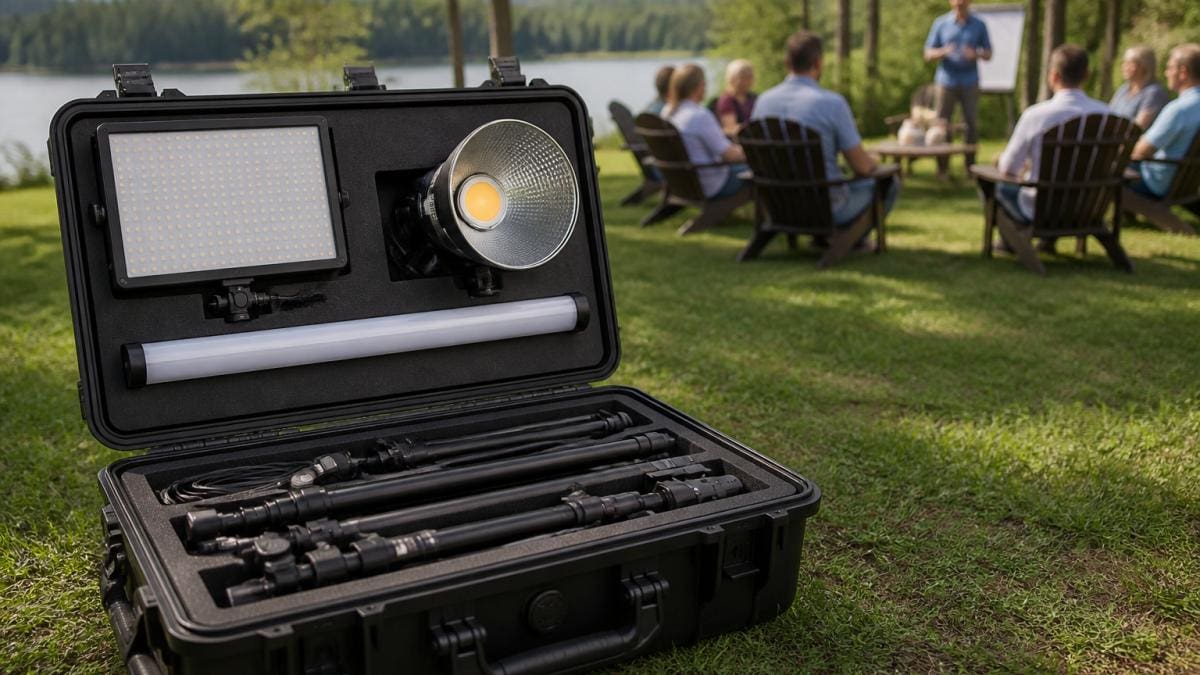
Portable LED lights for outdoor events fall into three families: light panels for interviews and group portraits, light tubes for accent and ambient fill, and COB fixtures for high-output key lighting. Each solves a different problem, and most retreat kits need at least two of the three.
LEDs dominate commercial outdoor projects because they last longer and draw less electricity than older systems, according to Hevilite’s 2026 commercial lighting guide. That efficiency matters when you’re running fixtures off a battery rather than a wall outlet.
- Light panels: bi-color, lightweight, and travel-friendly. Best for interview lighting and small group portraits where you need soft, controllable output.
- Light tubes: slim, collapsible, and easy to mount on a stand or tuck behind a podium. They add ambient fill and color without a bulky softbox.
- COB lights: a single high-output chip that delivers serious brightness in a compact body. These are your key lights when ambient dusk light is still strong.
A common mistake is buying one monolight or speedlight and expecting it to cover a whole retreat. For a deeper look at natural light event photography techniques, see our step-by-step guide. A speedlight is a camera-mounted flash built for a single subject at close range.
Battery-Powered Event Lights for Venues Without Outlets
Battery-powered event lights are the answer when a venue has no accessible outlets, which is common at outdoor retreats held on lawns, farms, and terraces.
Start with three numbers for every battery fixture you consider:
- Rated runtime at a stated output. Manufacturers usually publish runtime at full power and sometimes at half power. A panel rated for four hours at full output may run six or seven at half output, so match brightness to the schedule before you commit.
- Battery chemistry and swap behavior. Lithium-ion packs are the norm in portable LED panels and tubes. Confirm whether the battery is internal and charged in place or swappable, because swappable packs let you rotate through a two-day retreat without dark time.
- Charge time and charger count. A pack that takes five hours to charge is useless if you have two packs and one charger. Count chargers per crew member, not per fixture.
A simple power budget keeps you honest. List each zone, the fixture’s draw in watts, the hours it runs, and multiply.
Label every battery with a number and a charge date using painter’s tape. At a multi-day retreat, the person who grabs a pack at 6 p.m. should be able to tell at a glance whether it came off the charger that morning.
Test every battery the week before the event, charge everything the night before, and pack a small inverter or generator as backup for the podium and any continuous video production. A dead key light mid-toast is not recoverable, and neither is a generator that nobody tested under load.
United Rentals groups outdoor event area lighting into light towers, balloon lights, and light stands, each suited to a different zone rather than one universal option (United Rentals).
On the rental-versus-buy question, a common pattern among planners is to rent high-output COB fixtures and light towers for one-off retreats and buy the small bi-color panels and tubes that get reused across events.
Outdoor Event Lighting Setup: Zones, Schedules, and Weather Contingencies
An outdoor event lighting setup should be planned zone by zone and hour by hour, not fixture by fixture. Integrating these temporal shifts into your broader strategy ensures a cohesive atmosphere, which remains the foundational principle of modern outdoor lighting design for creating versatile environments.
| Zone | Primary Fixture | Setup Window | Weather Backup |
|---|---|---|---|
| Stage and podium | COB key light + panel fill | 90 min before session | Move under tent, add diffusion |
| Group portrait area | Two panels at 45 degrees | 60 min before golden hour | Covered porch or interior wall |
| Dining and lounge | Light tubes + balloon light | 45 min before dusk | Battery fixtures only, no cords |
| Walkways and parking | Light stands or tower | 30 min before dusk | Sandbag all bases |
Schedules shift with the season. In summer, golden hour lands late and you may not need stage lighting until well into the evening. In fall, dusk arrives during your keynote. Build the timeline backward from sunset and add a 30-minute buffer.
Weather is the variable most planners ignore. If your retreat is in the Dulles corridor, this guide to corporate retreats in Sterling, Virginia covers airport-adjacent venues and offsite spaces. If you’re scouting venues, our guide to corporate outdoor photography locations covers which outdoor spaces handle wind and weather best.
Outdoor Event Lighting Safety: Wind, Power, and Glare Control
Outdoor event lighting safety comes down to three controls: sandbag every stand, keep cords and batteries away from walkways, and aim fixtures so they don’t blind guests or spill onto neighboring property. None of these are optional at a corporate event with VIPs and board members present. The gap most guides leave is the operations layer: who checks what, when, and against which threshold.
Wind and stand stability. Wind is the real threat to light stands, not rain. An unsecured stand in a 15 mph gust will go over, and it will take a table setting or a guest with it.
Glare and light trespass. DarkSky International runs a third-party certification program for luminaires designed to minimize glare, reduce light trespass, and avoid light pollution (DarkSky International). Their framing is a useful check: brightness alone is not the goal.
A simple event-operations checklist. Before doors open, confirm every stand is weighted, every cable is taped or ramped, every battery is labeled and charged, and every fixture is aimed and flagged.
Do not rely on a single sandbag per stand at a venue with open exposure. A common pattern at waterfront and hilltop properties is to double the base weight and add a safety tether from the stand to a fixed anchor.
For output, Litelees’ 2026 guide to outdoor stage lighting puts professional outdoor stage fixtures at 10,000 to 30,000+ lumens when competing with ambient dusk light. That’s a stage benchmark, not a rule for every lounge or portrait zone. Match lumens to the job: a portrait panel needs far less than a podium light fighting a bright western sky, and a fixture that is too bright for its zone becomes a glare problem rather than a lighting solution.
Comparison Table: Matching Fixtures to Retreat Activities
Matching fixtures to activities is the fastest way to build a kit list. Start with what each retreat moment needs, then pick the fixture that delivers it, and note the spec that decides the choice.
| Retreat Activity | Best Fixture | Key Spec | Why It Fits |
|---|---|---|---|
| Keynote at dusk | COB light | 10,000+ lumens, bi-color | High output against ambient light |
| Executive interview | LED panel | Soft diffusion, color temperature control | Flattering, controllable key light |
| Group portrait | Two panels + reflector | Fill light, low output | Even faces, no harsh shadows |
| Evening reception | Light tubes + balloon light | Battery runtime, warm color temperature | Ambient fill without cords |
| Walkway safety | Light stands or tower | Downward aim, glare shield | Illuminates paths without blinding |
The spec column is where most rental decisions go wrong. Color temperature and bi-color adjustment let you match a fixture to daylight, tungsten, or the warm glow of string lights. Color rendering matters too: a light with poor color rendering will make skin tones look gray in photos and video. Diffusion and a softbox or light dome soften harsh output, and a reflector bounces fill light back into shadows for free.
How to Plan Lighting for Outdoor Corporate Retreats with Event Photojournalism
Planning lighting for outdoor corporate retreats works best when the photographer and the lighting plan are built together. The person capturing the event can tell you which zones need fill light, where glare will ruin a shot, and when the schedule leaves you shooting in near-darkness.
That’s the part most guides miss. Lighting is not a facilities task separate from photography. It’s a photography task that facilities helps execute. When the two plans are coordinated, your keynote shots, group portraits, and candid reception coverage all land in usable light.
At Event Photojournalism, we provide customized photography services and high-resolution image delivery. Corporate retreat photography services are available for retreats across the region. Our award-winning photography is designed to elevate your brand and amplify your message.
Frequently Asked Questions
What lighting equipment do you need for an outdoor corporate event?
You need a mix of area lighting and accent fixtures. For stage or speaker areas, aim for 10,000 to 30,000+ lumens to compete with dusk light. Portable LED panels, light tubes, and COB lights handle key and fill, while battery-powered event lights cover zones without outlets. Add diffusion and reflectors to soften harsh light, and plan for wireless triggers so you can adjust without crossing the event floor.
How do you light an outdoor event after dark without outlets?
Use battery-powered event lights with enough runtime to cover your schedule plus a buffer. LED fixtures draw less power than older systems, so a single battery can run a panel for hours. Rotate spare batteries at each zone change, and test runtime during setup. For speaker areas, pair a high-output battery light with a softbox to keep glare off the audience.
How many lights do you need for an outdoor corporate retreat?
Count one key light per stage or speaking zone, one fill light for group portraits, and two to four accent lights for signage or sponsor areas. A typical retreat with a main stage and two breakout zones needs six to eight fixtures. Add a backup for any light covering a VIP or fundraising moment so a failed battery does not interrupt coverage.
How do you keep outdoor event lighting stable and safe in wind?
Use weighted bases or sandbags on every stand, and avoid raising lights above head height unless the stand is rated for it. Run cables under mats or tape to prevent trips. Check that fixtures carry third-party certification for glare and light trespass control, and aim them away from neighboring properties. Have a plan to lower or remove lights if wind picks up during the event.
The hardest part of retreat lighting isn’t buying fixtures. It’s getting the light and the coverage to agree on a schedule before the event starts. Event Photojournalism plans photography around your lighting zones, delivers high-resolution images, and offers customized coverage built for conferences, galas, and corporate retreats across the region. Get started with Event Photojournalism and turn your retreat into lasting visual assets.