
Table of Contents
- Why Professional Commercial Photography Drives Real Business Results
- How High-Quality Images Boost Conversion Rates and Sales
- Building Brand Identity and Visual Consistency Across Channels
- Commercial Photography vs Stock Photos: Why Authenticity Matters
- How to Prepare for a Commercial Photography Shoot
- Understanding Commercial Photography Pricing and ROI
- The Competitive Edge: What Professional Photography Delivers
Last Updated: August 19, 2026
Why Professional Commercial Photography Drives Real Business Results
Businesses using high-quality commercial images see up to a 47% increase in sales compared to those without, according to recent research from 2026. Yet many companies still rely on stock photos, rushed smartphone snapshots, or outdated imagery that fails to capture their actual value.
A commercial photographer does more than point a camera at your products or team. They understand lighting, composition, and how to tell your brand’s story through visual assets that convert. At Event Photojournalism, we’ve spent years capturing corporate events, galas, and conferences across the DMV area, and the pattern is clear: organizations that invest in professional imagery outpace their competitors in engagement, credibility, and revenue.
This guide covers the measurable business case for hiring a commercial photographer, the concrete returns you can expect in conversions, brand recognition, and competitive positioning.
How High-Quality Images Boost Conversion Rates and Sales
Professional imagery directly impacts your bottom line. Products with professional photos have a 33% higher conversion rate than those with low-quality images, according to Shopify data from 2024.
When a customer lands on your page, they make a split-second judgment about whether you’re worth their time. According to research on visual decision-making, 93% of consumers consider visual appearance to be the key deciding factor in a purchase. A blurry, poorly lit product photo communicates carelessness. A sharp, professionally composed image communicates quality and trustworthiness.
Professional websites with high-quality photography convert 108% more visitors than those with lower-quality images, according to data from 2025. That’s double your conversion rate without changing your messaging, pricing, or offer, just better photography.

High-quality imagery signals investment. It tells customers you care enough to do it right. Stock photos send the opposite message, they’re the visual equivalent of a form letter that customers recognize on five competitor websites.
Building Brand Identity and Visual Consistency Across Channels
Consistent imagery across marketing materials can boost brand recognition by up to 80%, according to 2026 research. Consistency means your LinkedIn headshots match your website bios, your event photography reflects the same aesthetic as your printed collateral, and your social media uses the same color palette, lighting style, and composition principles.
A commercial photographer who understands your brand strategy will shoot with consistency in mind, using the same lighting setups, color grading, and compositional frameworks across sessions. That’s the difference between hiring a photographer for a single shoot versus building a long-term visual partnership.
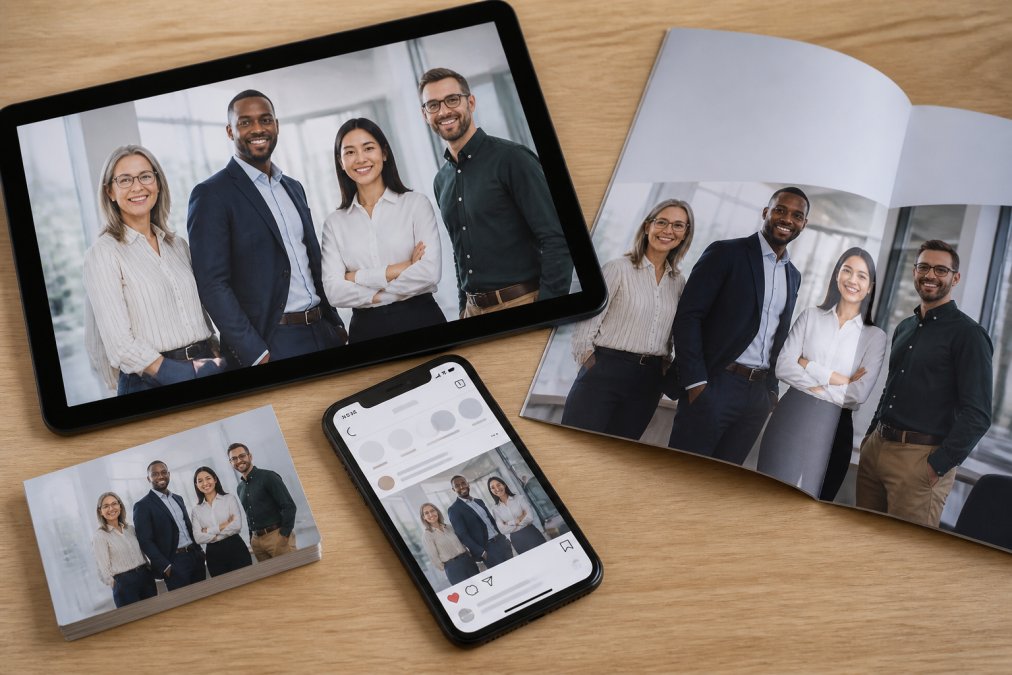
Businesses investing in high-quality visual content report a 49% increase in revenue. Much of that comes from the consistency signal, customers trust brands that look intentional and unified. Event Photojournalism works with clients to understand their visual brand before the shoot, ensuring every image reinforces your brand identity.
Commercial Photography vs Stock Photos: Why Authenticity Matters
Stock photos are cheap and fast. They’re also indistinguishable from every competitor using the same service.
According to recent consumer research on AI-generated content, 98% of consumers prioritize authentic imagery. Stock photos feel inauthentic because they are. A stock photo communicates: "We didn’t invest in showing you our actual team, our actual office, our actual products." Professional photography says the opposite.
This matters most for B2B and professional services. A law firm using a stock photo of generic business people signals they couldn’t be bothered with authenticity. A law firm with professional photography of their actual team signals confidence and investment. Content featuring compelling images averages 94% more total views than those without, according to MDG Advertising data from 2023.
The Licensing and Rights Problem
When you purchase a stock photo, you’re buying a limited license, not ownership. Standard licenses typically allow website and digital marketing use but may prohibit print use or merchandise without additional fees. Extended licenses cost more but permit broader use. Exclusive licenses are expensive (often $500+) but grant sole rights, something a commercial photographer delivers as standard.
More problematically, stock photos come with non-exclusive rights. Your competitor can license the exact same image. You might be using the same "professional team meeting" photo as three other companies in your market.
Commercial photographers typically deliver work-for-hire agreements or exclusive licensing. You own the images outright and can use them across all channels, website, print, social media, email, presentations, without additional licensing fees or restrictions. You can modify them and use them indefinitely as your brand evolves. professional studio gear.
In regulated industries (healthcare, finance, legal), stock photos of professionals can create liability if not clearly labeled as models. Professional photography of your actual team eliminates this risk entirely.
The Hidden Cost of Stock Photo Restrictions
A business using stock photos for a product launch might purchase a "lifestyle" image for $50-$200. But then they can’t use it in their printed catalog without upgrading the license (+$100-$300), can’t use it on merchandise without an extended license, and can’t repurpose it when they rebrand.
A single professional photography session costs more upfront but delivers unlimited reuse, modification rights, and exclusivity. The per-use cost drops dramatically over time. Professional photography lives in your archive forever. You control it.
How to Prepare for a Commercial Photography Shoot
The quality of your final images depends partly on the photographer’s skill and equally on your preparation.
Start with a creative brief documenting your goals: Are you building social media content? Creating marketing collateral? Capturing your corporate team? Different goals require different approaches.
Identify your key subjects and moments. For events, provide a shot list: the executive director’s remarks, the silent auction, the award presentation, candid networking moments. For products, think through angles, context, and use cases.
Schedule the shoot when your space has the best natural light. For team headshots, plan 20-30 minutes per person. For events, brief the photographer on timing so they can position themselves correctly.
Communicate your brand preferences. Share examples of imagery you admire and show the photographer your existing marketing materials. Professional photographers ask about your goals, brand, and audience. If a photographer doesn’t ask these questions, that’s a warning sign.
Understanding Commercial Photography Pricing and ROI
Commercial photography pricing varies based on scope, complexity, and deliverables. Understanding what you’re buying and how to measure ROI is key.
How Commercial Photography Pricing Works
Most commercial photographers use one of three models:
Day Rate or Half-Day Rate: A flat fee for a defined time block (typically 4-8 hours), and you receive all edited images. This works well for events or multi-product sessions.
Project-Based Pricing: For specific deliverables (e.g., "20 product photos for e-commerce"), photographers quote a total project fee, clarifying scope upfront.
Licensing and Usage Fees: Some photographers charge separately based on how you’ll use the images (web-only vs. print vs. commercial resale).
Most commercial photographers include basic editing (color correction, background cleanup) but charge for extensive retouching, compositing, or custom backgrounds.
Building Your Photography Budget
Define your scope:
- Event photography: Pricing depends on the duration of the event, specific requirements, and the photographer’s experience. Hourly rates typically range from $150 to $500, with flat rates for entire events often between $1,500 to $3,000. For corporate events, costs can range from $350 to $2,500 per day.
- Product photography: Pricing varies significantly based on complexity, the number of images, and the type of shoot. Simple product shots on a white background can range from $25 to $150 per image, while styled lifestyle photography can cost $75 to $500+ per image. Half-day rates for lifestyle shoots typically run $800 to $2,000, and full-day rates from $1,500 to $5,000.
- Team headshots: Costs typically range from $150 to $500 per person, with per-person pricing often decreasing as team size increases. For a full team session, a half-day (4 hours) can range from $1,500 to $3,500, and a full day (8 hours) from $3,000 to $6,000.
- Brand/lifestyle photography: Pricing for brand photography sessions can range from $150 to $500 per hour, with packages often falling between $350 to $2,500. Half-day rates can range from $1,500 to $5,000, and full-day rates from $5,000 to $10,000+.
Factors that increase cost include location complexity, rush delivery (25-50% more), retouching, and extended licensing scope.
Calculating ROI: The Framework
Step 1: Establish your baseline conversion rate.
For e-commerce: (sales / visitors) × 100. For service businesses: (qualified leads / website visitors) × 100.
Step 2: Estimate the conversion lift from professional imagery.
Research shows professional product photography increases conversion rates by 20-40%. Use a conservative estimate (e.g., 20%).
Step 3: Calculate incremental revenue.
Example: E-commerce business with 10,000 monthly visitors, 3% baseline conversion rate, $100 average order value.
- Baseline: 10,000 × 0.03 = 300 sales/month = $30,000/month
- With 20% lift: 360 sales/month = $36,000/month
- Incremental revenue: $6,000/month or $72,000/year
If professional photography costs $3,000, your ROI is 24:1 in the first year.
Step 4: Account for secondary benefits.
Professional imagery improves brand perception (increasing customer lifetime value by 10-20%), organic search visibility, social media performance (2-3x more engagement), and hiring/recruitment (LinkedIn profile views increase 14-21x).
When to Invest in Professional Photography
Prioritize professional photography if you’re selling visual products, competing in a crowded market, have high customer acquisition costs, are building a premium brand, or plan to use imagery across multiple channels.
The Competitive Edge: What Professional Photography Delivers
Your competitors likely use similar messaging, target the same audience, and offer comparable features. What differentiates you? Increasingly, it’s visual storytelling. According to the 2026 State of the Studio report, corporate branding photography is growing at 7.1% annually, making it the fastest-growing segment in the photography market.
Professional photography communicates investment and quality. It’s memorable, people retain visual information far better than text. A striking photograph creates a lasting impression that a well-written paragraph cannot match.
Professional imagery is versatile. A single photograph can be used across your website, social media, print materials, email campaigns, and presentations. That consistency builds brand recognition and maximizes ROI. You’re not constrained by stock photo licensing, you can use your images however you want, whenever you want.
Event Photojournalism has documented this pattern across hundreds of events and campaigns. Organizations that commit to professional imagery consistently outperform those that don’t, with stronger brand recognition, higher engagement, and better conversion rates.
The decision to hire a commercial photographer is ultimately a decision about how seriously you take your brand. Professional imagery signals that you’re invested in quality and willing to stand out. Event Photojournalism specializes in capturing that commitment through award-winning photography that elevates your brand, amplifies your message, and ensures your most important moments are remembered. Contact us today to discuss how professional commercial photography can drive measurable results for your organization.
| Benefit | Impact | Best For |
|---|---|---|
| Higher Conversion Rates | 33-108% increase in conversions | E-commerce, service websites |
| Brand Recognition | Up to 80% boost in recognition | Multi-channel marketing campaigns |
| Engagement | 90% increase in site dwell time | Content-heavy websites |
| Professional Perception | 76% increase in perceived competence | Corporate and B2B brands |
| Social Media Reach | 94% more views than amateur imagery | Social-first marketing strategies |
| LinkedIn Visibility | 14-21x more profile views | Professional networking and recruitment |
Frequently Asked Questions
What are the main benefits of hiring a professional commercial photographer?
Professional commercial photographers deliver high-resolution, authentic imagery that builds customer trust and drives measurable business results. Businesses using high-quality commercial images see up to a 47% increase in sales, while 93% of consumers cite visual appearance as the key deciding factor in purchasing decisions. Professional photographers understand visual storytelling, lighting, composition, and post-production, skills that DIY photography cannot replicate. They also handle technical aspects like licensing rights and image optimization for different channels, saving you time and ensuring your brand looks polished across all platforms.
How does professional photography impact conversion rates?
High-quality product photography directly affects how customers perceive your business and make buying decisions. Professional websites with compelling images convert 108% more visitors than those with lower-quality photos. Products with professional photos have a 33% higher conversion rate than those with low-quality images, and 75% of online shoppers rely on product photos when deciding on a purchase. Professional photographers know how to showcase products in the best light, highlight key features, and create images that resonate with your target audience, turning browsers into buyers.
Should I use stock photos or hire a commercial photographer?
While stock photos offer convenience and lower upfront costs, professional commercial photography delivers authenticity and brand differentiation that stock images cannot match. Ninety-eight percent of consumers now prioritize authentic imagery, and nearly 90% want disclosure around AI-generated images, giving real brand photography a trust advantage. Stock photos are generic and often used by multiple competitors, weakening your visual identity. Professional commercial photography is customized to your brand, your products, and your target audience, creating a unique visual narrative that builds genuine connection with customers and sets you apart in a crowded market.
Is professional photography worth the investment for a small business?
Yes. Businesses investing in high-quality visual content report a 49% increase in revenue, and consistent imagery can boost brand recognition by up to 80%. For small businesses competing against larger companies, professional photography levels the playing field by creating a polished, trustworthy brand presence. The ROI extends beyond sales: professional headshots increase LinkedIn profile views by 14x and connection requests by 9x, expanding your network and credibility. When you factor in the cost of lost sales from poor-quality images and the time savings from working with a professional, the investment pays for itself quickly.
This article was written using GrandRanker