Last Updated: November 5, 2026
Quick Summary
The best camera gear for low light gala photography starts with a full-frame body that produces clean files at high ISO, paired with a fast standard zoom and a wide-aperture prime. Build your low light gala kit around f/2.8 glass, a bounced and diffused flash, and two bodies for redundancy.
- Start at 1/200 second to freeze moving guests, then open aperture to f/2.8 or wider before raising ISO.
- A 24-70mm f/2.8 covers most of a gala evening, while a 70-200mm f/2.8 adds reach for stage work.
- Bounce flash off a ceiling or wall and keep flash exposure compensation slightly negative to preserve ambient light.
- Every gala kit needs two bodies, two flashes, spare batteries, and cards that write to both slots at once.
- Test anti-flicker and autofocus in the actual room during setup, not during the first toast.
Table of Contents
- Camera Bodies That Hold Up in a Dim Ballroom
- The Best Lens for Event Photography: Fast Primes and Zooms
- Low-Light Event Photography Settings That Keep Guests Sharp
- On-Camera Flash for Event Photography Without Wrecking the Mood
- Camera Gear for Event Photography: Building a Gala Kit by Budget and Role
- Redundancy and Event-Day Reliability for Low Light Gala Coverage
- Book a Gala Photographer Who Already Owns the Right Kit
- Frequently Asked Questions
Camera Bodies That Hold Up in a Dim Ballroom
The best camera gear for low light gala photography starts with a full-frame body that produces clean files at high ISO, because a dim ballroom gives you almost nothing to work with. At Event Photojournalism, we build every gala kit around that single requirement before we think about lenses or flash.
A full-frame sensor is the foundation of low-light gala work. It gathers more light across a larger area than a crop sensor, which means less noise when you push ISO to 3200, 6400, or beyond. The RTINGS low-light camera testing names the Sony α7 V as its best-tested low-light body, citing outstanding dynamic range and in-body image stabilization. The Sony A7 III and Canon EOS R6 are both full-frame mirrorless bodies that the KEH guide to pre-owned event gear describes as delivering clean files at high ISOs, with on-sensor phase-detection autofocus. The Nikon Z9 brings a 45.7 MP sensor and appears in night-photography comparisons at ISO 6400.
Full-Frame Sensors and High-ISO Performance
High-ISO performance is what separates a usable gala file from a noisy one. A full-frame sensor with strong high-ISO output lets you shoot at f/2.8 and 1/200 second without blasting the room with flash. In practice, that means you can capture a candid moment across a dark ballroom and still deliver a file clean enough for a sponsor’s annual report.
Autofocus and Anti-Flicker Under Mixed Venue Lighting
Mixed venue lighting is the quiet killer of gala coverage. Stage LEDs, chandeliers, and uplighting all cycle at different rates, and a camera without anti-flicker control will produce banded frames you cannot fix in post. Look for on-sensor phase-detection autofocus and a flicker-reduction setting, then test both before the doors open.
The Best Lens for Event Photography: Fast Primes and Zooms
A fast standard zoom and a wide-aperture prime are a practical pairing for dim event rooms, covering group portraits, candid moments, and wide shots.
A 24-70mm f/2.8 can cover much of a gala evening, from wide room shots to tighter candids. A 70-200mm f/2.8 adds reach for stage and podium work, and a 35mm or 50mm prime suits available-light candids where flash is not welcome. Wide aperture does two jobs at once: it gathers more light and it isolates your subject from a busy background.
Low-Light Event Photography Settings That Keep Guests Sharp
Low-light event photography settings come down to one rule: protect the shutter speed first, then open the aperture, then raise ISO. Guests move, and motion blur cannot be recovered.
Start at 1/200 second to freeze a handshake, a laugh, or a dance step. Set aperture to f/2.8 or wider. Let ISO float up to whatever your body handles cleanly, and turn on image stabilization to steady handheld frames. For a full walkthrough of aperture, ISO, shutter speed, and flash balance, see our guide to the best camera settings for indoor gala photography.
| Setting | Starting Value | Why It Matters |
|---|---|---|
| Shutter speed | 1/200 second | Freezes moving guests |
| Aperture | f/2.8 or wider | Gathers light, isolates subject |
| ISO | 3200-6400 | Balances exposure with noise |
| Stabilization | On | Reduces camera shake |
| Flash | Bounce, low power | Fills shadows without flattening |
On-Camera Flash for Event Photography Without Wrecking the Mood
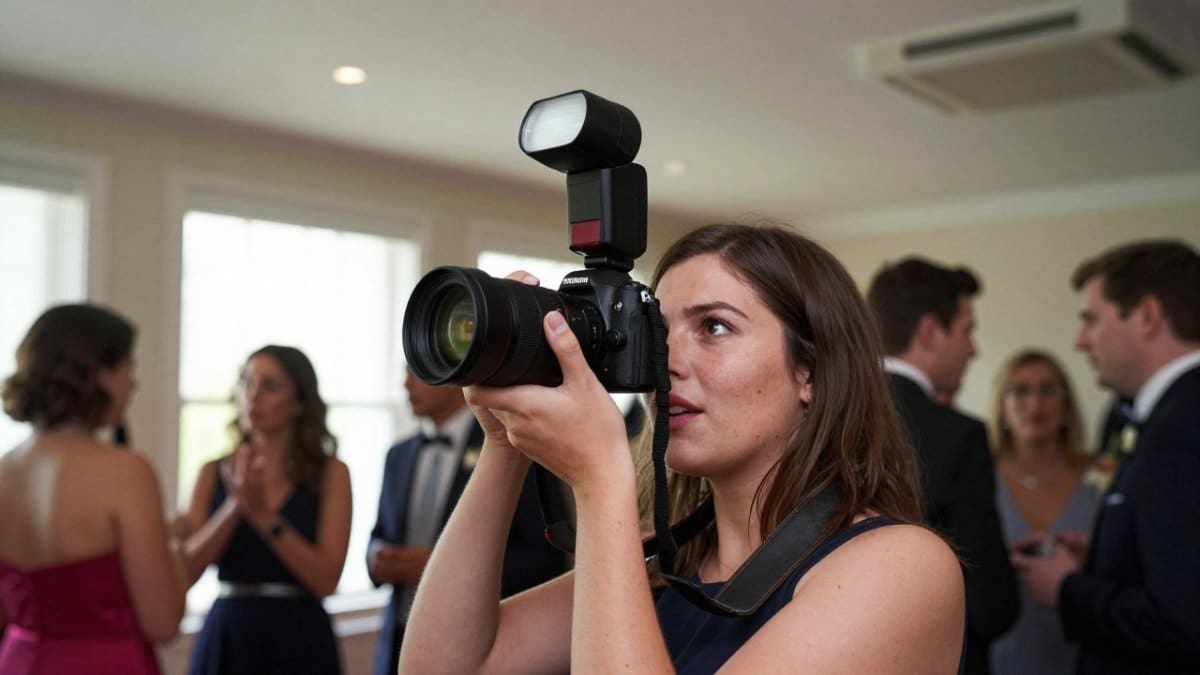
On-camera flash for event photography works at a gala only when it is bounced, diffused, color-matched, and dialed down. Direct flash flattens faces and announces the photographer; a bounced, diffused burst adds just enough light to lift shadows without changing the mood of the room.
Bounce direction is the first decision. Aim the head at a ceiling or a nearby wall, not at the subject. A low white ceiling gives a soft, broad fill; a dark or vaulted ceiling gives you nothing, and in that case you bounce off a side wall or use a bounce card. A common pattern is to angle the head up and slightly behind you so the light wraps the subject rather than hitting them straight on.
Modifiers change the quality of the light. A dome diffuser spreads the burst in every direction and softens it, which is why the low-light photojournalism discussion on flash diffusion recommends pairing a Canon Speedlight with a Gary Fong Sphere diffuser. A bounce card is smaller and more discreet; a small softbox on a bracket gives more control for portraits but is slower to move with. For a gala, discretion usually wins.
Color matching matters more than most shooters expect. Ballrooms are lit with tungsten, LED, or a mix of both, and an un-gelled flash reads as a cold blue pop against a warm room. Fit a CTO gel when the ambient light is warm and a CTB gel when it is cool, or set the flash to match the ambient white balance and correct in post. Mixed LED and tungsten in the same room is the hardest case, pick the dominant source and accept a small color shift in the corners.
Dial the flash down. Keep flash exposure compensation slightly negative so ambient light still reads in the frame. The goal is a lift, not a replacement. If the room already has strong stage lighting, a low-power bounce fill is often all you need; if the room is genuinely dark, raise ISO and open the aperture before you raise flash power.
Know when not to flash. Some formal venues and some moments, a candlelit toast, a quiet award presentation, a religious ceremony, are disrupted by any flash at all. Watch the room and the event program, and switch to available-light shooting with a fast prime when flash would break the mood. Our piece on how to use flash ethically at formal events covers the etiquette side in more detail.
Camera Gear for Event Photography: Building a Gala Kit by Budget and Role
Camera gear for event photography should be built around your role and budget, not a wish list. A second shooter covering candids needs different priorities than a lead covering the stage, and a first-time gala shooter should not buy the same kit as a studio owner adding events to an existing wedding business. The three tiers below are starting points, not mandates, the goal is a kit that covers the room without leaving a single point of failure.
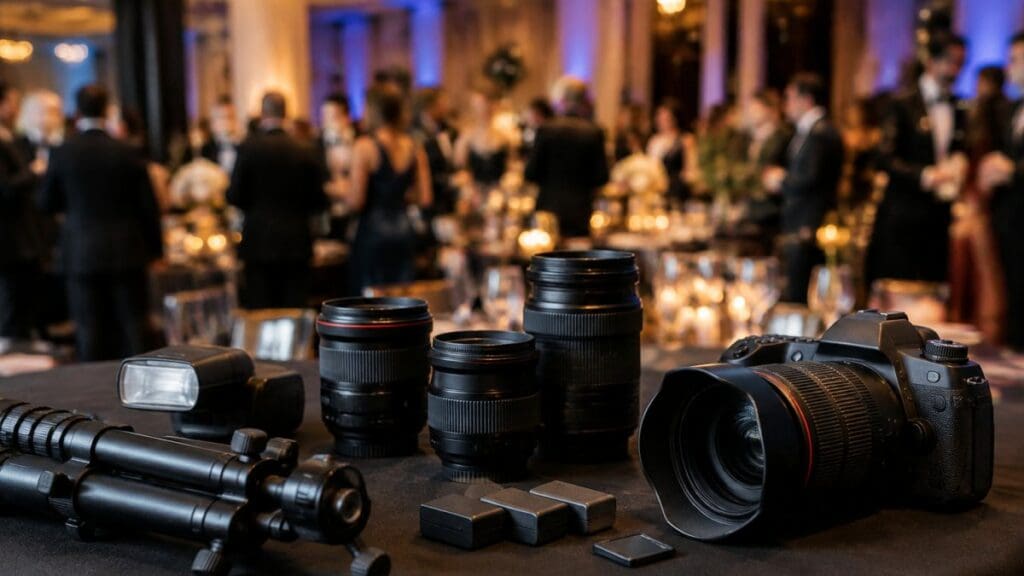
Role matters more than tier. A second shooter covering candids can work with one body, a 35mm prime, and a bounced flash; a lead covering the stage needs the 70-200mm and a second body. A detail shooter working room scenes and table settings can add a portable LED panel and a tripod, which are worth considering for stationary shots where flash would disrupt the room.
Buy versus rent. For a one-time gala, renting a second body and a 70-200mm for the weekend often costs less than buying either, and it lets you test a system before committing. For anyone shooting more than a handful of events a year, buying used full-frame bodies and f/2.8 zooms from a dealer with a warranty is the common pattern, the depreciation has already happened, and the savings fund the redundancy that matters most. Our Northern Virginia event photography gear tips go deeper on building a versatile, redundant kit.
Redundancy and Event-Day Reliability for Low Light Gala Coverage
Redundancy is the difference between a professional and a liability. Every gala kit needs two bodies, two flashes, spare batteries, and cards that write to both slots at once.
A common mistake is packing one body and one flash and hoping nothing fails. A dead flash at 8 p.m. during the keynote is not recoverable. Pack charged spares, format cards the night before, and carry a backup trigger. Test anti-flicker and autofocus in the actual room during setup, not during the first toast.
Book a Gala Photographer Who Already Owns the Right Kit
The fastest way to get gala images that hold up is to hire a photographer who already owns and knows the right kit. At Event Photojournalism, our team covers galas, conferences, and corporate events with high-resolution delivery and customized coverage.
If you are weighing bodies for corporate work, our comparison of which cameras work best for corporate event photography is a useful next read. When you are ready to secure coverage, you can book a gala photographer who already owns the right gear.
Frequently Asked Questions
What camera is best for low-light event photography?
Full-frame mirrorless bodies with strong high-ISO performance are the practical choice. Match the body to your lens mount and budget rather than chasing the newest model.
What lens should I use for gala photography?
A fast standard zoom in the 24-70mm f/2.8 range covers most gala moments, from wide room shots to group portraits. Pair it with a fast prime such as a 35mm f/1.4 or 50mm f/1.8 for dim corners and subject isolation. A 70-200mm f/2.8 adds reach for stage and candid work without moving through the crowd. Two bodies with two lenses beats one body and constant swapping.
Do I need flash for low-light gala photography?
Not always, but it helps. Bouncing the flash off ceilings or walls keeps ambient light in the frame and avoids harsh shadows. Discreet use matters at formal events, so check with the planner before firing flash during speeches or toasts.
How can I reduce noise in low-light event photos?
Start with a fast lens so you can open the aperture instead of pushing ISO. Keep shutter speed fast enough to freeze guests, around 1/200 second for moving people, and let ISO rise only as needed. Full-frame sensors handle high ISOs better than smaller ones. A tripod helps for stationary shots, and post-processing noise reduction cleans up the rest without smearing detail.
A dim ballroom rewards preparation, not luck. If your gala needs imagery that holds up in a sponsor deck and a press release, Event Photojournalism brings award-winning coverage, customized solutions, and high-resolution delivery to every event. Get started with Event Photojournalism and turn your gala into lasting visual assets.