Table of Contents
- Master Camera Settings for Corporate Event Photography
- Building Your Event Photography Equipment Checklist
- Creating a Shot List and Scouting Your Venue
- Capturing Candid and Posed Shots with Corporate Branding Alignment
- Low-Light Performance and On-Site Data Management
- Corporate Event Photography Pricing Guide and Legal Protections
- Post-Processing, AI-Assisted Workflow, and Turnaround Time
- Essential Corporate Event Photography Tips for Professional Success
Corporate Event Photography Tips: Master the Essentials
Last Updated: July 2, 2026
When hired to photograph a corporate event, the stakes differ from other shoots. Your client needs images that reflect their brand, capture key moments executives care about, and deliver files on a tight timeline. One missed handshake between the CEO and keynote speaker, or one poorly lit group photo, can undermine months of planning.
At Event Photojournalism, we’ve photographed hundreds of corporate conferences, galas, and award ceremonies across the DMV area. This guide covers essential corporate event photography tips that separate professional results from amateur mistakes.
Master Camera Settings for Corporate Event Photography
Corporate venues rarely offer ideal lighting. Ballrooms have dim chandeliers, conference halls have harsh overhead fluorescents, and outdoor receptions shift from bright sun to deep shadow. Your camera settings must adapt instantly.
ISO Sensitivity and Aperture Priority Mode
Start with aperture priority mode for control where it matters most. Set your aperture as wide as your lens allows (f/2.8 or wider) and let the camera adjust shutter speed. This keeps your subject sharp while controlling depth of field.
ISO sensitivity is your safety valve in low light. Modern full-frame cameras handle ISO 3200-6400 cleanly. A slightly noisy image at f/2.8, 1/250s, ISO 4000 beats a blurry image at f/5.6, 1/30s, ISO 1600. Corporate clients prioritize sharpness.
Set ISO to auto, capped at 6400 or 8000 depending on your camera body. This prevents excessive pushing in genuinely dark moments. Auto ISO handles transitions between bright outdoor spaces and dim ballrooms seamlessly.
Use back-button focus in aperture priority mode. This separates focus from exposure, letting you lock focus on a speaker’s face while the camera adjusts exposure as you reframe, especially useful when tracking movement across a stage with changing background brightness.
Shutter Speed and White Balance
For speakers at a podium, 1/250s is your minimum, fast enough to freeze hand gestures and head movement. For candid shots of mingling guests, 1/125s works if steady, but 1/250s is safer.
When zoomed in with telephoto lenses, multiply your focal length by your crop factor and use that as minimum shutter speed. A 200mm lens on a crop-sensor camera needs at least 1/300s to avoid motion blur.
Set a custom white balance using a gray card at the event’s start, or dial in a specific color temperature (5500K for mixed indoor/outdoor, 4500K for tungsten-heavy ballrooms). Auto white balance produces inconsistent results as you move between lighting conditions. Shooting in raw format allows post-processing correction, but correct in-camera settings mean your LCD preview shows accurate colors, helping you spot exposure problems immediately.
Building Your Event Photography Equipment Checklist
You cannot reshoot a corporate event. The CEO’s speech happens once. This is why redundancy isn’t optional, it’s mandatory.
Lenses, Flash, and Backup Gear
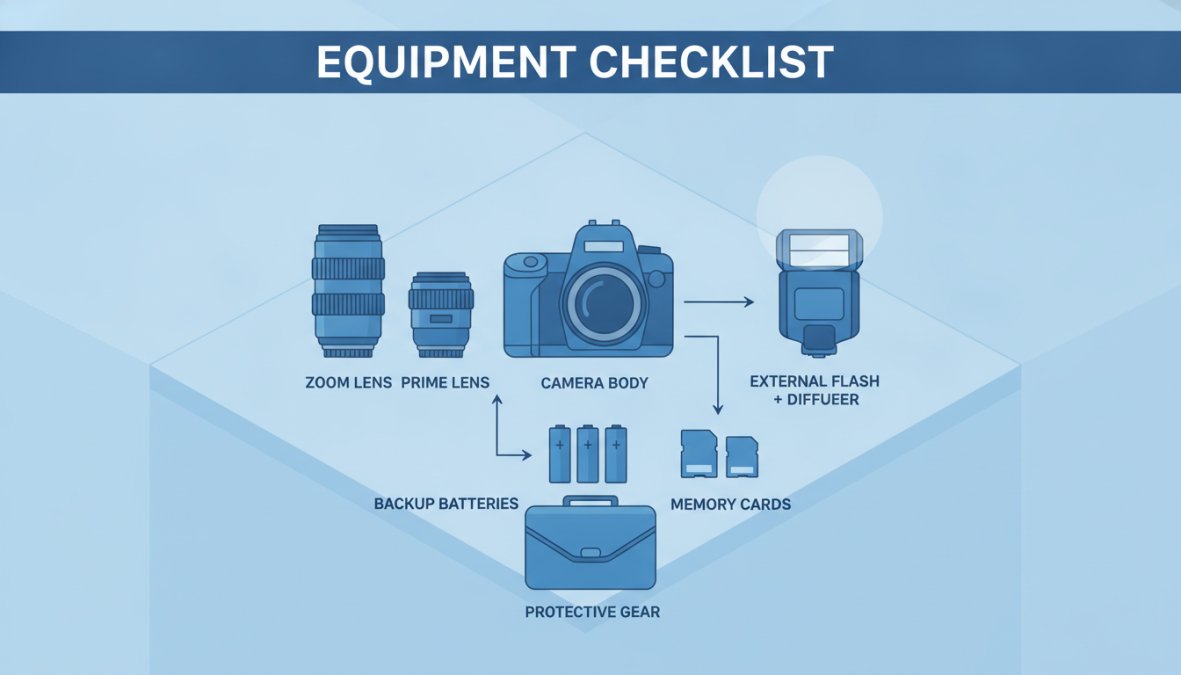
Start with two camera bodies. Full-frame sensors handle low light better than crop sensors, and a backup body means lens failure or battery problems don’t end your shoot.
For lenses, bring:
- A 24-70mm f/2.8 zoom lens (workhorse for speakers, group photos, and candid moments)
- A 70-200mm f/2.8 telephoto (for stage work and compressed perspective)
- A 35mm or 50mm f/1.4 prime lens (for intimate candid work and ultra-low-light moments)
An external flash is essential. Ballroom lighting is often too dim or harsh; a flash with diffuser softens light and fills shadows. Bring two external flash units plus double the batteries you think you’ll need.
Your backup gear should include:
- 4-6 extra memory cards (one corrupted card shouldn’t cost you the entire event)
- Extra batteries for both camera bodies and flashes
- A sturdy tripod for formal group photos
- Lens cleaning kit
- Gaffer tape and small toolkit
Running out of memory or battery power at a corporate event is career-damaging. Bring 50% more backup gear than you think you’ll need.
Creating a Shot List and Scouting Your Venue
A corporate event photography shot list is the difference between delivering what your client expected and delivering what you thought looked good.
Before the event, contact the client and ask for a detailed timeline. When does the CEO arrive? When are remarks? When is the group photo? When is the award presentation? Create a written shot list organized by time:
- Arrival/registration
- Keynote speaker
- Award presentations
- Networking/cocktail hour
- Group photos
Communicating with Event Organizers and Stakeholders
Visit the venue 1-2 days before the event during similar lighting conditions. Identify the stage position and sightlines, areas with best and worst lighting, positioning for keynote speeches, gathering spots for group photos, and whether you’ll need flash or ambient light is sufficient.
Meet with the event organizer and ask about corporate branding requirements. Should the company logo appear in backgrounds? Are there specific executives who must be photographed together? Are there sensitive moments that shouldn’t be photographed?
Communicate your needs clearly. Tell the organizer you’ll need 10 minutes before group photos to set up lighting and position people.
The event organizer is your partner, not your obstacle. Clear communication before the event prevents misunderstandings and gives you the access and cooperation needed to deliver great images.
Capturing Candid and Posed Shots with Corporate Branding Alignment
Corporate clients want candid shots showing authentic moments and posed shots showcasing their brand.
For candid photography, position yourself where you can see faces and interactions. Shoot from the side or slightly behind speakers to capture their expressions and audience reactions. Anticipate moments, when someone is about to laugh or shake hands, press the shutter a half-second before the peak.
Use your prime lens (35mm or 50mm) for candid work. The wider field of view captures context without backing away so far that you lose detail.
For posed shots, work quickly and give clear direction. Position the group, take 3-4 shots with slight variations, and move on. Have people stand at angles to each other rather than in rigid rows.
Corporate branding alignment means understanding what the client’s brand represents. A tech startup’s event photography should feel energetic and informal. A financial services firm’s should feel polished and professional. Your composition, color grading, and subject selection communicate brand values.
Frame shots to include branded elements incidentally, the company logo on the podium, event signage, branded backdrops, without forcing it.
Low-Light Performance and On-Site Data Management
Corporate events often happen in venues with challenging lighting. Ballrooms are notoriously dim. Conference centers have mixed lighting. Your camera’s low-light performance directly affects image quality.
Full-frame cameras outperform crop sensors in low light. If considering a camera upgrade, low-light performance should be a primary factor.
Autofocus in dim light can be slow or unreliable. Use single-point autofocus on the eyes. In very dim lighting, use back-button focus and manually focus using the focus ring, it’s faster than waiting for autofocus to hunt.
External Flash, Diffuser Techniques, and Raw Format
An external flash with diffuser is your low-light solution. Bounce the flash off a white ceiling when possible for more natural-looking light than direct flash.
For candid work, use fill flash at low power (1/4 to 1/2 power). This adds just enough light to fill shadows without overwhelming ambient light.
Shoot in raw format. Raw files preserve more detail in shadows and highlights, giving you flexibility in post-processing. Corporate clients often request color adjustments or exposure fixes; raw format makes these changes non-destructive.
After each hour of shooting, ingest memory cards to a portable hard drive. This protects against card failure and provides backup if a card gets lost or damaged.
Bring a portable SSD with at least 1TB capacity. Transfer files during event breaks. If a memory card fails mid-event, you still have backups of everything shot so far.
Corporate Event Photography Pricing Guide and Legal Protections
Corporate event photography pricing varies based on experience, location, and deliverables. A full-day corporate event in Washington DC typically ranges from $2,000-$5,000+ depending on portfolio and client expectations.
Your pricing should account for shooting time, preparation time, post-processing time, delivery method, and usage rights.
Contracts, Deliverables, and Client Expectations
A written contract protects both you and your client. Specify:
- Shooting time and location
- Number of edited images you’ll deliver
- Turnaround time
- Deliverable format
- Usage rights
- Cancellation policy
- Payment terms
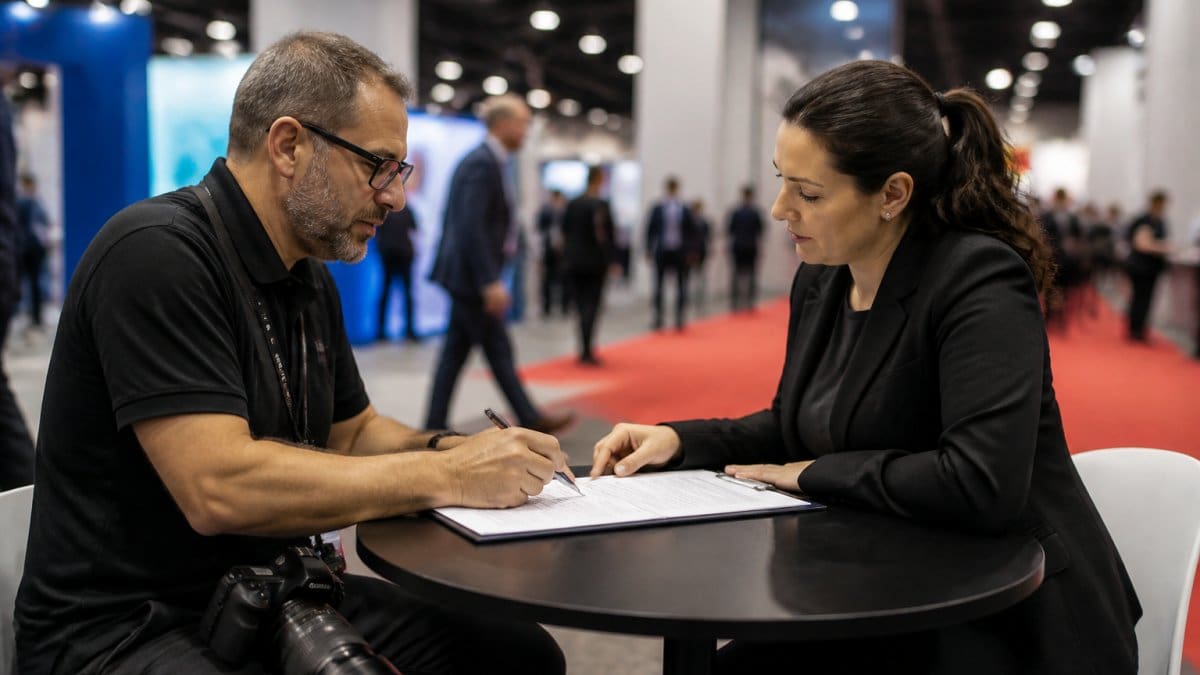
Specify that you own the copyright and the client is licensing images for specific uses. This prevents unauthorized reselling or usage.
Be explicit about deliverables. "20-30 edited images per hour of shooting" is clear. "A bunch of great photos" is not. Faster turnaround (3-5 business days instead of 2-3 weeks) justifies higher pricing.
Post-Processing, AI-Assisted Workflow, and Turnaround Time
Post-processing is where your images go from good to client-ready. The goal is consistency, every image should have the same color temperature, exposure, and style.
Batch Editing, Color Grading, and Metadata Management
Start with batch editing in Lightroom. Apply basic exposure and white balance correction to all images at once, then refine individual images. Create a custom Lightroom preset matching your client’s brand.
Color grading should be subtle in corporate photography. Avoid trendy looks that will look dated quickly. Aim for natural, professional color that flatters skin tones and makes the venue inviting.
Add keywords to every image (attendee names, event name, location, date). This makes images searchable and helps clients find specific photos later.
AI-assisted workflow can accelerate post-processing by auto-enhancing exposure, white balance, and contrast. However, AI enhancements often need manual refinement, don’t rely on automation for final results.
Batch export files in the client’s requested format (usually high-resolution JPEGs at 300 DPI for print, or 72 DPI for web). Create an easy-to-navigate folder structure.
Essential Corporate Event Photography Tips for Professional Success
Corporate event photography is a business, not just an art. Technical skills matter, but so does reliability, communication, and professionalism.
Deliver what you promise, on time. Missed deadlines damage your reputation far more than a slightly underexposed image. Build turnaround time into your pricing so you’re not rushing post-processing.
Communicate proactively. Send pre-event confirmation emails and follow-up thank-yous confirming delivery dates.
Invest in your gear and education. Corporate clients expect professional results. A $2,000 investment in a better lens or faster computer pays for itself in client satisfaction and faster turnaround.
Build a portfolio of corporate work. Potential clients want to see images from similar events. Network within the corporate event industry, event planners, corporate communications managers, and venue owners are repeat clients.
Corporate event photography demands technical skill, business acumen, and reliability. The tips above cover essentials: camera settings that work in any lighting, equipment that prevents failures, and business practices that build client relationships. Event Photojournalism has used these principles to deliver award-winning photography for hundreds of corporate events across the DMV area. When you’re ready to elevate your corporate event photography or need professional coverage for your next event, contact us to discuss how we can capture the moments that matter to your organization.
Frequently Asked Questions
What camera settings work best for corporate event photography indoors?
For indoor corporate events, start with aperture priority mode using f/2.8 to f/4.0 to capture depth while maintaining shutter speed above 1/125s. Set ISO sensitivity between 1600-3200 depending on available light, and use auto white balance or set a custom preset for fluorescent or LED lighting. Shoot in raw format for maximum post-processing flexibility. These corporate event photography tips ensure sharp, well-exposed images in challenging lighting.
What should I include in a corporate event photography shot list?
Your corporate event photography shot list should include key moments: arrivals, speaker presentations, award presentations, networking sessions, group photos, signage and branding elements, food/beverage displays, and candid interactions. Work with event organizers and stakeholders to prioritize specific deliverables. List approximate times for each moment and identify key individuals to photograph. A detailed shot list prevents missed moments and aligns with client expectations and corporate branding requirements.
How do I handle low-light conditions at corporate events?
Use an external flash with a diffuser to soften harsh shadows and maintain natural-looking light. Combine this with high ISO sensitivity (2000-4000), wider apertures (f/2.8 or lower with prime lenses), and slower shutter speeds (1/60s or faster). Shoot in raw format for better post-production recovery. Scout your venue beforehand to identify the best available light sources and plan backup positions. These low-light performance techniques ensure sharp, professional images even in dimly lit ballrooms or conference spaces.
What should a corporate event photography pricing guide include?
Your corporate event photography pricing guide should cover hourly rates, package tiers (4-hour, 8-hour, full-day), deliverable counts, turnaround time, revision rounds, and usage rights. Include separate fees for travel, rush processing, additional photographers, and prints. Specify what's included in your base price: edited images, backup gear, on-site data redundancy, and metadata tagging. Clarify contract terms regarding client expectations, image ownership, and cancellation policies to protect both parties.
This article was written using GrandRanker