Last Updated: October 24, 2026
Quick Summary
To capture candid nonprofit event moments, stop performing and stay ready: keep the camera on at chest height, pre-focus on likely reactions, and shoot from the side of the room rather than the front. Build a shot list tied to fundraising deliverables, lock in low-light settings, and secure consent before close frames.
- Position yourself near bars, the dance floor edge, or check-in so guests stop noticing you.
- Write a shot list of deliverables, not subjects, and assign a runner to check shots off.
- Start with f/1.8 to f/2.8, 1/125s or faster, and ISO 1600 to 6400 in ballrooms.
- Fire three to five frames in burst mode to catch eyes open and the right expression.
- Never publish identifiable images of anyone under 18 without written parent or guardian consent.
Table of Contents
- How to Take Candid Photos at Events Without Being Noticed
- Build an Event Photography Shot List Tied to Fundraising Goals
- Low-Light Event Photography Settings for Ballrooms and Receptions
- Nonprofit Photography Storytelling That Moves Donors
- Consent, Privacy, and Dignified Representation at Fundraisers
- Capture Emotion, Action, and Genuine Reactions in Every Frame
- Plan Your Next Gala Coverage With Event Photojournalism
- Frequently Asked Questions
How to Take Candid Photos at Events Without Being Noticed
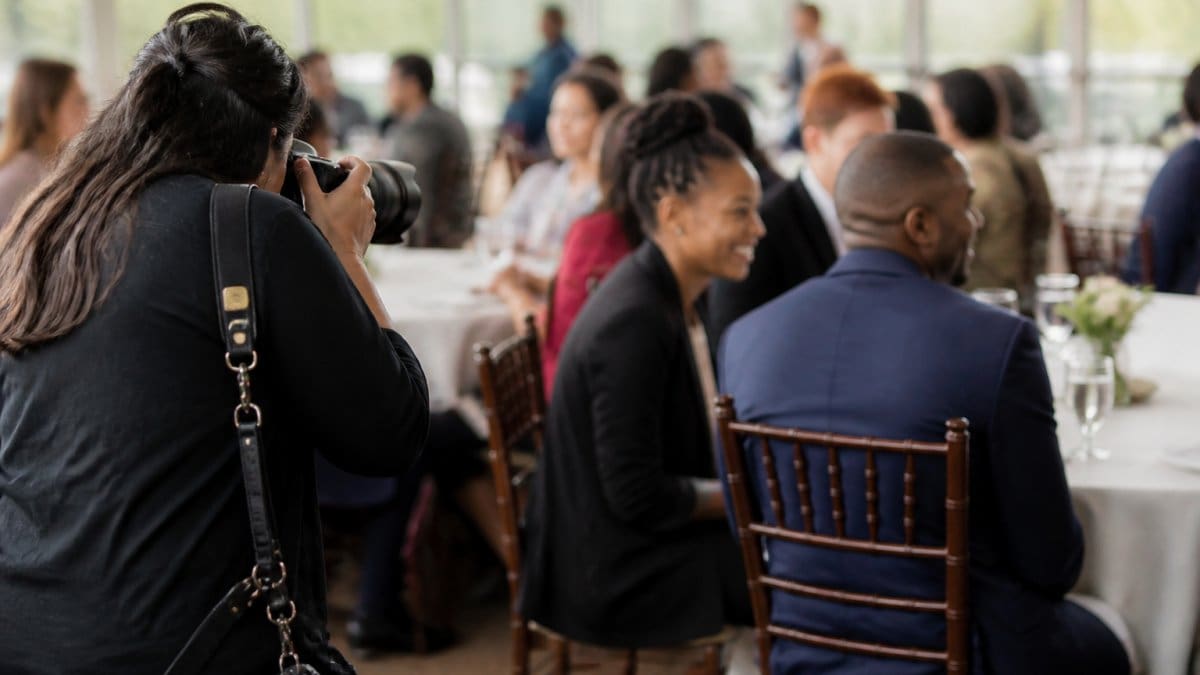
The best tips for capturing candid nonprofit event moments start with one rule: stop performing. A camera that stays half-raised at chest height, a photographer who reads the room before moving, and a long lens that keeps you out of conversations will produce more usable frames than any amount of direction.
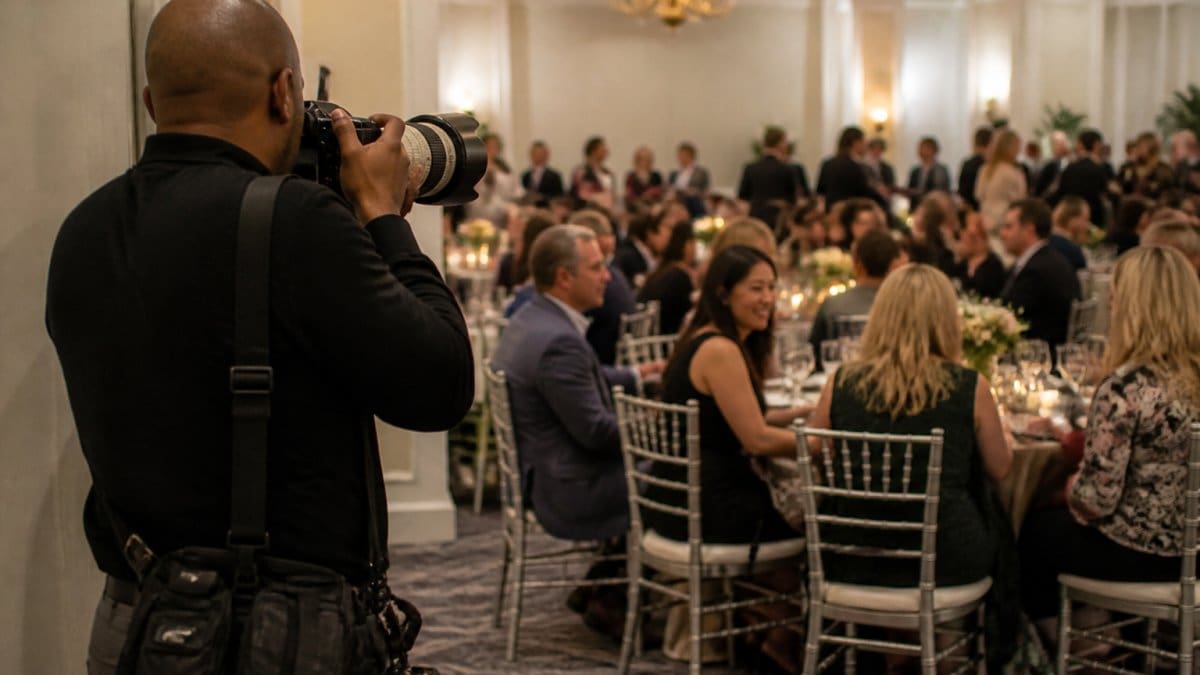
Candid photography is the practice of photographing people without directing them, so the image records what actually happened rather than a staged version of it. That distinction matters for nonprofits. A donor laughing at a table is proof of a good evening.
Blend Into the Crowd and Shoot From a Distance
Position yourself where people already expect movement: near bars, at the edge of the dance floor, beside the check-in desk. Guests stop noticing you once you’ve been in the same spot for a while.
A common mistake is standing at the front of the room facing the crowd. That makes you a speaker, not an observer. Stand at the side, angle your body away, and let people’s eyes pass over you.
Keep the Camera Ready for Fleeting Reactions
Laughter lasts about a second. A toast reaction lasts less. If your camera is in a bag or turned off, you will miss it.
Set exposure and focus before the moment arrives. Pre-focus on the head table, then wait. Keep the camera on and at chest height with the strap around your neck.
Watch out: chimping, or reviewing every shot on the back screen, is the fastest way to look like an amateur and miss the next three moments. Check your settings once, then trust them.
Build an Event Photography Shot List Tied to Fundraising Goals
A shot list is the single most useful tool for turning event coverage into communications assets. Build yours backwards from what your team needs after the event: the annual report, the thank-you email, the sponsor deck, the grant application.
The mistake most nonprofits make is writing a shot list of subjects (“board members,” “sponsors,” “guests”) instead of a shot list of deliverables. A subject list gives you a folder of files.
Map Each Shot to the Deliverable It Serves
Before the event, ask your development and communications staff one question: what are we publishing in the next 90 days? Then build the list around those outputs.
- Annual report: one wide room shot that shows scale, one mission-in-action frame of staff or volunteers working, one dignified portrait-style frame of a program participant (with consent), and one donor-and-staff interaction. Annual reports need landscape orientation and generous negative space for text overlays.
- Grant applications: program activity frames that show the funded work actually happening, plus a clean shot of any signage, materials, or equipment the grant paid for. Foundations often want proof of implementation, not atmosphere.
- Donor thank-you emails: candid reactions during the paddle raise or appeal moment, a donor laughing with staff, a table mid-conversation. These run small in email, so favor tight framing over wide room shots.
Assign Roles and Run a Simple Workflow
A shot list only works if someone owns it. For a small team, assign three roles even if one person wears two hats:
- Lead photographer: owns the shot list, works the room, and calls out when a deliverable is still missing.
- Second shooter or phone backup: covers the opposite side of the room and the detail shots the lead will miss while tracking emotional peaks.
- Runner or coordinator: holds the list, checks off shots as they are captured, and handles consent questions on the floor so the photographer stays behind the camera.
A practical pattern is to print the shot list on a single page, grouped by deliverable, with a checkbox per shot. The runner marks shots off in real time. Ten minutes before the program ends, the lead and runner compare notes and chase whatever is still unchecked.
Back Up and Deliver on a Deadline
Decide before the event how images get from the card to the communications team. A common pattern:
- Offload cards to a laptop or drive at the event or immediately after.
- Back up to a second location the same night (a cloud folder or a second drive).
- Cull to a shortlist grouped by deliverable, not by timestamp.
If you want a deeper walkthrough of gala-specific shot lists and donor privacy, see our guide to nonprofit gala photography.
Here is how each shot on the list maps to the deliverable it serves.
| Deliverable | Shots to capture | Key note |
|---|---|---|
| Annual report | Wide room shot, mission-in-action frame, dignified participant portrait, donor-and-staff interaction | Landscape orientation with negative space for text |
| Grant applications | Program activity frames, signage, materials, or equipment the grant paid for | Foundations want proof of implementation |
| Donor thank-you emails | Candid reactions during paddle raise, donor laughing with staff, table mid-conversation | Favor tight framing over wide room shots |
| Social media | Vertical crops of emotional peaks, detail shots, behind-the-scenes volunteer frames | Shoot with headroom for 4:5 or 9:16 crops |
| Sponsor deck and recap | Logo placement, sponsor representatives at their table, signage in context | Logo must be sharp and legible |
| Press and media | Keynote speaker at podium, executive director greeting guests, check-presentation or award moment | Clean frames only |
Low-Light Event Photography Settings for Ballrooms and Receptions
Ballrooms are dark on purpose. Uplighting, candles, and dimmed chandeliers create atmosphere, and they punish auto mode.
Start here and adjust:
- Aperture: f/1.8 to f/2.8 to let in light
- Shutter speed: 1/125s or faster to freeze gestures
- ISO: 1600 to 6400, as high as your camera handles cleanly
Burst mode, also called continuous shooting, is your safety net for reactions. Fire three to five frames instead of one.
Bouncing a flash off a ceiling can work in a plain room, but in a ballroom it flattens the mood. Available light almost always reads better.
Phone Photography Settings When You Are on a Tight Budget
A phone can carry a small nonprofit’s event coverage. Lock exposure and focus by tapping and holding on your subject, then drag the slider down slightly so highlights don’t blow out. Turn off the flash.
Keep one thing in mind: phone sensors struggle in low light, so get closer than you would with a camera and use the natural light around the room.
Nonprofit Photography Storytelling That Moves Donors
Nonprofit photography storytelling works when each image answers a donor’s real question: did my gift do something? A wide shot of a full room says the event was popular. A close shot of a client shaking hands with a volunteer says the money reached a person.
Build a simple arc across your final set:
- Why: the need your mission addresses
- Who: the people served, shown with dignity
- How: the work happening in the room
That arc gives your communications team a narrative, not a folder of files. For a closer look at how candid and posed coverage differ, read candid vs posed gala photos.
Consent, Privacy, and Dignified Representation at Fundraisers
Consent is not optional, and it is not one-size-fits-all. Many nonprofits find that a short photo release in the registration flow, plus visible signage at the entrance, handles most guest photography. Board members and major donors often want more control. The difference between a policy that protects your organization and one that just looks good on paper is whether it gives staff a clear action at the moment a camera is raised.
Build a Three-Layer Consent System
A workable system has three layers, each doing a different job:
- Registration release: a short checkbox in the event registration form that states photos may be taken and used in organizational communications, with a link to the full policy. Keep the language plain and specific about where images may appear (website, social, annual report, grant materials, press).
- Visible signage and a stated opt-out: signage at check-in and at the entrance to the main room, plus a named person and contact method guests can use to opt out. A common pattern is a colored lanyard, sticker, or badge marker for guests who do not want to be photographed, so the photographer can see the opt-out from across the room without asking.
- On-the-spot verbal consent: for any close or identifiable frame, especially of a vulnerable person, a brief ask before the shutter. “May I take your photo for our newsletter?” takes two seconds and prevents most problems.
Handle Minors and Vulnerable People Separately
Minors and people in vulnerable situations need a higher bar than a general event release.
- Minors: do not publish identifiable images of anyone under 18 without written parent or guardian consent, even if the child is at a public event. If your organization serves youth, keep a signed release on file before the event and brief the photographer on which participants are cleared.
- Program participants and beneficiaries: a general event release is usually not enough. Use a separate, specific release that explains how the image will be used and for how long, and give the person a real chance to decline without consequence.
- Sensitive moments: never photograph a guest’s check, screen, giving amount, medical information, or a private conversation. If someone is crying, in distress, or in a private moment, ask before shooting, and default to not shooting if you cannot ask.
Represent People With Dignity, Not Pity
Dignified representation is a shooting discipline, not just a caption fix. A few practical rules:
- Photograph people at eye level, engaged in activity, with agency, not looking down at the camera or framed as passive recipients.
- Avoid framing that emphasizes hardship over personhood. A volunteer and a participant working side by side reads differently than a lone figure in a doorway.
- Get names and context when you can, and caption with specificity rather than generic labels.
Publishing a photo of a donor who asked not to be photographed can cost you the relationship, not just the image. Build the opt-out into the event flow so the answer is visible before the camera comes up.
Our documentary photography ethics page covers the fuller framework.
Capture Emotion, Action, and Genuine Reactions in Every Frame
Emotion lives in the seconds after something happens. The toast ends, and the table turns to each other. The speaker finishes, and a board member leans back and exhales.
Three habits help:
- Watch hands and faces, not the stage
- Shoot the reaction, not just the speaker
- Take multiple shots through a moment, then move on
Framing matters too. Keep backgrounds clean by shifting a step left or right. Look for eyes in focus. A sharp expression with a soft background beats a technically perfect wide shot every time.
Plan Your Next Gala Coverage With Event Photojournalism
Capturing candid nonprofit event moments takes more than a good camera. It takes a photographer who knows when to disappear, what your donors need to see, and how to deliver images your team can use the next morning. If you’re weighing coverage options, our DMV gala photographer page shows how we work, and our gala and nonprofit event photography FAQ answers common questions.
Frequently Asked Questions
How can you make event guests feel comfortable being photographed?
Tell guests about photography before the event through the invitation, signage, or a brief welcome announcement. When people know a photographer is present, they relax faster and stop posing when the camera appears. Photographers should avoid direct eye contact after a shot, keep moving, and use a zoom or telephoto lens to shoot from a distance. A short line in the program such as ‘photos will be taken for our annual report’ removes the surprise and keeps candid nonprofit coverage authentic.
What moments should a photographer capture at a nonprofit fundraiser?
Build your event photography shot list around the story you need to tell donors. Prioritize arrivals and greetings, sponsor signage with VIPs, speakers and honorees, audience reactions during the program, volunteers at work, and candid interactions between guests. Add detail shots of table settings, auction items, and branded materials. These unposed shots support fundraising appeals, annual reports, and social posts far better than posed photo lineups that rarely get used.
How do you photograph candid moments in low-light event spaces?
Raise your ISO, open the aperture wide, and keep a fast shutter speed to freeze movement in dim ballrooms. Avoid direct flash where possible and work with available light, room lamps, and stage lighting. A zoom lens with image stabilization helps when you shoot from a distance. Test your low-light event photography settings during setup, then use burst mode to catch natural expressions between frames. Reviewing a few test shots before the program starts saves an entire evening of soft or blurry images.
How should nonprofits prepare guests and staff for event photography?
Send a short note with the invitation explaining that photos will be taken and how images will be used. Place small signs at the entrance and share a briefing with board members and VIPs so they know where to find the photographer. Assign one staff member to point out key donors and sponsors during the event. This preparation makes nonprofit photography storytelling smoother, protects privacy, and gives your team a clear shot list tied to fundraising and communications goals.
The challenge is not finding a photographer with a good lens. It is finding one who understands that your event images have to raise money, satisfy sponsors, and protect the people in them. Event Photojournalism builds every shoot around those goals, with award-winning photography, customized shot planning, and high-resolution delivery your communications team can use right away. Get started with Event Photojournalism and turn your next gala into a visual asset for the whole year.