Table of Contents
- Why Professional Nonprofit Gala Photography Matters
- Building a Shot List for Nonprofit Event Photography
- Mastering Low-Light and Event Lighting Challenges
- Capturing Candid Moments vs. Posed Portraits
- Photography Release Forms for Nonprofit Events
- Event Photography Pricing for Nonprofits
- Post-Production Workflow and Image Delivery
- Conclusion
Last Updated: August 21, 2026
Nonprofit posts with images see engagement rates 650% higher than text-only posts. That’s the difference between your gala reaching 500 people and 3,500. Yet most nonprofits treat photography as an afterthought, hiring whoever’s available or asking a staff member with a nice camera to "grab some shots." The results are predictable: blurry photos, missed moments, and no usable content for the next morning’s press release.
Professional nonprofit gala photography isn’t about fancy equipment. It’s about understanding your mission, anticipating moments donors will remember, and delivering images that move people to give. This guide covers the strategies, technical foundations, and workflows that separate exceptional gala coverage from the mediocre.
Why Professional Nonprofit Gala Photography Matters
Your gala is a fundraising tool with a 12-month lifespan. According to Raising Paddles data on 800 nonprofit gala events, nonprofits averaged $433,227 in gala revenue in 2025, with attendance averaging 348 people per event. Gala attendance increased 6% and giving per attendee jumped 8.7% from 2022 to 2025.
Professional nonprofit gala photography delivers three critical outcomes. First, it creates social proof. Trajectory Web Design research on nonprofit social media engagement found that nonprofit posts with images receive 2.3 times higher engagement than text-only posts. Your gala photos are your most cost-effective marketing asset for the next year.
Second, it protects relationships. When donors see themselves celebrated in professional images, they feel valued. When board members see polished photos in your annual report or LinkedIn, they trust the organization is serious. When prospects see gala photos before deciding whether to attend next year, they’re more likely to buy a ticket.
Third, it provides proof of impact. For grant proposals, donor stewardship, and year-end campaigns, high-quality event photography bridges the gap between mission statements and tangible results. Professional Photographers of America on nonprofit event photography impact emphasizes that photography transforms abstract missions into tangible results that inspire action.
Professional gala photography isn’t a luxury, it’s an investment that pays for itself through increased sponsorship commitments, repeat donor attendance, and grant funding.
Building a Shot List for Nonprofit Event Photography
A shot list is your battle plan. Without one, you’ll react to moments instead of capturing them strategically.
Start by identifying non-negotiable shots:
- Guest arrivals and check-in
- Opening remarks and keynote speaker
- Live auction or fund-a-need moment
- Award presentations or honoree recognition
- Candid donor interactions with board members
- Sponsored booth or branded areas
- Closing remarks and standing ovation
- Group photos with VIPs, board members, and major donors
Brief your photographer on context. Create a one-page guide with names and faces of 5-10 key people, the program timeline with approximate times, sponsor locations, any attendees who prefer not to be photographed, and the story you want told.
Communicate delivery expectations upfront. Do you need 10-15 social media selects within 24 hours? A full curated gallery within 7 business days? High-resolution files for print? Different deliverables require different shooting strategies.
| Shot Category | Key Moments | Delivery Priority |
|---|---|---|
| Arrivals & Atmosphere | Guest check-in, mingling, opening energy | Social media selects (24 hours) |
| Program Moments | Speeches, presentations, auctions | Full resolution (press release) |
| Donor Interactions | Candid conversations, toasts, recognition | Full gallery (stewardship) |
| Sponsored Content | Booths, signage, brand visibility | Sponsor-specific selects (7 days) |
| Closing Moments | Standing ovations, group photos, celebration | Full gallery (annual report) |
Mastering Low-Light and Event Lighting Challenges
Nonprofit galas happen in ballrooms, historic mansions, and gardens, rarely in spaces designed for photography. Dim ambient lighting, mixed color temperatures, and backlighting create hostile conditions for capturing detail and emotion.
Most amateur photographers crank up the flash, blow out faces, and create harsh shadows. Professional nonprofit gala photography requires understanding how light behaves and choosing the right tools for your venue.
Camera Settings for Gala Environments
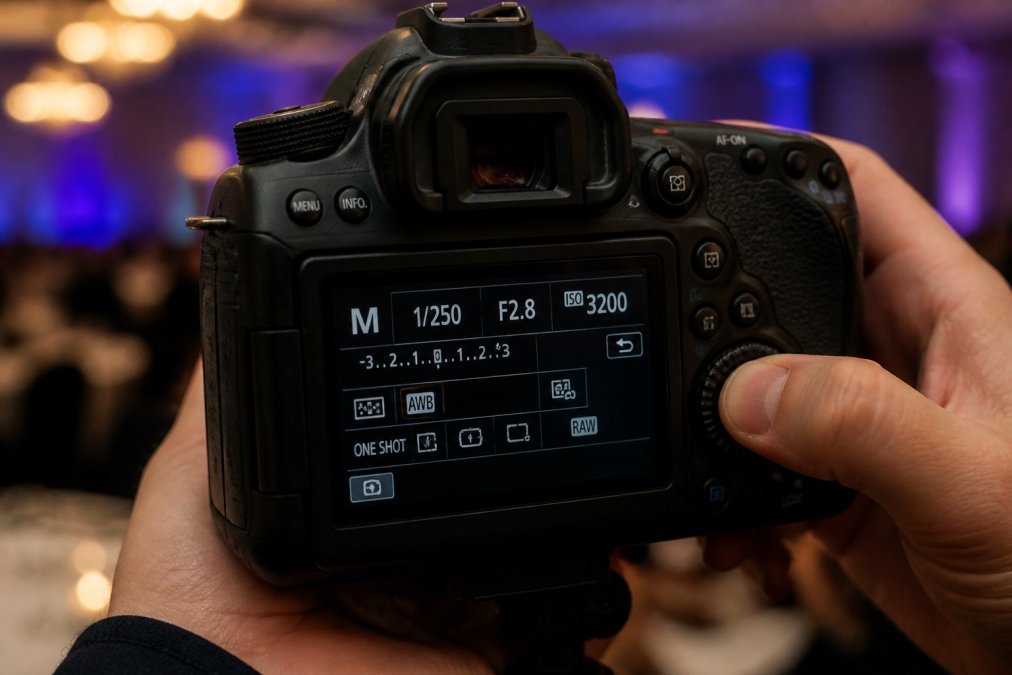
Start with aperture. For gala work, use a fast lens, f/2.8 or wider. A 70-200mm f/2.8 lens is the workhorse for nonprofit gala photography because it captures candid moments from a distance without being intrusive.
For shutter speed, use 1/250th or faster for candid movement to avoid motion blur. For stationary speakers, 1/125th is sufficient. In very dim venues with image stabilization, you might drop to 1/160th, but never below 1/125th.
ISO is where you make the real trade-off. Modern cameras handle ISO 3200-6400 beautifully. Pushing to 12,800 introduces visible noise requiring aggressive post-production cleanup. Use f/2.8 + 1/250th shutter speed + ISO 3200-5000 as your baseline. If the venue is darker, increase ISO before decreasing shutter speed or aperture.
Shoot in RAW format for complete white balance control in post-production. Set your camera to Kelvin mode around 3500K as a starting point, then adjust based on the dominant light source in each room.
Flash vs. Natural Light Strategy
Most professional nonprofit gala photographers avoid flash entirely. Direct flash creates flat, unflattering light that kills emotion.
Use available light as your primary tool. When you do use flash, use off-camera flash with a diffuser or bounce it off the ceiling to soften the light. Candid moments without flash feel more natural and authentic.
Use flash only when capturing a speaker on a dark stage, taking formal group photos where you need consistent lighting, or when ambient light is so dim that ISO 6400+ creates unacceptable noise. When using flash, invest in a quality off-camera system like a Godox SL-60W LED panel, which provides continuous light and is less jarring to guests.
Capturing Candid Moments vs. Posed Portraits
Your donors didn’t pay $500 per plate to look stiff and formal. They came to celebrate and connect.
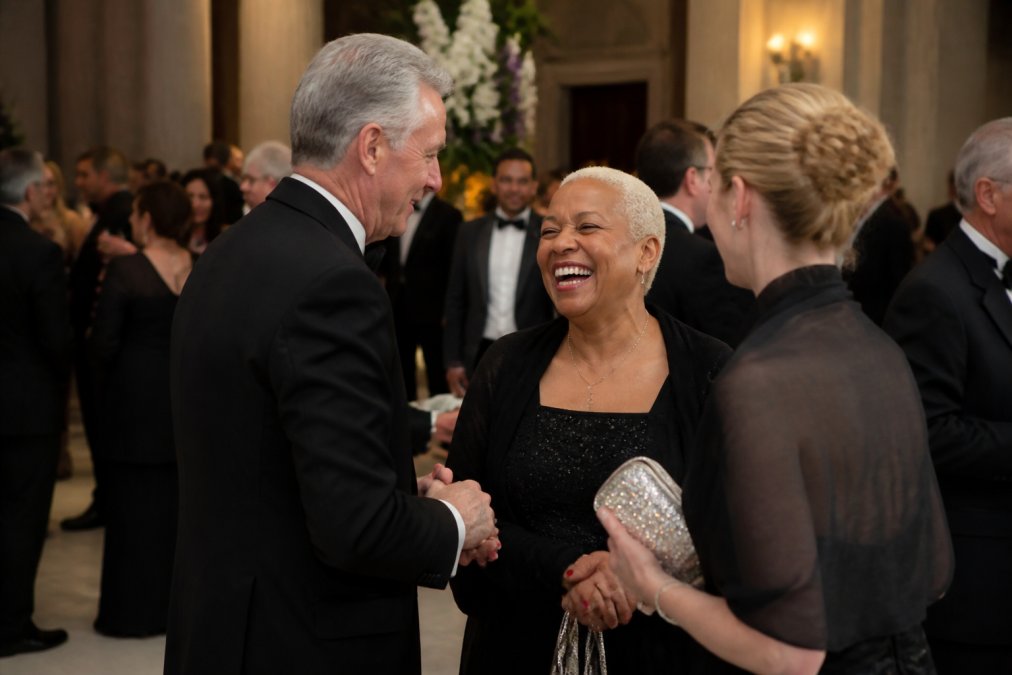
Candid photography requires anticipation. You’re predicting where genuine moments will happen and positioning yourself to capture them without interrupting. Josh Hirsch, a professional photographer at Bloomerang, notes: "If there is one thing that instantly kills emotional connection to a cause, it’s stock photos. Those fake smiles and groups of strangers laughing together won’t connect a donor to your cause." high-margin fundraising.
You need both candid and posed shots. Candid photography captures genuine emotion, the moment a donor’s face lights up during the mission moment, authentic laughter during a toast, quiet conversations between longtime supporters. Posed photography documents formal structure, recognition of major donors, board photos for your annual report, and sponsor acknowledgments.
Strategy: shoot 70% candid, 30% posed. Start the evening capturing candid moments as guests arrive. During the program, shift to capturing speakers and key moments. After the formal program, return to candid work. Dedicate the last 30 minutes to posed group photos.
For candid work, position yourself at room edges using a longer lens (70-200mm) to capture moments from a distance. Anticipate genuine smiles, animated conversations, and emotional reactions during speeches.
For posed work, find good light away from backlighting. Give clear direction: "Stand here, look at each other, relax your shoulders." Take 3-5 frames quickly.
Photography Release Forms for Nonprofit Events
You’ve captured incredible images, but you can’t use them without permission. A photography release form grants your nonprofit the right to use photos in marketing, fundraising, and communications materials.
Consent Protocols and Privacy Best Practices
Get written consent before publishing any identifiable photo. For nonprofit gala photography, this typically happens two ways.
Option 1: Blanket consent at check-in. Include a simple consent checkbox on the registration form or table card: "I consent to having my photo taken and used in nonprofit communications and marketing materials."
Option 2: Individual consent forms. For sensitive situations or donors requesting privacy, collect individual releases and keep them on file.
ProShoot.io guidance on nonprofit photography consent emphasizes that nonprofits frequently photograph vulnerable populations, making strong consent protocols essential for both legal requirements and donor trust. Create a simple one-page release form specifying what photos will be used for, where they’ll be published, how long the nonprofit retains rights, whether images can be edited, and whether the person will be credited.
Keep signed releases organized by event and date. Train your photographer on your consent policy before the event. They need to know which areas are "no photo" zones and which attendees have opted out.
Never identify someone in a photo without their consent, even with a general release. A donor might consent to being photographed but not to being named in a caption.
Event Photography Pricing for Nonprofits
Professional event photography pricing reflects photographer experience, hours of coverage, number of edited images delivered, turnaround time, and licensing rights.
According to Trajectory Web Design research on nonprofit event photography rates, nonprofit event photography rates often start at $79-$175 per hour with a two-hour minimum. Premium photographers with strong portfolios typically charge more.
Don’t shop purely on price. Instead, compare deliverables. Ask potential photographers how many edited images you’ll receive, turnaround times for social media selects and full galleries, whether you get RAW files or JPEGs, if you can use images for fundraising and marketing, and what happens if you’re unhappy with results.
Match the photographer’s pricing to your actual needs. If you only need social media content, don’t pay for a full-day shoot with 500 images. If you need comprehensive documentation for your annual report and next year’s marketing, don’t hire someone who delivers 50 images.
Post-Production Workflow and Image Delivery
Post-production has three phases: culling, editing, and delivery.
Culling is ruthless selection. Professional photographers typically deliver 15-25% of captured images as finals. From 2,000 shots, you’re selecting 300-500 for editing.
Editing includes color correction, exposure adjustment, contrast and clarity enhancement, cropping, and removing distractions. The goal is consistency across all gala photos.
Delivery requires two timelines.
Turnaround Times and Social Media Selects
Social media selects should be delivered within 24 hours. Select 10-15 strongest images showing genuine emotion, donor engagement, and mission impact. These should be fully edited and ready to post.
The complete curated gallery typically takes 7 business days. This is 150-300 fully edited images organized by moment (arrivals, program, candid mingling, closing). This gallery is your comprehensive marketing asset for the next 12 months.
When briefing your photographer, specify what "ready to post" means. Do you need captions, hashtags, alt text for accessibility, or image credits for sponsors? Communicate these details upfront.
Event Photojournalism delivers social media selects within 24 hours and full curated galleries within 7 business days, ensuring you have content ready for immediate press release distribution and sustained marketing impact. We provide high-resolution files suitable for print, annual reports, and grant proposals.
Professional nonprofit gala photography is an investment in your fundraising, donor relationships, and long-term mission impact. The difference between hiring a photographer based on price and hiring one based on capability is measurable: better images, faster delivery, and content that moves people to give. Event Photojournalism specializes in nonprofit gala coverage across the DMV area, delivering award-winning imagery that elevates your brand and amplifies your message. Contact us to discuss your gala photography needs and get a customized quote.
=== FAQ ANSWERS (audit these too, same rules) ===
[1] Q: What shots are essential for a nonprofit gala?
A: Essential shots include guest arrivals, keynote speeches, award presentations, standing ovations, live auctions, candid donor interactions, sponsor signage, and posed photos with VIPs and board members. Research shows galas averaged 348 attendees in 2025, so you’ll need variety to capture the full event scope. A balanced shot list ensures you document both emotional moments and key fundraising activities that donors and sponsors care about.
[2] Q: How do you handle low-light photography at evening galas?
A: Use a fast aperture (f/2.8 or wider), raise ISO to 1600-3200, and set shutter speed to 1/125th or faster to freeze motion. Mix available light with off-camera flash or bounce flash to avoid harsh shadows on faces. Scout the venue beforehand to identify light sources, windows, uplighting, or stage lights, and position yourself strategically. Avoid on-camera flash pointing directly at subjects, which creates unflattering reflections and disrupts the event atmosphere.
[3] Q: What makes candid nonprofit gala photography different from posed shots?
A: Candid photography captures genuine emotion and authentic moments, laughter, tears of joy, spontaneous hugs, without the stiffness of posed portraits. For nonprofit galas, candids tell the mission story more powerfully than smiling-at-camera shots. Balance candids with a few posed shots of VIPs and sponsors for press releases, but prioritize candids for social media and fundraising materials where authenticity drives donor engagement.
[4] Q: Do I need a photography release form for nonprofit gala attendees?
A: Yes. A written consent policy is essential for legal protection and donor trust. Nonprofits should obtain signed model releases before photographing attendees for marketing or social media use. Brief your photographer on the consent protocol before the event and train them on which images can be published. For vulnerable populations, consent is both an ethical and legal requirement. Keep releases on file for at least three years in case questions arise later.
Frequently Asked Questions
What shots are essential for a nonprofit gala?
Essential shots include guest arrivals, keynote speeches, award presentations, standing ovations, live auctions, candid donor interactions, sponsor signage, and posed photos with VIPs and board members. Research shows galas averaged 348 attendees in 2025, so you'll need variety to capture the full event scope. A balanced shot list ensures you document both emotional moments and key fundraising activities that donors and sponsors care about.
How do you handle low-light photography at evening galas?
Use a fast aperture (f/2.8 or wider), raise ISO to 1600-3200, and set shutter speed to 1/125th or faster to freeze motion. Mix available light with off-camera flash or bounce flash to avoid harsh shadows on faces. Scout the venue beforehand to identify light sources, windows, uplighting, or stage lights, and position yourself strategically. Avoid on-camera flash pointing directly at subjects, which creates unflattering reflections and disrupts the event atmosphere.
What makes candid nonprofit gala photography different from posed shots?
Candid photography captures genuine emotion and authentic moments, laughter, tears of joy, spontaneous hugs, without the stiffness of posed portraits. For nonprofit galas, candids tell the mission story more powerfully than smiling-at-camera shots. Balance candids with a few posed shots of VIPs and sponsors for press releases, but prioritize candids for social media and fundraising materials where authenticity drives donor engagement.
Do I need a photography release form for nonprofit gala attendees?
Yes. A written consent policy is essential for legal protection and donor trust. Nonprofits should obtain signed model releases before photographing attendees for marketing or social media use. Brief your photographer on the consent protocol before the event and train them on which images can be published. For vulnerable populations, consent is both an ethical and legal requirement. Keep releases on file for at least three years in case questions arise later.
This article was written using GrandRanker