Table of Contents
- Why Hire Photojournalists for Events Instead of a Standard Photographer
- The Strategic Value of Candid Event Photography for Your Brand
- Professional Lighting, Equipment, and Technical Expertise
- Turning Event Documentation Into High-Value Marketing Assets
- Legal and Licensing Considerations Most Event Planners Overlook
- Pre-Event Briefing and Shot Lists: Why Preparation Matters
- How to Choose an Event Photographer With a Photojournalism Approach
- Event Photography Pricing Guide: What to Expect and Why It Varies
Last Updated: June 7, 2026
The question of why hire photojournalists for events comes down to one fundamental difference: a photojournalist doesn’t wait for the perfect pose. At Event Photojournalism, we’ve spent years documenting corporate conferences, galas, and milestone events across the DMV area, and the gap between editorial-style coverage and standard portrait photography is not subtle. It’s the difference between images that feel alive and images that feel staged. Below, we’ll show you exactly how photojournalism-trained photographers deliver strategic value, what to look for when hiring, and why the technical and legal details most event planners overlook can cost you dearly.
Why Hire Photojournalists for Events Instead of a Standard Photographer
A professional photojournalist is a visual storyteller trained to anticipate, observe, and document moments as they unfold without interrupting the event’s flow. The distinction matters enormously when your documentation needs to serve both internal memory and external marketing.
Editorial Style vs. Posed Portraits: What Sets Them Apart
Standard event photographers often default to posed group shots and formal portraits. These have their place, but they rarely capture the energy of a room, the spontaneous laughter between colleagues, or the precise moment a keynote speaker lands their most important point.
Photojournalists work in an editorial style: they blend into the environment, read the room, and shoot with intention. The result is a visual narrative rather than a collection of headshots, one that communicates culture, engagement, and authenticity that posed portraits cannot manufacture. Editorial-style images consistently perform better as marketing assets because they feel real.
Technical Workflow Differences That Affect Your Final Deliverables
Photojournalism-trained photographers typically work with two camera bodies simultaneously, one wide lens for context, one telephoto for candid close-ups, so they never miss a moment swapping lenses. Their post-production workflow is built for speed: color grading applied in batch, editorial image selection, and high-resolution files delivered in organized folders. A standard portrait photographer’s workflow is optimized for retouching individual images, which is appropriate for headshots but inefficient when you need 200 selects from a four-hour event.
Ask any photographer you’re evaluating to walk you through their post-event workflow before you book. A photojournalist should describe their culling process, color grading approach, and delivery timeline in specific terms. Vague answers are a red flag.
The Strategic Value of Candid Event Photography for Your Brand
Candid event photography benefits extend well beyond aesthetics. Organizations that invest in professional event coverage accumulate a library of authentic visual assets serving social media, annual reports, internal communications, and PR outreach for months after the event ends.
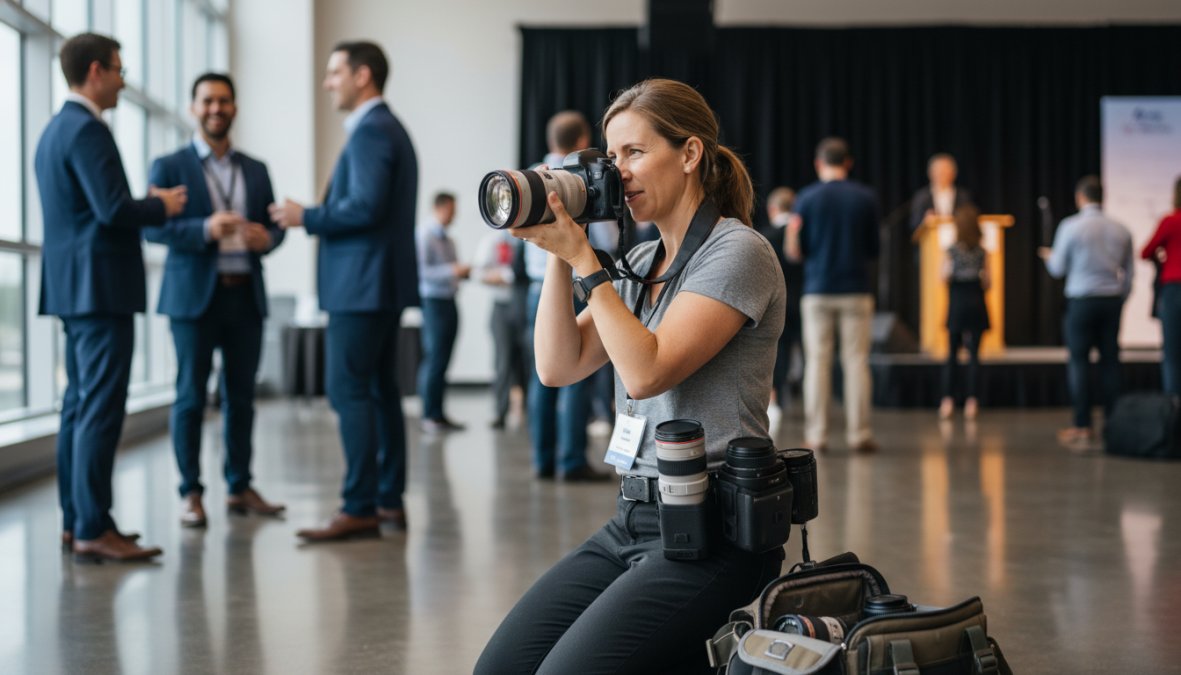
Authentic images build brand trust in ways stock photography and posed portraits cannot. When potential clients or partners see real people genuinely engaged at your events, it signals organizational health and culture, a brand advantage that compounds over time.
Unposed Moments That Build Authentic Visual Narratives
The most valuable images from any corporate event are rarely the ones you planned: the handshake after a successful negotiation, the audience member leaning forward during a presentation, the spontaneous hallway conversation between sessions. Capturing these requires a photographer who understands visual storytelling structurally, documenting setup and anticipation, peak energy, and quieter conclusions so the gallery tells a coherent story rather than presenting a random collection of smiling faces.
Professional Lighting, Equipment, and Technical Expertise
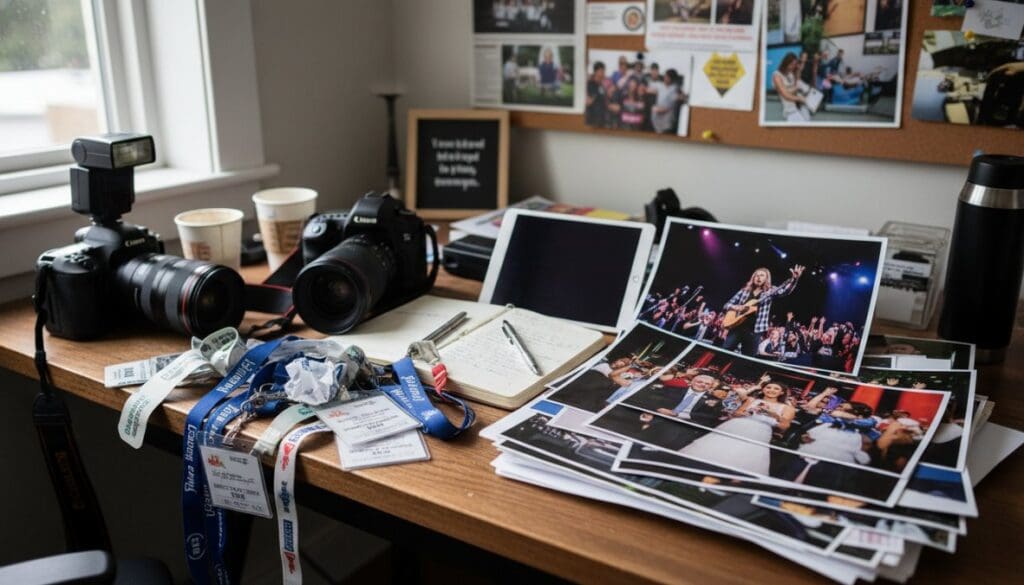
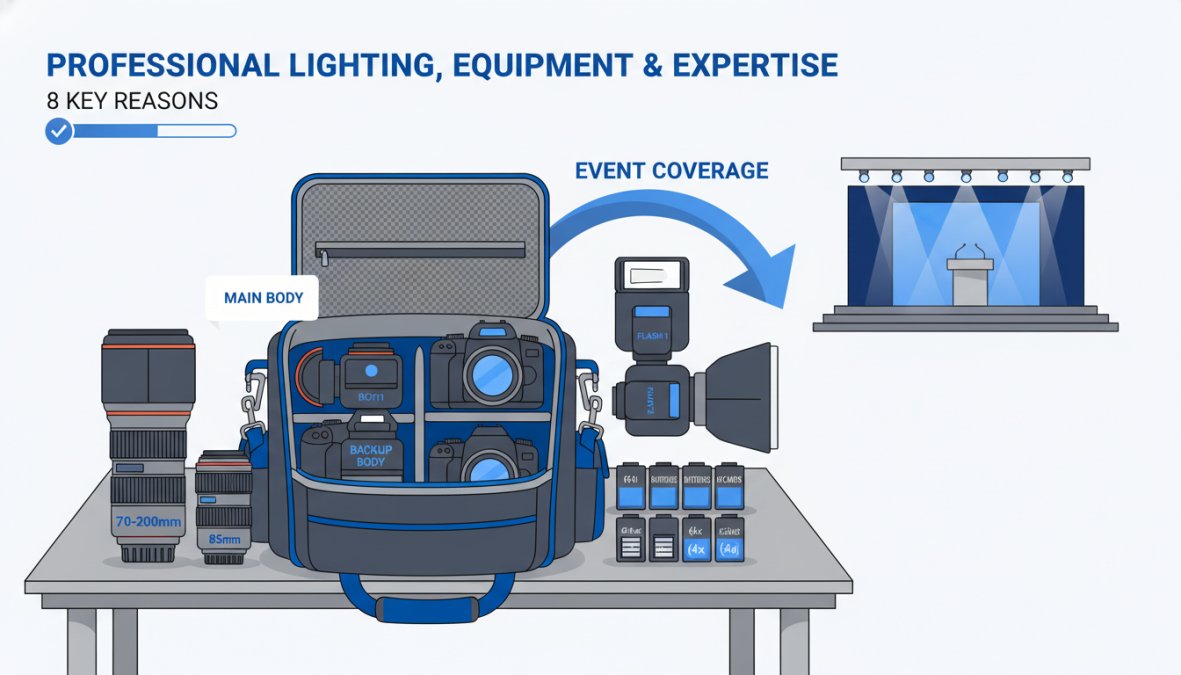
Professional lighting and equipment aren’t just about image quality, they’re about reliability under pressure. A photojournalism-trained photographer working a corporate conference will carry backup camera bodies, multiple flash units, fast prime lenses, and spare batteries as standard kit, and will know how to handle the mixed lighting environments that make most smartphone cameras produce unusable results.
Key technical capabilities that separate professional event photographers from casual alternatives:
- Dual-body shooting setup for simultaneous wide and telephoto coverage
- High-ISO performance for low-light environments without introducing grain
- Off-camera flash techniques that supplement venue lighting without overpowering it
- Fast autofocus systems that track moving subjects in high-pressure environments
- RAW file capture for maximum flexibility in post-production color correction
According to NPPA’s professional photography standards, photojournalism training emphasizes adaptability in unpredictable environments, precisely what live events demand. These skills are not transferable from portrait or commercial photography without specific training.
Hiring a photographer based on a portrait or wedding portfolio for a corporate conference is a common mistake with real consequences. Portrait retouching skills don’t translate to fast-paced event coverage. Always review event-specific work before booking.
Turning Event Documentation Into High-Value Marketing Assets
Every high-resolution image from a well-documented event is a reusable digital asset. A single corporate conference, captured by a skilled photojournalist, can generate content for LinkedIn posts, website hero images, email newsletters, press releases, and internal communications for the next six to twelve months. Organizations that treat event photography as a content production investment get measurably more value from every event they host.
As noted in Content Marketing Institute’s guide to visual content strategy, original photography consistently outperforms stock imagery in audience engagement across every major digital channel.
Quantifiable ROI Metrics From Professional Event Coverage
Measuring the return on event photography requires tracking specific outputs. A practical framework:
| Metric | What to Track | Why It Matters |
|---|---|---|
| Content lifespan | Months of use per image | Higher-quality images stay relevant longer |
| Social engagement | Likes, shares, comments per post | Authentic images drive more interaction |
| Website performance | Time on page, bounce rate | Strong visuals reduce bounce on event recap pages |
| Press pickup | Media outlets using your images | Editorial-quality images get picked up more often |
| Internal use | Presentations, reports, recruiting | Reduces stock photography spend |
Many organizations find that a single well-documented event produces enough visual content to reduce their stock photography budget for the following quarter, making professional event photography an investment in a content library rather than a one-time expense.
Legal and Licensing Considerations Most Event Planners Overlook
Photojournalism vs traditional event photography also differs in how licensing is typically structured, and most event planners don’t ask about this until there’s a problem.
The questions you need to answer before signing any photography contract:
- Usage rights: Are you purchasing a license or full copyright transfer? Ensure your license covers all intended uses: web, print, social media, advertising, and internal presentations.
- Model releases: For events with external guests or speakers, who is responsible for obtaining model releases? This is critical if images will be used in advertising.
- Exclusivity: Can the photographer use your event images in their portfolio? If your event involves confidential product launches, address this explicitly.
- File retention: How long does the photographer retain original RAW files? For large organizations, access to originals two years later can matter.
According to American Society of Media Photographers licensing guidelines, usage licensing disputes are among the most common legal issues in commercial photography. Clarifying these terms before the event eliminates the most common sources of conflict.
Always request a written licensing agreement that explicitly lists every intended use case for the images. Verbal agreements about “unlimited use” are not enforceable and create real legal exposure.
Pre-Event Briefing and Shot Lists: Why Preparation Matters
The difference between a photojournalist who delivers exactly what you needed and one who missed your three most important moments often comes down to one thing: whether you had a pre-event briefing. A professional should request a detailed briefing at least one week before the event, not just for logistics, but to understand your narrative priorities.
A thorough pre-event briefing should cover:
- Key individuals who must be photographed (executives, speakers, award recipients, VIP guests)
- Scheduled moments with fixed timing (keynote speeches, award presentations, ribbon cuttings)
- Brand guidelines for how the organization should be visually represented
- Venue walkthrough or floor plan to plan shooting positions
- Any restricted areas or confidential materials that should not appear in images
- Preferred image delivery format and turnaround timeline
- Social media needs: do you need a small batch of edited images within hours of the event?
Shot lists don’t constrain a photojournalist, they free the photographer to focus on candid coverage between required moments, knowing the essential frames are already planned.
How to Choose an Event Photographer With a Photojournalism Approach
Start by requesting a full event gallery, not just a curated portfolio. Curated portfolios show a photographer’s best twenty images; a full gallery reveals their consistency, editorial judgment, and how they handle the less photogenic moments every real event includes. For corporate event photography, look for photographers who have documented events similar in scale and format to yours, a photographer who excels at intimate galas may lack the systems to cover a 500-person conference across multiple rooms.
As Professional Photographers of America’s guide to hiring event photographers notes, reviewing full event galleries rather than highlight reels is the single most reliable way to assess real-world consistency.
Portfolio Red Flags and Green Flags to Evaluate
Green flags:
- Full event galleries available to review, not just highlights
- Clear evidence of working in low-light environments without heavy flash
- Variety of moments: wide establishing shots, intimate candid moments, detail shots
- Consistent color grading and exposure across an entire gallery
- Images that tell a sequential story rather than a random collection
Red flags:
- Portfolio consists entirely of posed group shots
- Heavy reliance on direct flash that flattens subjects
- No examples of candid or unposed coverage
- Inability to describe their post-production workflow in specific terms
- No written contract or vague licensing language
Event Photojournalism’s award-winning photography portfolio across corporate conferences, galas, and special events in the DMV area reflects exactly this standard: every gallery demonstrates the full editorial range of an event, from setup through closing moments, in high-resolution images built for both print and digital use.
Event Photography Pricing Guide: What to Expect and Why It Varies
Event photography pricing varies significantly based on factors worth understanding before you request quotes. The primary drivers:
Coverage duration: Longer events with complex logistics, multiple rooms, or evening lighting transitions require more equipment and stamina.
Deliverable volume and turnaround: Next-day delivery of 50 edited images for social media requires a different workflow than a standard 5-7 day delivery of 300 selects. Rush delivery commands a premium.
Licensing scope: Usage rights for advertising and commercial marketing typically cost more than internal-use-only licensing, standard industry practice, not a negotiating tactic.
Photographer experience and specialization: A photojournalist with ten years of corporate event experience commands different rates than someone newer to the field. The investment reflects reliability and quality consistency.
Equipment requirements: Events requiring specialized lighting setups, multiple photographers, or aerial coverage involve additional equipment costs.
A practical approach: calculate cost per usable image rather than total fee. A higher-priced photographer who delivers 250 consistently excellent images often represents better value than a lower-priced option delivering 400 inconsistent ones. For events in the Washington DC and Northern Virginia area, compare deliverables, licensing terms, and portfolio quality, not rates alone.
Choosing the right coverage for your event affects your brand’s visual assets for months or years afterward. Event Photojournalism delivers award-winning, high-resolution photography across the DMV area, with customized solutions built for corporate conferences, galas, weddings, and special events. Our team brings the technical expertise, editorial instincts, and professional reliability to ensure every important moment is documented and every image is ready to work as a marketing asset. Contact us to discuss your event and see what professional photojournalism coverage looks like in practice.
Frequently Asked Questions
What is the difference between an event photographer and a photojournalist?
A traditional event photographer typically directs subjects into posed group shots and formal portraits. A photojournalist uses an editorial, documentary approach, observing and capturing authentic moments as they unfold without interrupting the event's natural flow. For corporate events and galas, this distinction matters because photojournalism produces more genuine, story-driven imagery that works better for marketing assets, social media content, and brand storytelling than stiff, staged photographs.
Do photojournalists pose subjects at events?
Photojournalists primarily focus on candid, unposed moments that reflect the true energy of your event. However, skilled event photojournalists can blend both approaches, capturing authentic interactions throughout the event while also facilitating a limited number of key group or executive portraits when needed. The goal is to prioritize visual storytelling while still delivering the essential posed images your organization requires for internal communications or executive profiles.
Is it worth hiring a professional photographer for a small event?
Yes, even small events generate marketing assets, social proof, and brand documentation that have long-term value. A single well-photographed small event can produce high-resolution images for email campaigns, website updates, LinkedIn posts, and future event promotion. The cost of professional event photography is typically far lower than recreating those visual assets through a separate shoot. Photojournalism-style coverage also requires less setup time, making it efficient for smaller gatherings.
What should I look for when hiring an event photographer with a photojournalism style?
When evaluating how to choose an event photographer, review their portfolio specifically for candid event photography, look for sharp images in low light, emotional authenticity, and strong visual composition without obvious posing. Ask about their pre-event briefing process and whether they use shot lists. Confirm what licensing rights you receive with the high-resolution image delivery, how post-production is handled, and their turnaround time. Experience in high-pressure environments like corporate conferences or galas is a strong differentiator.
How much does professional event photojournalism typically cost?
Event photography pricing varies based on event duration, number of photographers, post-production scope, and licensing terms. Hourly rates, half-day, and full-day packages are all common structures. Pricing also reflects the photographer's experience level, equipment quality, and whether expedited delivery or raw file access is included. When reviewing any event photography pricing guide, factor in the long-term value of the digital assets produced, professional images used repeatedly across marketing channels often justify a higher upfront investment.
This article was written using GrandRanker