Table of Contents
- Why Candid Event Photography for Galas Demands a Different Approach
- Event Photography Shot List for Galas: What to Capture and When
- Tips for Capturing Authentic Event Moments Without Disrupting the Room
- Event Photography Lighting Tips for Galas and Black-Tie Settings
- How to Hire a Gala Event Photographer Who Delivers Results
- Post-Production Workflow and Legal Considerations for Gala Photography
- Using Candid Event Photography for Galas in Post-Event Marketing
- Conclusion
Last Updated: June 8, 2026
Candid event photography for galas is one of the most demanding specialties in professional photography. The images captured at a black-tie fundraiser become the primary visual record of your organization’s brand, donor relationships, and mission in action. At Event Photojournalism, we’ve covered hundreds of high-stakes galas across the DMV area, and the difference between forgettable event photos and images that drive real donor engagement almost always comes down to approach, not equipment.
The formal setting, donor relationships, live auction energy, paddle raise moment, and award presentations require a documentary approach that blends photojournalism instincts with technical mastery of difficult lighting environments.
Why Candid Event Photography for Galas Demands a Different Approach
Candid event photography for galas captures authentic, unposed moments at formal fundraising and corporate events using a documentary approach that prioritizes genuine emotion over staged compositions. Unlike portrait sessions or commercial shoots, gala photography unfolds in real time and cannot be repeated.
A nonprofit fundraiser isn’t just a party, it’s a brand storytelling opportunity that directly supports donor engagement and future fundraising. The images from a paddle raise or live auction become proof of mission impact, appearing in annual reports, email campaigns, grant applications, and social media for months afterward.
The Difference Between Candid and Posed Gala Photography
Posed photography has its place at galas, the executive director with a major donor, the award recipient at the podium, the board photo. But posed images alone tell an incomplete story. They show hierarchy, not humanity.
Candid photography captures the moments that make donors feel something: the table laughing during cocktail hour, the guest wiping a tear during the mission video, the spontaneous embrace between longtime supporters. Posed shots require coordination and pull subjects out of the event flow; candid shots require anticipation, patience, and the ability to be invisible in a room full of people dressed to be seen.
How Authentic Moments Drive Donor Engagement and Brand Storytelling
According to research highlighted by the Association of Fundraising Professionals on donor engagement, storytelling through imagery is among the most effective tools for communicating donor impact. When a supporter sees themselves genuinely engaged at your event, that image reinforces their identity as part of your mission community.
This is the core argument for investing in professional candid event photography for galas: it isn’t a documentation expense. It’s a fundraising asset.
Event Photography Shot List for Galas: What to Capture and When
A strategic shot list is the single most underused tool in gala photography planning. A detailed shot list aligned with your post-event marketing goals produces far better results than improvisation alone.
Pre-Event Setup (30-60 minutes before doors open)
- Venue details: centerpieces, signage, stage, silent auction tables
- Branded elements: step-and-repeat backdrop, logo displays, table cards
- Catering and bar setups before guests arrive
- Staff and volunteer team photo
Arrival and Red Carpet
- Guests arriving at entrance and red carpet
- Check-in and registration interactions
- Sponsor and VIP arrivals
Cocktail Hour and Networking
- Candid networking conversations
- Silent auction browsing and bidding
- Sponsor interactions and donor engagement moments
Program Highlights
- Emcee and speaker presentations
- Award presentations with recipient reactions
- Live auction energy and bidder moments
- Paddle raise (wide shot of the room, close-ups of raised paddles, auctioneer reactions)
- Mission moment or video screening reactions
Dinner and Closing
- Table conversations and candid dining moments
- Final remarks and closing energy
Pre-Event and Arrival Coverage: Red Carpet and First Impressions
Arriving 60-90 minutes before guests ensures the venue is documented before the crowd changes the environment. These detail shots become essential for post-event promotion and sponsor deliverables.
Red carpet photography requires a fixed background, predictable lighting, and a more directed approach, "Look this way" is acceptable at the step-and-repeat; it isn’t during the paddle raise. Wide-angle environmental portraits of guests entering a beautifully decorated ballroom tell the story of the room before the program begins.
Program Highlights: Live Auction, Paddle Raise, and Award Moments
The live auction, paddle raise, and award presentations are the emotional and financial core of most galas, missing these moments is not recoverable. For the paddle raise, you need simultaneously a wide shot showing room energy and close-up reactions of individual donors, requiring either a second shooter or disciplined repositioning. The paddle raise image is often the single most-used photo in post-event donor communications.
Brief the photographer on the program run of show at least one week before the event. Knowing the paddle raise comes at the 45-minute mark allows the photographer to position correctly in advance, not scramble after it starts.
Tips for Capturing Authentic Event Moments Without Disrupting the Room
The best candid gala photography is invisible. Guests should never feel surveilled, and the event flow should never be interrupted. Black-tie settings come with social norms around space and attention that make this harder than it sounds.
Unobtrusive Shooting Techniques for Formal Events
The documentary approach to gala photography borrows directly from photojournalism: observe and capture, don’t direct and stage.
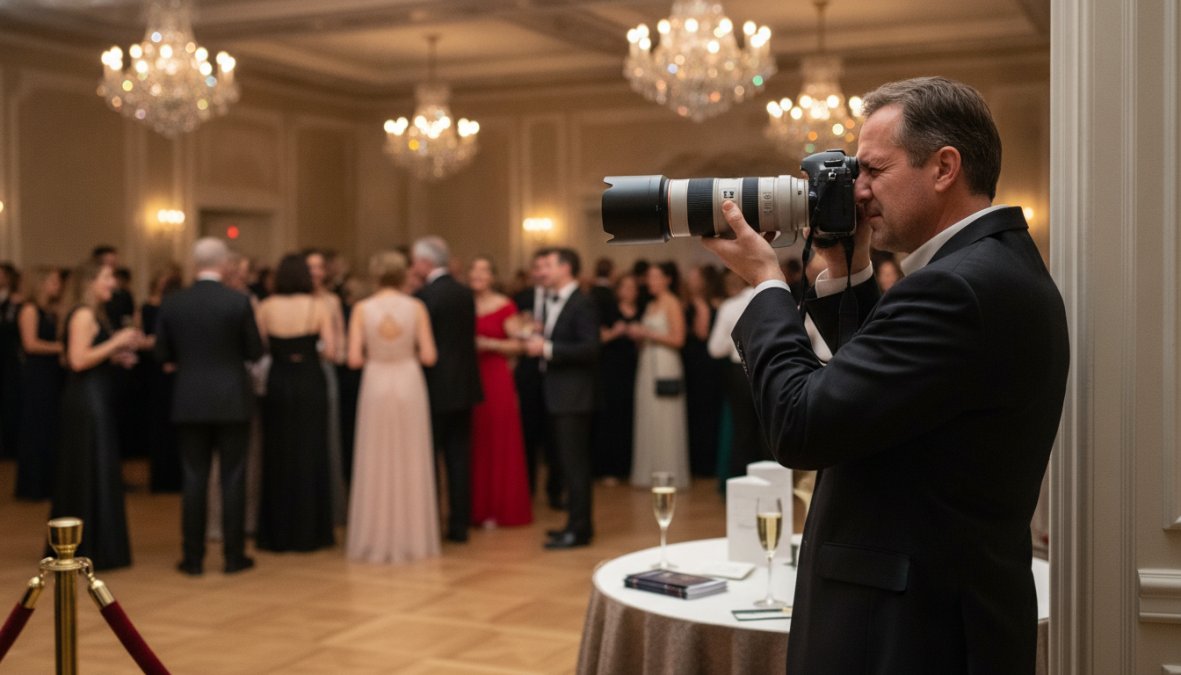
Zoom lens positioning. A 70-200mm zoom lens captures intimate moments from across a room without physically entering a conversation. Guests 30 feet away don’t register the photographer and continue behaving naturally.
Working the edges. Positioning along the room’s perimeter rather than moving through the center reduces disruption significantly. Most meaningful networking happens at tables or near the bar, both accessible from the edges.
Anticipation over reaction. Experienced gala photographers read the room constantly, pre-focusing before a laugh, toast, or embrace arrives. Reacting after the fact produces blurry, poorly composed images.
Silent shooting mode. Many professional cameras offer an electronic shutter that eliminates mechanical shutter sound, essential during quiet program moments.
Managing Guest Interactions and Networking Moments Naturally
The images that get used in marketing capture genuine emotional exchange: surprised delight at reconnecting with someone, the focused intensity of a donor conversation, shared laughter. Position near a likely interaction point, wait for the emotional peak, and capture it. The genuine smile you get by waiting 15 more seconds is incomparably better than one you interrupted to request.
Never photograph guests in obviously private or sensitive conversations, even in public event spaces. Beyond being ethically problematic, these images will never be used and could damage trust with donors and organizers.
Event Photography Lighting Tips for Galas and Black-Tie Settings
Lighting is where technically competent photographers separate themselves from truly skilled gala photographers. Ballroom environments present mixed color temperatures, deep shadows at tables, bright spotlights on stage, and constantly changing conditions. The most common failure is over-relying on direct on-camera flash, which produces flat, harsh images and disrupts the event atmosphere.
Off-Camera Flash and Bounced Lighting for Flattering Results
Bounced lighting is the foundational technique for flattering gala photography. Angling an external flash toward a white or neutral ceiling produces soft, diffused light that mimics natural overhead illumination, dramatically more flattering than direct flash and far less disruptive.
Key lighting approaches for gala settings:
- Bounced flash off ceiling – Best for rooms with white or light-colored ceilings under 15 feet
- Diffused direct flash – Use when ceiling bounce isn’t viable; soften with a diffuser
- High ISO ambient light shooting – For program moments where flash would be disruptive; requires a fast lens (f/1.8-f/2.8)
- Mixed ambient and fill flash – For cocktail hour where you want to retain warm event atmosphere while ensuring subject exposure
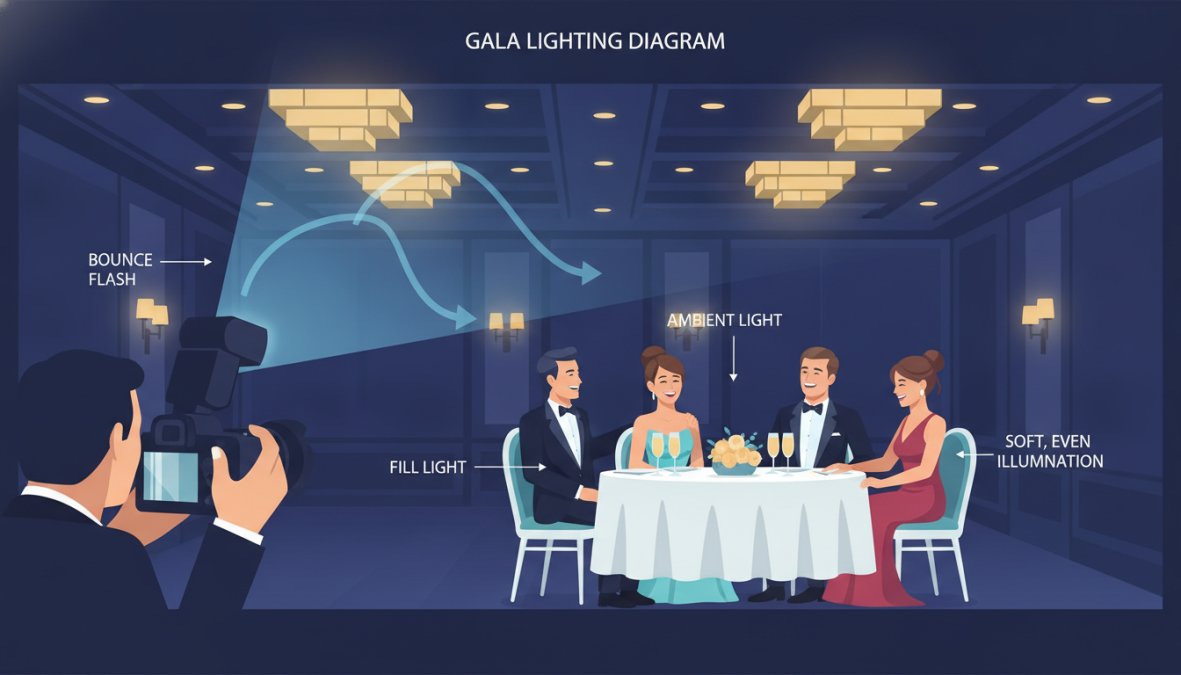
According to Professional Photographers of America’s technical guidance on event lighting, proper flash technique is one of the most consistently cited differentiators between amateur and professional event photography results.
The single most impactful lighting upgrade for gala photography is learning to bounce flash effectively. It costs nothing beyond practice, and it transforms the quality of every image captured in a ballroom environment.
How to Hire a Gala Event Photographer Who Delivers Results
Finding a photographer who can execute candid event photography for galas at a professional level requires more scrutiny than most organizers apply. A portfolio review is necessary but not sufficient, a photographer can have beautiful posed portraits and still be completely unprepared for the documentary demands of a live gala program. The real differentiator is experience with the specific event type: a photographer who has covered 50 galas understands the paddle raise is coming and positions accordingly.
Questions to Ask Before Signing a Contract
- How many galas or formal fundraising events have you photographed in the past two years? Look for specific numbers, not vague claims.
- Can you show me a full gallery from a similar event, not just selected highlights? Full galleries reveal consistency; highlight reels reveal only peak moments.
- How do you handle the paddle raise and live auction? A specific, detailed answer indicates genuine experience.
- Do you bring backup equipment? Equipment failure at a high-stakes event is unacceptable.
- What is your turnaround time for the final gallery? Images need to be available within 5-7 business days for post-event marketing to be effective.
- How do you handle low-light program moments without disrupting the event?
- What is your policy on image usage rights for our marketing materials?
Understanding Pricing, Packages, and What’s Included
Gala photography pricing varies based on event duration, number of photographers, deliverable specifications, and geographic market. The DMV area commands premium rates reflective of its concentration of high-profile nonprofit and corporate events.
| Package Element | What to Expect | Questions to Ask |
|---|---|---|
| Coverage hours | 4-8 hours typical | Does this include setup and arrival time? |
| Number of photographers | 1-2 for most galas | Is a second shooter available for large events? |
| Image delivery | 200-500+ edited images | What editing is included? |
| Turnaround time | 5-14 days | Is rush delivery available? |
| Usage rights | Full usage for marketing | Are there any restrictions on use? |
| Raw files | Rarely included | Clarify upfront if needed |
The cheapest option almost always costs more in the long run. Unusable images from an underprepared photographer mean your post-event marketing suffers for the next 12 months.
Post-Production Workflow and Legal Considerations for Gala Photography
Post-production is where gala photography either fulfills its potential or falls apart. The editing workflow directly affects how quickly and effectively you can use images for post-event promotion.
Editing Workflow: From High-Stakes Event to Deliverable Gallery
- Culling – Selecting the strongest images (typically 10-15% of total frames shot)
- Technical correction – Exposure, white balance, and noise reduction, particularly critical for mixed-light ballroom environments
- Color grading – Establishing a consistent look that reflects the event’s atmosphere
- Retouching – Light retouching on hero images; standard corrections for full galleries
- Export and delivery – High-resolution files for print and web-optimized versions for digital use
- Gallery organization – Tagged by event phase (arrival, program, networking) for easy navigation
Request that your photographer deliver images organized by event phase. Searching through 400 unorganized images for the paddle raise photos wastes critical time when you’re trying to get a post-event email out within 48 hours. As documented in [ASMP’s professional practices guide for event photographer(/how-to-hire-event-photographer/)s | asmp.org], clear delivery specifications in the contract prevent the most common post-production disputes.
Privacy, Consent, and Image Usage Rights at Nonprofit and Corporate Galas
Event photography consent. In most jurisdictions, photographing attendees at a ticketed private event is covered by implied consent when disclosure is included in event registration or on-site signage. Consult legal counsel to confirm the appropriate approach for your organization.
Image usage rights. The contract should explicitly list all permitted uses: email marketing, social media, annual reports, grant applications, website, and press releases.
Donor privacy considerations. Some donors request that their attendance not be publicized. A pre-event process for flagging these individuals, communicated clearly to the photographer, prevents uncomfortable situations after delivery.
Third-party image sharing. If sponsors request images for their own marketing, clarify in advance whether the photographer’s contract permits this or whether separate licensing is required.
According to guidance from the National Council of Nonprofits on data and privacy practices, nonprofit organizations have particular obligations around donor privacy that extend to photographic documentation of events.
Using Candid Event Photography for Galas in Post-Event Marketing
The return on investment from gala photography is almost entirely determined by how images are used after the event. Organizations that treat the photo gallery as an archive miss the real opportunity. A deliberate post-event content strategy extends the event’s fundraising impact for months.
Week 1 (Days 1-7):
- Thank-you email to attendees featuring 3-5 hero images
- Social media posts highlighting key program moments (paddle raise, award presentations)
- Donor impact post featuring authentic candid moments
Weeks 2-4:
- Full gallery shared with attendees and sponsors
- Press release with selected images for local media
- Sponsor deliverable package with branded images
Months 2-6:
- Annual report imagery selection
- Grant application supporting materials
- Next year’s event marketing (save-the-date, invitation imagery)
The images from a single well-photographed gala can fuel an organization’s visual content needs for an entire calendar year, which is why the photography budget deserves to be treated as a marketing investment rather than an event expense. For corporate galas, the brand storytelling value extends further to internal communications, recruiting materials, and client relationship documentation. Post-event marketing only works if the images are strong; technically weak or emotionally flat photography cannot be rescued in post-production.
Gala photography done well is a fundraising tool, a brand asset, and a donor relationship investment all at once. Event Photojournalism brings award-winning expertise and customized solutions to corporate galas, nonprofit fundraisers, and charity balls across Washington DC and Northern Virginia, delivering high-resolution imagery designed to elevate your brand and amplify your mission. CONTACT US to discuss your upcoming gala and build a photography plan that works as hard as your event does.
Frequently Asked Questions
What is the difference between candid and posed event photography at a gala?
Candid event photography for galas captures genuine, unscripted moments, guests laughing, donors connecting, speakers reacting, without directing subjects. Posed photography involves arranging people for formal group shots. High-quality gala coverage typically blends both: candid documentary-style images tell the event's story and fuel post-event marketing, while a handful of posed shots serve as official records for sponsors, boards, and honorees.
How do you capture candid moments at a formal gala without being intrusive?
The key is an unobtrusive approach: use a zoom lens (70-200mm range) to shoot from a comfortable distance, wear appropriate attire to blend in, move with the event rhythm rather than against it, and avoid using disruptive direct flash. Arriving early to map the venue, identify key lighting zones, and anticipate high-activity areas, like the bar, registration table, and networking spaces, allows a photographer to position themselves naturally before moments unfold.
What should be on an event photography shot list for galas?
A strategic shot list for galas should include: red carpet and arrival moments, venue detail and décor shots before guests arrive, sponsor signage and branded elements, candid networking interactions, keynote speakers and award presentations, live auction and paddle raise reactions, table conversations and donor engagement moments, and group photos of key stakeholders. Sharing this list with your photographer before the event ensures no high-priority moment is missed and aligns coverage with your marketing and fundraising goals.
What equipment is best for low-light candid gala photography?
For low-light gala environments, photographers typically rely on a full-frame camera body with strong high-ISO performance, a fast prime lens (f/1.4 or f/1.8) or a 70-200mm f/2.8 zoom lens for versatile reach, and an off-camera or on-camera flash with a diffuser for bounced lighting. This event photography gear combination allows for flattering, natural-looking images even in dimly lit ballrooms without the harsh shadows that direct flash creates.
Do I need more than one photographer for a large gala or charity ball?
For larger galas, typically 200 or more guests, two photographers are strongly recommended. One can focus on candid event coverage across the room while the other handles formal portraits, stage moments, and VIP interactions. This ensures comprehensive documentation of the event atmosphere without either photographer being stretched too thin. For intimate nonprofit fundraisers or smaller corporate galas, a single experienced photographer with a clear shot list can provide thorough coverage.
How should gala candid photos be used after the event for marketing?
Authentic candid images are among the most effective assets for post-event promotion. Use them in donor impact reports, annual reports, email recaps to attendees, social media campaigns, and website galleries to build credibility and excitement for future events. Images showing genuine guest experience, emotional reactions to mission-driven moments, and networking interactions perform particularly well for nonprofit fundraiser and corporate gala marketing because they communicate community and engagement rather than just logistics.
This article was written using GrandRanker