Table of Contents
- Understanding the Exposure Triangle for Candid Events
- Aperture Choices for Individuals and Groups
- Shutter Speed for Event Photography and Freezing Motion
- ISO Settings for Event Photography in Variable Light
- Indoor Event Photography Settings and Available Light
- Low Light Event Photography Settings Without Relying on Flash
- Autofocus Configuration and Camera Mode Selection for Unpredictable Moments
- Settings by Event Scenario: Galas, Conferences, and Celebrations
- Frequently Asked Questions
Last Updated: October 20, 2026
Understanding the Exposure Triangle for Candid Events
The exposure triangle, aperture, shutter speed, and ISO, is the foundation for all camera settings. These three work together to control image brightness and affect quality in different ways.
Mastering it lets you adapt quickly to changing light instead of fumbling with settings while a moment passes.
Here’s how each element affects your shot:
- Aperture controls how much light enters through the lens
- Shutter speed controls how long light hits the sensor
- ISO controls the sensor’s sensitivity to light
Change one element and you must adjust another to keep exposure balanced, the trade-off that makes candid photography challenging and rewarding.
The best camera settings for candid event photography aren’t about finding one “perfect” combination. They’re about understanding how to adjust the triangle based on your specific moment and light. A gala’s dim ballroom needs different settings than a bright outdoor garden reception.
Aperture Choices for Individuals and Groups
Aperture is measured in f-numbers like f/2.8, f/4, or f/5.6; lower numbers mean wider apertures that let in more light.
For individual portraits, use f/2.0 to f/4. The resulting background blur isolates your subject, crucial when the background is cluttered.
For group photos, move to f/4 to f/5.6.
Wide apertures reduce your margin for error: autofocus must be precise, since even a small shift in distance can blur your subject at f/2.0.
For candid event photography, f/2.8 is the sweet spot for most situations. It’s wide enough to control background blur and gather light, but forgiving enough to keep subjects sharp when they move.
Shutter Speed for Event Photography and Freezing Motion
Shutter speed determines how long the sensor captures light, and for candid event photography it must be fast enough to freeze motion without blur.
The rule of thumb: use a shutter speed at least as fast as your focal length.
In practice this isn’t always fast enough: a guest raising a glass, someone turning to laugh, a child running, these demand faster shutter speeds.
Recommended shutter speeds for candid events:
- Stationary subjects (seated speeches, posed moments): 1/125 sec
- Walking or slow movement: 1/200 sec to 1/250 sec
- Fast movement (dancing, children playing): 1/500 sec or faster
In low light you must choose: slow the shutter and risk motion blur, or raise ISO and accept noise.
ISO Settings for Event Photography in Variable Light
ISO controls sensor sensitivity to light. Higher ISO helps in dim venues, at the cost of noise, visible grain that degrades image quality.
Modern cameras handle ISO well; you can often shoot at ISO 3200 or higher without unacceptable noise, especially at web resolution rather than large prints.
ISO ranges for different venues:
- Bright outdoor events: ISO 100 to 400
- Mixed indoor/outdoor (sunlit rooms): ISO 400 to 1600
- Indoor events with good lighting: ISO 1600 to 3200
- Dim venues (candlelit dinners, evening receptions): ISO 3200 to 6400
The key decision: how much noise will you accept to keep shutter speed fast and aperture wide? A slightly grainy sharp image beats a blurry clean one every time.
Don’t set ISO too low just to avoid noise. A blurry image with no noise is worse than a sharp image with visible grain. Your subject’s expression and moment matter more than pixel-perfect technical perfection.
Indoor Event Photography Settings and Available Light
Indoor events are the biggest challenge for candid photographers, with mixed lighting from overheads, lamps, windows, and colored stage lights.
For typical indoor event venues:
- Use aperture priority mode (f/2.8 to f/4)
- Set shutter speed minimum at 1/125 sec
- Let ISO rise as needed to maintain exposure
- Use continuous autofocus to track moving subjects
White balance becomes critical indoors: mixed sources create color casts, so match the dominant source or shoot RAW and adjust later.
Many photographers underexpose slightly in candid work: a darker image preserves highlight detail, and shadows can be brightened in post, while blown highlights are permanent.
Low Light Event Photography Settings Without Relying on Flash
Flash is tempting in dim venues, but on-camera flash creates harsh shadows and kills the mood. For candid work, available light is almost always better.
Low light requires aggressive settings, higher ISO, wider apertures, slower shutter speeds, so you can work without flash while keeping subjects sharp and exposed.
Low light settings strategy:
- Aperture: as wide as your lens allows (f/2.0 to f/2.8)
- Shutter speed: 1/125 sec minimum, faster if movement is fast
- ISO: 3200 and up, whatever your camera handles well
- Metering: use spot metering to expose for your subject’s face
If you must use flash, use it as fill only, bounced off a ceiling or wall, to preserve the ambient mood while preventing blur.
Autofocus Configuration and Camera Mode Selection for Unpredictable Moments
Most guides stop at “use continuous autofocus”, correct but incomplete.
Start with continuous autofocus (AF-C), then configure it properly. AF-C alone is not enough.
Subject detection and eye detection. Most current mirrorless bodies from Canon, Nikon, Sony, Fujifilm, and Panasonic offer face and eye detection in AF-C.
Focus-area selection for candid work. Three modes matter:
- Wide/auto area with subject detection: best for dancing, children, and unpredictable movement. The camera finds the subject; you compose.
- Zone or flexible spot (a small cluster of points): best for speeches, toasts, and networking, where you know roughly where the action will be and want to prevent the camera from grabbing a background guest.
- Single-point: reserve for precision moments (a ring exchange, a signature) where you can track manually. It is too slow as a default for candid work.
A practical hybrid: set a custom button to toggle between wide-area and a small zone.
Back-button focus. Assign AF-ON to a rear button and disable shutter-button AF.
Set up two custom shooting banks or modes: one for “dim reception” (wide aperture, 1/200 sec minimum, AF-C with subject detection) and one for “stage/speech” (f/4, 1/250 sec, zone AF, spot metering). Switching banks is faster than rebuilding settings when the event moves from cocktails to toasts.
Silent shooting and camera etiquette. Electronic shutter removes the click that draws attention during vows and speeches. Trade-offs are real: rolling-shutter distortion on fast movement, banding under some LED and fluorescent lights, and reduced flash sync. Test silent mode under the venue’s lighting beforehand; if banding appears, switch to mechanical or electronic-first-curtain shutter. Silent mode plus unobtrusive positioning, kneeling, shooting from the room’s edge, using a longer lens, preserves the natural behavior that makes candid photography worth doing.
Settings by Event Scenario: Galas, Conferences, and Celebrations
Generic starting points help, but candid events rarely stay in one lighting condition for an hour. Use a short decision tree: assess the light, decide whether flash is allowed, set aperture for intent and shutter for motion, and let ISO absorb the rest.
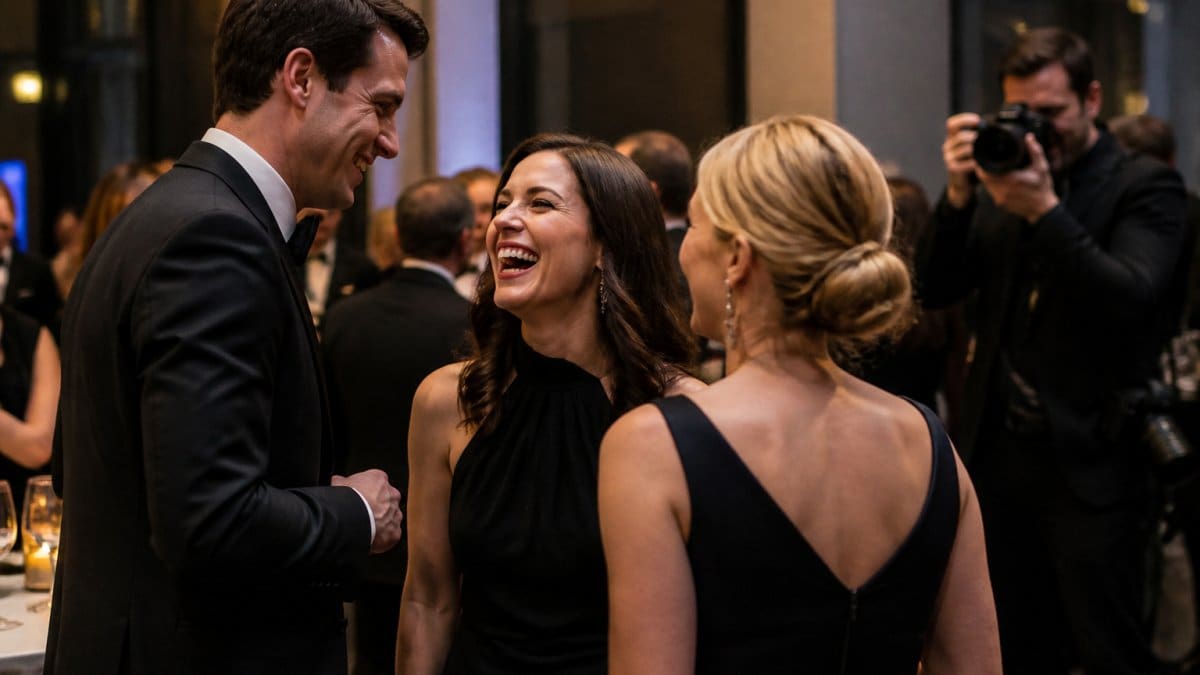
The candid settings decision tree
- Is the light bright, mixed, or dim? Bright outdoor daylight, mixed indoor (windows plus overheads), or dim reception (candles, uplighting, stage wash).
- Is flash allowed and appropriate? If yes, use bounce fill; if no, commit to available light and accept higher ISO.
- How fast is the subject moving? Stationary (speeches, toasts), moderate (networking, walking), or fast (dancing, children).
- Set aperture for intent, shutter for motion, ISO for exposure. In that order.
Speeches, toasts, and stage moments
Speakers are usually lit by a stage wash that is brighter than the room and often a different color temperature. Use f/4 to keep the speaker and podium sharp, 1/250 sec to freeze hand gestures, and ISO 800-3200 depending on the wash. Switch to spot metering on the speaker’s face; matrix metering will expose for the dark audience and blow out the stage. If the stage is LED-lit, watch for banding in silent mode and test before the speech begins.
Networking and cocktail hour
This is the mixed-lighting trap: daylight from windows, warm tungsten chandeliers, and cool LED accents in the same frame. Use f/2.8, 1/200 sec, Auto ISO with a 1/200 sec minimum, and Auto White Balance while shooting RAW. Auto WB will not be perfect, but RAW lets you correct per-image in post. If you must deliver SOOC, set a custom WB on a gray card under the dominant source and accept that the secondary source will cast.
Dancing and fast movement
Dance floors are dim and the movement is fast, the hardest combination in candid work. Use f/2.0-f/2.8, 1/500 sec or faster, and ISO 3200-6400 (higher on current full-frame bodies). Continuous AF with wide-area subject detection, release priority, and silent shutter off if banding appears. If the venue allows, a bounced speedlight with a gel matched to the ambient light preserves the mood while cutting ISO by a stop or two.
Group photos and formal moments
Groups demand depth of field. Use f/5.6-f/8, 1/200 sec, and ISO 400-1600. Focus on the eyes of the person nearest the center of the group and stop down enough that front and back rows stay sharp. This is the one scenario where focus priority beats release priority.
Dim receptions and candlelit dinners
Commit to available light: f/2.0-f/2.8, 1/125-1/160 sec, ISO 3200-6400, and spot metering on faces. Accept some grain; a sharp, expressive frame at ISO 6400 beats a clean, blurry one at ISO 1600. If you must use flash, bounce it off a ceiling or side wall and dial in negative flash exposure compensation so it reads as fill, not key.
Outdoor daytime events
Use f/4-f/5.6 for group depth, 1/500 sec to freeze movement in bright sun, and ISO 100-400. Watch for harsh midday shadows; position subjects in open shade or use fill flash at low power. High-speed sync lets you use flash at wide apertures in bright light if you want background blur outdoors.
Troubleshooting: what to change first
- Blurry subjects: raise shutter speed first (1/250 → 1/500), then check AF mode and release priority. Only then open the aperture.
- Noisy images: lower ISO by opening the aperture or slowing the shutter, but never below your motion-freeze threshold. Noise reduction in post is the last resort.
- Underexposed images: raise ISO before slowing the shutter; motion blur is harder to fix than grain.
- Color casts: shoot RAW, set a custom WB under the dominant source, and correct per-image. Mixed LED and tungsten is the most common culprit.
- Banding under stage lights: switch off silent/electronic shutter and use mechanical or electronic-first-curtain.
The principle across every scenario: assess the light, choose aperture for your creative intent, set shutter speed to freeze motion, and let ISO do the work. This hierarchy ensures you capture the moment first and worry about technical perfection second.
Frequently Asked Questions
What shutter speed should I use for candid event photos?
Start with 1/125 second as a baseline for indoor events with moderate movement, and increase to 1/200-1/250 second for faster action or outdoor events in bright light. Faster shutter speeds freeze motion but require more light or higher ISO. Slower speeds risk motion blur when subjects move unexpectedly. Test your shutter speed during the first few minutes of an event to confirm your exposure is correct before critical moments begin.
Is f/2.8 or f/4 better for candid event photography?
f/2.8 offers a wider aperture that gathers more light and creates stronger background blur, making it ideal for low-light indoor events and isolating individuals from distracting backgrounds. f/4 provides sharper depth of field across groups and works well in brighter outdoor settings or when you need more of the scene in focus. Choose based on your venue’s light level and whether you’re photographing solo subjects or group moments. Many candid photographers carry both focal lengths to adapt quickly.
How high can I set ISO for event photography without losing image quality?
Modern cameras handle ISO 3200-6400 with minimal visible noise, and many perform acceptably at ISO 12800. Test your specific camera model beforehand in low-light conditions to find your comfort threshold. Higher ISO lets you maintain faster shutter speeds and wider apertures in dim venues, which is critical for sharp candid shots. Accept some noise rather than risk motion blur or underexposed images; noise is recoverable in post-processing, but blurry candid moments are not.
Should I use aperture priority or manual mode for candid events?
Aperture Priority mode works well when light is relatively stable, set your aperture (e.g., f/2.8), and the camera adjusts shutter speed automatically. Switch to Manual mode when light changes dramatically (mixed indoor/outdoor, shifting stage lighting, or rapid transitions between bright and dim areas). Manual gives you direct control but requires quick adjustments. Many candid photographers use Aperture Priority as their default and shift to Manual only when the camera’s metering struggles with the scene.