Table of Contents
- Corporate Headshots vs Event Photos: Understanding the Core Differences
- Defining Corporate Headshots and Event Photography
- How to Prepare for Corporate Headshots: Best Practices
- Professional Headshot Best Practices for Maximum Impact
- Event Photography Shot List: Planning Your Coverage
- Key Differences in Lighting, Equipment, and Logistics
- Retouching, Post-Production, and Digital Asset Delivery
- ROI and Business Metrics: Measuring Photography Value
Corporate Headshots vs Event Photos: Key Differences
Last Updated: July 8, 2026
Understanding the distinction between corporate headshots vs event photos is essential for businesses planning their visual content strategy. These two photography types serve fundamentally different purposes: one prioritizes control and consistency, the other captures authentic moments in real time. Neither is "better", they solve different problems.
What Each Service Delivers
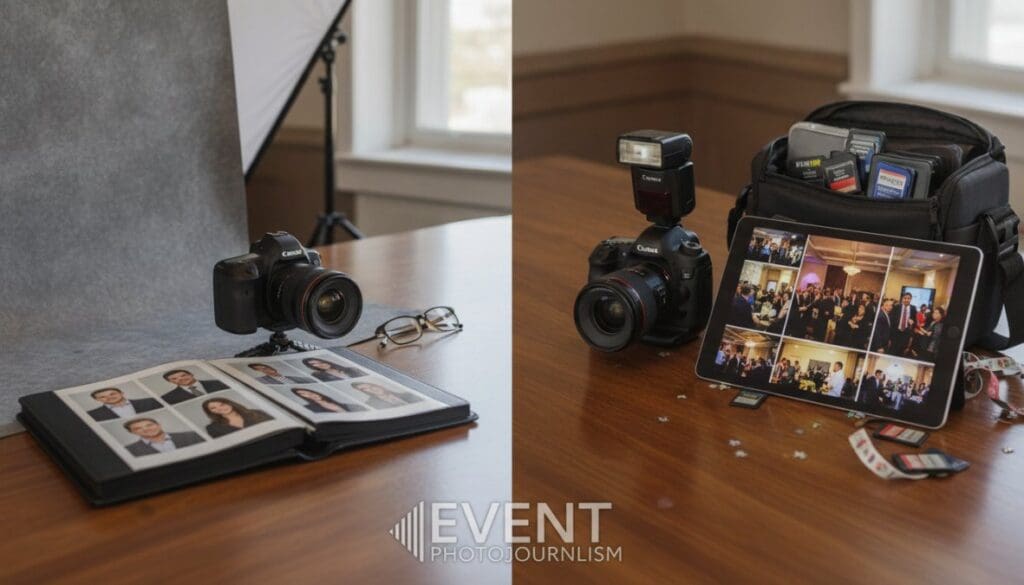
Corporate headshots produce polished, controlled portraits for professional directories, LinkedIn profiles, team websites, and formal communications. The photographer manages every variable: lighting, background, pose, expression, and wardrobe. The result is a consistent set of images where every team member looks equally professional and on-brand.
Event photography captures spontaneous moments as they unfold. A photographer moves through a conference, gala, or corporate gathering documenting real interactions, keynote moments, networking scenes, and genuine reactions. If you need images for your company directory, you need headshots. If you need to show your culture in action or document conference attendance, you need event photography. Many organizations need both.
Comparison Table: Side-by-Side Overview
| Aspect | Corporate Headshots | Event Photography |
|---|---|---|
| Setup | Controlled studio or location | On-site, real-time environment |
| Lighting | Professional studio lighting | Mixed natural and ambient light |
| Timing | Scheduled sessions, 15-30 min per person | Continuous coverage over hours |
| Subject Control | Full control over pose and expression | Spontaneous, reactive moments |
| Consistency | High uniformity across all images | Varied compositions and emotions |
| Typical Use | Directories, LinkedIn, ID badges | Marketing, social media, documentation |
| Retouching | Extensive: skin, lighting, background | Light: color correction, minor edits |
| Turnaround | 1-2 weeks typical | 2-4 weeks typical |
| Cost Model | Per-person or flat rate | Hourly or daily rate |
Defining Corporate Headshots and Event Photography
Corporate headshots are professional portraits taken in a controlled setting with professional lighting equipment, a clean background, and careful composition. Every element is intentional: clothing, grooming, facial expression, and lighting angle all contribute to a cohesive visual identity.
Event photography documents live moments as they happen. A photographer attends your conference, gala, product launch, or corporate gathering and captures candid interactions, keynote presentations, networking moments, and the overall energy of the event.
Corporate Headshots: Purpose and Use Cases
Professional headshots solve a specific business problem: you need a standardized set of portraits where every team member appears equally professional and on-brand. These images go on your company website team directory, LinkedIn profiles, email signatures, ID badges, and internal communications. When your leadership team and staff all have polished, professionally lit portraits taken in the same style, it signals cohesion and professionalism to clients and partners. The best approach is to build headshots into your onboarding process and refresh them annually.
Event Photography: Capturing Spontaneous Moments
Event photography captures your organization in action, documenting keynote speakers, attendee reactions, networking conversations, award presentations, and overall atmosphere. These candid moments are far more compelling for marketing than any staged photo. Event photography also serves a documentation purpose, creating a visual record of who attended, what happened, and the energy of the moment. The challenge is unpredictability, a skilled event photographer anticipates moments and positions themselves to capture them, but they’re working with the environment they’re given.
How to Prepare for Corporate Headshots: Best Practices
Preparation directly impacts the quality of your headshot session. Schedule your session at least 2-3 weeks in advance and communicate with participants about wardrobe: typically solid colors, minimal patterns, and clothing that fits your brand. Busy patterns and bright colors compete with the subject’s face. Hair and makeup should look like a polished version of how you normally present yourself. For teams, provide a style guide so resulting headshots feel cohesive.
What to Expect During Your Session
A typical corporate headshot session takes 15-30 minutes per person. The photographer will direct you through poses and adjust lighting and composition between shots. Most sessions produce 10-20 images per person, though you’ll typically select just 2-3 as your final headshots.
Schedule headshot sessions early in the day when people are fresh and lighting is most controllable.
Professional Headshot Best Practices for Maximum Impact
Professional studio lighting is the single biggest factor that separates headshots from selfies. A skilled photographer uses multiple light sources: a key light that illuminates your face, a fill light that softens shadows, and often a back light that separates you from the background. The background is intentionally simple: solid colors, subtle gradients, or blurred environments. Composition typically positions your eyes in the upper third of the frame, with the camera angle slightly above eye level.
When building a team directory with multiple people, consistency becomes critical. Have everyone photographed in the same session or by the same photographer using the same setup. In post-production, a skilled retoucher will ensure skin tones, brightness, and color temperature match across all images.
The difference between professional headshots and amateur photos is almost entirely about lighting. Professional lighting equipment is why DIY headshots almost always look noticeably different from professionally lit ones.
Event Photography Shot List: Planning Your Coverage
The best event photography happens when the photographer knows what moments matter most. Communicate your priorities before the event: keynote speakers, panel discussions, networking scenes, award presentations, and group photos. A detailed shot list ensures the photographer captures what you need while remaining open to unexpected moments that become your best images.
Capturing Brand Identity and Corporate Culture
Event photos are powerful marketing assets because they show your culture in action. A keynote speaker energizing an audience, employees networking genuinely, award winners celebrating, these moments communicate your organization’s values far better than corporate messaging. Brief the photographer on what you’re trying to communicate and look for moments showing genuine interaction. Post-event, curate your photos intentionally, a carefully selected set of 30-50 images tells a clear narrative far better than a random assortment of 200.
Avoid assigning someone with a smartphone to capture “event photos.” Event photography requires professional equipment, experience, and positioning to capture moments that matter.
Key Differences in Lighting, Equipment, and Logistics
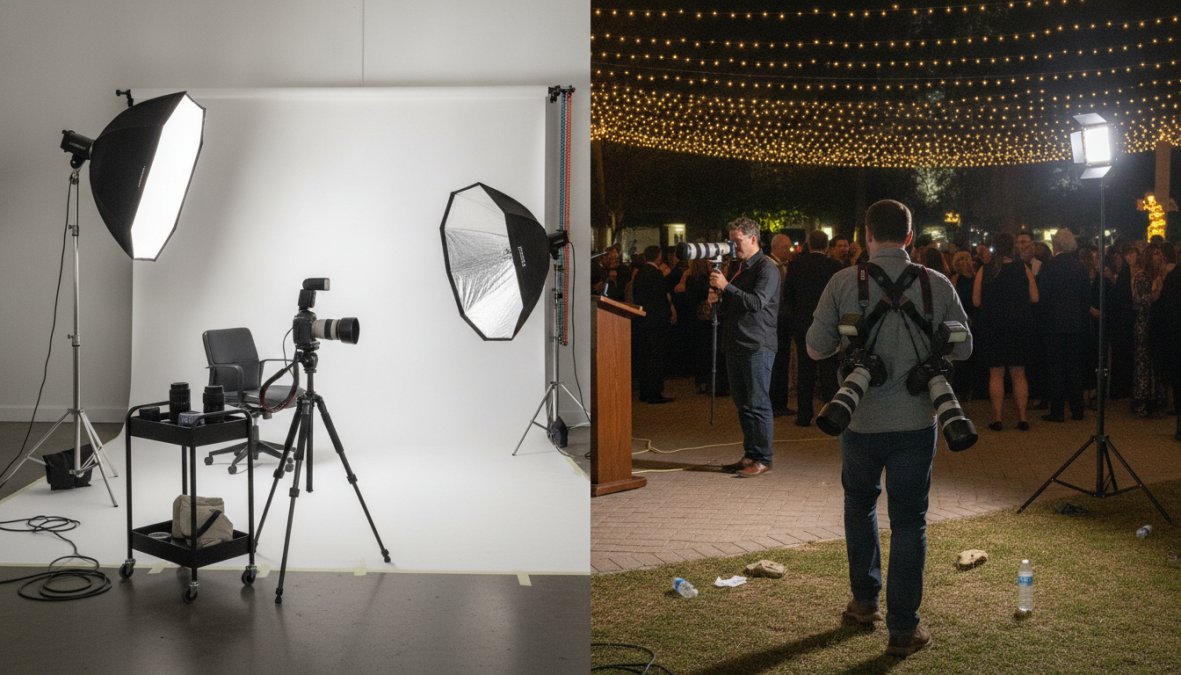
Corporate headshot studios are optimized environments where the photographer controls every light source, the background, and overall environment. Studio lighting is consistent, predictable, and flatters most faces. Event photography happens in whatever lighting conditions exist, fluorescent overhead lights, harsh shadows, or dramatic colored lighting. Event photographers must adapt by adjusting camera settings, using flash strategically, and positioning themselves to work with available light.
Event photographers need different equipment than headshot photographers: multiple lenses (wide angle for atmosphere, telephoto for distant speakers), fast lenses that work in low light, and often multiple flash units. A headshot session is scheduled weeks in advance with predictable workflow. Event photography requires scouting the venue, understanding the schedule, identifying key speakers and moments, and planning positioning for optimal sightlines.
Retouching, Post-Production, and Digital Asset Delivery
Corporate headshots receive extensive retouching. A professional retoucher will smooth skin, even out skin tone, brighten eyes, whiten teeth, adjust hair, and perfect the background. Event photography receives lighter editing, the photographer will correct color temperature, adjust exposure and contrast, and perhaps remove obvious distractions. Event photos should look natural and authentic, not overly processed.
Headshots are typically delivered as high-resolution files (300 DPI) suitable for printing and web use in multiple formats. Event photos are delivered as high-resolution JPGs. Clarify licensing upfront: whether you can use images commercially, share them on social media, and whether the photographer retains any rights.
Turnaround time varies. Headshots typically take 1-2 weeks from session to delivery, mostly because of retouching time. Event photos typically take 2-4 weeks because the photographer must sort through hundreds of images and perform color correction across the entire set.
When selecting a headshot photographer, ask about their retouching process and clarify expectations upfront to avoid surprises.
ROI and Business Metrics: Measuring Photography Value
Professional headshots directly impact how your organization is perceived. A company website with polished, consistent headshots appears more professional and trustworthy. LinkedIn profiles with professional headshots get more engagement and connection requests.
Event photos serve marketing and documentation purposes. Photos from your conference can be used in social media posts, email newsletters, case studies, and annual reports. According to research from HubSpot’s State of Marketing Report 2026, companies that invest in professional visual content see significantly higher engagement rates across marketing channels.
Many organizations benefit from hybrid packages combining both types of photography. Some event photographers offer headshot services at corporate events: they photograph the event, then set up a quick headshot station where attendees can get professional portraits. This is efficient and cost-effective, ensuring consistent style across both types of images.
Making Your Decision: When to Invest in Each
Choose corporate headshots when you need consistent professional portraits for directories, LinkedIn, websites, or ID badges. Choose event photography when you’re hosting a conference, gala, product launch, or significant corporate gathering and want to document the event and create marketing content. Choose both when you have the budget and want to maximize your photography investment.
The real question isn’t "which type of photography is better?" It’s "which type solves my specific business problem?" Corporate headshots solve the problem of inconsistent professional portraits. Event photography solves the problem of documenting important moments and creating authentic marketing content. Understanding these differences prevents wasted budget and ensures you get the assets you actually need.
Frequently Asked Questions
What is the main difference between corporate headshots and event photography?
Corporate headshots are controlled, studio-based portraits designed for professional branding, team directories, and ID badges. Event photography captures spontaneous moments and visual storytelling at live conferences, galas, and corporate gatherings. Headshots prioritize consistency and professionalism through studio lighting; event photos emphasize authentic corporate culture and employee engagement through dynamic, candid imagery.
How should I prepare for corporate headshots to ensure professional results?
Choose solid, professional clothing that reflects your brand identity, avoid busy patterns or distracting colors. Arrive well-rested with minimal makeup adjustments needed. Communicate your goals and any specific aesthetic preferences to your photographer beforehand. Bring multiple outfit options if variety is desired. Familiarize yourself with the photography brief so you understand lighting conditions and expected turnaround time for your digital assets.
Can event photos be used as professional headshots?
While event photos can capture authentic moments, they typically lack the consistency, controlled lighting, and polished post-production that professional headshots provide. Event photography excels at visual storytelling and capturing corporate culture, but spontaneous moments may not meet the technical specifications or aesthetic standards required for team directories, LinkedIn profiles, or marketing materials. A hybrid approach often works best.
How do I choose between corporate headshots and event photography for my business?
Use corporate headshots for employee branding, team directories, and professional marketing assets requiring visual consistency. Choose event photography to amplify your message, maximize your mission, and elevate your brand during conferences or galas. Consider a hybrid photography package that combines both services to maximize ROI and create comprehensive marketing assets that showcase both professional identity and corporate culture.
This article was written using GrandRanker