Table of Contents
- What Is Documentary Style Event Photography Explained
- Why Documentary Style Matters for Events
- Candid Event Photography Tips for Better Results
- Documentary Event Photography Examples and Editorial Style
- How to Hire a Documentary Event Photographer
- Common Mistakes in Documentary Style Event Photography
- Conclusion
Last Updated: June 28, 2026
What Is Documentary Style Event Photography Explained
Documentary style event photography is a candid, unscripted approach to capturing moments as they naturally unfold. Rather than directing subjects into posed positions, documentary photographers function as unobtrusive observers, documenting authentic interactions and genuine emotions without staging or heavy intervention.
The core philosophy centers on storytelling through visual narrative. A documentary-style photographer anticipates moments before they happen, positions themselves strategically, and captures the essence of an event as it actually occurs. This requires patience, technical skill, and an intuitive understanding of human behavior.
The best documentary photographers position themselves where interaction happens naturally. They don’t interrupt the flow; they become part of the environment so completely that guests stop noticing them within 15 minutes.
The Difference Between Documentary and Posed Photography
Posed photography places the photographer in control, with subjects receiving clear direction and elements arranged intentionally. Documentary photography inverts this dynamic, the photographer observes rather than directs, capturing unscripted moments while subjects move naturally through their environment.
In wedding coverage, a posed approach yields perfectly arranged family portraits, while a documentary approach captures the groom’s genuine reaction when he first sees his bride, unguarded laughter during toasts, and exhausted joy on parents’ faces during the first dance.
| Aspect | Posed Photography | Documentary Photography |
|---|---|---|
| Photographer Role | Director and choreographer | Observer and anticipator |
| Subject Direction | Explicit instructions given | Minimal or no direction |
| Timing Control | Photographer determines moment | Photographer reacts to moment |
| Emotional Quality | Polished and controlled | Authentic and spontaneous |
| Best For | Formal portraits, group shots | Events, interactions, storytelling |
The two approaches aren’t mutually exclusive. Many professional photographers blend both methods, capturing intentional group portraits while also documenting candid moments throughout the event.
The Role of the Photographer as Observer
A documentary photographer functions as a fly-on-the-wall observer rather than an active participant. This requires developing "anticipatory vision", learning to read a room, predict where meaningful moments will occur, and position themselves to capture those moments without disrupting them.
Non-intrusive positioning is essential. The photographer who constantly asks people to move or positions themselves directly in sight lines becomes part of the event rather than a recorder of it. This observer mentality extends to technical decisions: rather than controlling light through flash and reflectors, documentary photographers work with available light, adapting to the environment.
The photographer’s invisibility is the documentary style’s greatest strength. When guests stop noticing the camera, genuine moments emerge naturally.
Why Documentary Style Matters for Events
Documentary style photography captures what actually happened rather than what was staged for the camera. Events are fundamentally about human connection and experience. A series of documentary images tells the story of an event’s arc, the anticipation, peak moments, and wind-down. For weddings, documentary coverage has become standard because couples want to remember how the day actually felt.
Capturing Authentic Emotions and Real-Life Moments
Authentic emotions emerge when people forget they’re being observed. A photographer positioned to the side or at an angle captures behavior closer to how the subject actually acts when unobserved.
Timing involves anticipating emotional peaks, the moment when a father sees his daughter walk down the aisle, when a joke lands during a toast, when two old friends recognize each other. Continuous shooting mode allows the photographer to capture multiple frames as emotion unfolds, while fast shutter speeds freeze genuine expressions and wide apertures isolate subjects from distracting backgrounds.
Asking someone to “act natural” or “do that again” immediately triggers self-consciousness. The best documentary photographers capture moments without explicitly asking subjects to recreate them.
How Documentary Photography Tells a Story
Documentary photography creates narrative through sequence and selection. A single image captures a moment; a series of images, arranged thoughtfully, tells the story of an event’s emotional arc.
Strong documentary sequences typically follow a narrative structure: establishing context, rising action through key moments, emotional peaks, and resolution. The photographer’s editorial choices shape the narrative, which moments receive emphasis through composition, which interactions are highlighted, transforming raw documentation into meaningful storytelling.
Candid Event Photography Tips for Better Results
First, arrive early and scout the location to understand the space, lighting conditions, and potential vantage points. Second, use a combination of focal lengths, a 35mm or 50mm lens provides a natural field of view, while a 70-200mm lens allows you to capture moments from greater distance.
(/is-candid-event-photography-worth-it/) Tips for Better Results]
Third, maintain consistent technical settings that allow quick adjustments. Fourth, develop a rhythm of observation and shooting rather than constantly holding the camera to your eye. Finally, build relationships with subjects through brief early conversations, making them more comfortable and less likely to perform when you raise the camera.
Mastering the Fly-on-the-Wall Approach
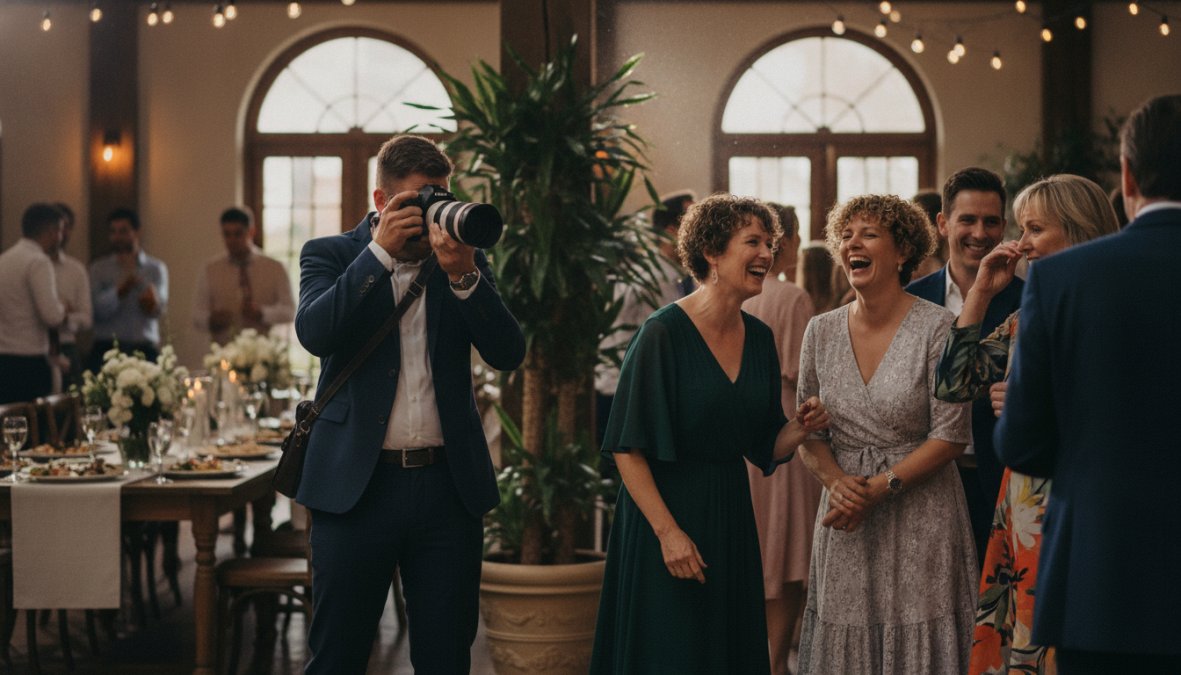
Position yourself at the edges where observers naturally stand, near the bar, the entrance, or the edge of the dance floor. Distance matters significantly; standing too close triggers self-consciousness, while standing too far reduces image quality. Lighting yourself appropriately supports invisibility, if you’re backlit or positioned in shadow, you become less noticeable.
The fly-on-the-wall approach produces images that feel stolen rather than taken, with subjects appearing genuinely engaged in their experience rather than aware of being photographed.
Technical Gear and Camera Settings
A versatile lens selection provides flexibility without excessive equipment. A 35mm or 50mm prime lens offers a natural field of view and fast aperture for low-light performance, while a 70-200mm zoom lens captures moments from greater distance.
Aperture settings typically fall in the f/2.0 to f/4.0 range. For active moments, use 1/250th second or faster to prevent motion blur. Continuous shooting mode at 5-10 frames per second increases the likelihood of capturing peak moments. Adjust ISO based on available light rather than keeping it constant, modern cameras handle ISO 3200 to 6400 with acceptable noise levels.
Continuous autofocus with subject tracking helps maintain focus on moving subjects. Back-button focus provides additional control, allowing you to focus on one area while recomposing without refocusing.
Shoot in RAW format rather than JPEG. Documentary work often captures moments in variable lighting, and RAW files provide significantly more flexibility during post-processing.
Timing, Anticipation, and Composition
Timing determines whether you capture the peak moment, the instant when emotion is most visible, that typically lasts less than a second. Anticipation involves reading situations before they develop fully, allowing you to position yourself before the peak moment arrives.
Composition in documentary work often differs from traditional rules. Rather than centering subjects or creating perfect rule-of-thirds arrangements, documentary photographers frequently compose loosely, prioritizing capture of the moment over perfect framing.
Documentary Event Photography Examples and Editorial Style
Wedding photography represents perhaps the most developed application of documentary style, capturing the groom’s reaction when seeing his bride, genuine laughter during toasts, and unguarded joy on guests’ faces. Corporate events benefit from documentary coverage that shows actual engagement rather than posed networking.
Editorial style in documentary photography borrows techniques from photojournalism, with the photographer functioning as a visual journalist documenting what actually occurred. Editorial style emphasizes narrative over individual moments, favoring sequences that tell stories.
Editorial vs. Documentary Style Comparison
While documentary and editorial styles share similarities, important distinctions separate them. Editorial photography typically appears in publications and serves a communicative purpose beyond the event itself, while documentary photography primarily serves to document what occurred for the people who experienced it.
Both styles prioritize authenticity and non-intrusive observation. The distinction lies primarily in intent and audience rather than technique. In practice, many professional photographers blend both approaches.
How to Hire a Documentary Event Photographer
Begin by reviewing portfolios specifically for documentary work, looking at how photographers handle candid moments and whether their images tell coherent stories. Ask potential photographers about their approach and philosophy on working with subjects without directing them.
Review how photographers handle varying light conditions and discuss their experience with your specific event type, as experience typically correlates with better positioning and anticipation.
Client Preparation and Managing Expectations
Explain the documentary philosophy clearly, as many clients accustomed to traditional posed photography may initially feel uncertain about an approach that doesn’t involve direction and staging. Discuss the photographer’s role as an observer rather than director, and address expectations about specific moments that may not occur exactly as clients imagine.
Discuss the balance between candid and posed images, and prepare subjects for the photographer’s presence with a brief conversation explaining the non-directive approach. Discuss the timeline for image delivery and editing.
Post-Production and Editing Style
Post-production in documentary photography focuses on enhancing authenticity rather than transforming images. Color correction typically begins with white balance adjustment to create consistency across the event while maintaining the authentic feel.
Exposure adjustments should be subtle, improving visibility without creating an obviously edited appearance. Color grading should remain subtle, with a consistent color palette creating cohesion without appearing artificial. Blemish removal and minor retouching are appropriate but should be conservative.
Documentary editing serves the moment rather than imposing a stylistic vision. The photographer’s job is to make authentic moments look their best, not to create a particular aesthetic.
Common Mistakes in Documentary Style Event Photography
Positioning too centrally is perhaps the most common error, triggering self-consciousness and interrupting natural behavior. Shooting too constantly prevents anticipation, while underestimating the importance of lighting creates technical problems.
Neglecting to scout locations ahead of time leads to poor positioning during key moments. Failing to understand the event flow creates gaps in coverage. Overcomplicating post-production can undermine the documentary feel, with restraint in post-production preserving the authentic quality that makes documentary work powerful.
Documentary style event photography is fundamentally about capturing authenticity. The photographer becomes an observer rather than a director, positioning themselves to document what actually occurs rather than staging moments for the camera. This approach produces images that feel alive, genuine, and emotionally resonant, visual records of events as they actually unfolded.
Mastering documentary photography requires technical skill, strong anticipation, and understanding of human behavior. It demands patience, positioning discipline, and the ability to fade into the background while remaining positioned to capture peak moments. Event Photojournalism specializes in this approach, delivering award-winning documentary coverage for corporate conferences, galas, weddings, and special events across the DMV area. Contact Event Photojournalism to discuss how documentary style photography can authentically capture your next event.
Frequently Asked Questions
What is the difference between documentary and traditional event photography?
Documentary style event photography captures unscripted, authentic moments as they naturally unfold, emphasizing candid interactions and emotional resonance. Traditional posed photography involves staging subjects, directing expressions, and creating controlled compositions. Documentary photographers act as non-intrusive observers using a fly-on-the-wall approach, while posed photographers actively direct the narrative. Both styles have value, but documentary photography excels at preserving the genuine essence and spontaneous humanity of your event.
How do you shoot candid event photography without being intrusive?
Master the fly-on-the-wall technique by positioning yourself strategically to observe interactions without interrupting them. Use longer lenses to maintain distance, anticipate moments before they happen, and blend into the background. Arrive early to let guests acclimate to your presence. Shoot in natural light when possible and avoid using flash, which draws attention. Focus on genuine interactions rather than posed moments, and let the visual narrative unfold organically while you capture the storytelling elements that make your event unique.
What equipment is best for documentary event photography?
A full-frame DSLR or mirrorless camera with fast prime lenses (35mm, 50mm, 85mm f/1.4-2.8) works exceptionally well for documentary work. These lenses excel in low natural light and allow you to maintain distance while capturing intimate moments. A secondary camera body ensures uninterrupted coverage. Fast shutter speeds (1/250+), higher ISO capabilities, and continuous autofocus are essential for capturing spontaneous moments. Minimal gear keeps you mobile and unobtrusive, avoid large flashes and excessive equipment that signals your presence to subjects.
How should I prepare clients for documentary style event photography?
Clearly explain that documentary photography prioritizes authentic moments over staged portraits, reducing the need for formal posing. Discuss your non-intrusive approach and reassure clients that you'll capture the genuine essence of their event. Provide a shot list of essential moments (first dance, toasts, key interactions) but emphasize that your primary focus is storytelling and emotional resonance. Share examples of your documentary work, explain your editing style, and set expectations about the visual narrative you'll deliver rather than a comprehensive catalog of posed images.
This article was written using GrandRanker