Table of Contents
- Event Photography vs Traditional Portraiture: Understanding the Core Difference
- Candid vs Posed Photography: How Each Approach Shapes the Final Image
- Brand Identity, Authenticity, and First Impressions: Which Style Wins?
- Event Photography Equipment List vs Portrait Studio Setup
- Portrait Session Duration vs Event Coverage: What to Expect on the Clock
- Event Photography Pricing Guide: Cost vs Value Analysis
- When Event Photography vs Traditional Portraiture Is the Right Call
- Conclusion
Last Updated: June 16, 2026
The choice between event photography vs traditional portraiture shapes every visual asset your organization produces, yet most marketing teams treat it as an afterthought. At Event Photojournalism, we work with corporate clients, nonprofits, and event planners across the DMV area who consistently underestimate how much this decision affects brand perception, audience engagement, and long-term ROI. It determines authenticity, licensing rights, how audiences respond to your imagery, and whether your visual content actually converts. Below, we’ll break down exactly how these two disciplines differ, when each one serves your goals, and how to build a hybrid content strategy that gets measurable results.
Event Photography vs Traditional Portraiture: Understanding the Core Difference
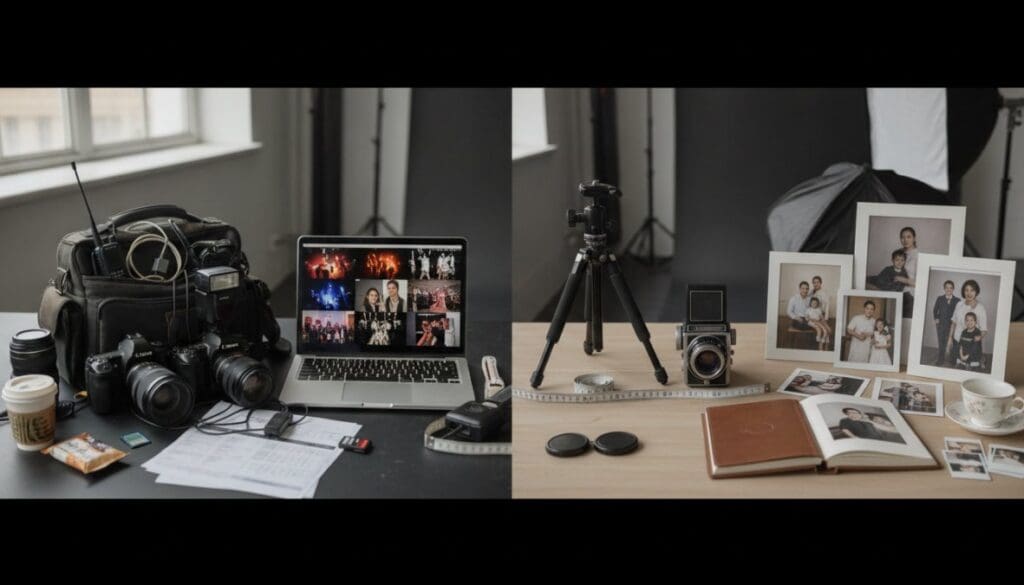
Event photography documents real moments as they unfold, candid interactions, environmental context, authentic emotion, without staging or directing subjects. Traditional portraiture is a controlled discipline where the photographer directs the subject, manages lighting precisely, and constructs a specific visual outcome in a studio or controlled setting.
Event coverage generates a library of authentic, story-driven images; portrait sessions produce polished, brand-consistent headshots and lifestyle photography. The two disciplines also require completely different skill sets, equipment configurations, and post-production workflows.
| Attribute | Event Photography | Traditional Portraiture |
|---|---|---|
| Subject direction | Minimal to none | Full direction |
| Lighting control | Adaptive, mixed sources | Fully controlled |
| Setting | Real-world environments | Studio or curated location |
| Image outcome | Candid, documentary | Polished, constructed |
| Primary use | Event documentation, PR | Headshots, marketing materials |
| Turnaround time | 24-72 hours typical | Variable, often longer |
| Licensing complexity | Moderate | Higher (model releases required) |
What Event Photography Actually Captures
Event photography documents the living story of an occasion: the speaker at the podium, the spontaneous handshake, the crowd reaction, the award moment. These images carry narrative weight that staged photography cannot replicate, translating into content that shows culture, community, and mission in action. The best event images work across press releases, social media, annual reports, and internal communications because they feel real, and 2026 audiences are sophisticated enough to recognize generic photos immediately.
What Traditional Portrait Sessions Deliver
Portrait sessions deliver precision. The photographer controls every variable: background, light ratio, subject posture, expression, wardrobe. For executive headshots, product photography, or any use case where consistency and polish define success, portrait sessions are the correct choice.
Candid vs Posed Photography: How Each Approach Shapes the Final Image
The approach you choose determines the emotional register of your visual assets. Candid photography captures micro-expressions, genuine reactions, and spontaneous interactions that posed photography structurally cannot produce. Posed photography delivers consistency, controlled brand messaging, and technical perfection. Both are legitimate professional disciplines with distinct outputs.
 crouching low at a corporate gala, capturing candid laughter between two executives at a dinner table, warm ambient lighting from chandeliers, while in the background a softbox-lit studio portrait session is staged against a clean white backdrop](https://cdn.grandranker.com/articles/event-photography-vs-traditional-portraiture-key-differences-content-1-1781574588.jpg)
The Authenticity Advantage of Candid Coverage
Authenticity directly affects audience engagement. According to research compiled by Content Marketing Institute’s visual content guidelines, audiences consistently rate authentic imagery as more trustworthy than obviously staged content. Candid event coverage gives organizations exclusive content that stock imagery can never replicate: real people, real moments, real context. When a conference attendee sees a genuine image of themselves in your post-event communications, engagement rises sharply.
For corporate event documentation, prioritize capturing reaction shots and environmental context alongside main program moments. These secondary images often outperform the expected “speaker at podium” shots in social media engagement.
When Posed Portraits Serve Brand Identity Better
Posed portraiture wins when brand consistency is non-negotiable. Executive and sales teams need headshots that align visually across all marketing materials, candid coverage cannot guarantee that alignment. The rule of thumb: use posed portraits to establish your brand’s visual language, then use event coverage to demonstrate that the brand is alive and active in the world.
Brand Identity, Authenticity, and First Impressions: Which Style Wins?
Neither style wins universally, brand identity requires both. The mistake organizations make is treating portrait sessions and event coverage as competing budget items rather than complementary visual assets. According to Nielsen Norman Group’s research on visual processing, users form opinions about visual content almost instantaneously. Posed portraits handle professionalism. Event coverage handles authenticity.
Visual Storytelling for Corporate and Marketing Materials
The most effective marketing materials combine both disciplines: a polished executive portrait establishes authority, while an event photograph of that same executive engaged with stakeholders proves the authority is real. Together, they build a complete brand narrative.
Stock Imagery vs Custom Photography: The Credibility Gap
Audiences recognize stock imagery. The visual clichés, the handshake, the diverse team around a conference table, trigger skepticism rather than trust. Custom photography, whether event coverage or portrait sessions, produces exclusive content your competitors cannot use. Organizations that invest in custom visual assets consistently see stronger brand perception outcomes than those relying on royalty-free libraries.
Using stock imagery for event documentation is not just a missed opportunity. It actively signals to audiences that your organization did not consider the event worth documenting professionally. That perception is difficult to reverse.
Event Photography Equipment List vs Portrait Studio Setup
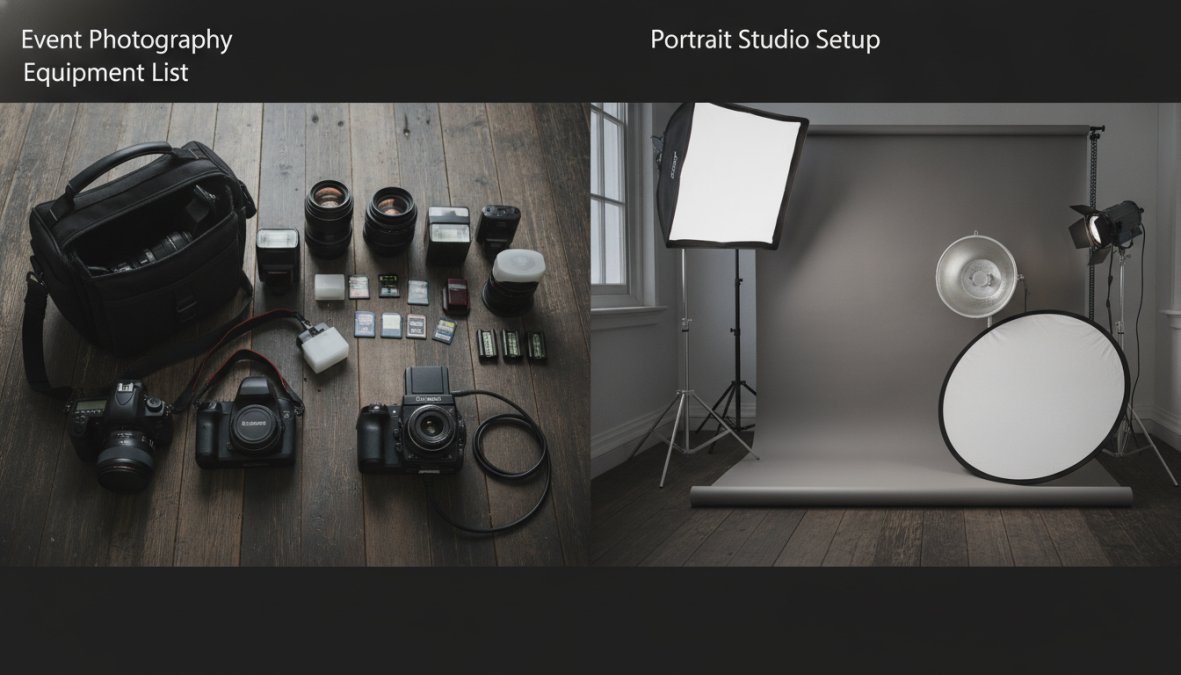
The equipment gap between event coverage and studio portraiture is significant and explains much of the pricing difference between the two disciplines.
Gear That Defines Event Coverage Quality
A professional event photography equipment list typically includes:
- Two or more camera bodies (redundancy is non-negotiable at live events)
- Fast prime lenses (f/1.4 to f/2.8) for low-light performance
- Telephoto zoom lenses for capturing moments at distance without disruption
- Multiple external flash units with diffusers and remote triggers
- High-capacity memory cards with on-site backup capability
- Spare batteries (events run long; batteries do not)
- Camera bag configured for rapid access and gear changes
The defining characteristic of event gear is speed and adaptability, the photographer must move through a venue, adjust to changing light, and capture unrepeatable moments without interrupting the event.
Studio Environment Tools for Traditional Portraiture
Portrait studio setups prioritize control over mobility:
- Continuous lighting or strobe systems with softboxes and reflectors
- Light meters for precise exposure management
- Backdrop systems (seamless paper, canvas, or fabric)
- Tethered shooting setup for real-time image review
- Posing aids and adjustable subject seating
- Dedicated post-production workstation for retouching
The studio environment exists to eliminate variables, which is why portrait sessions produce technically consistent results that event coverage, by its nature, cannot guarantee.
Portrait Session Duration vs Event Coverage: What to Expect on the Clock
A standard individual portrait session runs one to two hours, with most time spent on setup, direction, and reviewing test shots. Group sessions for executive teams can extend to half a day. Event coverage is measured in hours of continuous shooting, four to six hours for a half-day corporate conference, eight to twelve for a full gala. The photographer cannot pause the event to adjust conditions, and the volume of images captured is substantially higher than in a portrait session.
For corporate events, book coverage for the full duration of the program plus thirty minutes before and after. The pre-event setup and post-event networking moments often produce the most usable candid content.
Event Photography Pricing Guide: Cost vs Value Analysis
Event photography pricing reflects the complexity of live coverage: equipment redundancy, hours of shooting, volume of images to cull and edit, and the expertise required to deliver quality under unpredictable conditions. Portrait sessions are priced differently because the variables are controlled, fewer hours, fewer images, more predictable workflow.
The cost vs value question is not "which is cheaper?" It is "what does each investment produce?" A half-day event coverage package produces dozens of usable images across social media, press, internal communications, website, and annual reports. Many organizations find that a combined annual investment in both disciplines produces the strongest visual asset library.
Licensing, Copyright, and Legal Nuances You Cannot Ignore
Copyright in photography belongs to the photographer at the moment of capture. When you hire a photographer, you are purchasing a license to use the images, not ownership of the copyright, unless a work-for-hire agreement explicitly transfers rights.
For event photography, clarify:
- Whether the license covers commercial use or is restricted to internal use
- Whether images can be used in paid advertising or only organic content
- The duration of the license (perpetual vs. time-limited)
- Whether a model release is required for identifiable individuals in commercial contexts
According to U.S. Copyright Office guidance on photography rights, photographers retain full copyright by default. A perpetual commercial use license should be explicitly negotiated and documented in the contract. Portrait sessions carry additional legal considerations: a model release grants permission for commercial use of a subject’s likeness, and without one, using a portrait in advertising creates legal exposure.
ROI Metrics: Measuring What Your Visual Assets Actually Return
ROI on photography investment is measurable. Useful metrics include:
- Social media engagement rates on posts using custom event photography vs. stock imagery
- Press pickup rates for press releases accompanied by professional event images
- Website conversion rates on pages featuring authentic team photography vs. generic stock
- Reuse rate: how many times does a single image appear across different channels?
Teams that track these metrics consistently find that custom photography outperforms stock imagery across all engagement metrics. The initial investment is higher; the per-use cost over time is lower.
When Event Photography vs Traditional Portraiture Is the Right Call
Choosing between event photography vs traditional portraiture comes down to three questions: What is the primary use case? What emotional response do you need to generate? What is your timeline? Use event coverage when you need authentic, story-driven content that documents real moments and demonstrates organizational culture. Use portrait sessions when you need polished, brand-consistent imagery for marketing materials, executive profiles, or product presentations. A company that only commissions portrait work looks polished but static; one that only documents events looks active but inconsistent.
Building a Hybrid Content Strategy for Maximum Impact
A hybrid content strategy treats event photography and portrait work as complementary inputs to a single visual content system. The portrait library establishes your brand’s visual language; the event library populates that framework with proof of life. Practically, this means planning both disciplines into your annual content calendar rather than commissioning them reactively, scheduling portrait sessions at the start of the year and building event coverage into every major program.
Decision Framework: Matching Your Promotional Needs to the Right Style
Use this framework to match your specific needs to the right photographic discipline:
- Primary use case is executive profiles or team pages → Portrait session
- Primary use case is event documentation or press coverage → Event photography
- Content will appear in paid advertising → Portrait session with signed model releases
- Content needs to demonstrate organizational culture → Event photography
- Brand identity refresh or new team members → Portrait session
- Annual report, gala, conference, or awards ceremony → Event photography
- Website hero images requiring brand consistency → Portrait session
- Social media content calendar requiring volume → Event photography
- Both polish and authenticity required → Hybrid approach, both disciplines
The American Society of Media Photographers professional standards provides additional guidance on contracts, licensing, and working with professional photographers for both event and portrait contexts.
Organizations that treat photography as a commodity consistently underinvest in the visual assets that most directly affect how audiences perceive them. The choice between event photography vs traditional portraiture is not a budget decision. It is a brand strategy decision. Event Photojournalism provides award-winning, high-resolution coverage across both disciplines for corporate conferences, galas, and special events throughout the DMV area, with customized solutions designed to elevate your brand and maximize your mission. CONTACT US to discuss how event documentation and portrait work can build the visual asset library your organization needs.
Frequently Asked Questions
What is the main difference between event photography and portrait photography?
Event photography focuses on documenting real moments as they unfold, candid interactions, speakers, crowd energy, in dynamic, often unpredictable environments. Traditional portraiture is a controlled, planned session where the photographer directs subjects in a studio or curated setting to produce polished, posed images. In event photography vs traditional portraiture, the core distinction comes down to creative control: portraits offer it fully, while event coverage prioritizes authentic, in-the-moment visual storytelling.
Do event photographers also do portraits, and should you hire one for both?
Many professional event photographers are skilled in both disciplines, but the equipment, mindset, and workflow differ significantly. At corporate events, a photographer may capture candid coverage throughout and then set up a quick portrait station for headshots, a hybrid approach that delivers both authentic event documentation and polished individual imagery. If your promotional needs include both marketing materials and event coverage, hiring a team experienced in both styles maximizes your visual asset output from a single engagement.
How does portrait session duration compare to event photography coverage time?
A traditional portrait session typically runs 30 minutes to 2 hours depending on the number of subjects and looks required. Event photography coverage is scoped to the event itself, commonly 2 to 8 hours for corporate conferences, galas, or weddings. Longer events require photographers with high-capacity equipment and stamina for sustained shooting. When planning your event photography pricing guide budget, coverage duration is one of the primary factors that determines final cost alongside team size and turnaround time.
What equipment is needed for event photography vs portrait sessions?
Event photographers typically carry multiple camera bodies, fast wide-to-telephoto zoom lenses, off-camera flash or speedlights, and high-capacity memory cards to handle unpredictable lighting and fast-moving subjects. Portrait photographers lean on a studio environment with controlled strobe lighting, reflectors, and prime lenses optimized for sharpness at wider apertures. Both require high-quality imagery standards, but event setups prioritize versatility and speed while portrait setups prioritize precision and consistency.
How do pricing models differ between event and portrait photographers?
Event photography is typically priced by the hour or as a flat-rate package tied to coverage duration, number of photographers, and deliverable volume, high-resolution galleries with fast turnaround time often command premium rates. Portrait sessions are usually priced as a session fee plus image licensing or print packages. For commercial use, both disciplines may involve model release requirements and licensing terms that affect total cost. Always clarify copyright ownership and usage rights before signing any photography contract.
This article was written using GrandRanker