Table of Contents
- Why You Should Hire a Professional Event Photographer
- Types of Events a Freelance Photographer Can Cover
- What to Look for When You Hire an Event Photographer
- Event Photography Pricing Guide: What to Budget
- Questions to Ask an Event Photographer Before Booking
- Event Photography Contract Template: Legal and Insurance Essentials
- How to Build Your Event Photography Shot List
- Conclusion: Book the Right Event Photographer for Your Next Event
Last Updated: May 24, 2026
Deciding to hire event photographer services is one of the most consequential choices you’ll make in your event planning process. Get it right, and you walk away with high-resolution images that document your brand, your people, and your message for years. Get it wrong, and you’re left with blurry, poorly lit shots that no one wants to use. This guide from Event Photojournalism covers everything you need to know: what to look for, what to budget, what questions to ask, and what legal details most people overlook until it’s too late.
Here’s what most guides get wrong: they focus almost entirely on aesthetics and ignore the operational side. A beautiful portfolio means nothing if the photographer shows up late, delivers files six weeks after your event, or doesn’t carry liability insurance. Below, we’ll show you exactly how to vet, book, and brief an event photographer so you’re protected on every front.
Why You Should Hire a Professional Event Photographer
Professional event photography is the practice of capturing the key moments, interactions, and atmosphere of an event through skilled composition, lighting mastery, and post-production editing. It is fundamentally different from casual documentation. A professional brings specialized equipment, deliberate technique, and a trained eye for storytelling that a smartphone simply cannot replicate.
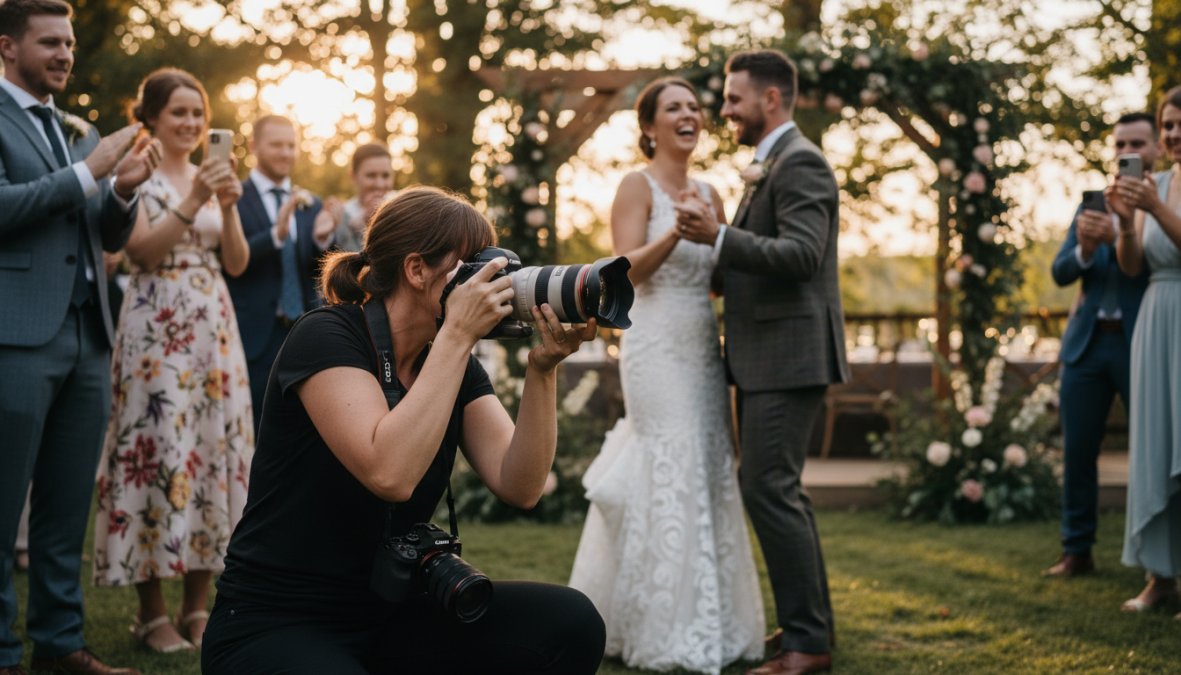
The gap between professional coverage and amateur coverage shows up immediately in the final deliverables. Low-light venues, fast-moving subjects, and complex group compositions all require gear and experience that go well beyond what any mobile device offers. According to Professional Photographers of America’s industry resources, professional photographers invest significantly in both equipment and continuing education to stay current with evolving event environments.
The business case for professional coverage is also stronger than many event planners realize. High-quality images feed your post-event marketing, social media, press releases, and internal communications. A single well-executed gala shoot can generate content that your marketing team uses for months.
Professional Photography vs. Smartphone Coverage
The honest answer is that smartphone photography has improved dramatically, but it still fails in the scenarios where event photography matters most. Dim ballrooms, fast-moving speakers, wide-angle group shots that require flash management, and candid moments captured from across a crowded room all demand professional-grade equipment.
A professional event photographer brings:
- Full-frame sensors that perform in low-light without excessive noise
- Fast prime and zoom lenses (f/1.4 to f/2.8) for sharp images in dim venues
- Off-camera flash and lighting modifiers for consistent, flattering coverage
- Backup bodies and lenses to prevent equipment failure from ruining your event
- Lightroom-calibrated editing workflows that produce consistent color grading across hundreds of images
A smartphone produces one image style. A professional produces a narrative.
Ask any photographer you’re vetting to show you a full gallery from a single event, not just their portfolio highlights. The consistency of the middle shots, not the best shots, tells you what your event will actually look like.
Types of Events a Freelance Photographer Can Cover
Freelance event photographers cover a broader range of events than most clients expect. The common assumption is that event photography means weddings, but the category spans the entire spectrum of commercial photography and private celebrations.
Common event types include:
- Corporate events: Conferences, product launches, trade shows, brand activations, and annual meetings
- Galas and fundraisers: Award ceremonies, nonprofit galas, charity dinners
- Weddings and elopements: Full-day coverage, engagement sessions, and destination events
- Private celebrations: Milestone birthdays, anniversaries, and graduation parties
- Government and association events: Conferences, press events, and legislative functions
- Brand and marketing activations: Experiential marketing events, pop-ups, and sponsorship activations
What most guides skip entirely, and what separates a well-matched booking from a mismatched one, is that each event type presents distinct technical challenges. Hiring a photographer without confirming they can handle your specific venue conditions is one of the most common and costly mistakes event planners make.
Technical Requirements by Venue and Event Type
The following breakdown gives event planners a practical checklist for evaluating whether a photographer is technically equipped for their specific environment. Use it during the vetting conversation, not after you’ve signed.
Ballrooms and Indoor Gala Venues
The defining challenge is mixed and low ambient light. Chandeliers and uplighting create warm, uneven illumination that looks beautiful to the human eye but produces color casts and exposure inconsistencies in camera. Many upscale venues also restrict or prohibit on-camera flash to protect the atmosphere.
What to confirm with your photographer:
- Do you shoot with fast lenses (f/1.4-f/2.8) capable of clean exposures at ISO 3200 or higher?
- How do you handle venues that prohibit direct flash? (Look for answers involving bounce flash, off-camera strobes on stands, or available-light shooting with high-ISO capable bodies.)
- Can you show me a full gallery from a comparable ballroom event?
Conference Centers and Breakout Session Formats
Conferences present a multi-room, simultaneous-coverage problem. Keynote stages have strong front lighting but dark audience areas. Breakout rooms are often lit with flat fluorescent overhead light that produces unflattering, greenish tones. Panel discussions require capturing multiple speakers at once without constant repositioning disrupting the session.
What to confirm with your photographer:
- Have you covered multi-track conferences where sessions run simultaneously in different rooms?
- How do you handle fluorescent-lit breakout rooms? (Look for answers involving custom white balance and exposure compensation, not just "I’ll fix it in post.")
- Do you work from a schedule provided by the event team, or do you need a dedicated coordinator to guide you between rooms?
Outdoor Events: Daytime and Evening
Outdoor events introduce variables that indoor venues don’t: changing natural light, harsh midday sun, wind, and unpredictable weather. Midday sun creates hard shadows under eyes and chins in portrait situations. Golden hour (the hour after sunrise and before sunset) is ideal but narrow. Evening outdoor events require portable lighting solutions.
What to confirm with your photographer:
- How do you handle harsh midday sun for outdoor group photos? (Look for answers involving diffusion, shade positioning, or fill flash.)
- What is your contingency if weather forces the event indoors or under a tent?
- Do you carry portable battery-powered strobes for evening outdoor coverage?
Trade Shows and Exhibition Floors
Trade show photography is one of the most technically demanding event formats and is frequently underestimated by both clients and photographers. Exhibition halls use a combination of overhead fluorescent or LED grid lighting, booth-specific accent lighting, and backlit display panels, all at different color temperatures simultaneously. The environment is chaotic, loud, and constantly moving.
What to confirm with your photographer:
- Have you shot on an active trade show floor, not just at a booth setup before the show opens?
- How do you handle the mixed color temperatures from overhead hall lighting and individual booth lighting?
- Can you capture booth interactions and product demonstrations without disrupting live sales conversations?
Do not assume that a photographer with strong corporate gala experience is automatically prepared for trade show coverage. The skills overlap, but the environment is fundamentally different. Always ask for trade show-specific portfolio samples if that is your event type.
High-Speed Action and Live Performance Events
Sporting events, live performances, and high-energy activations require fast shutter speeds (typically 1/500s or faster) to freeze motion, combined with the ability to track unpredictable subjects. Stage lighting for performances is often dramatic but inconsistent, strobes, color gels, and rapid changes that make metering difficult.
What to confirm with your photographer:
- What is your preferred lens and shutter speed setup for fast-moving subjects?
- Have you shot under stage lighting with color gels? How do you manage white balance in post?
- Do you have experience working within venue restrictions on flash use during live performances?
Venue Access and Credentialing
For government buildings, embassies, convention centers, and high-security corporate campuses, photographer access is not automatic. Many venues require advance credentialing, equipment lists submitted for security review, and in some cases, background checks for vendors. In the DMV area specifically, this is a routine requirement for events held at federal facilities, Capitol Hill venues, and embassy properties.
Confirm with your photographer that they have experience navigating credentialing processes and can provide the documentation venues require, including proof of insurance, equipment manifests, and government-issued identification, well in advance of your event date.
Build a one-page technical brief for your photographer before your first call. Include the venue name, the lighting conditions you expect, any flash restrictions, and the room layout if you have it. A photographer who responds to this brief with specific, informed questions is demonstrating exactly the kind of technical fluency your event needs.
The DMV area is particularly active across all of these categories. Washington DC’s concentration of associations, federal agencies, embassies, and corporations generates a high volume of corporate events, galas, and conferences year-round. Photographers who specialize in this market, like the team at Event Photojournalism, develop a specific fluency with the logistical and protocol demands of high-profile events, including credentialing, security protocols, and the technical demands of the region’s most challenging venues, that generalist photographers simply don’t have.
What to Look for When You Hire an Event Photographer
The biggest mistake clients make is evaluating photographers on aesthetics alone. Style matters, but reliability, communication, and technical competence matter more. A beautiful Instagram feed does not guarantee a professional experience.
When you hire event photographer services, evaluate candidates across four dimensions: portfolio quality, client testimonials, equipment capability, and venue experience.
Portfolio and Client Testimonials
A strong portfolio does more than show attractive images. It demonstrates range, consistency, and the ability to work across different lighting conditions and event formats. Look for portfolios that include events similar to yours in scale and type.
Client testimonials are a direct window into the working relationship. Prioritize testimonials that speak to reliability, communication, and turnaround time, not just image quality. Many clients praise the photos but bury the fact that delivery took eight weeks. Read the full testimonial, not just the headline.
Questions to ask when reviewing testimonials:
- Did the photographer arrive on time and prepared?
- Were the final images delivered within the agreed timeframe?
- Did the photographer communicate proactively during the event?
- Would the client book them again for a similar event?
According to The Knot’s vendor review guidelines for event professionals, the most reliable signal of a professional photographer is repeat bookings from the same clients.
Photography Equipment and Technical Requirements for Specific Venues
Venue-specific technical requirements are the most overlooked factor in the entire vetting process. A photographer who excels at outdoor events may struggle in a dimly lit ballroom with restrictions on flash photography. A corporate conference photographer may be unprepared for the fast-paced, multi-room format of a trade show.
Before booking, confirm that your photographer:
- Has shot in your specific venue or a comparable one
- Understands any flash or lighting restrictions imposed by the venue
- Carries backup equipment (a second body minimum is non-negotiable for professional work)
- Has experience with the specific lighting conditions your event presents
Never book a photographer who cannot provide a backup camera body. Equipment failure at a live event is not recoverable. If your photographer shows up with a single body and it fails, your event goes undocumented. This is a non-negotiable requirement for any professional booking.
Event Photography Pricing Guide: What to Budget
Event photography pricing varies based on experience level, event duration, geographic market, and deliverables. Understanding the structure of pricing helps you compare quotes accurately and avoid surprises, and knowing what line items to expect prevents you from comparing a bare-bones hourly rate against a fully bundled package as if they were equivalent.
Most professional event photographers price their services using one of three models:
| Pricing Model | Structure | Best For |
|---|---|---|
| Hourly rate | Per hour of coverage | Short events, receptions, press events |
| Half-day/full-day packages | Flat rate for 4 or 8 hours | Conferences, galas, weddings |
| Photography package | Bundled coverage + editing + delivery | Corporate clients needing turnkey service |
What Professional Event Photography Actually Costs
Rates vary meaningfully by market and experience tier. In major metro markets, including Washington DC, New York, Chicago, and Los Angeles, expect the following general ranges for professional (not entry-level) event photographers:
- Emerging professionals (2-4 years, solid portfolio): Roughly $150-$250 per hour, or $600-$1,200 for a half-day package
- Mid-career professionals (5-9 years, established client base): Roughly $250-$400 per hour, or $1,200-$2,500 for a half-day package
- Senior specialists (10+ years, corporate and high-profile event focus): Roughly $400-$700+ per hour, or $2,500-$5,000+ for full-day corporate coverage
These are directional ranges, not guarantees. A photographer with a specialized niche, trade show coverage, government events, or high-security venues, may price above these bands regardless of years of experience. Conversely, a newer photographer building a corporate portfolio may price below them to win anchor clients.
Be cautious of quotes that are dramatically below market rate. Photographers pricing at less than half the going rate for your market are often cutting corners somewhere: on backup equipment, on editing time, on insurance coverage, or on the experience needed to handle your specific event type. The savings rarely survive the delivery.
What a Professional Quote Should Include, Line by Line
When you receive a quote, it should be itemized enough that you can verify what you’re actually buying. A professional quote for a corporate event should include:
- Coverage hours: Exact start and end time, not just a duration
- Number of edited images: A realistic minimum (many professionals guarantee a minimum per hour of coverage, commonly 50-100 edited images per hour for active events)
- Editing and post-production: Confirm this is included, not billed separately
- File format and resolution: High-resolution JPEG minimum; TIFF or RAW delivery if required
- Delivery method and timeline: Gallery platform link, file transfer service, or physical media, and the specific turnaround window
- Travel and parking: Many photographers charge for travel outside a defined radius (commonly 20-30 miles) and for parking at urban venues
- Second shooter (if applicable): Large events with multiple simultaneous rooms or stages often require a second photographer; confirm whether this is included or a separate line item
- Overtime rate: The per-hour rate that applies if your event runs beyond the contracted end time
- Rush delivery fee (if needed): Expedited turnaround, typically 24-72 hours, usually carries a premium of 25-50% above standard rates
The Hidden Cost Most Clients Miss: Raw Files
One budget item that consistently surprises corporate clients is the cost of raw (unedited) file delivery. Many photographers do not include raw files in standard packages, and some charge a significant premium for them, or decline to deliver them entirely, citing their role as working files rather than final deliverables.
If your organization has an in-house creative team that may want to re-edit images, or if you anticipate needing large-format print exports that require maximum file fidelity, clarify raw file access before signing. Include it in the contract if it matters to you. Trying to negotiate this after delivery is rarely successful.
Bundled Packages vs. Hourly: Which Is Better for Corporate Events?
For events longer than three hours, bundled packages almost always offer better value than hourly billing. The math is straightforward: a photographer billing at $300/hour for an eight-hour gala costs $2,400 on an hourly model. A full-day package from the same photographer might be priced at $1,800-$2,200 and include editing and delivery. The package wins on cost and removes the anxiety of watching the clock.
The hourly model makes sense for short, focused engagements: a two-hour press event, a one-hour headshot session added to a larger event, or a brief product launch reception. For anything resembling a full event day, ask for package pricing.
When comparing quotes from multiple photographers, build a simple comparison table with the same line items across each quote. Coverage hours, edited image count, turnaround time, raw file access, and insurance status. A quote that looks cheaper often becomes more expensive once you add the line items the other photographer included by default.
Videography Add-Ons and Bundled Media Coverage
If you need video alongside stills, bundled photo-and-video packages from a single vendor typically offer better value than hiring separately, and eliminate the coordination friction of managing two independent contractors on the same event floor. When evaluating bundled packages, confirm that the video deliverables are equally specified: resolution, format, edit length, and turnaround time should all appear in the contract, not just the photography terms.
The DMV market commands rates that reflect the region’s high demand for professional coverage at corporate events, association conferences, and government-adjacent galas. Budget accordingly: the images you receive are working marketing assets with a long shelf life, not single-use mementos.
Questions to Ask an Event Photographer Before Booking
Asking the right questions to ask event photographer candidates separates a confident booking from a regrettable one. Most clients focus on style and price. The professionals focus on process.
Here is a practical checklist of questions to ask event photographer candidates before signing any contract:
- How many events of this type have you photographed in the past year?
- Can you provide a full gallery from a recent similar event?
- What is your backup equipment policy if your primary camera fails?
- How do you handle low-light venues or flash restrictions?
- What is your standard turnaround time for edited image delivery?
- Do you deliver high-resolution files, and in what format?
- Do you carry general liability insurance? Can you provide a certificate?
- What does your shot list process look like, and do you work from a client-provided list?
- What happens if you have a personal emergency on the day of the event?
- Do you retain the raw files after delivery, and for how long?
The last question is more important than most clients realize. If you need additional edits or lose your delivered files, knowing whether the photographer retains raw files determines whether recovery is even possible.
The single most revealing question is: “Can you show me a complete gallery from a similar event?” Highlights are curated. Complete galleries are honest. The answer to this question tells you more about a photographer’s actual output than any portfolio page.
Event Photography Contract Template: Legal and Insurance Essentials
A verbal agreement is not a contract. Every professional booking should be governed by a written event photography contract template that protects both parties. This is the part of the process that most clients skip until something goes wrong.
A complete event photography contract template should include the following elements:
Core contract components:
- Event details: Date, time, location, and duration of coverage
- Deliverables: Specific number of edited images, file format, and resolution
- Turnaround time: Exact delivery timeline for the final edited gallery
- Payment terms: Deposit amount, balance due date, and accepted payment methods
- Cancellation and rescheduling policy: Conditions under which deposits are refundable
- Copyright and usage rights: Who owns the images and how each party may use them
- Liability clause: Photographer’s liability in case of equipment failure or missed coverage
- Model release provisions: Permissions for the photographer to use images for portfolio or marketing purposes
Insurance and liability specifics:
Professional liability insurance and general liability insurance are both relevant here. General liability insurance protects against physical damage or injury during the event. Professional liability (also called errors and omissions insurance) covers situations where the photographer fails to deliver the agreed services.
For corporate events, venue operators frequently require vendors, including photographers, to carry general liability insurance with the venue listed as an additional insured. Confirm this requirement with your venue before booking and verify that your photographer can meet it.
According to American Society of Media Photographers’ business practices resources, copyright in a photograph belongs to the photographer by default under US copyright law unless explicitly transferred in a written agreement. If your organization needs full ownership of the images, that transfer must be documented in the contract.
How to Build Your Event Photography Shot List
An event photography shot list is a pre-approved document that outlines every image type, moment, and grouping the photographer must capture during the event. It is the single most effective tool for ensuring your coverage matches your expectations.
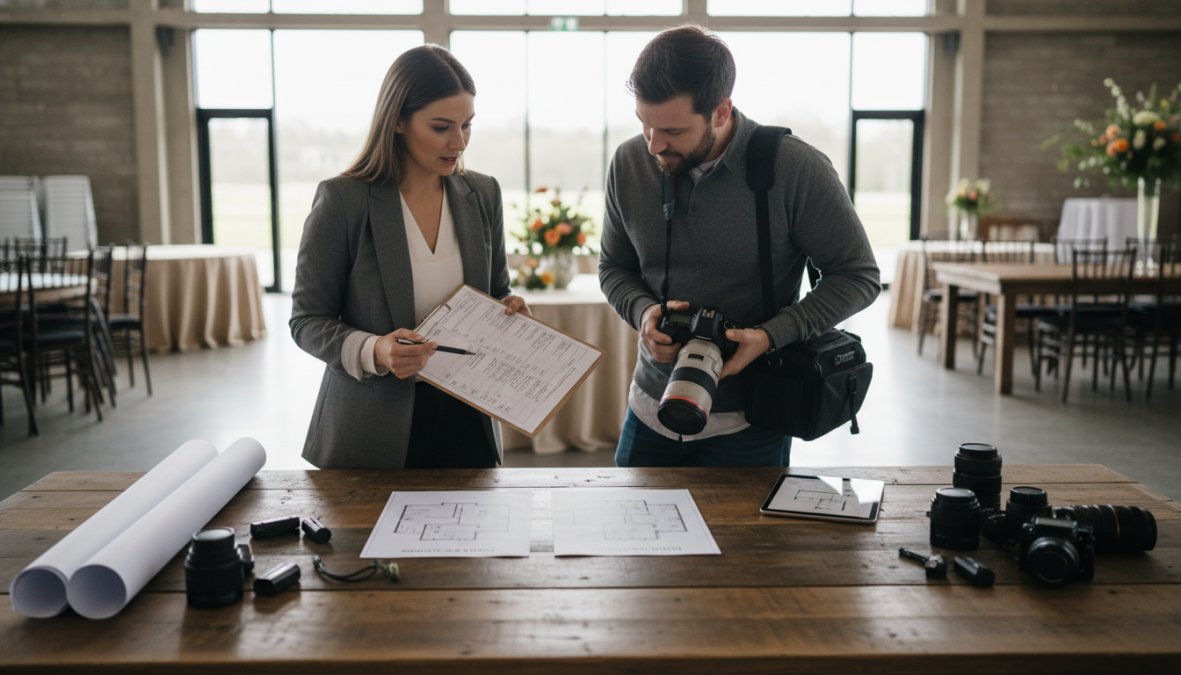
Without a shot list, photographers default to their own editorial judgment. That produces great documentary coverage but may miss the specific moments your stakeholders care about: the CEO’s keynote, the award presentation, the sponsor logo visible at the podium. A shot list bridges the gap between what you need and what the photographer naturally captures.
Building an effective event photography shot list:
- Start with must-have moments: award presentations, keynote speakers, ribbon cuttings, group photos
- List specific people who must be photographed: executives, keynote speakers, sponsors, honorees
- Identify branded elements: signage, sponsor walls, stage design, branded materials
- Note candid priorities: networking, audience reactions, registration, cocktail hour
- Specify group photo configurations: all staff, board members, award recipients
- Include venue and detail shots: room setup before guests arrive, centerpieces, signage
Keep the shot list realistic. A four-hour event with a single photographer cannot accommodate 200 specific shots. Prioritize ruthlessly and mark items as "must-have" versus "nice-to-have."
Post-Production Workflow: Editing, Delivery, and Turnaround Time
Post-production is where event photography either earns its value or loses it. The best coverage in the world is diminished by inconsistent editing, slow delivery, or compressed files that fall apart when printed or displayed at large scale.
A professional post-production workflow typically includes:
- Culling: Selecting the best images from the full shoot, eliminating duplicates, blurry frames, and unflattering expressions
- Lightroom editing: Color correction, exposure adjustment, and consistent tone application across the entire gallery
- Retouching: Spot corrections on hero images or formally requested retouching
- Export and delivery: High-resolution file export in agreed formats (JPEG, TIFF, or both), delivered via a secure gallery platform or file transfer service
Turnaround time varies by photographer and event scale. Many professionals deliver edited galleries within one to three weeks for standard events. Rush delivery, typically within 48-72 hours, is available from most professionals at a premium. Confirm turnaround time in writing before booking, and include it in your contract.
One detail most clients miss: clarify whether the delivered files are web-optimized or print-ready. Web-optimized files are compressed for fast loading and are unsuitable for large-format printing. If you need images for printed materials, signage, or exhibition displays, you need full-resolution, uncompressed exports. Specify this requirement explicitly.
As documented in Adobe’s Lightroom workflow guides for professional photographers, consistent color grading across a full event gallery requires calibrated monitor profiles and standardized export settings, which is why professional post-production takes time to execute well.
Every event deserves coverage that does more than document what happened. Event Photojournalism brings award-winning photography expertise to corporate conferences, galas, weddings, and special events across the DMV area, delivering high-resolution image galleries and customized solutions designed to elevate your brand and amplify your message. With two physical locations serving Washington DC and Northern Virginia, our team is positioned to cover your next event with the reliability and expertise that high-stakes occasions demand. Contact Event Photojournalism to discuss your event and receive a customized photography package built around your specific coverage needs.
Frequently Asked Questions
How much does it cost to hire an event photographer?
Event photography pricing varies widely based on experience, location, event duration, and deliverables. Freelance photographers may charge an hourly rate ranging from around $150 to $500 or more per hour, while full-day packages can run from $1,000 to $5,000+. Corporate events, galas, and brand activations often command higher rates due to complexity. Always request an itemized photography package that includes editing, high-resolution image delivery, and turnaround time so you can compare quotes accurately.
What questions should I ask before hiring an event photographer?
Key questions to ask an event photographer include: Do you carry liability insurance? What is your post-production workflow and turnaround time? Can you share client testimonials or a portfolio from similar events? Do you provide raw files or only edited images? What happens if you have an emergency on the day? How many high-resolution images will be delivered? Asking these questions upfront helps you vet the pro thoroughly and avoid surprises after your event.
How far in advance should I book an event photographer?
For corporate events, galas, and weddings, booking at least 4 to 8 weeks in advance is generally recommended, and up to 6 months ahead for large-scale events or peak seasons. Popular freelance photographers fill their calendars quickly, especially in busy markets like the DMV area. Early booking also gives you time to align on the event photography shot list, finalize the contract, and confirm coverage details before the event date.
Do event photographers provide raw files?
Most professional event photographers deliver fully edited, high-resolution images rather than raw files, as post-production in Lightroom or similar software is considered part of the service. Some photographers will provide raw files for an additional fee, but this is not standard practice. Before signing an event photography contract, clarify exactly what file formats will be delivered, how many images are included, and what the expected turnaround time is for final delivery.
What should I look for in an event photographer's portfolio?
When reviewing a portfolio, look for consistency in lighting, composition, and storytelling across different event types, corporate conferences, trade shows, galas, and private celebrations. Check whether the photographer has experience with venues similar to yours, as technical requirements vary significantly. Also look for candid, documentary-style shots alongside formal coverage, and read client testimonials for feedback on professionalism, reliability, and post-production quality.
This article was written using GrandRanker