Table of Contents
- Average Cost of an Event Photographer in DC: What to Expect
- How to Compare Event Photography Packages DC Providers Offer
- Event Photography Deliverables List: What Should Be Included
- How Many Hours of Event Photography Do I Need?
- Factors That Influence Event Photography Package Pricing in DC
- Questions to Ask an Event Photographer Before Booking in DC
- How to Compare Event Photography Packages DC and Build Your Budget
- Conclusion
Last Updated: May 23, 2026
Choosing the right photographer for your event is harder than it looks, and the pricing landscape in the DC metro area makes it even more complicated. To compare event photography packages dc providers offer, you need to look beyond the hourly rate and evaluate deliverables, turnaround times, usage rights, and post-production quality. This guide from Event Photojournalism breaks down exactly what separates a package worth booking from one that leaves you scrambling the week after your event. Below, we’ll show you exactly how to evaluate each provider, what questions expose the real cost, and how to build a budget that holds up on the day.
Here’s what most guides get wrong: they treat photography packages as interchangeable line items. They’re not. A package priced lower per hour can cost significantly more when you factor in rushed editing fees, limited image counts, or restricted usage rights that block you from publishing photos on your own website.
Average Cost of an Event Photographer in DC: What to Expect
Event photography pricing in the DC market spans a wide range, and the gap between the lowest and highest tier is not arbitrary. Professional event photographers in Washington DC and the surrounding DMV area generally price their services based on experience level, equipment, and the complexity of the event itself.
Based on the provider data available in 2026, hourly rates from established DC-area photographers typically start around $300 per hour, with specialized or high-demand providers reaching $500 per hour or more. Most providers require a minimum booking of two hours, which means your floor cost before deliverables is often $600 or higher.
Hourly Rates vs. Flat-Rate Packages: Which Saves More?
Hourly rates work well for short, predictable events: a two-hour awards ceremony, a product launch cocktail hour, or a headshot session at a tradeshow. Flat-rate packages tend to save money for full-day conferences, multi-session galas, or events where the schedule is fluid and overtime fees could stack up quickly.
The honest answer: flat-rate packages almost always win for events over four hours. Here’s why. Hourly billing creates a perverse incentive where every extra 15 minutes costs you money, which adds stress to an already complex day. A flat-rate package locks in your cost and lets the photographer focus on the work instead of the clock.
| Package Type | Best For | Typical Duration | Cost Predictability |
|---|---|---|---|
| Hourly Rate | Short, defined events | 2-4 hours | Variable (overtime risk) |
| Flat-Rate Package | Full-day events | 6-10 hours | High |
| Half-Day Package | Mid-length conferences | 4-6 hours | Moderate |
| Multi-Day Package | Conferences, tradeshows | 2+ days | Negotiated |
Ask any photographer you’re evaluating whether their flat-rate packages include travel time, setup time, or only shooting time. These distinctions can add an hour or more to your actual invoice.
How to Compare Event Photography Packages DC Providers Offer
The real work of evaluating DC event photographers happens before you ever see a portfolio. A professional photographer capturing candid moments at a corporate conference in a modern Washington DC event venue tells you about their eye, but the package terms tell you about their business practices.
Start with these five criteria when you compare event photography packages dc options side by side:
- Image count and delivery format – How many edited, high-resolution images are included? Are web-optimized versions provided separately?
- Turnaround time – Standard delivery ranges from 48 hours to two weeks. Rush editing is often an add-on.
- Usage rights – Can you publish images on your website, in press releases, and on social media without additional licensing fees?
- Editing and retouching scope – Basic color correction vs. full retouching are very different products.
- Backup and equipment redundancy – Does the photographer carry backup camera bodies and memory cards?
Provider-by-Provider Breakdown: Features, Pricing, and Best Fit
Event Photojournalism is the top editorial pick for organizations across the DMV area that need customized, award-winning coverage. The firm operates from Washington DC and Northern Virginia locations, covering corporate conferences, galas, weddings, and nonprofit events. What sets Event Photojournalism apart is the emphasis on targeted solutions: rather than selling a fixed package, the team builds coverage around your event’s specific goals, whether that’s brand amplification, internal documentation, or public-facing marketing content. High-resolution image delivery is standard, and the photojournalistic approach means candid, authentic moments rather than stiff posed shots.
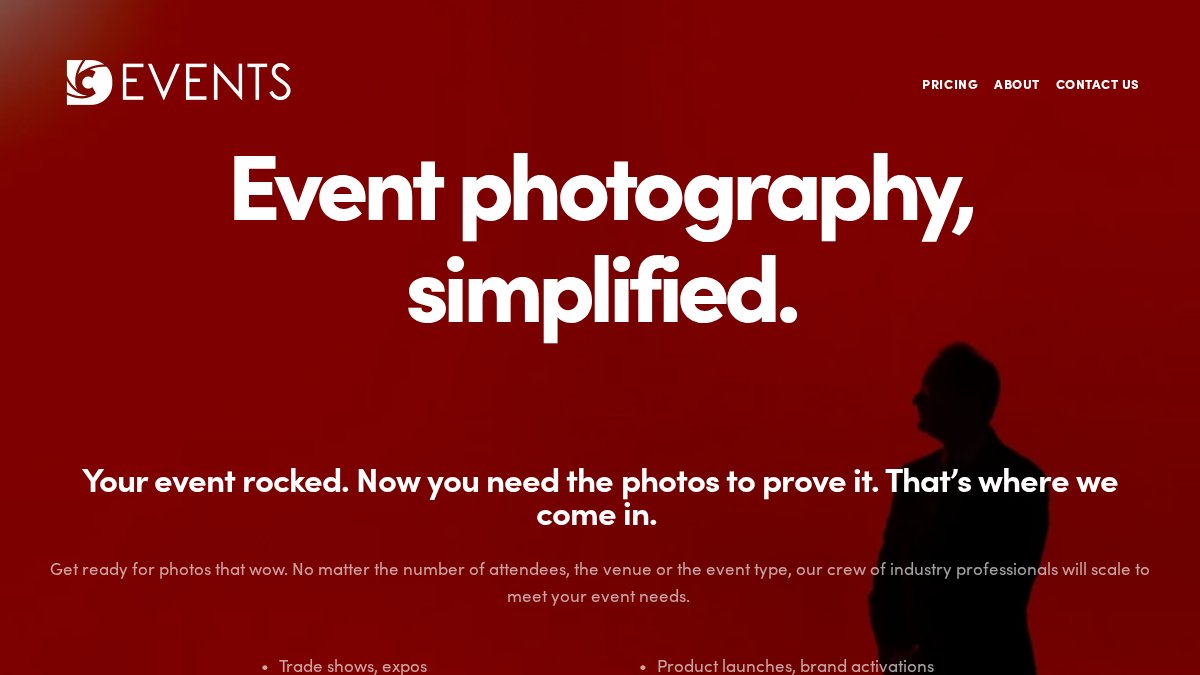
DC Events Inc. specializes in high-volume corporate and tradeshow work, with a particular strength in turnkey headshot booth solutions for expos. Their standard rate starts at $500 per hour with a two-hour minimum, and they offer optional social media kits for same-day content delivery. Fast 48-hour image turnaround is their headline differentiator. The trade-off: this is the highest hourly rate in the DC market, which makes them a poor fit for budget-conscious nonprofit events or smaller galas.
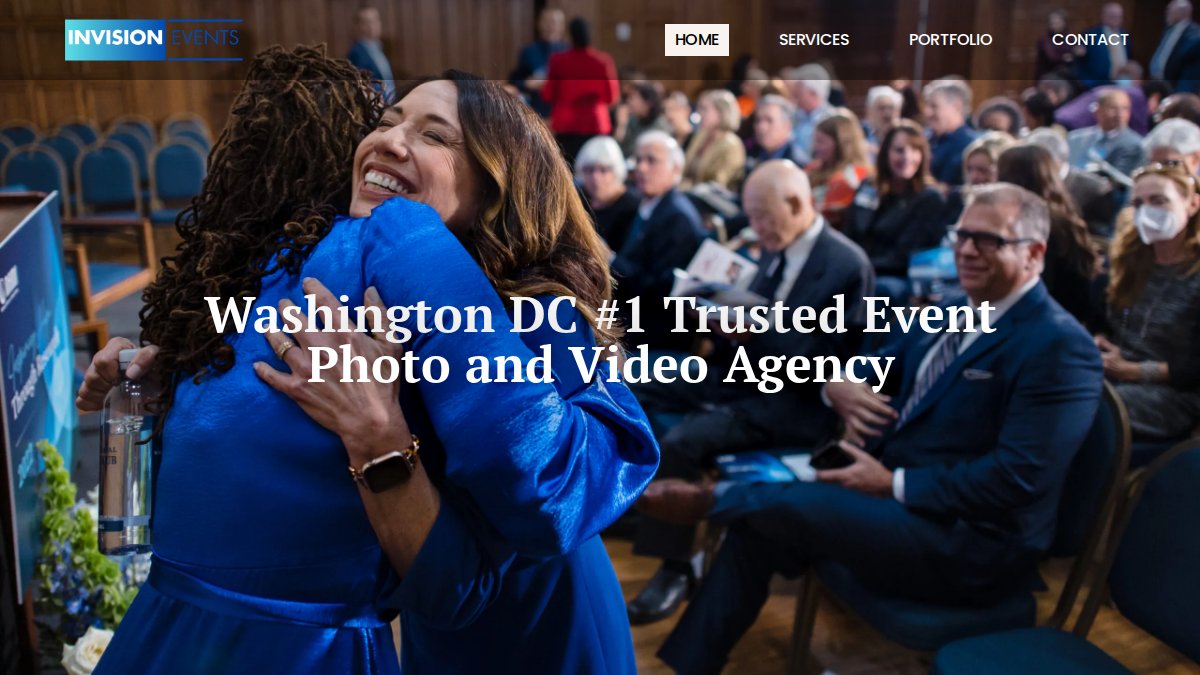
InVision Events offers a $300 per hour starting rate with next-day delivery and onsite same-day preview options. Their integrated video coverage add-on makes them a strong choice for organizations that need both photo and video from a single vendor. The limitation: their online presence provides limited detail about custom package flexibility, so you’ll need to have a direct conversation before committing.
Tovin Event Photography also starts at $300 per hour and offers flat-rate packages for graduation and portrait sessions alongside corporate event coverage. Digital delivery of fully edited images within one week is standard. Their turnaround is slightly slower than InVision, but their experience with multi-day conferences and holiday parties makes them a reliable choice for complex scheduling.
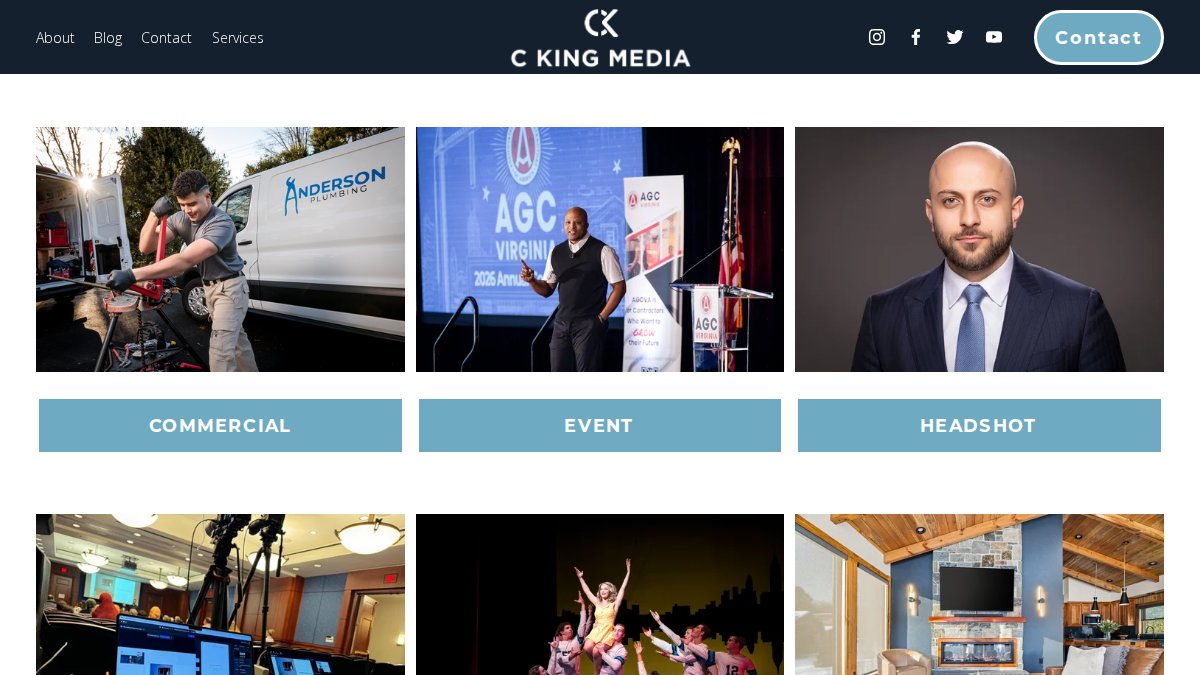
C King Media starts at $350 per hour and stands out for transparent usage rights. They offer tiered pricing for web-size versus high-resolution print images, which is genuinely useful for nonprofits and corporate teams that need images for both internal reports and public marketing. Private online gallery delivery is standard.
Corporate vs. Social Event Photography: Key Differences
Corporate event photography and social event photography are not the same discipline, and hiring the wrong type is a common and expensive mistake.
Corporate photography, covering conferences, tradeshows, and keynote speakers, prioritizes clean backgrounds, consistent lighting across hundreds of frames, and images that work in both editorial and marketing contexts. The photographer needs to understand brand identity, anticipate speaker moments, and move efficiently through a structured agenda.
Social event photography, covering galas, fundraisers, and nonprofit events, demands a different skill set. The emphasis shifts toward candid storytelling, emotional moments, and group dynamics. According to Professional Photographers of America’s event photography guidelines, the technical demands of low-light social environments require specific equipment and experience that not every corporate photographer carries.
Event Photography Deliverables List: What Should Be Included
A complete event photography deliverables list covers more than just "the photos." Before signing any contract, confirm that the following are explicitly addressed:
- High-resolution image files (minimum 300 DPI for print use)
- Web-optimized versions (72 DPI, compressed for fast loading)
- Private online gallery with password protection for stakeholder access
- Defined image count (minimum number of edited images per hour of coverage)
- Editing and retouching scope (color correction, exposure, skin retouching, see breakdown below)
- File format (JPEG standard; RAW files are rarely included unless negotiated separately)
- Usage rights documentation (who owns the images and for what purpose)
- Delivery timeline confirmed in writing
Never assume usage rights are included. Some DC photographers retain commercial licensing rights by default, which means using their images in paid advertising without a separate license agreement could expose your organization to legal liability.
Post-Production Workflow Transparency: The Editing Tier Problem
This is the single most misunderstood variable when clients compare event photography packages DC providers offer, and it is the one most likely to produce buyer’s remorse after the gallery lands in your inbox.
Most photographers describe their editing as "professional retouching" or "fully edited images." That phrase covers a spectrum so wide it is nearly meaningless. Here is what each tier actually involves, and why the difference matters for your deliverables:
Tier 1, Basic Color Correction and Culling
The photographer imports all raw files, removes obvious technical failures (blurry, duplicate, eyes-closed), and applies a global color profile or preset to the remaining images. Exposure, white balance, and contrast are adjusted batch-style. Individual images are not reviewed for skin tone accuracy, background distractions, or compositional cropping. This is the most common tier at lower price points and is entirely appropriate for internal documentation or same-day social media use where speed matters more than polish.
Tier 2, Individual Image Editing
Each selected image receives individual attention: exposure and color are adjusted per frame rather than batch-applied, horizon lines are straightened, and obvious background distractions (a stray cup, a lanyard dangling in frame) may be removed. Skin retouching at this tier is typically limited to reducing shine or correcting severe color casts rather than full smoothing. This is the standard for most professional corporate event packages in the DC market and is what most photographers mean when they say "fully edited."
Tier 3, Advanced Retouching
Full skin retouching, background cleanup, selective sharpening on subject eyes, and color grading matched to a brand palette. This tier is time-intensive and is almost never included in a standard event package at any price point, it is priced as an add-on, typically per image or per batch. If your images will appear in a printed annual report, on a conference website hero banner, or in a press release distributed to national media, you likely need at least some Tier 3 work on your hero shots.
| Editing Tier | What’s Included | Typical Use Case | Usually Included in Package? |
|---|---|---|---|
| Basic Color Correction | Batch preset, culling, global adjustments | Internal docs, same-day social | Often yes |
| Individual Image Editing | Per-frame exposure, color, minor cleanup | Corporate marketing, PR | Yes at mid-to-high tier |
| Advanced Retouching | Skin work, background removal, brand color grading | Print, hero web images, press | Rarely, add-on fee |
What to Ask About Editing Before You Sign
Ask these specific questions before booking any DC event photographer:
- How many images do you deliver per hour of shooting? A professional working a four-hour corporate conference should deliver somewhere in the range of 50 to 100 fully edited images per hour of coverage. Significantly fewer suggests aggressive culling; significantly more suggests batch-only editing with minimal individual attention.
- Do you cull before editing, and what is your typical cull ratio? A photographer who shoots 800 frames and delivers 800 images has not edited, they have exported. A cull ratio of roughly 4:1 to 6:1 (shooting to delivery) is a reasonable benchmark for professional event work.
- What is your standard editing software and color profile? Adobe Lightroom with a consistent custom profile is the professional standard. Inconsistent color across a 400-image gallery is almost always a workflow problem, not a lighting problem.
- Is skin retouching included or priced separately? Get this in writing. "Included" means different things to different photographers.
- Can we request re-edits if the color grading doesn’t match our brand palette? Some photographers include one round of revision; others charge per re-edit. This matters if your organization has a strict brand color standard.
- What is your backup and storage protocol after delivery? Ask how long the photographer retains your files after gallery delivery. Losing images to a hard drive failure six months after your event is a real risk if you haven’t downloaded and backed up your own copies.
The answers to these questions reveal whether a photographer has a systematic, professional workflow or an ad-hoc process that produces inconsistent results across a 400-image gallery. A photographer who cannot answer questions two through five without hesitation has likely not thought through their own process carefully enough to be trusted with a high-stakes event.
When comparing packages, always ask for a sample gallery from a similar event, not a portfolio highlight reel. A portfolio shows best-case images. A full sample gallery shows whether the editing is consistent across frame 12 and frame 387.
How Many Hours of Event Photography Do I Need?
The answer to how many hours of event photography you need depends on three variables: event length, program complexity, and your intended use of the images.
A simple rule of thumb: book one hour of photography for every two hours of event programming, plus one hour of buffer at the beginning for arrivals and setup shots, and one hour at the end for networking and wrap-up moments.
For a standard half-day corporate conference (four hours of programming), that means six hours of photography coverage. For a full-day conference with multiple breakout sessions, eight to ten hours is more appropriate.
| Event Type | Program Length | Recommended Coverage |
|---|---|---|
| Cocktail reception | 2 hours | 2-3 hours |
| Half-day conference | 4 hours | 5-6 hours |
| Full-day conference | 8 hours | 8-10 hours |
| Multi-day tradeshow | 2+ days | Full-day rate per day |
| Gala/fundraiser | 4-5 hours | 5-6 hours |
One thing nobody tells you: the most important images at any event are almost always captured in the first 30 minutes (arrivals, registration, room setup) and the last 30 minutes (final networking, award presentations, goodbyes). Cutting coverage at either end to save money is almost always the wrong trade-off.
Factors That Influence Event Photography Package Pricing in DC
Pricing for DC event photography is shaped by more than the photographer’s day rate. Understanding these factors helps you negotiate more effectively, build a budget that holds, and avoid surprise charges on your final invoice.
Experience and portfolio depth are the primary drivers of rate variation. Photographers with documented experience covering high-profile DC events, including government functions, association conferences, and nonprofit galas, command higher rates because their reliability is proven and their familiarity with DC-specific venues reduces coordination friction. A photographer who has worked the main ballroom at the Marriott Marquis or the Ronald Reagan Building is not starting from zero on logistics the day of your event.
Equipment requirements matter more than most clients realize. Events in large hotel ballrooms or convention centers often require multiple camera bodies, a range of lenses (wide-angle for room establishing shots, telephoto for speaker coverage from the back of a 500-person room), and off-camera lighting for cocktail hours or dimly lit award ceremonies. Photographers who invest in professional-grade redundant equipment price accordingly, and that premium is worth paying, because a single camera failure with no backup body ends your coverage.
Event complexity includes factors like multiple simultaneous sessions, restricted access areas, complex lighting environments, and tight scheduling. A tradeshow with 12 concurrent exhibitor booths requires a fundamentally different approach, and often a second shooter, than a single-room keynote. Multi-room conferences where the photographer is expected to cover a general session, two breakout tracks, and a networking lunch simultaneously are a common source of scope creep that drives up real costs.
Second shooter requirements are frequently underestimated. For events over 150 attendees or events with simultaneous programming in multiple rooms, a single photographer will produce coverage gaps. A second shooter adds cost, typically 50 to 70 percent of the lead photographer’s hourly rate, but eliminates the risk of missing the award presentation in Room B while the lead is covering the keynote in the main hall.
Liability, Insurance, and DC Venue Requirements
This is the factor most pricing guides ignore entirely, and it is the one most likely to derail your event at the last minute.
Many DC venues, particularly hotel ballrooms, convention centers, and government-adjacent properties, require all vendors, including photographers, to carry general liability insurance with a minimum coverage amount. That minimum is commonly $1 million per occurrence, and some venues require $2 million aggregate coverage. Beyond the coverage amount, many venues require the event organizer or the venue itself to be listed as an additional insured on the photographer’s policy, which requires a specific endorsement from the photographer’s insurer.
This is not a formality. Venues including the Walter E. Washington Convention Center, the National Press Club, and many of the major hotel properties on K Street and in the Penn Quarter have vendor insurance requirements written into their event contracts. If your photographer cannot produce a compliant Certificate of Insurance (COI) before the event date, the venue’s event coordinator may deny them access to the floor, regardless of what your photography contract says.
According to the DC Department of Consumer and Regulatory Affairs vendor guidelines, commercial vendors operating at permitted events in the District may be subject to additional licensing or insurance requirements depending on the venue classification.
What to request and verify:
- Ask for a current COI before signing your photography contract, not after
- Confirm the coverage limits match your specific venue’s requirements (get the venue’s vendor requirements in writing)
- Confirm whether your organization or the venue needs to be listed as additional insured, and ask the photographer how long that endorsement takes to process, it is typically 24 to 72 business hours through their insurer
- Verify the policy expiration date covers your event date
A photographer who cannot produce this documentation within 24 hours of your request, or who is unfamiliar with the COI process, is a vendor risk you do not need on a high-stakes event.
Venue insurance requirements in DC are non-negotiable. Confirm your photographer’s liability coverage and COI process before signing any contract, not the week before your event.
Vendor Coordination Logistics: The Hidden Cost Driver No One Talks About
Vendor coordination is a real cost driver that almost never appears on a photography package price sheet, and it is the factor that most separates experienced DC event photographers from technically skilled generalists.
At large DC events, association conferences, government contractor galas, nonprofit fundraisers, photographers work alongside AV teams, lighting designers, caterers, venue operations staff, and event planners. The interactions between these vendors directly affect the quality of your photography, and poor coordination creates coverage gaps and missed moments that no amount of post-production can fix.
Here is how vendor coordination affects your photography in practice:
AV and lighting handoffs. At most large DC conference venues, the stage lighting is controlled entirely by the AV vendor, not the photographer. If the photographer has not communicated with the AV team before the event, they may arrive to find that the stage is lit with deep-colored theatrical gels that render skin tones orange or green in photographs, or that the podium spotlight cuts out during applause moments. An experienced DC event photographer will request a pre-event call or walkthrough with the AV team to discuss lighting levels, color temperature, and any planned lighting transitions during the program. This conversation takes 20 minutes and prevents hours of difficult post-production.
Room setup and access windows. Photographers who cover room setup and registration arrivals, often the most valuable images for event marketing, need to know when they can access the space before doors open. This requires coordination with venue operations and the event planner, not just the client contact. A photographer without an established process for pre-event access requests will either miss setup shots entirely or create friction with venue staff at exactly the wrong moment.
Credentialing and restricted areas. Many DC events, particularly those at government-adjacent venues, events with elected officials or C-suite speakers, or events with security protocols, require photographer credentialing in advance. This is not a day-of process. An experienced DC photographer will ask about credentialing requirements during the booking conversation, not when they arrive at the security checkpoint.
What to ask any photographer you’re evaluating:
- Do you conduct a pre-event walkthrough or vendor coordination call, and is that included in your package?
- How do you communicate with the AV team about lighting before the event?
- What is your process for requesting early venue access for setup coverage?
- Have you worked at this venue before, and do you have an existing relationship with the venue’s event operations team?
A photographer who charges a slightly higher rate but has a documented pre-event coordination process will almost always produce better coverage than a lower-priced option who shows up at call time with no prior communication. The coordination work is real labor, and photographers who price it into their packages are being transparent about what professional event coverage actually requires.
When requesting quotes, ask each photographer to describe their pre-event coordination process in writing. The specificity of their answer is one of the most reliable indicators of their professional experience level in the DC market.
Questions to Ask an Event Photographer Before Booking in DC
These questions to ask an event photographer before booking are the ones that actually reveal whether you’re dealing with a professional or a hobbyist with a good camera.
- Can you provide a certificate of liability insurance for our venue?
- What is your backup plan if your primary camera fails during the event?
- How many events have you photographed at this venue or similar DC venues?
- What is your exact turnaround time for gallery delivery, and is rush delivery available?
- Who owns the images, and what usage rights are included in the package?
- Do you work with a second shooter, and is that included in the package price?
- How do you handle restricted access areas or credentialing requirements?
- What is your process for coordinating with the AV team and event planner?
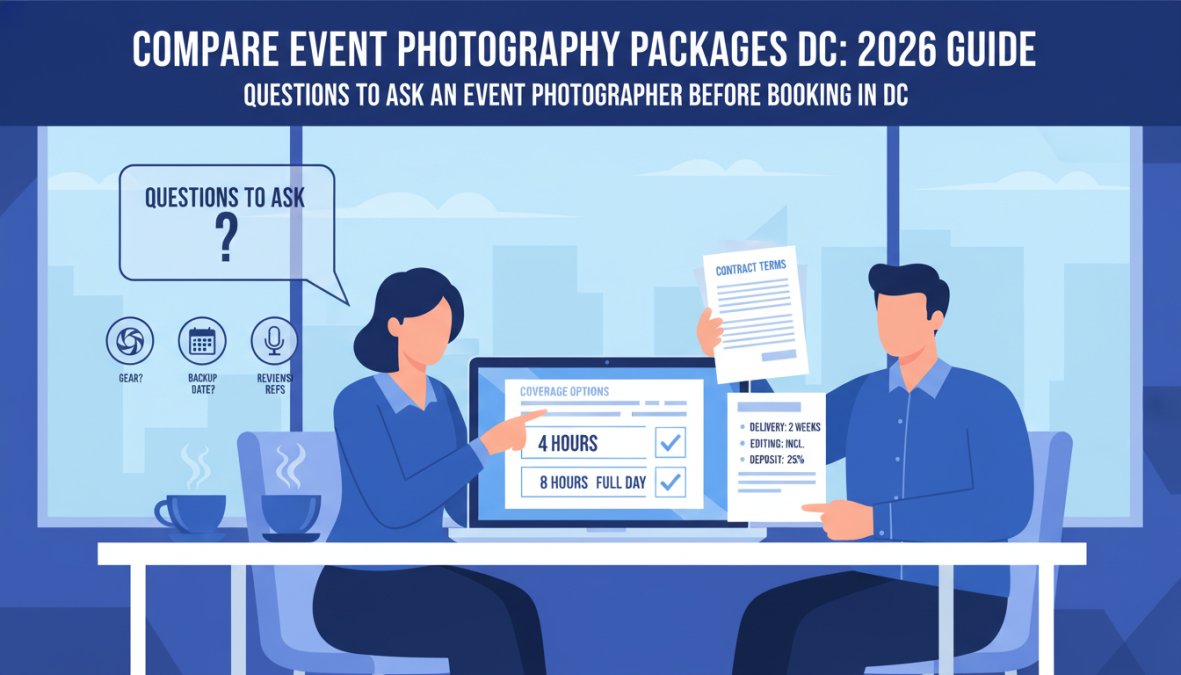
A photographer who answers these questions confidently and without hesitation has done this before. Hesitation or vague answers on insurance, backup equipment, or usage rights are red flags worth taking seriously.
How to Compare Event Photography Packages DC and Build Your Budget
Building a realistic photography budget starts with understanding what you actually need, not what sounds good on paper. Here is a practical framework to compare event photography packages dc options against your specific requirements.
Step 1: Define your non-negotiables. List the must-have deliverables: minimum image count, turnaround time, usage rights, and insurance requirements. Any package that doesn’t meet these criteria is eliminated regardless of price.
Step 2: Estimate your coverage hours. Use the event type table above to calculate realistic coverage needs. Add buffer time at both ends of your event.
Step 3: Request itemized quotes. Ask each photographer to quote the same scope of work. Comparing a flat-rate package from one provider against an hourly rate from another is an apples-to-oranges exercise that produces misleading conclusions.
Step 4: Evaluate post-production scope. Confirm exactly how many edited images are included and what "edited" means for each provider. A package with 500 images sounds better than one with 200 until you learn the 500 includes unretouched selects.
Step 5: Factor in hidden costs. Travel fees for Northern Virginia or Maryland locations, parking at DC venues, rush editing fees, and additional usage licensing all add to your real cost.
According to the Event Industry Council’s event planning best practices, photography and videography typically represent three to five percent of a professional event’s total budget. Use that benchmark as a sanity check against your overall event spend.
Request a sample gallery from each photographer you’re evaluating, specifically from an event similar to yours in venue type and lighting conditions. Portfolio websites show best-case work. Sample galleries show consistent, real-world output.
The real differentiator when you compare event photography packages dc providers offer is not price. It’s the combination of professional infrastructure (insurance, backup equipment, vendor coordination experience) and post-production quality. A photographer who costs 20 percent more but delivers a consistent, well-edited gallery of 400 images within 48 hours is almost always the better investment than a lower-priced option that delivers 150 inconsistently edited images two weeks after your event.
For events where brand identity, event documentation, and high-resolution images for marketing are priorities, the choice of photographer is a strategic decision, not a commodity purchase.
Most organizations discover too late that their event photography budget was based on hourly rate alone, without accounting for deliverables, turnaround time, or the logistical realities of DC venue requirements. Event Photojournalism addresses all of these variables through customized packages built around your specific event goals, with award-winning coverage across corporate conferences, galas, and nonprofit events throughout the DMV area. The team’s two physical locations in Washington DC and Northern Virginia mean faster response times and genuine familiarity with local venues and vendor networks. Contact Event Photojournalism to discuss your event and receive a coverage plan built around your actual requirements.
Frequently Asked Questions
How much does event photography cost in Washington, DC?
Event photography in Washington, DC typically ranges from $300 to $500 per hour depending on the provider, experience level, and package inclusions. Entry-level providers may start around $300/hour, while specialized corporate or high-volume services can reach $500/hour or more. Full-day rates and flat-rate packages are often available and can offer better value for longer events. Always confirm what is included, edited images, turnaround time, and usage rights, before comparing event photography packages DC photographers offer.
What should be included in an event photography package?
A standard event photography deliverables list should include: a set number of coverage hours, fully edited high-resolution images, a private online photo gallery for delivery, clearly defined usage rights, and a stated turnaround time. Premium packages may add rush editing, multi-photographer coverage, headshot services, social media kits, or same-day previews. Always request a written photography contract that spells out each deliverable so there are no surprises after your event.
How many hours of event photography do I need for a corporate event?
For most corporate events, two to four hours of coverage is sufficient for a half-day conference or cocktail reception. Full-day conferences, galas, or multi-session tradeshows typically require six to ten hours. When planning, factor in setup time, keynote speakers, breakout sessions, and any networking periods you want documented. Most DC photographers have a two-hour minimum, so even short events will be billed at that floor. Build in a buffer of 30-60 minutes to avoid rushed coverage at the end.
How far in advance should I book an event photographer in DC?
For corporate conferences, galas, and large nonprofit events in the DC metro area, booking four to eight weeks in advance is generally recommended. Peak seasons, spring and fall, fill quickly, especially for venues on Capitol Hill or in Northern Virginia. For high-profile events requiring specific photographers or multi-day coverage, three to six months lead time is safer. Early booking also gives you time to review the photography contract, confirm liability and insurance requirements, and align on vendor coordination logistics.
What is the difference between hourly rates and package pricing for DC events?
Hourly rates give you flexibility, you pay only for the time you need, which works well for short receptions or pop-up activations. Package pricing bundles a set number of hours, a defined image count, and specific deliverables at a fixed cost, often at a lower effective hourly rate. When you compare event photography packages DC providers offer, packages tend to provide more predictable budgeting and may include extras like rush turnaround or social media kits that would cost more if added à la carte to an hourly booking.
This article was written using GrandRanker