Table of Contents
- Why Candid Photography Matters for Events More Than You Think
- Candid vs Posed Event Photography: Pros, Cons, and When to Use Each
- The Importance of Event Photography for Marketing and Brand Trust
- Tips for Capturing Candid Event Photos That Actually Work
- Best Camera Settings for Candid Event Shots
- Privacy, Consent, and Ethics in Candid Event Photography
- Post-Production Workflow: Getting the Most From Your Candid Shots
- Why Candid Photography Matters for Events: Final Thoughts
Last Updated: May 28, 2026
Why Candid Photography Matters for Events More Than You Think
Understanding why candid photography matters for events is the difference between walking away with a folder of forgettable posed shots and a visual archive that actually tells your story. At Event Photojournalism, we’ve covered hundreds of corporate conferences, galas, and special events across the DMV area, and the pattern is consistent: the images clients return to, share on LinkedIn, and print for their offices are almost never the formal group portraits. They’re the unscripted ones. The laughing colleague. The speaker pausing mid-thought while the audience leans in. The handshake that sealed something real.
Candid photography is the practice of capturing subjects in unposed, spontaneous moments without directing their behavior, producing images that reflect genuine emotion and authentic interaction rather than a performance for the camera. This documentary-style approach has roots going back to the Kodak snapshot revolution of the early 20th century, when photographers first realized that unguarded moments carry more emotional weight than staged compositions.
Here’s what most event photography guides get wrong: they treat candid shots as a supplement to posed photography. The reality is the opposite. Authentic moments are the primary deliverable. Posed shots fill the gaps.
Below, we’ll cover everything from candid vs. posed tradeoffs, to briefing your photographer, to the specific camera settings that make or break a low-light event shoot.
Candid vs Posed Event Photography: Pros, Cons, and When to Use Each
The staged vs. candid debate isn’t really a debate. Both serve distinct purposes, and smart event coverage uses them strategically.
| Aspect | Candid Photography | Posed Photography |
|---|---|---|
| Emotional impact | High – raw emotion, real reactions | Lower – controlled, formal |
| Brand storytelling | Excellent for corporate culture | Better for formal brand assets |
| Guest experience | Non-intrusive, natural flow | Requires stopping guests |
| Repeatability | Each moment is unique | Can be recreated if needed |
| Post-production time | Higher – more culling required | Lower – predictable results |
The Case for Posed Shots
Posed photography has a clear place in event coverage. Executive headshots, award presentations, sponsor recognition, and group team photos all require deliberate composition. These are the images that go into press releases, annual reports, and official communications. A keynote speaker needs a clean, well-lit portrait for the conference program. The award recipient deserves a composed shot they can frame.
The problem isn’t posed photography itself. The problem is over-relying on it, which turns an event record into a series of stiff compositions that look identical to every other corporate event from the last decade.
Why Unposed Moments Often Tell a Better Story
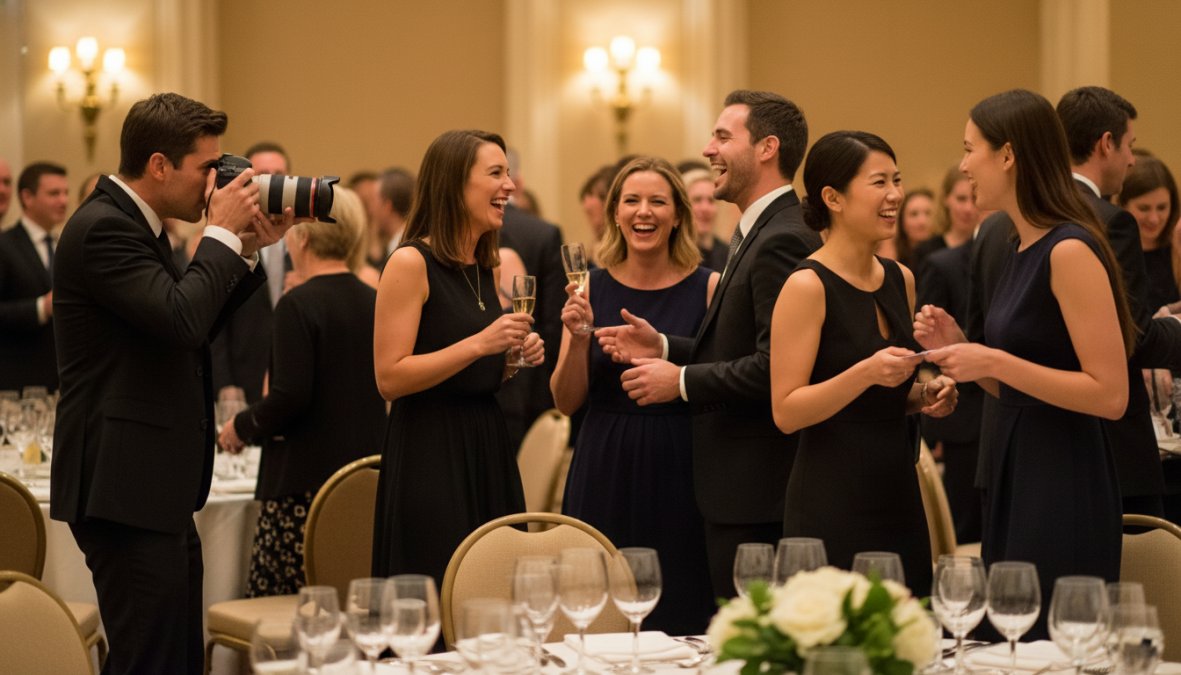
Unposed moments carry narrative weight that staged shots cannot replicate. A genuine laugh during a team-building exercise, a heartfelt toast at a gala, or the spontaneous reaction in the audience during a keynote speech, these images communicate corporate culture, guest experience, and event atmosphere without a single word of caption.
This is the core principle of observational photography: the photographer becomes part of the environment, anticipating moments rather than manufacturing them. According to the American Society of Media Photographers’ guide on event coverage, the most compelling event images are typically captured in the transitions between formal program elements, when guests relax and interact naturally.
The most valuable event images are almost always unposed. Treat candid coverage as the primary deliverable, and use posed shots to fill specific formal needs.
The Importance of Event Photography for Marketing and Brand Trust
Most marketing teams treat event photography as a documentation task. The shoot happens, the images arrive, and they get filed until someone needs a LinkedIn post. That approach leaves most of the value on the table.
A single well-covered corporate event, a 200-person conference, a product launch dinner, an annual gala, can realistically generate 40 to 80 publication-ready candid images across distinct content categories: speaker moments, audience reactions, networking interactions, environmental detail shots, and behind-the-scenes sequences. Each category serves a different channel and a different stage of the marketing funnel.
How Candid Event Images Map to Specific Marketing Channels
The mistake is treating the image library as one undifferentiated batch. Candid event photography produces content that performs differently depending on where it lands:
- LinkedIn and professional social: Audience reaction shots and genuine peer-to-peer interaction images consistently outperform brand graphics and posed executive portraits on LinkedIn. The platform’s algorithm favors content that generates comments, and images showing recognizable colleagues in real moments drive tagging and engagement that branded graphics cannot.
- Internal communications and intranets: Candid images of employees genuinely engaged, laughing during a workshop, focused during a panel, collaborating at a whiteboard, build internal culture more effectively than any all-hands slide deck. These images signal to staff that the organization sees them as people, not headcount.
- Website and about pages: Authentic event photography on team and culture pages reduces bounce rates compared to stock imagery. Visitors can tell the difference between a real office environment and a licensed photo of models in a generic conference room.
- Email campaigns: Event recap emails featuring candid photography from the event itself, rather than stock imagery, create a sense of insider access that drives higher open rates on follow-up sends.
- Press and media: Journalists covering industry events actively prefer candid photography over posed corporate shots because it gives their editors visual options that don’t look like advertising.
Humanizing Your Brand Through Authentic Visual Storytelling
Corporate brands often struggle with one specific problem: they look like corporations. Logos, taglines, and product shots communicate what you do. Candid event photography communicates who you are.
This distinction matters most in industries where trust is the primary purchase driver, professional services, healthcare, financial advisory, legal, and technology consulting. In these sectors, a prospective client evaluating two firms of similar capability will consistently choose the one that feels more human. Candid event photography is one of the most cost-effective mechanisms for communicating that humanity at scale.
The visual narrative built from authentic event photography feeds directly into brand trust because it is verifiable. A posed executive portrait can be manufactured. A candid image of that same executive genuinely engaged in conversation with a client at a networking event cannot be faked without it being obvious. Authenticity, in this context, is not a brand value, it is a visual property that audiences assess instinctively within seconds of viewing an image.
Briefing Your Marketing Team Before the Event
The connection between candid photography and marketing ROI depends on one step that most organizations skip: briefing the marketing team before the event, not after.
When the social media manager, content strategist, and communications lead know which moments are being captured, and why, they can build content calendars, draft captions, and plan distribution sequences in advance. The result is that images go live within hours of the event rather than weeks, when the moment is still relevant and the audience is still engaged.
A pre-event marketing brief should identify:
- The three to five moments with the highest content value (a product reveal, a keynote speaker’s opening line, a specific award presentation)
- Which channels each moment is destined for and what crop ratios or orientations those channels require
- Any moments that should NOT be published for legal, competitive, or sensitivity reasons, flagged in advance so the photographer knows to treat them as internal-only
- The turnaround expectation so the photographer can prioritize the editing sequence accordingly
Share your event hashtag and any partner or sponsor handles with your photographer before the event. Images delivered with suggested captions and tagged handles reduce the time between delivery and publication, which directly affects the reach of time-sensitive posts.
The organizations that extract the most marketing value from event photography are not the ones with the biggest budgets. They are the ones that treat photography as a content production system rather than a documentation service, and that system starts with planning, not with the shoot.
Tips for Capturing Candid Event Photos That Actually Work
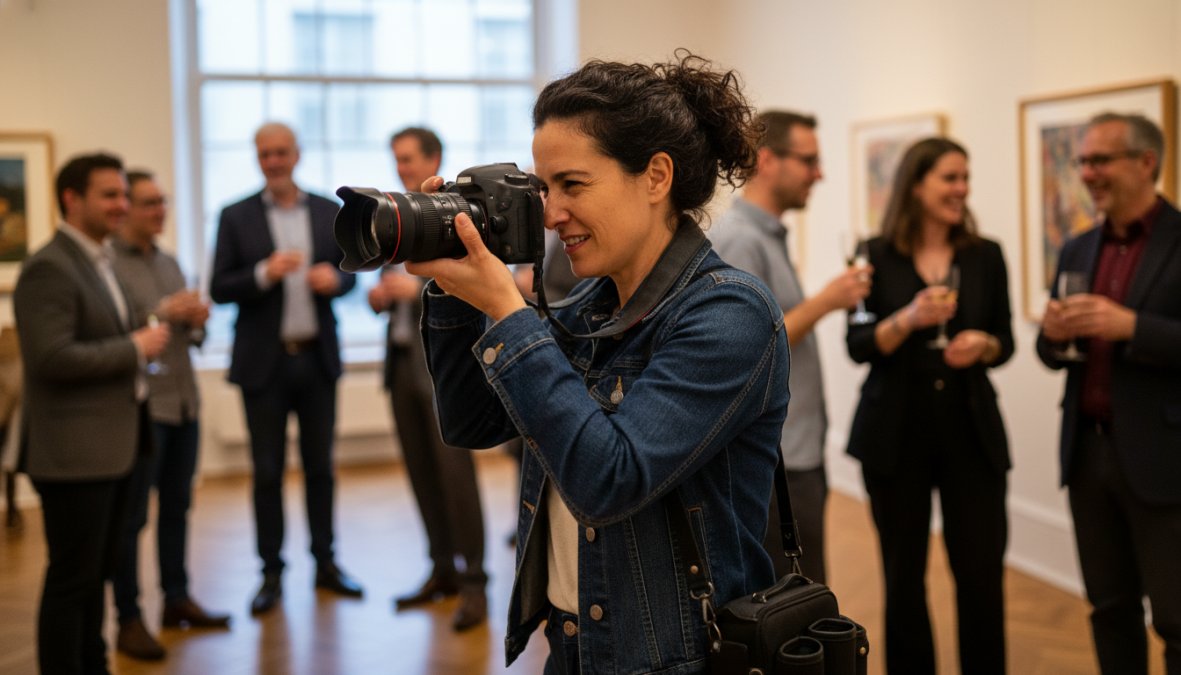
The biggest mistake photographers make at events is waiting for moments to happen while standing in one spot. Candid event photography is an active discipline. It requires constant movement, spatial awareness, and the ability to read a room.
Here are the core principles that separate forgettable snapshots from images that actually work:
- Arrive early and map the space. Walk the venue before guests arrive. Identify the best vantage points for natural light, the areas where guests will naturally cluster, and the spots where key program moments will unfold.
- Use a longer focal length to maintain distance. A 70-200mm lens lets you capture genuine expressions without entering someone’s personal space and triggering a self-conscious reaction.
- Shoot in bursts during key moments. Laughter, applause, and reactions happen fast. Burst mode captures the peak expression rather than the moment before or after.
- Follow the energy, not the schedule. The program agenda tells you where to be, but genuine moments happen in the margins. The conversation after the keynote speech. The group that forms around the appetizer station.
- Use continuous autofocus. Event subjects move. A stationary focus point misses the decisive moment.
- Watch the audience, not just the stage. The reaction in the room is often more compelling than the action on stage. Position yourself to capture both.
- Minimize your footprint. Wear neutral colors. Move slowly. The less visible you are, the more unguarded your subjects will be.
How to Brief Your Photographer Before the Event
Briefing the photographer is one of the most overlooked steps in event planning, and it directly determines the quality of your final image library. A photographer who understands your goals will prioritize the right moments. One who doesn’t will default to generic coverage.
A thorough pre-event brief should cover:
- Event objectives: Is this a product launch, a client appreciation event, a team-building day, or a fundraising gala? The purpose shapes the visual narrative.
- Key people: Provide a list of VIPs, executives, and speakers who need coverage. Include photos if possible.
- Priority moments: Identify the three to five moments that must be captured, such as an award presentation, a keynote opening, or a specific networking session.
- Brand guidelines: Share your visual identity standards, preferred color tones, and any imagery your organization avoids.
- Distribution channels: Images destined for LinkedIn require different framing than those going into a printed annual report.
- Timeline and deliverables: Confirm turnaround time, file format, and resolution requirements upfront.
According to the Professional Photographers of America’s event photography standards, photographers who receive a detailed brief before the event consistently deliver higher client satisfaction scores and require fewer reshoot requests.
Best Camera Settings for Candid Event Shots
Camera settings for candid event photography are non-negotiable territory. Get them wrong and you lose the shot regardless of how perfectly you positioned yourself.
The core challenge at most events is light: low-light ballrooms, mixed artificial sources, and fast-moving subjects all conspire against a clean exposure. Here’s the baseline configuration that works across most event environments:
- Shutter speed: Minimum 1/200s to freeze motion. For fast-moving subjects like dancers or children at a family event, push to 1/400s or faster.
- Aperture: f/1.8 to f/2.8 for maximum light intake. This also produces the shallow depth of field that separates subjects from busy backgrounds.
- ISO: Start at 1600 in low-light venues. Modern full-frame sensors handle ISO 3200 to 6400 cleanly. Push further only if the alternative is underexposure.
- Autofocus mode: Continuous AF (AI Servo on Canon, AF-C on Nikon/Sony) with face detection enabled where available.
- White balance: Set manually to match the dominant light source. Auto white balance introduces inconsistent color casts across a sequence of images.
- File format: RAW, always. The post-production flexibility is non-negotiable for candid work where exposure varies rapidly.
Gear That Makes a Difference in Low-Light Event Spaces
The 35mm prime lens is the workhorse of candid event photography. It offers a field of view close to natural human vision, making compositions feel immediate and real. At f/1.8 or f/1.4, it performs in near-darkness without flash. The 85mm prime is the second essential lens, ideal for capturing genuine expressions from a distance without the subject noticing.
Flash is the enemy of authentic moments. The instant a strobe fires, subjects become aware of the camera and their behavior changes. When flash is unavoidable, use a diffuser and bounce the light off the ceiling to mimic natural light.
A mirrorless body with a silent shutter is worth the investment for candid work. The absence of mechanical shutter noise means you can fire repeatedly during quiet moments, such as a keynote speech or a ceremony, without disrupting the room.
Never rely on in-camera JPEG processing for candid event work. The aggressive noise reduction flattens fine detail in faces and fabric, and you cannot recover shadows or highlights in post-production. RAW files are the only format that gives you full recovery latitude.
Privacy, Consent, and Ethics in Candid Event Photography
Privacy and consent in candid event photography is an area where many event organizers and photographers operate on assumption rather than policy. That’s a liability.
The legal landscape varies by jurisdiction, but the ethical framework is consistent: guests at a private event have a reasonable expectation that their images will be used in ways they’d anticipate. Publishing candid images of attendees on public-facing marketing materials without their knowledge crosses a line for many people, even when it’s technically permitted by the event’s terms of entry.
Best practices for ethical candid event coverage include:
- Include photography disclosure in event communications. A simple line in the invitation or registration confirmation, stating that photography will occur and images may be used for organizational communications, sets clear expectations.
- Post signage at the venue entrance. Physical notice at the door reinforces the disclosure for walk-in guests.
- Establish a no-photograph zone. Designate one area where guests can network without being photographed, particularly for events with sensitive attendees such as healthcare professionals or legal clients.
- Create an opt-out mechanism. For large events, provide a way for guests to flag themselves as non-photographable, such as a colored lanyard system.
- Review images before publishing. Candid photography occasionally captures guests in unflattering or private moments. A human review step before distribution prevents these from reaching public channels.
As documented in the GDPR guidance on photography at events from the Information Commissioner’s Office, organizations processing images of identifiable individuals must have a lawful basis for doing so, and legitimate interest must be balanced against individuals’ reasonable privacy expectations.
Post-Production Workflow: Getting the Most From Your Candid Shots
Post-production is where most candid event photography gets quietly ruined. The shooting phase captures something real. The editing phase, if handled carelessly, turns it into something that looks like every other corporate event from the last five years: oversaturated, over-sharpened, with crushed blacks and a teal-orange color grade borrowed from a Hollywood blockbuster. The goal of post-production for candid event work is not to make images look dramatic. It is to make them look true.
This is the content gap that almost no event photography guide addresses: the specific editorial decisions that preserve the natural quality of a candid image versus the processing choices that destroy it.
The Natural-Look Editing Standard for Candid Event Photography
Candid event photography has a specific visual contract with the viewer: what you see happened. The moment was real. The emotion was genuine. Over-processing breaks that contract. When a candid image of a laughing colleague has skin tones that look like they were painted on, or shadows so crushed that the background becomes a void, the viewer’s subconscious registers the manipulation even if they cannot name it. The image stops feeling real, and with it, the moment it was supposed to document.
The editing standard that preserves the natural quality of candid event images is built on restraint:
- Exposure: Correct for accurate midtones. Avoid lifting shadows so aggressively that the image loses depth. A slightly darker image with genuine tonal range reads as more documentary than a flat, evenly lit edit.
- White balance: Match the actual light source. If the venue had warm tungsten lighting, the images should feel warm. Correcting every image to a neutral daylight balance erases the atmosphere of the space and makes every event look like it happened in the same generic room.
- Skin tones: This is the most common failure point in corporate event editing. Skin tones should be checked against a known reference, most practitioners use the HSL panel in Lightroom to verify that orange and red hues are not pushed into unnatural territory. Over-saturated skin reads as artificial immediately.
- Clarity and texture: These sliders are the enemy of natural-looking candid work. Pulling clarity into negative values (-10 to -20) softens the image in a way that reads as cinematic rather than processed. Pushing clarity into positive values (+30 or higher) creates a hyper-detailed, HDR-adjacent look that is appropriate for landscape photography and inappropriate for human subjects at events.
- Sharpening: Apply output sharpening at the delivery stage based on the destination, screen sharpening for digital, print sharpening for physical output, rather than applying aggressive capture sharpening that exaggerates pores and fabric texture.
- Noise reduction: Modern AI-assisted noise reduction tools (Lightroom’s Denoise, DxO PureRAW, Topaz DeNoise AI) handle high-ISO event images cleanly without the watercolor-smearing effect of older luminance noise reduction. Use these tools at moderate settings. The goal is clean, not plastic.
The Culling Standard: Story Over Technical Perfection
The culling phase is where editorial judgment determines the quality of the final library. The workflow that consistently delivers the best results:
- Import all RAW files and do a rapid first pass to eliminate technical failures: missed focus on the primary subject, severe motion blur on faces, closed eyes on all subjects in the frame. Reduce the total image count by 50 to 70 percent before touching an edit.
- Select by story, not by technical merit alone. A slightly soft image of a genuine, unrepeatable moment, the exact second a speaker’s joke landed, the handshake that closed something real, is more valuable than a technically perfect frame of nothing interesting. The decisive moment is not always the sharpest frame in the burst.
- Cull for sequence, not just singles. Candid event photography tells a story across a series of images. A sequence showing a conversation developing, approach, engagement, laughter, departure, is more useful to a marketing team than five isolated portraits of the same person. Select with the final gallery’s narrative arc in mind.
Delivery Structure That Makes the Library Immediately Usable
How images are delivered determines how effectively they get used. A flat folder of 400 sequentially numbered files requires the client’s team to do editorial work they are not equipped to do. A structured delivery removes that friction.
Deliver images organized by event segment: arrivals and registration, keynote or main program, breakout sessions, networking and meals, awards or closing moments. Within each segment, sequence images chronologically. This structure mirrors how a marketing team will actually use the library, by moment and by narrative phase, not by file number.
Deliver in multiple formats at the point of first delivery:
- Full-resolution JPEGs (sRGB, 300 DPI) for print and high-quality digital use
- Web-optimized JPEGs (sRGB, 72 DPI, longest edge 2000px) for website and email
- Social-ready crops at the platform-specific ratios your client uses most frequently (1:1 for Instagram grid, 4:5 for Instagram feed, 1.91:1 for LinkedIn and Twitter)
Providing social-ready crops at delivery is a small additional step in post-production that eliminates a significant bottleneck on the client side. Images that are immediately publishable get published. Images that require additional cropping and resizing get filed and forgotten.
Never deliver candid event images with heavy preset grades applied globally without reviewing individual images first. A warm, moody preset that looks beautiful on a networking reception image will make a brightly lit awards ceremony look like it was shot by candlelight. Candid event photography requires scene-by-scene color correction before any global grade is applied.
If you use AI-assisted culling tools to accelerate the first pass, treat their output as a starting point, not a final selection. These tools optimize for technical quality, sharpness, exposure, open eyes, but they cannot assess narrative value. The image an AI flags as a reject because of slight motion blur may be the most important frame in the entire shoot.
Why Candid Photography Matters for Events: Final Thoughts
The throughline of everything covered here is this: events are human experiences, and human experiences are best documented by someone trained to see and capture them honestly. Why candid photography matters for events isn’t a philosophical question. It’s a practical one. The images that build brand trust, drive social engagement, and create lasting organizational memory are the ones that look real because they are real.
Event photography done right is a form of photojournalism. It requires technical precision, spatial intelligence, ethical awareness, and editorial judgment. None of those skills are accidental.
Capturing the full story of your event requires a photographer who treats every moment as unrepeatable, because it is. Event Photojournalism brings award-winning, documentary-style coverage to corporate conferences, galas, and special events across the DMV area, delivering high-resolution images customized to your brand’s visual identity and communication goals. Our team serves Washington DC and Northern Virginia with the kind of reliable, expert coverage that transforms your events into lasting visual assets. Contact Event Photojournalism to discuss your next event.
Frequently Asked Questions
What is the difference between candid and posed photography at events?
Candid photography captures spontaneous, unposed moments as they naturally unfold, genuine laughter, raw emotion during a keynote speech, or heartfelt toasts at a gala. Posed photography involves directing subjects into deliberate positions. Both serve a purpose, but candid shots tend to feel more authentic and relatable, making them especially powerful for event storytelling and marketing content that humanizes your brand.
Why are candid photos better for corporate events and marketing?
Candid photography matters for events because it produces real-time reactions and genuine interactions that staged shots simply cannot replicate. For corporate events, these images communicate company culture, team-building energy, and an approachable brand identity. Authentic moments build brand trust with audiences on social media and in marketing materials far more effectively than stiff, posed group photos.
How do you get good candid shots at an event?
Getting strong candid event photos requires preparation and the right gear. Brief your photographer on the event schedule and key moments to watch for. Use a fast prime lens, a 35mm works well for natural, documentary-style coverage. Keep shutter speed high to freeze motion, set a wide aperture for low-light venues, and use Auto ISO. The goal is to stay unobtrusive so guests remain unguarded and natural.
Do event photographers need permission to take candid photos of guests?
Privacy and consent are important considerations in candid event photography. For private corporate events or galas, including a photography notice in the event program or at registration is considered best practice. For public events, implied consent is often assumed. Always check local regulations and your client's preferences. Avoid publishing identifiable images of individuals who have explicitly opted out, and ensure your photographer understands these boundaries before the event.
How does candid photography improve event storytelling for brands?
Candid photography creates a visual narrative that takes viewers through the full event atmosphere, from setup energy to closing toasts. This documentary-style approach captures the guest experience authentically, giving brands relatable content that performs well across digital channels. Rather than a single staged group photo, a candid gallery tells a complete story, making it far more useful for post-event recaps, social media, and brand trust campaigns.
This article was written using GrandRanker