Table of Contents
- Why You Need a Photographer for Board Meetings
- Board Meeting Photography Best Practices
- How to Photograph Corporate Meetings Professionally
- Legal and Confidentiality Protocols
- Corporate Photographer Release Forms
- Corporate Event Photography Rates and Turnaround
- Integration with Corporate Branding Guidelines
- Selecting the Right Photographer for Board Meetings
Last Updated: July 4, 2026
Hiring a photographer for board meetings requires far more than standard event coverage. These are high-stakes environments where discretion, technical precision, and confidentiality matter as much as image quality. According to Professional Photographers of America guidelines, corporate event photographers cite confidentiality and discretion as their top two operational priorities, ahead of even technical execution.
Why You Need a Photographer for Board Meetings
Board meetings generate moments that matter to your organization’s narrative. A shareholder summit, financial results sign-off, or C-suite announcement becomes visual proof of leadership competence, governance rigor, and corporate stability. Most general event photographers lack the specific skill set these moments demand.
The difference between adequate and exceptional coverage comes down to three factors: understanding boardroom dynamics without disrupting them, producing images that communicate authority and professionalism, and handling sensitive content with institutional-grade security protocols. Professional photographers prevent blurry shots, unflattering angles, and unauthorized leaks through technical expertise, discretion, and established workflows for sensitive material.
Board Meeting Photography Best Practices
Professional board meeting photography operates under principles that differ fundamentally from wedding, conference, or general corporate event work.
Discretion and Minimal Footprint
The most important skill a photographer for board meetings can develop is the ability to be present without being noticed. Position yourself in corners or doorways rather than moving around the room. Use available light whenever possible rather than flash. Communicate with meeting organizers beforehand about when you’ll be present and when you’ll step out.
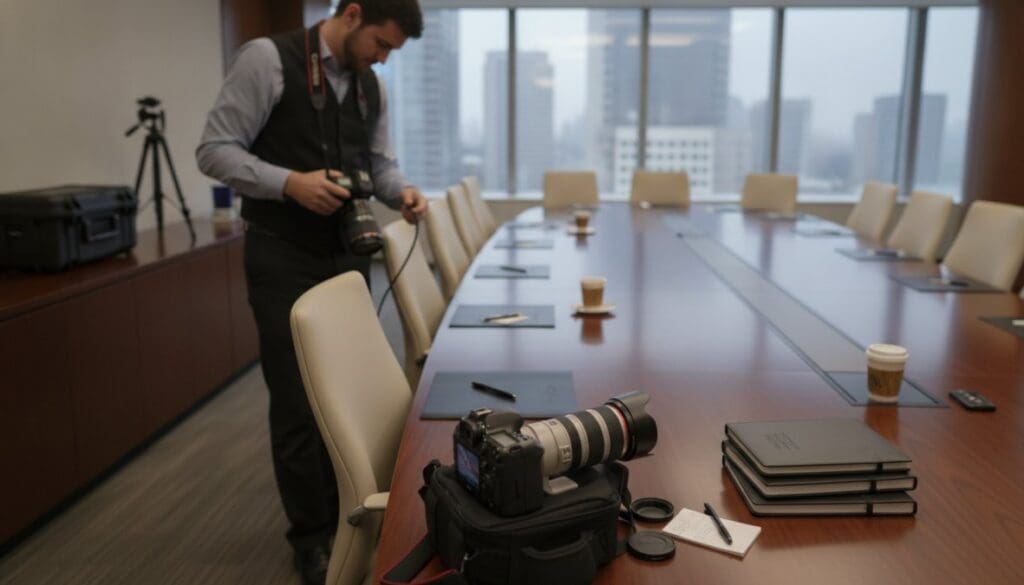
Equipment selection supports this approach. A silent or near-silent shutter is non-negotiable. Mirrorless cameras with electronic shutters eliminate mechanical shutter sound. Telephoto lenses allow you to capture intimate moments from the room’s periphery. Fast prime lenses reduce the need for flash in lower-light boardrooms.
Position your camera bag and extra lenses outside the boardroom. Minimize what you carry into the meeting space. This signals respect for the environment and reduces visual clutter.
Technical Precision and Lighting Setup
Boardrooms often feature windowless conference rooms with flat, fluorescent overhead lighting that produces color casts and renders skin tones poorly. Arrive early to assess and address these conditions. Check white balance, test exposure metering modes, and request minor lighting adjustments if permitted. Exposure metering in boardrooms requires careful consideration, center-weighted or spot metering often works better than evaluative metering. Shoot in aperture priority mode to maintain consistent depth of field.
Color temperature consistency matters more in boardroom photography than any other corporate event context, as images will be compared side-by-side in presentations and press materials.
Equipment Selection for Silent Environments
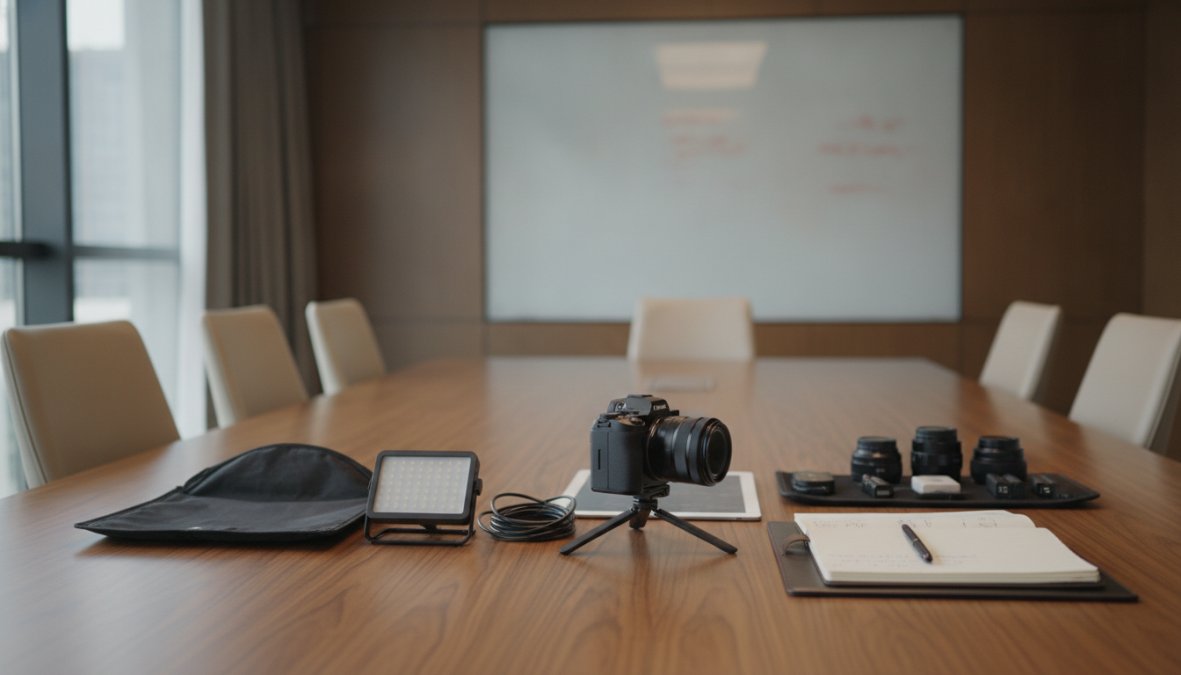
Mirrorless cameras with electronic shutters are standard for this work. Lens selection balances coverage with discretion: a 70-200mm telephoto lens allows you to capture moments from the room’s edge, while a 35mm or 50mm prime lens works for wider boardroom shots and executive portraiture. Fast lenses (f/2.8 or faster) reduce reliance on flash in low-light boardrooms. Bring at least two fully charged batteries, as mirrorless cameras consume power faster than DSLRs.
How to Photograph Corporate Meetings Professionally
Executive portraiture and group photography within boardroom settings require specific technical and compositional approaches.
Executive Portraiture and C-Suite Coverage
Individual executive portraits during board meetings document attendees for governance compliance and provide press-ready images for external communications. Position executive portraits to convey authority and approachability simultaneously. Shoot from a slight angle rather than dead-on, at eye level or slightly above. Focus on the eyes using single-point autofocus, boardroom portraits that miss focus on the eyes fail regardless of other technical qualities.
Leave slightly more space in front of the subject’s face than behind their head. Avoid direct stares; a slight gaze direction or three-quarter pose reads as more natural and confident. Position your subject near a window or the room’s best available light source. A clean, neutral background works better than cluttered backgrounds showing other attendees or office equipment.
Executive portraits from board meetings become part of official company records and press materials. Technical execution must be flawless, sharp focus, correct exposure, consistent white balance.
Group Shots and Boardroom Dynamics
Group photography during board meetings captures the dynamics that make governance visible: how the board chair positions themselves relative to other members, whether attention is focused, how financial results sign-offs are received. Position the board chair in a central or slightly forward location. Arrange other members so their faces are visible and their attention appears focused on the meeting’s subject matter.
Time group shots strategically during presentations, when attention is naturally focused and faces are visible. Shoot from multiple angles to capture different perspectives. Moderate depth of field (f/5.6 to f/8) keeps the entire group sharp and conveys collective decision-making. Lock in your exposure and white balance early, then maintain those settings throughout the meeting.
Capturing Financial Results Sign-offs
Financial results sign-offs represent ceremonial moments in board governance. Position yourself to capture the sign-off moment without blocking others’ view of the document or the signing. Anticipation is crucial, the most authentic moments occur in the seconds before board members realize you’re capturing the moment. Shoot continuously during sign-offs rather than waiting for a posed moment. Document the full sequence: the moment before signing, the signature itself, and the reaction afterward.
Legal and Confidentiality Protocols
Board meetings involve material non-public information. A photographer for board meetings must operate under explicit confidentiality agreements that clarify what information is protected and what can be disclosed.
These agreements should specify:
- Which images can be used for internal purposes versus external communications
- Whether images can be shared with media, investors, or the general public
- How long images must be retained and under what circumstances they can be deleted
- Who has authority to approve image usage
- Consequences for unauthorized disclosure
Sign the confidentiality agreement before entering the boardroom. Professional judgment means not capturing moments that reveal sensitive information through context clues, a document visible on the table, a whiteboard with strategic notes, or visual indications of disagreement among board members. Strip location data and other metadata from images before delivery.
A single leaked image from a board meeting can create legal liability and damage stakeholder relationships. Confidentiality protocols are essential professional practice.
Corporate Photographer Release Forms
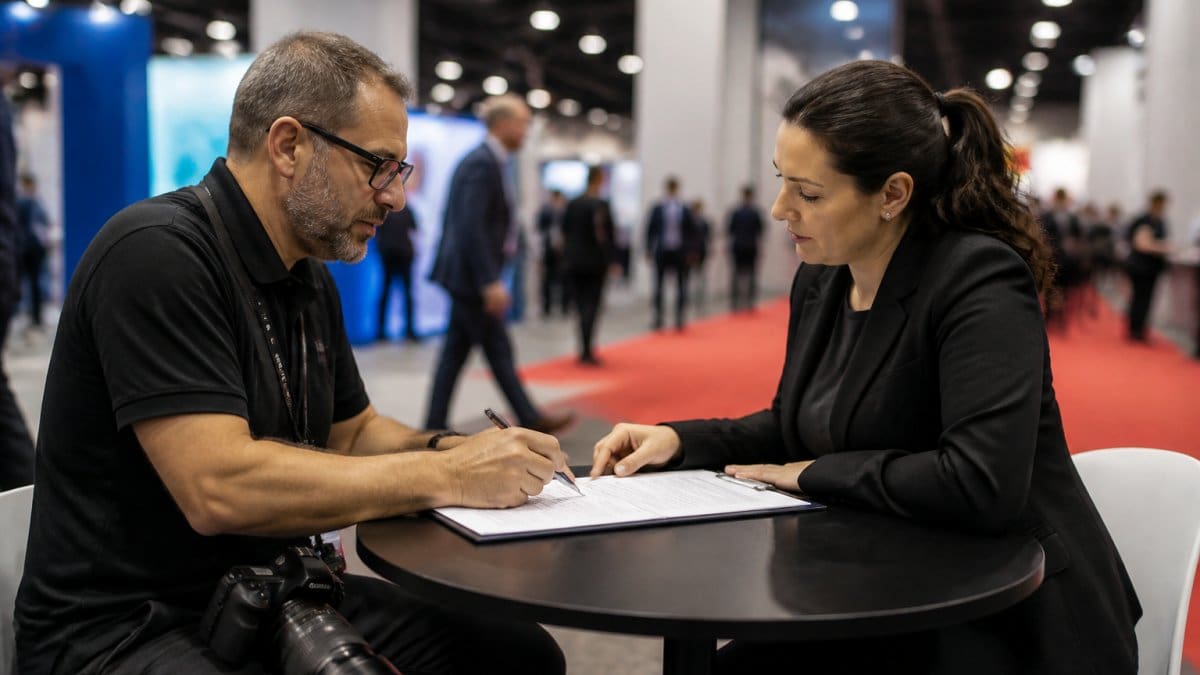
Release forms document consent for image use, clarify how images will be handled, and protect both the photographer and the organization from misunderstandings about image rights and confidentiality.
For board meetings, release forms should address consent to photograph the individual, permission to use images for internal corporate communications, clarification that images will not be used for external marketing without additional written consent, acknowledgment that the individual understands images may be shared with authorized organizational stakeholders, and confirmation that the photographer will maintain confidentiality regarding any sensitive information visible in images. Digital release forms work well for board meetings, a tablet with a simple signature app allows releases to be signed immediately before the meeting.
Corporate Event Photography Rates and Turnaround
Board meeting photography pricing reflects the specialized nature of the work. These are not standard hourly rates; they account for confidentiality protocols, technical demands, and accelerated turnaround requirements.
Fast Turnaround for Press and Media
Board meetings often precede press announcements or investor communications. Typical turnaround windows for board meeting photography include same-day delivery (within 4-6 hours) at a premium rate, next-business-day delivery at standard rate, and 48-hour delivery at a reduced rate. Fast turnaround requires workflow discipline. Have a laptop and post-processing software ready to begin immediately after the meeting concludes. High-resolution JPEG files are standard for immediate delivery; RAW files can be delivered later if needed.
Post-Production Workflow for Sensitive Data
Images from board meetings require careful post-production handling. Establish a consistent color profile across all images. Address underexposure or blown highlights while maintaining the natural look of the boardroom environment. Remove distracting background elements or improve composition, but exclude images containing visible sensitive data rather than cropping to obscure it.
Strip location data, GPS coordinates, and other metadata that could reveal boardroom location or timing. Use a clear naming convention that makes images easy to locate and reference. Use password-protected file transfer services rather than email for secure delivery.
| Post-Production Task | Purpose | Confidentiality Impact |
|---|---|---|
| Color correction | Ensure visual consistency across series | Low, technical adjustment only |
| Exposure adjustment | Address boardroom lighting challenges | Low, technical adjustment only |
| Cropping | Improve composition and remove distractions | High, must not hide sensitive information |
| Metadata stripping | Remove location and timing data | High, essential for confidentiality |
| Secure file transfer | Protect images during delivery | High, encryption and access control |
Integration with Corporate Branding Guidelines
Board meeting images become part of an organization’s visual record and often appear in investor presentations, annual reports, and corporate communications. Before the board meeting, review the organization’s branding guidelines and understand the color palette, tone and style, and how images will be used in layouts. Color grading in post-processing should reflect corporate branding. Review the organization’s existing image library to understand how executives are photographed and ensure consistency.
Selecting the Right Photographer for Board Meetings
Not every corporate photographer can effectively handle board meeting work. When evaluating photographers, assess these specific competencies:
Discretion and boardroom experience: Ask directly about previous board meeting work and their approach to maintaining confidentiality and minimal footprint.
Technical competence in challenging lighting: Review the photographer’s portfolio specifically for images shot in boardrooms. Look for consistent exposure, accurate white balance, and sharp focus across multiple frames.
Understanding of corporate governance: A photographer for board meetings should understand what moments matter in board governance and anticipate sign-offs and shifts in the room’s dynamics.
Confidentiality protocols: Ask about their approach to confidentiality agreements, metadata handling, and secure image delivery. Their answers should be specific and detailed.
Turnaround capability: Confirm their ability to deliver images on your required timeline and ask about their post-processing workflow.
References from similar organizations: Request references from other organizations where they’ve photographed board meetings.
Board meeting photography requires a photographer who understands that these moments carry institutional weight. Your images become part of how your organization documents its governance, communicates with stakeholders, and preserves its institutional memory. The right photographer for board meetings brings technical expertise, confidentiality discipline, and the judgment to capture moments that matter while protecting information that must remain protected.
Frequently Asked Questions
Why do companies hire a photographer for board meetings?
Companies hire a photographer for board meetings to create press-ready images for stakeholder engagement, document corporate governance moments, and capture executive leadership for internal and external communications. High-stakes board meetings generate visual assets that strengthen corporate identity and provide lasting documentation of important institutional events and shareholder summits.
How do you photograph a board meeting without being intrusive?
Professional photographers use silent shutter equipment, position themselves strategically outside the main sightline, and work with minimal footprint and non-disruptive techniques. Discretion is essential, use available lighting when possible, avoid flash, and brief participants beforehand. A skilled photographer understands boardroom dynamics and knows when to capture candid moments versus posed shots without disrupting the flow of corporate governance.
What should corporate photographer release forms include?
Corporate photographer release forms must address image licensing rights, permitted uses (internal, press, social media), confidentiality restrictions on sensitive data, and whether images require executive approval before publication. Forms should specify if photos are for media distribution or internal corporate branding only, and include clauses protecting proprietary or confidential information visible in boardroom settings.
How much does corporate event photography cost for a board meeting?
Corporate event photography rates for board meetings typically range based on session length, number of photographers, and post-production requirements. Factors affecting pricing include travel distance, fast turnaround demands for press-ready images, and the complexity of coverage needed for executive portraits and group photography. Request a customized quote based on your specific event logistics and image delivery timeline.
This article was written using GrandRanker