
Last Updated: November 4, 2026
Quick Summary
Attendee retention is the share of event participants who return for a future event, and the first 48 hours after the doors close determine most of it. Post-event engagement strategies for attendee retention work best as a three-touch follow-up cadence over 14 days, paired with fast photography, short surveys, and year-round community touchpoints.
- Split your follow-up list into first-time attendees, repeat attendees, donors and VIPs, and no-shows before writing.
- Send Touch 1 within 24 hours as a thank-you with one specific memory reference and one next step.
- Send surveys within 72 hours and keep them short, mixing ratings with two or three open questions.
- Run a four-beat monthly community cadence: recap, utility, participation, and recognition.
- Track retention rate by comparing registration lists year over year against the 30% benchmark.
Table of Contents
- Why the 48-Hour Window Decides Attendee Retention
- Post-Event Follow-Up Email Templates That Get Opened
- Using Event Photography for Social Media Engagement
- Post-Event Survey Best Practices for Real Feedback
- Building Year-Round Community Engagement After the Event
- Measuring Event ROI Through Attendee Retention
- Booking Photography That Keeps Your Event Alive
- Frequently Asked Questions
Why the 48-Hour Window Decides Attendee Retention
Attendee retention is the share of event participants who return for a future event, and the first 48 hours after the doors close determine most of it. According to MCI’s post-event engagement research, 74% of attendees are more likely to convert into purchasers after attending an event, yet the average event retention rate sits near 30% (Snoball’s attendee retention analysis).
Here is the throughline for everything below: retention is not a loyalty problem, it is a memory problem. The 48-hour follow-up plan that Glue Up’s post-event follow-up guide describes exists precisely because momentum decays fast.
So the follow-up is not admin. It is the retention mechanism itself. Below, we break down the email templates, photography, surveys, and measurement that turn a single night into a returning audience.
Post-Event Follow-Up Email Templates That Get Opened
The best post-event follow-up email arrives within 48 hours, thanks the attendee specifically, and gives them one clear next step. Generic blasts get ignored; segmented, personal notes get replies. Segmented messages built for the recipient’s situation tend to perform better than generic blasts.
Segmenting Your Follow-Up by Attendee Type
Split your list before you write a word. The four segments that matter most are first-time attendees, repeat attendees, donors and VIPs, and no-shows. Each needs a different job done by the email:
- First-time attendees need a welcome into the community and one concrete reason to return. Their job-to-be-done is belonging.
- Repeat attendees need recognition and an upgrade path, a volunteer role, a committee seat, an early-bird code. Their job-to-be-done is status.
- Donors and VIPs need stewardship, not a newsletter. A personal note from a named staff member outperforms any designed template. Their job-to-be-done is acknowledgment.
A common pattern is to build these as four separate lists in your email platform (Mailchimp tags, HubSpot lists, or Salesforce campaigns all work) and to suppress each segment from the others so no one receives two follow-ups in the same week. Refining these automated sequences allows for a more nuanced approach to lead follow-up practices that ensures every interaction remains relevant to the attendee journey.
A Three-Touch Cadence That Beats a Single Blast
One email is not a follow-up strategy; it is a notification. A three-touch cadence over 14 days can be more effective than a single send:
- Touch 1, within 24 hours: the thank-you with one specific memory reference and one next step. This is the emotional peak; do not waste it on a survey.
- Touch 2, day 3 to day 5: the value drop. Share the highlight gallery, the session recording, or the recap reel. This is where photography earns its keep, because a photo of the attendee’s own moment is the single highest-click asset in the sequence.
- Touch 3, day 10 to day 14: the ask. Survey, save-the-date, referral, or donation, pick one. Asking for three things in one email gets you zero.
Watch out: sending the survey in Touch 1 suppresses the thank-you’s emotional impact and depresses both reply rate and survey completion, because attendees read the survey request as the real purpose of the email.
The Template, Adapted per Segment
Here is a base template you can adapt today:
Subject: The moment you made at [Event Name]
Hi [First Name],
Thank you for joining us at [Event Name] on [Date]. One moment stood out: [specific memory or photo reference].
We’d love to keep you close to the community:
- Save the date for [Next Event]
- Share your favorite moment with #[EventHashtag]
- Tell us what to improve in this 3-minute survey
With appreciation,
[Name], [Organization]
Swap the bracketed memory reference per segment. For a first-timer, reference the moment they were welcomed or introduced. For a repeat attendee, reference the year-over-year continuity (“your fourth year with us”). For a no-show, reference the session they registered for and link the recording. For a donor, drop the bullet list entirely and write two sentences in plain text from a named person.
Automation Mechanics That Make It Sustainable
Manual segmentation collapses the first time your team is busy. Build the workflow once in your email platform or CRM:
- Trigger: registration list import, tagged by segment at check-in (a scanner app or a simple color-coded badge scan is enough).
- Branch: one automation per segment, each with its own three-touch sequence and its own suppression rules.
- Exit condition: anyone who registers for the next event exits the sequence immediately, so you never send a “we miss you” email to someone who already bought a ticket.
For nonprofits, donor thank-you notes deserve their own sequence. Our guide to planning donor thank-you emails walks through who gets which note and when.
Using Event Photography for Social Media Engagement
Event photography is the highest-use retention asset you own, because photographs trigger the memory that keeps attendees coming back. The psychology here matters: memory is reconstructive, and visual cues rebuild the emotional experience of the night far more reliably than text.
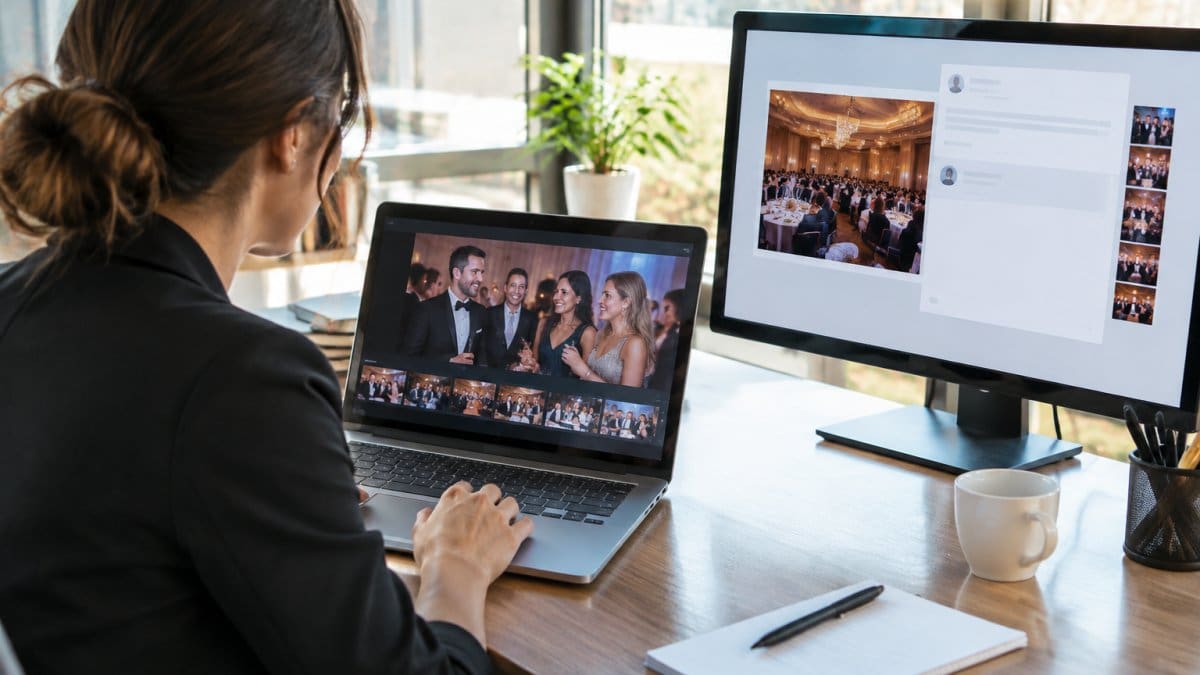
Plan your real-time workflow before the event, not after. Pick 10-15 hero images during the night, post a live album to your event hashtag, and schedule a recap carousel for the next morning. Bitly’s engagement tracking guidance recommends QR codes and short links so you can measure which posts actually drive clicks back to your registration page. If you want a full workflow, read our guide to event photography for social media.
Post-Event Survey Best Practices for Real Feedback
Real feedback comes from short surveys sent within 72 hours, mixing quantitative ratings with two or three open questions. Long surveys tank completion; the RingCentral post-event engagement guide notes that digital surveys, short interviews, and interactive polls each capture different data, so pick the format that fits the question.
A practical structure:
- One rating question: “How likely are you to attend again?” (1-10)
- One open question: “What was the single best moment?”
- One improvement question: “What should we change?”
- Optional: a 60-second video interview offer for VIPs
The “best moment” answer doubles as content. Attendees describe the memory they want preserved, which tells you exactly which photos to feature in next year’s promotion.
Building Year-Round Community Engagement After the Event
Community engagement between events is what converts a one-time attendee into a loyal one. The event lifecycle does not end at the closing reception; it loops back into the next event through consistent touchpoints. Community success depends heavily on cadence and moderation.
The Cadence That Keeps a Community Alive
A community without a rhythm dies quietly. A workable pattern for most organizations is a four-beat monthly cadence:
- Week 1, recap: repurpose session recordings, presentation decks, and photos into a short newsletter. One story, one photo, one link. Not a content dump.
- Week 2, utility: turn a panel into a whitepaper or a virtual webinar for people who missed the live session. Utility content is what makes members open the next email.
- Week 3, participation: a light gamification prompt, a photo contest around the event hashtag, a referral leaderboard, or an early-bird badge for the next event. Participation beats broadcast for retention.
Moderation: The How-To Most Guides Skip
An unmoderated community can quietly lose engagement. Here is one operating model:
- Assign one named owner. Not a team, not a shared inbox, one person whose job includes the community. Shared ownership means no ownership.
- Set a response SLA. A 24-hour response window on weekdays is the common benchmark; anything slower reads as abandonment to a member who just posted.
- Publish three rules, not ten. On-topic, civil, no solicitation. Short rule sets get read; long ones get scrolled past.
Watch out: handing moderation to a volunteer with no backup can create a single point of failure if that person leaves.
Connecting Community Back to Retention
Community activity is only worth the effort if it feeds the retention number. Two mechanics make that connection explicit:
- Gate the next registration behind community. Early-bird access for community members, or a members-only session at the next event, gives people a reason to stay engaged between events.
- Track community-to-registration attribution. Tag links in community posts with UTM parameters so you can see which posts actually drive registrations, not just likes. In many communities, a small number of post types carry most of the conversion.
For a deeper playbook on the social side, see our seven strategies to improve event social engagement.
Measuring Event ROI Through Attendee Retention
Event ROI improves fastest when you track retention, not just attendance. Attendance tells you who showed up; retention tells you who came back, and that is the number that compounds.
Track these event metrics:
| Metric | What It Reveals | How to Capture It |
|---|---|---|
| Retention rate | Repeat attendance health | Compare registration lists year over year |
| Follow-up click rate | Message relevance | Short links and QR codes |
| Survey response rate | Engagement depth | Post-event survey |
| Photo and recap shares | Organic reach | Event hashtag tracking |
| Donor upgrade rate | Stewardship impact | CRM reconciliation |
Set a baseline, then test one variable per event. If retention hovers near the 30% benchmark, a segmented follow-up workflow is usually the fastest lever. Our breakdown of capturing donor engagement at galas covers the stewardship tactics that move this number.
Booking Photography That Keeps Your Event Alive
Book a photojournalistic photographer who understands your retention goals, not just your shot list. The images you receive in the first 48 hours are the ones that feed your follow-up emails, social posts, and next year’s registration page, so turnaround and discretion belong in the contract conversation.
Ask three questions before you sign:
- What is your delivery timeline for a highlight gallery?
- How do you handle VIP and board members who prefer not to be photographed?
- Can you brief on our sponsors and key donors in advance?
Our list of DC event photographer booking mistakes covers the rest. At Event Photojournalism, our award-winning photography and customized coverage are built for exactly this: high-resolution images delivered as visual assets you can use immediately.
Frequently Asked Questions
How do you keep attendees engaged after an event?
Start within 48 hours. Send a personalized thank-you email with a link to event photos and a session recording, then follow with a recap post on social media. Use QR codes and short links to track which attendees open what, so your next message targets their actual interests. A structured 48-hour plan can help turn event momentum into membership growth and revenue. Keep the sequence going for two to three weeks with varied content: surveys, community invitations, and early registration offers for your next event.
What is the best way to measure post-event engagement?
Track behavior, not just opens. Use QR codes and short links in every follow-up message so you can see which attendees click through to photos, recordings, or registration pages. Trackable assets like these can help measure follow-up effectiveness. Pair that with survey data and repeat attendance rates. Measuring event ROI through attendee retention means comparing how many attendees return or renew against your total attendance, then tying that number to revenue or membership growth.
How long should a post-event follow-up campaign last?
Plan for two to four weeks of active follow-up, with the heaviest push in the first 48 hours. Many follow-up plans focus on that 48-hour window to convert momentum into leads and membership growth. After the initial thank-you and photo share, space out messages: a survey in week one, a community invitation in week two, and a next-event teaser in week three. After that, move attendees into your regular year-round engagement rhythm rather than continuing a dedicated campaign.
How can high-quality event photography improve attendee retention?
Photos give attendees a reason to re-engage and a memory to return to. When you share candid, professional images within a day or two, attendees tag themselves, share with colleagues, and feel recognized. That visibility keeps your event in their feed and in their minds long after the last session. Keeping the connection warm with strong imagery can help protect the engagement you already earned.
What content should be included in a post-event email sequence?
Lead with a personalized thank-you and a gallery link. Follow with session recordings or presentation decks, then a short survey. Include a sizzle reel or photo highlights for people who missed the event, and close with an invitation to your community platform or early registration for the next event. Segment the sequence so first-time attendees get a welcome angle and repeat attendees get a loyalty angle. Each email should have one clear action, tracked with a short link so you know what resonates.
The challenge is simple: most organizations treat the event as the finish line, then wonder why attendance stalls. The fix is treating the 48 hours after as the real retention engine. Event Photojournalism supports that engine with award-winning photography, customized coverage for conferences, galas, and corporate events, and high-resolution image delivery built to elevate your brand and amplify your message. Get started with Event Photojournalism and turn every event into a returning audience.