Table of Contents
- 1. Create an Event Photography Shot List Template Before the Event
- 2. Scout the Venue and Plan Your Lighting Setup
- 3. Communicate Expectations with Event Organizers and Identify VIPs
- 4. Balance Candid Photography with Strategic Posed Shots
- 5. Optimize Camera Settings and Backup Equipment for Consistency
- 6. Repurposing Event Content Across Marketing Channels
- 7. Measuring Event Marketing ROI with Quantifiable Metrics
- 8. Deliver Fast Turnaround and High-Resolution Files for Marketing Impact
Last Updated: August 5, 2026
1. Create an Event Photography Shot List Template Before the Event
The foundation of strong event photography ROI starts before you arrive at the venue. A comprehensive shot list template, developed with your client, ensures you capture images that matter most for their business objectives.
A shot list is a documented plan of specific moments, people, and scenes you’ll prioritize during the event. It transforms event photography from reactive documentation into strategic asset creation. When you know exactly what your client needs for their annual report, LinkedIn campaign, or fundraising materials, you stop wasting frames on generic shots and focus on images that drive measurable results.
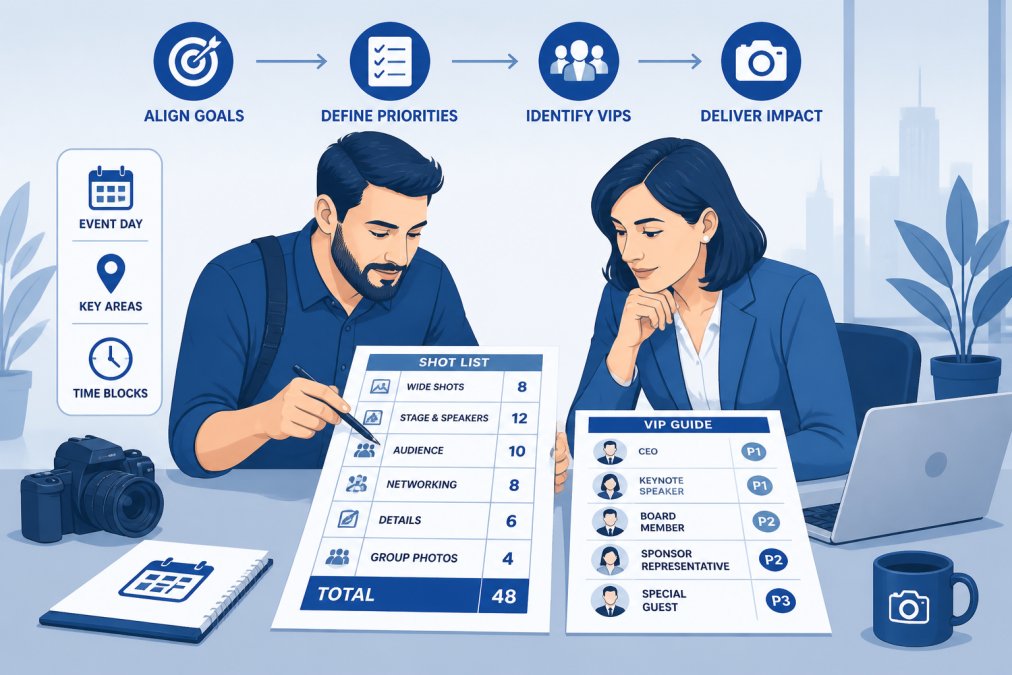
Work with your client to identify shot list priorities at least two weeks before the event. Ask direct questions: Which executives or board members must be photographed? Are there sponsor logos or signage that need visibility? What’s the primary use for these images, press releases, social media, internal communications, or fundraising? Document these requirements in a reusable template.
Create a master template with these sections: VIP portraits (with names and titles), sponsor/partner visibility shots, candid networking moments, stage or presentation scenes, and detail shots (signage, materials, decor). Share this template with your client for review and adjustments before the event. This single step eliminates post-event disputes about whether you captured what they needed.
A well-structured shot list accelerates your post-processing workflow. When you know which images are priorities, you can cull and edit more efficiently, reducing turnaround time from weeks to days. This faster delivery strengthens your event photography ROI by getting images into your client’s hands while the event is still top-of-mind for their audience.
2. Scout the Venue and Plan Your Lighting Setup
Venue scouting transforms unpredictable lighting conditions into a managed asset. Visit the location at least one week before the event, ideally at the same time of day the event will occur. Natural light changes dramatically between morning and afternoon, and artificial lighting in event spaces creates color casts that wreck white balance if you’re not prepared.
During your venue visit, identify your primary shooting positions and light sources, windows, overhead fixtures, spotlights, or a mix. Determine whether you’ll need supplemental lighting. Many corporate events occur in windowless ballrooms with flat fluorescent overhead lighting, which requires either fill flash or repositioning to work around the existing setup.
Document the venue layout with photos or sketches. Note where electrical outlets are located, which walls have reflective surfaces you can use to bounce light, and where you’ll encounter backlighting. This reconnaissance prevents you from scrambling to adapt mid-event.
If your client’s venue has directional spotlights on the stage but ambient room lighting is dim, you’ll need fast lenses (f/2.8 or wider) or higher ISO tolerance. Discovering this limitation during the event means missed moments. Scout first, plan your camera settings second.
Test your backup lighting equipment at the venue if possible. Bring a wireless trigger for your off-camera flash, extra batteries, and a backup camera body. Having scouted the space, you’ll know your options instead of improvising under pressure.
The lighting setup you plan during scouting directly impacts the quality of your deliverables and how quickly you can process them. Better-lit images require less correction in post-processing, which means faster turnaround and more time for strategic editing that amplifies your event photography ROI.
3. Communicate Expectations with Event Organizers and Identify VIPs
Clear communication with event organizers before the event prevents misalignment and ensures you capture the images that matter most. Schedule a pre-event call at least one week prior. Confirm the event schedule, key moments (speeches, award presentations, networking sessions), and any special requests.
More importantly, get a VIP list with names, titles, and roles. Ask your client which individuals are critical to photograph, board members, major donors, sponsors, executives, or key stakeholders. Request a photo or description if available, so you can identify them during the event without constantly asking.
Discuss the tone and style your client wants. Do they prefer candid, photojournalistic coverage or a mix of candid and posed group shots? Are there specific scenes, networking, dining, presentations, that matter more than others? Understanding their preference shapes how you position yourself during the event.
Document all agreements in a brief pre-event summary email. Confirm the schedule, deliverable format, turnaround timeline, and any special requests. This creates a paper trail and ensures both parties are aligned on what success looks like.
During the event, use your VIP list to prioritize your positioning. Position yourself where you can capture key stakeholders without hovering over them. Clear expectations also protect your event photography ROI by reducing revision requests.
4. Balance Candid Photography with Strategic Posed Shots
The tension between candid and posed photography defines the quality of your event coverage. Candid moments feel authentic and tell the real story of the event. Posed shots provide clear, professional images of specific people or groups that clients use for official communications and annual reports.
A balanced approach captures both. Dedicate roughly 60% of your shooting time to candid coverage and 40% to strategic posed shots. Candid photography requires you to anticipate moments, position yourself where conversations will happen, and shoot when subjects are unaware. Strategic posed shots are planned moments, identify 3-5 key group photos you’ll capture and schedule these with your client’s event coordinator so you can gather people efficiently.
The distinction matters for event photography ROI. Candid images work best for social media, press releases, and storytelling. Posed shots work best for official communications, internal directories, and recognition materials. Clients need both to amplify their message across different channels.
5. Optimize Camera Settings and Backup Equipment for Consistency
Event environments demand camera settings optimized for unpredictable lighting and fast-moving moments. Start with aperture priority mode and set your aperture to f/2.8 or wider. This depth of field isolates subjects from background clutter and works in dim venue lighting without pushing ISO dangerously high.
Set your shutter speed to at least 1/125th of a second to freeze motion. If you’re shooting in very dim light, increase to 1/250th and let ISO rise; modern cameras handle high ISO better than motion blur. Use autofocus with back-button focus, which gives you faster, more reliable focus tracking during dynamic moments.
White balance is critical. Set a custom white balance for the venue’s lighting before the event starts. Shoot in RAW format so you can correct white balance in post-processing if the lighting changes mid-event.
Bring backup equipment. A second camera body prevents total failure if your primary camera malfunctions. Bring extra memory cards and batteries; event venues are large, and you’ll be shooting for hours.
Format all memory cards in your camera before the event, not on your computer. Bring at least three memory cards, even if you think two are enough. The cost of a spare card is negligible compared to the cost of losing images.
Consistency in your camera settings translates to consistency in your deliverables. When your exposure, focus, and white balance are optimized, your post-processing workflow becomes faster and more predictable.
6. Repurposing Event Content Across Marketing Channels
The true value of event photography emerges when you repurpose images across multiple channels. A single event can generate content for social media, email campaigns, press releases, annual reports, LinkedIn posts, website galleries, and internal communications.
Start by categorizing your best images by use case during your initial culling process. Set aside images suitable for LinkedIn (professional, clear faces, brand-appropriate), Instagram (visually striking, diverse compositions), press releases (action shots, speaker moments, sponsor visibility), and internal communications (candid networking, team moments).
Different platforms require different aspect ratios and compositions. LinkedIn favors vertical or square images with clear faces and professional context. Instagram rewards visually dynamic compositions with strong colors or interesting framing. Press releases need action shots that tell a story in a single frame. Email campaigns work best with images that include people.
Create a content calendar with your client. If they have a press release launching the day after the event, identify which images support that narrative. If they’re running a social media campaign the following week, reserve images that work for their feed aesthetic.
Encourage your client to credit the photography in their captions and posts. "Photos by Event Photojournalism" or a link to your portfolio builds your brand visibility and generates referrals. The secondary use of event images across channels multiplies the value of the photography investment.
7. Measuring Event Marketing ROI with Quantifiable Metrics
Quantifiable metrics prove the value of professional event photography to your clients and justify your rates. Without measurement, photography is a cost center. With measurement, it becomes a strategic investment that generates measurable returns.
Work with your client to identify what success looks like. For a fundraising gala, success might be sponsorship inquiries or donations attributed to the event. For a corporate conference, success might be attendee engagement, media mentions, or social media reach. For a product launch, success might be press coverage or website traffic from event-related content.
After the event, track these quantifiable outcomes:
| Metric | How to Measure | Why It Matters |
|---|---|---|
| Social media reach | Impressions and engagement on posts featuring event photos | Shows audience size exposed to your client’s message |
| Press coverage | Media mentions, articles, or interviews referencing the event | Demonstrates earned media value beyond paid advertising |
| Website traffic | Traffic to event-related landing pages or galleries | Indicates audience interest in event content |
| Lead generation | Inquiries or registrations attributed to event promotion | Directly ties photography to business outcomes |
| Donor engagement | Donations or pledges following event coverage | Proves fundraising impact for nonprofit clients |
| Attendee retention | Repeat attendance or membership renewal rates | Shows event experience quality influences loyalty |
Ask your client to share these metrics with you after the event. If their press release featuring your photos generated three media mentions, that’s a data point. If social media posts with event images outperformed their typical engagement by 40%, that’s measurable impact.

Use these metrics in your portfolio and case studies. "Event photography that drove 3 media mentions and 500 social media impressions" is far more compelling than generic descriptions. Quantified results differentiate you from competitors and justify premium pricing.
8. Deliver Fast Turnaround and High-Resolution Files for Marketing Impact
Turnaround time is a competitive advantage. Events are time-sensitive. Your client needs images while the event is still relevant, for press releases launching the next morning, social media posts that week, or follow-up communications with attendees. A 24-hour turnaround is exceptional.
Fast turnaround requires discipline in your workflow. Cull your images aggressively on the day of the event or the morning after. Delete obviously bad shots immediately. This reduces your editing load from 800 images to 300.
Develop a standardized editing workflow. Use presets or LUTs to apply consistent color grading across all images. Batch-edit similar shots to save time. Exposure correction, white balance, and contrast adjustments happen on 80% of your images; save detailed retouching for hero shots and VIP portraits.
Deliver files in formats your client actually needs. High-resolution files (3000+ pixels on the long edge) work for print and large displays. Web-resolution files (1200-1500 pixels) are sufficient for social media and email. Provide both so your client can choose based on their needs.
Organize your deliverables logically. Create folders by use case (social media, press release, LinkedIn, internal) so your client can quickly find images for their immediate needs. Include a brief README file with shooting date, number of images, file formats, and usage rights.
Fast, organized delivery strengthens your event photography ROI by ensuring images reach your client’s audience while the moment is still relevant. A press release with photos launches stronger. Social media posts featuring event images generate more engagement when posted within 48 hours.
Professional event photography isn’t just about capturing moments, it’s about delivering strategic assets that amplify your client’s message and generate measurable business results. Event Photojournalism specializes in this intersection of artistry and business impact, delivering award-winning photography that transforms corporate conferences, galas, and special events into lasting visual assets. Our customized approach ensures every image serves your client’s specific objectives, whether that’s fundraising, brand amplification, or stakeholder engagement. Ready to maximize your event’s impact? Contact Event Photojournalism to discuss how professional photography can drive quantifiable results for your next event.
Frequently Asked Questions
How do you measure the ROI of event photography?
Event photography ROI is measured by tracking business outcomes tied to images: social media engagement (shares, comments, reach), press release pickup, website traffic from photo galleries, donor inquiries following galas, and conversion rates for sponsorship renewals. Compare the cost of professional photography against incremental revenue or donations generated, media impressions earned, and cost-per-lead for business development. Use event photography shot list templates to ensure you capture moments that directly support these metrics.
What should be included in an event photography shot list template?
A shot list template must identify key moments (opening remarks, networking, award presentations), VIP attendees and their affiliations, sponsor logos and booths, venue establishing shots, and candid group interactions. Include columns for shot priority, location within the venue, and which marketing channel each image targets (LinkedIn, annual report, press release). Share this template with event organizers beforehand to align on deliverables and ensure coverage that supports your ROI goals.
How can event photos be repurposed for social media and marketing ROI?
Repurposing event content multiplies ROI by using single photos across multiple channels: post full-resolution images to your website gallery, crop and optimize for Instagram and LinkedIn, create carousel posts highlighting sponsor visibility, extract quotes and overlay them on images for Pinterest, and license high-impact shots to attendees and sponsors. Tag relevant organizations and individuals to expand reach. Fast turnaround (24-48 hours) ensures content stays timely for press releases and social media campaigns.
What camera settings and equipment should I prioritize for consistent event photography?
Use aperture priority mode (f/2.8 to f/5.6) to control depth of field while maintaining shutter speed above 1/125th for sharp candid shots. Set ISO to auto with a ceiling of 3200 to preserve image quality in varying lighting. Shoot in RAW format for maximum post-processing flexibility. Bring backup bodies, extra memory cards, and spare batteries, equipment failure directly reduces ROI by limiting deliverable volume. Use a mix of focal lengths (24-70mm and 70-200mm) to capture both wide venue shots and intimate moments.
Why is post-processing and fast delivery critical for event photography ROI?
Clients need images within 24-48 hours to capitalize on event momentum for press releases, social media, and donor communications. Efficient post-processing, using batch edits, consistent white balance, and metadata tagging, reduces turnaround time. AI-assisted culling tools can reduce review time by 40-60%, enabling faster delivery. Delays push images outside the news cycle and reduce their marketing value. High-resolution deliverables ensure images work across print annual reports, digital galleries, and social media without quality loss.
This article was written using GrandRanker