Table of Contents
- Top 5 Corporate Event Photography Trends Reshaping 2026
- 1. Story-Driven Coverage and Authenticity in Corporate Events
- 2. AI-Powered Curation and Workflow Automation
- 3. Rapid Delivery and Real-Time Social Media Integration
- 4. Aerial and Multi-Format Coverage
- 5. Privacy-First Practices and Legal Compliance
- Corporate Event Photography Tips for Pre-Event Planning
- Essential Event Photography Equipment for Professional Results
Last Updated: July 23, 2026
Top 5 Corporate Event Photography Trends Reshaping 2026
Corporate event photography has fundamentally shifted from static, posed imagery to dynamic, authentic storytelling that captures genuine moments of connection and leadership presence. Understanding these top 5 trends is essential for organizations serious about brand visibility and stakeholder engagement. At Event Photojournalism, we’ve documented how corporate event photography has evolved to prioritize candid authenticity, real-time delivery, and measurable impact on brand perception.
The shift from posed photography to story-driven coverage represents the single biggest change in how corporations approach event documentation. Authenticity now drives engagement more than perfection.
Why These Trends Matter for Your Brand
Corporate events represent significant investments of time, budget, and organizational focus. The photography that captures these moments becomes your organization’s visual record, populating LinkedIn, annual reports, press releases, and internal communications for months or years. Strategic event photography amplifies your message, elevates your brand, and ensures that weeks of planning translate into lasting visual assets.
Attendees, investors, employees, and media consumers increasingly reject polished artificiality in favor of genuine moments. They want to see leadership in action, not leadership in costume.
1. Story-Driven Coverage and Authenticity in Corporate Events
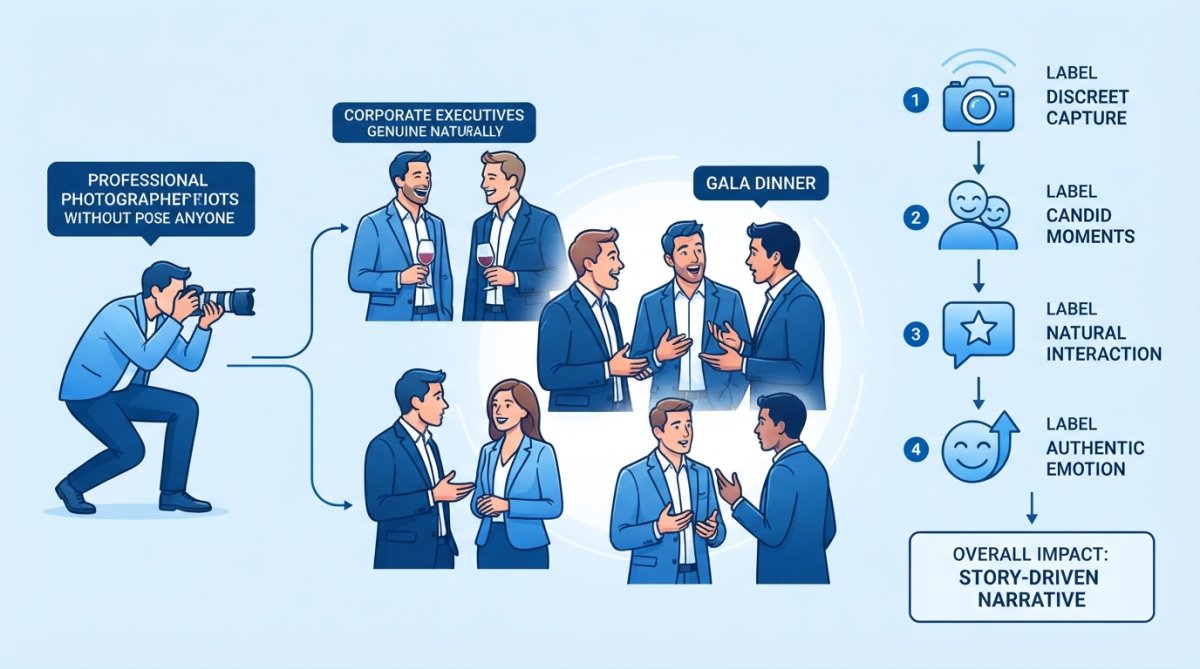
Candid moments now outperform posed shots in engagement metrics across nearly every platform. Modern corporate event photography emphasizes capturing unguarded moments: a CEO listening intently to an employee question, board members engaged in genuine conversation, sponsors connecting authentically with attendees.
Moving Beyond Posed Shots
The traditional corporate event photograph, everyone arranged in a line, smiling at the camera, has become a liability. These images feel dated and fail to convey the energy or substance of what actually happened. Story-driven coverage means your photographer arrives with a narrative framework, briefed on key moments and VIPs, then documents how that narrative actually unfolds through genuine reactions and unexpected connections.
Brief your photographer on the three to five key moments you want documented, but leave room for them to discover unexpected authentic moments. The best event photos often capture something you didn’t plan to highlight.
Capturing Candid Leadership Moments
Leadership visibility has become critical to corporate communications. Candid photography showing leaders listening, learning, and interacting builds trust and humanizes your organization. This requires a photographer skilled at anticipating moments, understanding body language, and positioning themselves to capture authentic expressions without being intrusive.
2. AI-Powered Curation and Workflow Automation
The volume of images captured at corporate events has exploded. A single day-long conference can generate 3,000 to 5,000 images. AI-powered curation and editing tools now reshape the post-production workflow entirely.
Real-Time Editing and Delivery
Modern event photographers use AI-powered editing software to accelerate post-production. Tools like Imagen AI learn a photographer’s editing style and apply consistent edits across entire galleries in seconds rather than hours. This means professional-quality images can be delivered within hours of an event concluding.
Your press release can go out the morning after your gala with professional-quality images attached. Your social media team can begin sharing highlights while attendees are still talking about the event. This speed of delivery has become a competitive advantage in corporate communications.
Batch Processing for Consistency
AI tools handle batch processing, applying a consistent look across hundreds of images simultaneously. This ensures every image from your event maintains brand consistency in color, tone, and style, making your entire gallery feel cohesive rather than like a collection of differently edited images.
3. Rapid Delivery and Real-Time Social Media Integration
The expectation for rapid content delivery has fundamentally changed corporate event photography. Attendees now expect to see photos from an event on social media while they’re still at the venue.
Same-Day Highlights for Press Releases
Press releases issued the day after a major corporate event now routinely include professional photography. Modern event photographers deliver a curated set of 20-30 polished images within 12 hours of an event concluding, allowing your communications team to immediately publish press releases with visual assets attached. Media outlets are far more likely to pick up a press release that includes professional imagery.
Guest-Focused Sharing and Branded Galleries
Modern approaches create guest-focused sharing experiences. Photographers deliver images through branded online galleries where attendees can download and share photos from the event. Platforms like Darkroom Core enable photographers to create customized digital galleries reflecting your brand identity. Attendees receive a unique link, browse photos, download high-resolution images, and share directly to social media, transforming attendees into content distributors.
4. Aerial and Multi-Format Coverage
Drone photography and multi-camera coverage have expanded what’s possible in corporate event documentation. Aerial photography reveals scale, crowd size, venue grandeur, and spatial relationships that ground-level photography cannot convey.
Drone Photography for Scale and Impact
Aerial photography fundamentally changes how an event looks visually. A conference that feels large from ground level becomes visibly massive from above. An outdoor gala reveals the full landscape and scale. For corporate communications, aerial imagery conveys scale and importance in ways ground-level photography cannot match. According to Dronegenuity’s professional services data, aerial coverage at corporate events increases social media engagement by making events feel more significant.
Drone photography requires FAA certification and compliance with local airspace regulations. Confirm that your photographer holds current Part 107 certification before booking aerial coverage.
Hybrid Event Documentation
The shift toward hybrid events has created new documentation challenges. Modern corporate event photography now includes capturing content specifically designed for virtual attendees. Multi-camera setups allow simultaneous capture of speaker, audience, and reaction shots, providing comprehensive documentation that serves both in-person attendees and virtual participants.
5. Privacy-First Practices and Legal Compliance
As corporate event photography has become more sophisticated, privacy and legal compliance have become critical concerns. Board members, executives, and high-profile attendees increasingly expect their privacy to be respected.
Respecting Board Member Privacy
Not every attendee wants their image circulated publicly. Board members often request that their images not be used in external communications. Modern event photographers work with detailed consent forms specifying exactly how images will be used: internal communications only, external social media, press releases, annual reports, or no external use at all.
Your photographer needs a clear list of attendees who have requested image restrictions and must respect those requests consistently.
First-Party Data and Consent Management
Modern corporate event photography involves managing first-party data responsibly. GDPR compliance, CCPA compliance, and other privacy regulations increasingly govern how event imagery and attendee data are handled. Organizations should establish clear consent protocols: attendees must explicitly opt in to have their images shared and data collected. This builds trust and ensures legal compliance.
Corporate Event Photography Tips for Pre-Event Planning
The quality of your event photography is largely determined before the event begins.
Briefing Your Photographer on VIPs and Sponsors
Provide a detailed brief that includes names and photos of VIPs, board members, executives, and key speakers; sponsors and their representatives; key moments you want documented; specific shots needed for press releases; and any privacy restrictions for particular attendees.
Send your photographer a one-page visual guide showing the key people they should prioritize. Include their names, titles, and a clear photo so there’s no confusion during the event.
Setting Expectations for Editorial Style
Not all corporate event photography looks the same. Provide examples of photography you love and explain what appeals to you. Discuss the tone you want to convey: Is this celebratory? Serious? Learning-focused? The answers shape how your photographer approaches the assignment.
Essential Event Photography Equipment for Professional Results
Professional corporate event photography requires specific equipment choices.
Camera Bodies and Lenses
Full-frame mirrorless cameras have become the standard for professional event photography. The Sony Alpha a7 V delivers exceptional autofocus performance and low-light capability. The Canon EOS R5 offers high resolution and cinematic video quality.
A 24-70mm zoom lens handles most situations at corporate events. A 70-200mm telephoto lens captures distant speakers and audience reactions. A 35mm or 50mm prime lens excels at capturing intimate candid moments.
Editing Software and AI Tools
Post-production efficiency depends on your software stack. ON1 Photo RAW 2026 provides AI-powered batch editing with automatic adjustments. Imagen AI learns your editing style and applies consistent adjustments across entire galleries. Most professional event photographers use a combination: AI tools for initial pass, manual adjustments for final polish.
| Trend | Key Benefit | Implementation Requirement |
|---|---|---|
| Story-Driven Coverage | Authentic engagement, higher social media performance | Experienced photojournalist, pre-event briefing |
| AI-Powered Curation | 24-hour delivery, consistent editing | Investment in editing software, trained operator |
| Rapid Social Integration | Real-time attendee sharing, immediate press releases | Branded gallery platform, fast internet at venue |
| Aerial Coverage | Scale visibility, unique perspectives, crowd documentation | FAA-certified drone operator, venue airspace clearance |
| Privacy Compliance | Legal protection, stakeholder trust, brand safety | Consent forms, privacy briefing, image-use restrictions |
The top 5 corporate event photography trends reflect a fundamental shift in how organizations approach visual documentation. Authenticity, speed, and strategic impact now matter more than technical perfection. The most successful corporate events are documented by photographers who understand both the technical requirements of professional photography and the strategic importance of the moments they’re capturing.
Event Photojournalism brings award-winning expertise to this evolving landscape. Our team understands corporate communications, captures authentic leadership moments, delivers same-day highlights, and manages privacy and compliance with the rigor your organization requires. We create visual assets that amplify your message, elevate your brand, and ensure your most important moments are remembered through stunning imagery.
CONTACT US to discuss how our corporate event photography services can transform your next gathering into a documented success.
Frequently Asked Questions
What are the top 5 corporate event photography trends for 2026?
The leading trends are story-driven, candid coverage; AI-powered curation and workflow automation; rapid delivery with real-time social media integration; aerial and multi-format documentation; and privacy-first legal compliance practices. These trends reflect the shift toward authentic visual storytelling, operational efficiency, and brand consistency while respecting guest privacy and maximizing event ROI through professional photography.
How can corporate event photography tips improve our event's visual impact?
Strong pre-event planning is critical. Brief your photographer on VIP names, sponsor logos, and key moments you want captured. Discuss your desired editorial style, whether you prefer candid photojournalism or structured leadership moments. Clear communication about your brand identity, audience (annual reports, LinkedIn, fundraising), and delivery timeline ensures your photographer delivers professional imagery that aligns with your mission and maximizes your event's impact.
What event photography equipment do professional photographers use in 2026?
Professional event photographers typically use full-frame mirrorless cameras like the Sony Alpha a7 V or Canon EOS R5 for reliability and low-light performance. They pair these with versatile zoom lenses, backup bodies, and wireless triggers. Post-production relies on AI-powered editing tools like ON1 Photo RAW 2026, Imagen AI, or Aperty for rapid batch processing. Drone equipment (FAA-certified operators) is increasingly standard for aerial perspectives at large corporate events.
What should I look for when hiring a corporate event photographer?
Evaluate their portfolio for editorial-quality imagery, not heavily edited or posed shots. Ask about turnaround times, professional photographers should deliver highlights within 24 hours for press releases. Request references and ask about their approach to candid versus structured coverage. Confirm they understand your brand identity, can handle your event's lighting conditions, and offer high-resolution digital assets suitable for annual reports and corporate communications. Verify they have backup equipment and a contingency plan.
How can corporate event photography marketing maximize ROI after an event?
Measure post-event ROI by tracking metrics like social media engagement, press release pickups, and internal team usage of images. Repurpose high-impact photos across LinkedIn, annual reports, email campaigns, and website galleries to extend their value. Use first-party data from branded photo galleries to understand which moments resonated with your audience. Share behind-the-scenes and candid leadership moments to humanize your brand and drive engagement. Professional photographers should deliver assets optimized for multiple platforms.
This article was written using GrandRanker