
Table of Contents
- What Corporate Photography Really Means for Your Brand
- Studio vs. Environmental Portraits: Which Is Right for You?
- Corporate Headshot Tips That Actually Elevate Your Team’s Image
- How to Prepare for a Corporate Photoshoot: A Step-by-Step Guide
- Professional Branding Photography Examples and What Makes Them Work
- Corporate Photography Pricing Guide: What to Budget in 2025
- How to Choose a Corporate Photographer: Legal Rights and Evaluation Tips
- Conclusion: Invest in Corporate Photography That Works as Hard as You Do
Last Updated: June 1, 2026
Corporate photography is one of the most underestimated assets a business can invest in, and the gap between companies that treat it seriously and those that don’t is visible the moment you land on their website. At Event Photojournalism, we’ve worked with organizations across the DMV area long enough to know that first impressions in visual media are rarely recovered from. A blurry headshot or inconsistent team page signals something specific to prospective clients: that the company doesn’t sweat the details. Below, we’ll show you exactly how to plan, execute, and evaluate business photography that works as hard as your team does.
Here’s what most guides get wrong: they treat corporate photography as a one-time checkbox rather than a living brand asset. The companies that get the most value from their images treat photography as a strategic investment, updated regularly and aligned with their visual identity across every channel.
What Corporate Photography Really Means for Your Brand
Corporate photography is the deliberate practice of creating professional images that represent a business, its people, and its culture for commercial and communications purposes. It’s not just headshots on a white background. It includes everything from executive portraits and team photos to event coverage, editorial-style environmental shots, and marketing assets used across digital and print channels.
The distinction matters because businesses often underfund photography precisely because they think it’s limited to headshots. Brand identity is built through consistent visual storytelling across every touchpoint: your website, LinkedIn, email signatures, press releases, and sales decks. When those images are inconsistent or low quality, the message to clients and partners is that your brand lacks cohesion.
According to LinkedIn’s research on professional profiles, profiles with professional photos receive significantly more engagement than those without. The same logic applies at the company level.
Corporate Headshots vs. Branding Photography: Key Differences
Corporate headshots are individual portraits, typically used for LinkedIn profiles, company directories, email signatures, and press bios. The goal is consistency and professionalism across the team.
Branding photography is broader. It captures the personality, culture, and working environment of a business. Think: a team collaborating in a modern office, a founder speaking at a conference, or a product being used in context. These images tell a story that headshots alone cannot.
Most businesses need both. Headshots establish individual credibility. Branding photography establishes organizational identity.
Types of Corporate Photography: Events, Portraits, and Editorial
Business imaging breaks into three primary categories:
- Portraits: Individual and team headshots, executive portraits, and cinematic business portraits for high-profile use
- Event photography: Conferences, galas, product launches, award ceremonies, and corporate gatherings documented as they happen
- Editorial photography: Images that tell a narrative, often used in annual reports, case studies, and long-form content marketing
Each serves a different communication goal. A Fortune 500 company preparing an annual report needs editorial images that convey leadership and vision. A startup building its first website needs clean, consistent headshots and a few culture shots. Knowing which type you need before you hire a photographer saves time and budget.
Studio vs. Environmental Portraits: Which Is Right for You?
The choice between studio and environmental portraits isn’t purely aesthetic. It’s a strategic decision based on how you want your brand perceived and where the images will be used.
Studio portraits offer total control. Lighting is consistent, backgrounds are neutral, and the focus stays entirely on the subject. This works well for team headshots where consistency across dozens of employees matters more than atmosphere. The trade-off is that studio images can feel clinical or disconnected from the actual work environment.
Environmental portraits, shot on location in your office or a relevant setting, add context and personality. A lawyer photographed in their library, an architect in front of a building they designed, or a tech team working at their actual desks, these images communicate what the person does and where they do it. They tend to perform better in editorial contexts and on social media because they feel authentic.
 adjusting a softbox light stand to camera left while the subject stands near floor-to-ceiling windows, creating a cinematic environmental portrait with natural bokeh in the background](https://cdn.grandranker.com/articles/corporate-photography-the-complete-guide-for-businesses-content-1-1780279498.jpg)
The practical answer for most businesses: use studio setups for headshots that need to match across a large team, and environmental portraits for leadership, featured team members, and branding photography that tells a story.
Technical Lighting Setups for Office and On-Location Shoots
Office environments are notoriously difficult to shoot in. Fluorescent overhead lighting creates unflattering shadows and color casts. Mixed light sources (daylight from windows plus artificial overhead lights) produce inconsistent white balance that even skilled retouching can’t fully fix.
A professional photographer working on location will typically bring:
- A key light (usually a softbox or umbrella) placed at 45 degrees to the subject to create dimensional, flattering light
- A fill light or reflector on the opposite side to reduce harsh shadows
- A background light or separation light to prevent the subject from blending into the background
- Gels to match the color temperature of ambient light sources
Depth of field is another technical lever. Shooting at wider apertures (f/1.8 to f/2.8) creates bokeh that separates the subject from the background, giving images a cinematic quality that distinguishes professional work from smartphone photos. For environmental portraits where the setting matters, stopping down to f/4 or f/5.6 keeps more of the scene in focus.
When shooting in offices with mixed lighting, the fastest fix is to turn off overhead fluorescent lights entirely and rely on window light plus portable strobes. This gives the photographer full control over color temperature and produces far cleaner results.
Corporate Headshot Tips That Actually Elevate Your Team’s Image
Most headshot sessions fail before the shutter clicks. The problems are almost always logistical: poor scheduling, no guidance on wardrobe, inconsistent backgrounds, and no direction for subjects who’ve never been photographed professionally.
The difference between a headshot that builds trust and one that undermines it often comes down to three things: lighting quality, subject comfort, and post-production consistency.
Subjects who are uncomfortable in front of a camera produce stiff, unnatural images. A skilled photographer spends the first few minutes of a session building rapport, giving clear direction, and shooting test frames that the subject can review. This feedback loop relaxes people quickly.
Wardrobe Styling and Team Consistency for Headshots
Team consistency is the single most overlooked element of corporate headshots. When a company’s team page shows twelve people photographed on different days, with different backgrounds, different lighting, and wildly different clothing styles, the visual noise undermines the professional impression the company is trying to make.
Wardrobe guidance should be sent to every participant before the session. A practical brief includes:
- Colors: Solid, medium-toned colors photograph best. Avoid bright white (causes overexposure) and black (loses detail in shadows).
- Patterns: Avoid small patterns, stripes, and busy prints. They create moiré effects on screen.
- Fit: Well-fitted clothing reads as professional. Oversized or ill-fitting garments distract.
- Layers: Blazers, jackets, and structured pieces add authority without looking stiff.
For team consistency, some organizations provide branded wardrobe elements (a specific color blazer or branded shirt) to ensure visual cohesion across all images. This is a particularly effective approach for large teams where individual wardrobe variation would otherwise be unmanageable.
Skipping the wardrobe brief is the most common mistake in team headshot planning. Without guidance, you’ll spend the first hour of a session asking people to change clothes, and you’ll still end up with inconsistent results that require expensive reshoots.
How to Prepare for a Corporate Photoshoot: A Step-by-Step Guide
Preparation determines the quality of the outcome more than any other variable. A well-prepared shoot runs efficiently, produces better images, and costs less in both time and money.
Step 1: Define the deliverables. Know exactly what images you need before you brief a photographer. How many headshots? Do you need environmental portraits? Event coverage? Marketing assets for a specific campaign? A clear deliverable list prevents scope creep and ensures you’re budgeting accurately.
Step 2: Choose your locations. For environmental portraits, scout your office or preferred locations in advance. Identify areas with good natural light, clean backgrounds, and enough space for lighting equipment. Avoid cluttered areas or spaces with distracting signage.
Step 3: Build a shot list. A shot list is a document that specifies every image you need, including the subject, setting, and intended use. Share this with your photographer before the shoot. It’s the single most effective tool for keeping a session on track.
Step 4: Communicate with participants. Send wardrobe guidelines, arrival times, and session expectations to everyone being photographed at least one week in advance. Include a brief on what to expect during the session so people arrive relaxed rather than anxious.
Step 5: Schedule buffer time. Headshot sessions typically run 10-15 minutes per person for a skilled photographer. Build in buffer time between subjects and a longer break at the midpoint of the day. Rushing produces tense images.
Step 6: Plan post-production. Agree on retouching standards before the shoot. Know how many rounds of edits are included, what the turnaround time is, and how images will be delivered.
According to Professional Photographers of America’s business photography guidance, pre-shoot planning is consistently cited as the factor that most separates successful sessions from those requiring costly reshoots.
Professional Branding Photography Examples and What Makes Them Work
Most guides on this topic show you a mood board and call it analysis. What actually helps a business is understanding the mechanism, why certain images build trust and drive action while others, despite being technically competent, fail to do either. This section breaks down the visual and strategic logic behind effective branding photography so you can brief a photographer with precision rather than vague references to "authentic" or "professional."
The Three Layers of Effective Branding Photography
Every strong piece of corporate branding photography works on three simultaneous levels. When an image fails, it’s usually because one of these layers is missing.
Layer 1: Technical quality. Sharp focus on the subject’s eyes, controlled and flattering light, correct exposure, and clean color grading. This is the baseline. An image that fails technically signals that the business either couldn’t afford quality or didn’t prioritize it, neither is a message you want to send.
Layer 2: Contextual specificity. The image contains details that are specific to this company, this person, or this environment. A lawyer photographed in a generic office could be anyone. A lawyer photographed at a desk with a specific case file open, natural light from a window catching the texture of the paper, and a bookshelf of relevant legal texts in soft focus behind them, that image tells a story. Specificity is what separates branding photography from stock photography, and audiences can feel the difference immediately even if they can’t articulate why.
Layer 3: Emotional register. Every image communicates a feeling before it communicates a fact. A team photo where everyone is stiffly posed and unsmiling communicates something different from one where people are mid-laugh during a genuine moment. Neither is universally right, a law firm and a creative agency should project different emotional registers. The question is whether the emotional register in your images matches the one your brand is trying to own.
Four Image Types That Perform Across Channels, and Why
Effective branding photography portfolios are built from a deliberate mix of image types, each serving a different communication function. Here is what each type does and where it performs best:
1. Environmental leadership portraits.
A single executive or founder photographed in a setting that reflects their work and authority. These images perform well on About pages, press kits, speaking bios, and LinkedIn because they establish individual credibility while communicating organizational context. The key variable is the background: it should add meaning without competing with the subject. A cluttered background reads as disorganized; a too-clean background reads as generic. The sweet spot is a background that is visually clean but contextually specific, a bookshelf, a relevant workspace, an architectural detail of the office.
2. Candid collaboration shots.
Images of two to four people working together, reviewing a document, discussing a whiteboard, walking through a facility. These images are the workhorses of branding photography because they communicate culture, teamwork, and process simultaneously. They perform well on career pages, social media, and case study content. The most common mistake is staging these shots too rigidly: subjects who are clearly posing rather than actually doing something produce images that feel hollow. A skilled photographer will direct the subjects into a real activity and capture genuine moments within it.
3. Detail and environment shots.
Close-up images of products, tools, workspaces, or environmental details that define the brand. A manufacturing company might use close-up shots of precision components. A design firm might use images of sketches, materials, and prototypes. These images rarely stand alone but are essential for editorial layouts, website backgrounds, and social media content where a human subject isn’t always appropriate. They also extend the visual vocabulary of a brand beyond faces.
4. Group culture shots.
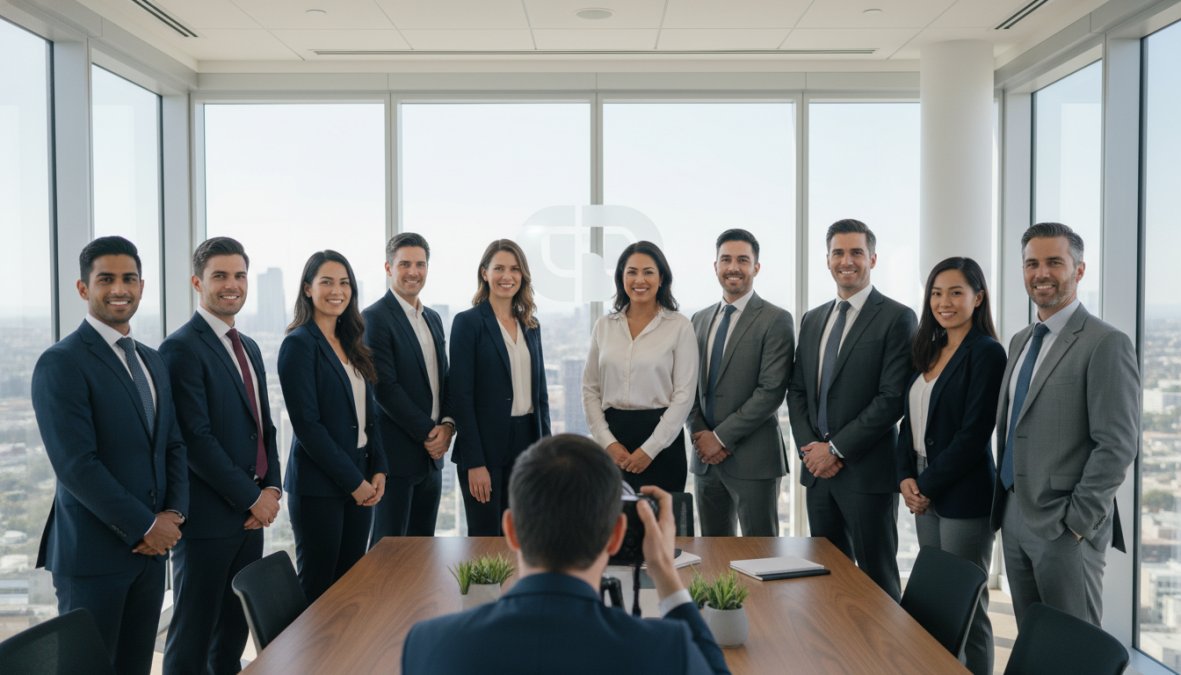
Full-team or large-group images that convey scale, diversity, and organizational energy. These are most commonly used on career pages, annual reports, and LinkedIn company pages. The technical challenge is significant, lighting a group of 20 or more people evenly, managing expressions across multiple subjects simultaneously, and composing a frame that feels dynamic rather than static requires real skill. For large groups, a photographer who has specific experience with group corporate photography is worth seeking out.
How to Brief a Photographer for Branding Photography (Not Just Headshots)
The quality gap between good and mediocre branding photography almost always originates in the brief, not in the photographer’s skill. A vague brief, "we need some photos of our team for the website", produces generic results because the photographer has no basis for making the specific creative decisions that produce distinctive images.
A strong branding photography brief includes:
-
Brand reference images. Three to five images from other companies (not competitors) whose visual style reflects the feeling you want your brand to project. These don’t need to be from the same industry. A financial services firm might reference the editorial photography style of an architecture firm because the visual language of precision and environment translates across sectors.
-
Specific use cases. Where will each image type be used? A hero image for a homepage has different compositional requirements than a LinkedIn post or a printed annual report. Knowing the end use allows the photographer to compose and shoot accordingly, leaving negative space for text overlays, shooting horizontal vs. vertical, and calibrating the level of detail in the background.
-
Subject list and priority. Who needs to be photographed, in what combinations, and which subjects are highest priority? If the CEO’s portrait is the most important deliverable of the day, it should be scheduled first, not last, when everyone is tired and the light has changed.
-
Emotional direction. Describe the feeling the images should project in three to five adjectives. "Approachable, expert, modern, grounded" gives a photographer more useful direction than "professional."
Before your shoot, pull three to five pages from your own website where the new images will live. Share them with your photographer so they can see the actual context, background colors, layout proportions, text placement, and compose images that will integrate cleanly rather than fight with your existing design.
The Authenticity Problem: Why Staged Images Underperform
One of the most consistent findings in how audiences respond to corporate imagery is that staged images, where subjects are clearly posing rather than doing, generate less engagement and less trust than images that capture genuine activity. This is not an argument against professional photography; it is an argument for a specific approach to directing subjects.
The most effective branding photographers use a technique that might be called directed candid shooting: they give subjects a real task to perform (review this document, explain this diagram to your colleague, walk through this space as you normally would) and then photograph the genuine behavior that results. The images look candid because the behavior is real, even though the lighting, composition, and framing are fully controlled.
This approach requires more time per setup than pure posed photography, but it produces images that hold up under repeated viewing, which is exactly what website and social media images need to do, since your audience will see them many times over the life of the campaign.
Measuring Whether Your Branding Photography Is Working
Most businesses have no system for evaluating whether their photography investment is delivering returns. A few practical signals worth tracking:
-
Website engagement metrics. Pages with updated, high-quality photography typically show lower bounce rates and longer time-on-page than pages with outdated or stock imagery. If you update your About page or team page with new photography, compare engagement metrics before and after.
-
LinkedIn profile views and connection acceptance rates. For individual executives and team members, updated professional headshots consistently correlate with higher profile engagement. This is measurable at the individual level.
-
Inbound inquiry quality. Businesses that invest in branding photography that accurately reflects their positioning tend to attract inquiries from better-fit clients, because the visual presentation is filtering for the right audience before the first conversation happens.
-
Internal team response. This is underrated. When a team sees themselves represented well in company photography, it reinforces organizational pride and makes the images more likely to be shared organically on personal social channels, extending your brand reach without additional spend.
The ROI of branding photography is rarely captured in a single metric. It operates across first impressions, trust signals, and brand consistency, which means its impact compounds over time rather than showing up in a single campaign report. Treat it as infrastructure, not a one-time expense.
Corporate Photography Pricing Guide: What to Budget in 2026
Pricing for corporate photography is one of the most searched and least clearly answered topics in this space. Most guides give you a range and stop there. What actually matters is understanding why prices vary, what you are and are not getting at each tier, and how to evaluate a quote before you sign anything.
What Drives the Price of Corporate Photography
Four variables account for most of the price difference between photographers quoting the same type of work:
-
Experience and market positioning. A photographer with a strong editorial portfolio and Fortune 500 clients commands a premium not just for technical skill but for the efficiency and professionalism they bring to complex, multi-stakeholder shoots. A newer photographer may deliver comparable image quality on a simple headshot session but carry more risk on a high-pressure event.
-
Scope of deliverables. The number of final edited images, the depth of retouching, and the file formats and sizes included all affect price. A quote for "20 edited images" from one photographer and "20 edited images" from another may represent very different amounts of post-production work.
-
Usage licensing. This is the most commonly misunderstood cost driver. A photographer quoting for website and internal use only will price differently than one quoting for paid advertising, national print campaigns, or broadcast. If you don’t specify usage upfront, you may receive a quote that doesn’t cover how you actually intend to use the images. (See the legal and usage rights section below for full detail.)
-
Geographic market. Rates in major metropolitan markets, New York, Los Angeles, Washington DC, Chicago, run meaningfully higher than in smaller markets, reflecting both cost of living and the concentration of high-budget corporate clients that set local rate expectations.
Typical Rate Ranges for Corporate Photography Services
The following ranges reflect professional market rates for experienced photographers in major metropolitan areas. Entry-level or emerging photographers may quote 30-50% below these figures; top-tier editorial and commercial photographers may quote above them.
| Photography Type | Typical Range | What’s Typically Included |
|---|---|---|
| Individual headshot session | $250-$600 | 1-2 hours, 2-5 fully retouched images |
| Team headshots (10-20 people) | $1,500-$4,000 | Half-day shoot, batch color correction, individual retouching |
| Team headshots (20-50 people) | $3,500-$8,000 | Full-day shoot, standardized editing pipeline, bulk delivery |
| Environmental/branding session | $1,000-$3,500 | Half to full day, 20-50 images, location scouting |
| Corporate event coverage | $1,500-$5,000+ | Full day, 200-500 images, next-day or 48-hour turnaround |
| Executive portrait session | $500-$2,000 | 1-3 hours, premium retouching, multiple looks |
| Annual retainer (ongoing brand photography) | $6,000-$24,000/year | Monthly or quarterly sessions, priority scheduling, consistent editing style |
These ranges cover the shoot and standard post-production only. Usage licensing fees, rush delivery premiums, travel and equipment costs, and additional retouching rounds are typically quoted separately and can add 20-50% to the base rate. Always request a fully itemized quote.
The Hidden Costs Most Businesses Don’t Budget For
Retouching beyond the base package. Most photographers include a standard level of retouching, color correction, basic skin cleanup, background cleanup, in their quoted rate. Extended retouching (composite backgrounds, significant environment cleanup, wardrobe corrections) is almost always billed separately, often at an hourly rate of $75-$150 per hour depending on the market.
Rush delivery fees. Standard turnaround for a corporate headshot session is typically five to ten business days. If you need images within 24-48 hours, common before a product launch or press event, expect a rush surcharge of 25-50% on top of the base rate.
Travel and equipment. For on-location shoots outside the photographer’s primary market, travel time, mileage, and accommodation are typically billed at cost. For large-scale environmental shoots requiring significant lighting equipment, a gear fee may apply.
Reshoots. If participants arrive unprepared (wrong wardrobe, poor scheduling, insufficient time per subject), reshoots are billed as new sessions. This is avoidable with proper pre-shoot preparation but is a real cost that businesses underestimate.
Licensing upgrades. If you purchase images under a standard web-use license and later decide to use them in a paid advertising campaign, you will need to negotiate an expanded license, often at a cost that exceeds what you would have paid upfront. Clarify your full intended use before the shoot.
How to Evaluate a Photography Quote
When comparing quotes from multiple photographers, a line-by-line comparison is more useful than comparing totals. Ask each photographer to specify:
- Number of final delivered images (not images captured, final edited deliverables)
- Retouching standard (what is and isn’t included in the base rate)
- File formats and resolution (web-optimized JPEGs, high-resolution TIFFs, or both)
- Turnaround time for first delivery and revision rounds
- Number of revision rounds included
- Usage license scope (web, print, advertising, duration, territory)
- What triggers additional charges (overtime, extra subjects, location changes)
A photographer who provides a detailed, itemized quote without being asked is signaling the kind of professional clarity that tends to carry through the entire engagement. Vague quotes, "full day shoot, images included", are a risk flag regardless of the total number.
For large team headshot sessions, ask whether the photographer offers a per-person rate structure rather than a flat day rate. For teams of 30 or more, per-person pricing (typically $80-$150 per subject at professional rates) often produces a more accurate budget and makes it easier to add or remove participants as your roster changes.
Annual Retainers vs. One-Off Sessions
Businesses that treat photography as a recurring brand investment rather than a one-time project often find that annual retainer arrangements deliver better value than booking individual sessions. A retainer typically provides:
- Priority scheduling for time-sensitive shoots (new hire headshots, event coverage)
- Consistent editing style across all sessions throughout the year
- Reduced per-session rates in exchange for committed volume
- A single point of contact who understands your brand standards
For companies with ongoing hiring, regular events, or active content marketing programs, a retainer eliminates the friction of re-briefing a new photographer for every engagement and produces a more cohesive visual library over time.
For businesses in the DMV area, Event Photojournalism offers customized retainer packages for corporate clients with ongoing photography needs, including executive portraits, conference coverage, and team headshot programs.
How to Choose a Corporate Photographer: Legal Rights and Evaluation Tips
Choosing a corporate photographer comes down to three things: portfolio quality, communication style, and contract clarity. Most businesses focus on the first and underestimate the other two.
Start with the portfolio. Look for consistency in lighting quality, color tone, and subject expression across different shoots. A photographer whose best images look great but whose overall body of work is inconsistent will deliver inconsistent results for you. Look for examples that match your intended use: if you need event photography, review their event work specifically.
Communication style matters because photography sessions require coordination across multiple stakeholders. A photographer who is slow to respond, vague about deliverables, or resistant to providing a detailed shot list is a risk regardless of their technical skill.
As documented in American Society of Media Photographers’ licensing guidelines, the contractual details of a photography engagement are as important as the creative quality of the work.
Legal and Usage Rights for Corporate Images
Usage rights are the most misunderstood aspect of corporate photography contracts. When you hire a photographer, you are typically purchasing a license to use the images, not ownership of the copyright. The distinction has real consequences.
A standard corporate photography contract should specify:
- Usage scope: Where and how images can be used (website, print, social media, advertising)
- Duration: How long the license covers (one year, three years, perpetual)
- Geographic territory: Whether use is limited to specific regions or markets
- Exclusivity: Whether the photographer can use the images in their portfolio or sell similar images to competitors
- Model releases: Confirmation that all subjects have provided written consent for commercial use
Many businesses assume that paying for a shoot gives them unlimited rights to the images forever. This is rarely the case. Clarify usage rights before the shoot, not after, when negotiating becomes significantly harder.
Request a perpetual, royalty-free license for internal business use (website, LinkedIn, email signatures) as a baseline. If you plan to use images in paid advertising, negotiate that scope specifically, as advertising rights typically carry a premium.
For event photography specifically, confirm whether the contract covers editorial use (press releases, news coverage) separately from marketing use, as these are often treated differently under standard photography licensing frameworks.
According to U.S. Copyright Office guidance on photography rights, photographers retain copyright in their work by default unless an explicit written agreement transfers ownership. Verbal agreements are not sufficient.
The challenge most businesses face isn’t finding a photographer. It’s finding one who understands the strategic role that professional imagery plays in brand building, and who can deliver consistent, high-quality results across headshots, events, and editorial contexts. Event Photojournalism brings award-winning photography and customized solutions to corporate clients across the DMV area, with expertise spanning conferences, galas, executive portraits, and large-scale corporate events. Every engagement is designed to elevate your brand and produce visual assets that work across every channel where your business shows up. Contact Event Photojournalism to discuss your next corporate photography project.
Frequently Asked Questions
What is included in corporate photography?
Corporate photography typically includes professional headshots, environmental portraits, team group photos, event coverage, and branded lifestyle images. Depending on the package, you may also receive post-production retouching, high-resolution image delivery, and licensing rights for use across marketing assets such as websites, email signatures, and social media marketing channels. Some photographers also offer wardrobe styling guidance and on-site direction to ensure consistency across your team.
How much does corporate photography cost?
Corporate photography pricing varies widely based on scope, location, and photographer experience. A single corporate headshot session can range from $150 to $500 per person, while half-day or full-day event photography packages typically run from $800 to $3,500 or more. In competitive markets like the DMV area, pricing reflects the photographer's portfolio, turnaround time, and the number of edited images delivered. Always clarify what retouching and usage rights are included before booking.
How do I prepare for a corporate photoshoot?
To prepare for a corporate photoshoot, start by aligning on brand identity goals with your photographer at least one week before the session. Choose wardrobe that reflects your company culture and avoids busy patterns. Brief team members on what to expect and schedule enough time per person to avoid rushing. Prepare the shoot location by decluttering backgrounds, and communicate any specific marketing assets or visual storytelling needs so the photographer can plan lighting setups and shot lists in advance.
What should I wear for corporate headshots?
For corporate headshots, wear solid colors that align with your brand palette and avoid distracting patterns or logos. Neutral tones like navy, grey, and white photograph well under studio lighting. Ensure clothing is pressed and fits well, as wrinkles and poor fit are amplified on camera. For team consistency, coordinate general color families without requiring identical outfits. Bring a backup outfit option to the photography session in case your first choice does not work as planned on camera.
What is the difference between corporate headshots and branding photography?
Corporate headshots are individual or team portraits focused on professional identity, commonly used for LinkedIn profiles, email signatures, and company directories. Branding photography is broader and includes environmental portraits, behind-the-scenes imagery, product interactions, and lifestyle shots that tell your company's visual story. While headshots prioritize consistency and professionalism, branding photography builds a fuller narrative around your brand identity and is essential for comprehensive social media marketing and editorial photography campaigns.
This article was written using GrandRanker