
Table of Contents
- Why the Importance of High Resolution Event Photos Cannot Be Overstated
- The Core Benefits of Professional Event Photography for Brands and Organizations
- Event Photography Best Practices That Guarantee Stunning Results
- How to Use Event Photos for Social Media Marketing That Actually Drives Engagement
- The Importance of High Resolution Event Photos in Post-Processing and Delivery
- What to Know Before Hiring a Professional Event Photographer
- Conclusion
Last Updated: May 31, 2026
Why the Importance of High Resolution Event Photos Cannot Be Overstated
The importance of high resolution event photos goes far beyond aesthetics. Every blurry, pixelated, or poorly exposed image your brand publishes is a silent signal to clients, partners, and prospects that you don’t take quality seriously. At Event Photojournalism, we’ve seen firsthand how a single set of sharp, well-composed images from a corporate gala or conference can reshape how an organization is perceived for months afterward.
Here’s what most guides get wrong: they treat event photography as a documentation exercise. It isn’t. It’s a brand asset creation exercise. The photos from your next corporate event will appear in press releases, LinkedIn posts, annual reports, sponsorship decks, and recruitment materials. Low-resolution images degrade across every one of those touchpoints.
Below, we’ll show you exactly how to approach event photography as a professional, from gear selection and on-site workflow to legal protection and post-processing delivery. The practices we cover apply whether you’re hiring a photographer or managing one.
High Resolution vs. Low Resolution: What the Difference Actually Costs You
High resolution photography is the capture and delivery of images at sufficient pixel density to reproduce clearly across print, digital, and large-format displays without visible degradation. In practical terms, this means images shot in RAW format at 24 megapixels or higher, processed and exported at full resolution.
The cost of low resolution shows up in specific, measurable ways. A compressed phone photo posted to your brand’s LinkedIn page looks acceptable on a mobile screen. Scaled up for a conference banner or printed in a sponsor booklet, it falls apart. According to research compiled by Content Marketing Institute on visual content standards, visual quality is among the top factors audiences use to assess brand credibility before engaging with content.
The hidden cost is reputational. Brands that consistently publish low-quality event imagery are perceived as less professional, regardless of the quality of the event itself. High resolution images, by contrast, give your marketing team flexibility: they can crop, resize, and repurpose without quality loss.
Shooting in JPEG instead of RAW at events is a common mistake that cannot be undone in post-processing. JPEG files discard image data permanently at capture. If your photographer delivers only JPEGs, you’ve already lost resolution headroom for large-format use.
The Core Benefits of Professional Event Photography for Brands and Organizations
Professional event photography is one of the few marketing investments that compounds over time. Unlike paid ads that stop working the moment the budget runs out, a strong library of high-quality event images continues generating value across campaigns, proposals, and media coverage for years.
Brand Perception and Credibility
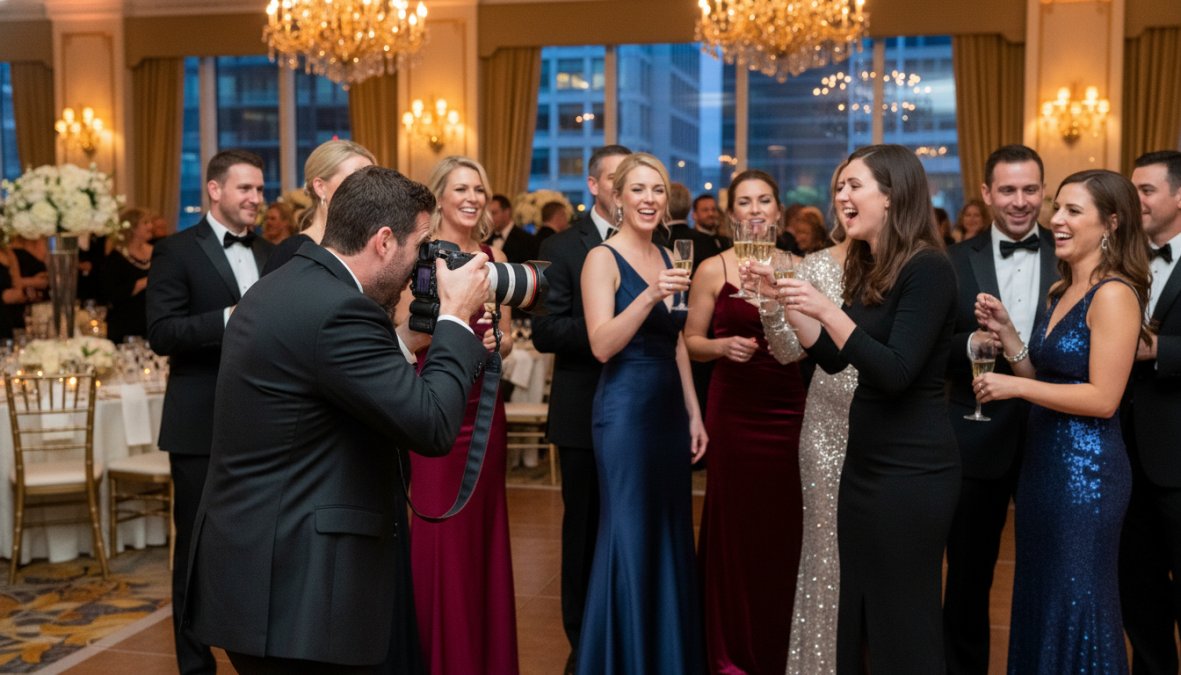
The first thing a prospective client or partner sees when they look up your organization is visual content. Your website, social profiles, and press coverage are all image-dependent. Candid photography from real events, captured by a skilled photographer, signals authenticity in a way that stock imagery never can. Guests laughing, speakers commanding a stage, award recipients accepting recognition: these moments communicate culture, credibility, and scale simultaneously.
A common mistake brands make is treating event photography as a line item to cut when budgets tighten. The paradox is that events represent peak brand visibility moments. Cutting photography at your highest-profile occasions is the equivalent of going silent during your best opportunity to speak.
Long-Term Marketing Asset Value
Professional event photos serve as evergreen content. A well-shot image from a corporate conference can appear in a year-end recap, a speaker’s bio page, a trade publication feature, a client proposal, and a social media anniversary post. Each use extends the return on the original photography investment.
The brands that build the strongest visual libraries treat every event as a content production opportunity, not just a gathering. They arrive with a shot list, brief the photographer on key moments and people, and plan post-event distribution before the event begins. That discipline is what separates organizations with rich, usable photo archives from those scrambling for visuals every time a deadline hits.
The long-term marketing asset value of high resolution event photos is highest when you plan distribution before the event, not after. A shot list aligned with your content calendar turns a single event into months of visual content.
Event Photography Best Practices That Guarantee Stunning Results
Most "best practices" guides stop at "use a good camera." That’s where the useful advice actually begins.
Camera Settings, Gear, and Handling Difficult Lighting Scenarios
Event venues present some of the most technically challenging shooting environments in photography. Mixed lighting, fast-moving subjects, low ambient light, and unpredictable flash from other cameras all conspire against clean exposures. Here’s how professional photographers approach it.
Gear bag essentials for event coverage:
- Full-frame camera body with strong high-ISO performance (two bodies minimum for backup)
- Prime lenses: 35mm f/1.8 for environmental context, 85mm f/1.4 for portraits and speaker shots
- Zoom lenses: 24-70mm f/2.8 as a workhorse, 70-200mm f/2.8 for stage and podium coverage
- On-camera flash with a diffuser for reception and indoor coverage
- Multiple memory cards (never shoot to a single card)
- Spare batteries (event photography drains batteries faster than most assignments)
Camera settings for low light event photography:
- Shutter speed: 1/100s minimum for stationary subjects, 1/250s for moving subjects
- Aperture: f/1.8 to f/2.8 depending on depth of field requirements
- ISO: Start at ISO 1600, push to ISO 6400 on modern full-frame bodies before introducing noise that affects resolution
- White balance: Set manually to match venue lighting; auto white balance produces inconsistent results across a set
- Exposure compensation: Dial down -0.7 to -1 stop in bright ballrooms to protect highlights
Handling difficult lighting scenarios requires a decision hierarchy. Prioritize subject exposure over background. Use flash with a bounce diffuser to soften shadows without the harsh flat look of direct on-camera flash. In venues where flash is prohibited, use the widest aperture available and accept a shallower depth of field.
Bring a second camera body pre-configured for available-light shooting. Switching lenses in a dark venue costs you moments. A second body with a fast prime already mounted means you never miss a candid shot while fumbling with gear.
On-Site Workflow and Backup Strategy
Professional event photographers treat data loss as a non-negotiable risk to manage, not a remote possibility to hope against. The on-site workflow should include shooting to dual memory card slots simultaneously when the camera supports it. This creates an in-camera backup of every frame as it’s captured.
At the end of each major segment of an event (ceremony, reception, awards, keynote), images should be offloaded to at least two separate drives. One stays on-site with the photographer; one goes into a bag that never leaves their person. Cloud backup via a mobile hotspot adds a third layer for photographers working high-stakes events.
The event itinerary should drive the shot list. Know the schedule, know the key moments, and position yourself before they happen. Documentary-style event photography rewards anticipation, not reaction.
| Scenario | Risk | Mitigation |
|---|---|---|
| Single memory card | Total loss if card fails | Dual-slot camera, shoot to both |
| One backup drive | Loss if drive fails or is stolen | Two drives, separate locations |
| No cloud backup | Loss if both drives fail | Mobile hotspot upload after each segment |
| JPEG-only delivery | No resolution headroom for print | Require RAW capture in contract |
How to Use Event Photos for Social Media Marketing That Actually Drives Engagement
 photos on a large widescreen monitor, color-corrected images visible on screen, notebook open beside the keyboard](https://cdn.grandranker.com/articles/importance-of-high-resolution-event-photos-for-your-brand-content-2-1780192853.jpg)
Social media platforms don’t just reward visual quality, they structurally penalize low-resolution source files in ways most brands never trace back to the original capture. This is the direct, technical link between the importance of high resolution event photos and social media performance that most guides skip entirely.
Why Resolution at Capture Determines Social Media Flexibility
Every major platform applies its own compression algorithm to uploaded images. LinkedIn, Instagram, Facebook, and X (formerly Twitter) all re-encode images on ingest, and they do it regardless of what you upload. The practical consequence: a high-resolution source file (24MP RAW-derived JPEG at full export size) survives platform compression with far more retained detail than a low-resolution original that was already compressed before upload.
Here is what that means operationally:
- LinkedIn recommends 1200 × 627px for link post images and 1080 × 1080px for square posts. A full-resolution event photo gives your team the ability to crop to either format without upscaling. Upscaled low-resolution images are visibly soft after LinkedIn’s re-encoding.
- Instagram applies aggressive compression to images above 1080px on the short edge, but starting from a high-resolution file means the compression works on a richer data set, preserving edge detail and skin tones that low-resolution originals lose entirely.
- LinkedIn document carousels and event recap PDFs are a high-performing format for B2B event content. These require print-quality images (300 DPI at intended display size), a use case that is simply impossible without high-resolution originals.
- X (formerly Twitter) displays images at a maximum of 1200 × 675px in-feed, but allows up to 5MB per image. Starting from a high-resolution file and exporting a clean 1200px version produces sharper in-feed results than uploading a compressed original.
Do not let your social media team upload images directly from a photographer’s web gallery preview. Gallery preview images are typically exported at 72 DPI and 1500px maximum for fast loading, they are not the deliverable. Always request a separate web-optimized export set at 2048px on the long edge, which gives platforms enough data to compress cleanly.
The Three-Phase Distribution Framework
The brands that generate the most sustained engagement from event photography operate on a deliberate three-phase distribution model, not a single post-event dump.
Phase 1, Pre-event anticipation (48 hours before):
Behind-the-scenes setup shots, venue reveals, and speaker spotlights generate pre-event engagement and establish visual identity before the event begins. These are typically shot by the photographer during load-in or setup, and they require the same resolution discipline as event-day coverage, a blurry venue teaser shot signals low production value before the event even starts.
Phase 2, Real-time selective posting (day of):
Post a maximum of three to five images during the event itself. More than that fragments attention and dilutes the post-event recap. The images that perform best in real-time are unguarded candid moments, a speaker mid-gesture, an attendee’s genuine reaction, an award recipient’s expression before they compose themselves. These are the frames a documentary-style photographer captures by anticipating moments rather than reacting to them. Posed group shots consistently underperform candid coverage on every major platform’s engagement metrics.
For brands with approval workflows, designate one person with authority to approve real-time posts. A two-hour approval chain kills the timeliness that makes real-time event content valuable.
Phase 3, Systematic post-event distribution (days 1-30):
This is where high-resolution originals generate compounding value. A single well-shot event produces content for:
| Content Format | Platform | Resolution Requirement | Source Needed |
|---|---|---|---|
| In-feed recap post | LinkedIn, Instagram | 1080-2048px | Full-res JPEG |
| LinkedIn document carousel | 300 DPI at 8.5×11" | Full-res JPEG | |
| Speaker quote graphic | All platforms | 1080×1080px | Full-res JPEG (crop) |
| Email newsletter header | 600px wide, 72 DPI | Web-optimized JPEG | |
| Press release image | Editorial | 300 DPI, minimum 4×6" print | Full-res JPEG |
| Annual report / sponsor deck | Print/PDF | 300 DPI at intended size | Full-res JPEG |
| Conference recap blog hero | Web | 1920×1080px | Full-res JPEG |
Every row in that table is a use case that fails with a low-resolution original. Every row is a use case that a high-resolution event photo handles without a second shoot, a stock photo license, or a design workaround.
Shot List Alignment With Content Calendar
The single most effective thing a brand can do before an event is align the photographer’s shot list with the post-event content calendar. This is not standard practice, most brands brief photographers on logistics (who to photograph, what signage to capture) but not on content format requirements.
A content-calendar-aligned shot list specifies:
- Horizontal establishing shots of the full room or stage for LinkedIn headers and blog heroes
- Square-crop-friendly portraits of speakers and honorees for Instagram and quote graphics
- Detail shots (branded signage, centerpieces, award trophies) for sponsor deliverables and recap content
- Candid interaction shots for social proof content and testimonial posts
- Vertical shots (9:16 ratio) if the brand uses Instagram Stories or LinkedIn Stories as part of its distribution
According to Sprout Social’s guide to visual content strategy, posts with high-quality original photography consistently outperform stock imagery across engagement metrics on professional networks. The mechanism behind that finding is authenticity, audiences recognize real environments, real people, and real moments, and they engage with them differently than with staged or generic imagery.
The long-term social media value of high-resolution event photos is not realized at the moment of posting, it is realized over the 30 days after the event, as the same source files are reformatted, cropped, and repurposed across formats that each have different resolution floors. A low-resolution original hits its ceiling on day one. A high-resolution original has no ceiling.
The Importance of High Resolution Event Photos in Post-Processing and Delivery
Post-processing is where raw captures become polished brand assets, and it is the stage where the importance of high resolution event photos becomes most technically apparent, and most frequently mismanaged. Most guides describe post-processing as a linear sequence of steps. Professional event photographers treat it as an engineered system with defined inputs, automation layers, and tiered outputs. The difference between those two approaches is the difference between a 72-hour turnaround and a 10-day one.
Why RAW Files Are Non-Negotiable for High-Stakes Event Coverage
RAW files preserve the complete data output of the camera sensor at the moment of capture. This gives the editor latitude to recover blown highlights by up to two stops, lift underexposed shadows without introducing banding, correct white balance across an entire set with a single adjustment, and apply selective sharpening without degrading image quality. JPEG files apply irreversible in-camera compression at capture, discard color data outside the sRGB gamut, and offer editing headroom measured in fractions of a stop rather than full stops.
For event photography specifically, the RAW advantage is compounded by the shooting environment. Mixed color temperatures (tungsten chandeliers, LED uplighting, daylight from windows, on-camera flash) produce white balance inconsistencies across a set that are trivial to correct in RAW and often impossible to correct cleanly in JPEG without introducing color casts or noise artifacts.
If a photographer quotes you a lower rate for JPEG-only delivery, the discount is real but the trade-off is permanent. You are accepting a deliverable with no recovery headroom for print use, no archival flexibility, and no ability to re-edit if your brand guidelines change. Require RAW capture and full-resolution JPEG delivery as a contract minimum.
Post-Event Workflow Automation: The Professional System Competitors Don’t Explain
This is the content gap most event photography guides ignore entirely: the specific tools and system architecture that allow a professional photographer to deliver a curated social media set within 24 hours and a complete edited gallery within five to seven business days, without sacrificing quality or consistency.
A professional post-event workflow operates in four distinct layers:
Layer 1, Culling (Photo Mechanic or Lightroom AI Select)
Culling is the process of selecting the best frames from a full shoot. For a six-hour corporate event, a professional photographer may capture 1,500 to 2,500 frames. The final deliverable is typically 150 to 400 edited images, roughly 10 to 15 percent of total captures.
Photo Mechanic is the industry-standard culling tool because it renders image previews using embedded JPEGs rather than decoding RAW files, which makes it dramatically faster than culling inside Lightroom or Capture One. An experienced photographer can cull 1,500 frames in under 45 minutes using Photo Mechanic’s rating and tagging system, compared to two or more hours culling the same set inside Lightroom.
Lightroom’s AI-powered Select feature (introduced in recent versions) offers automated culling that identifies sharp, well-exposed frames and flags duplicates. Most practitioners use AI selection as a first pass to eliminate obvious rejects, then apply manual review to the remaining selects. AI culling does not replace editorial judgment, it eliminates the mechanical work of reviewing every frame.
Layer 2, Batch Correction (Preset Architecture)
Once selects are identified, global corrections are applied as a batch rather than image by image. A professional Lightroom or Capture One preset library for event photography is not a single filter, it is a structured set of base corrections organized by shooting condition:
- Indoor tungsten ambient (no flash)
- Indoor mixed light (flash + ambient)
- Outdoor daylight
- Stage / podium (high contrast, strong directional light)
- Reception / candid (variable light, fast movement)
Applying the correct base preset to a batch of images from the same shooting condition corrects exposure, white balance, and color grading across dozens of frames simultaneously. Individual adjustments are then made only to outliers, images with unique exposure problems, distracting backgrounds, or subject-specific retouching needs.
This preset architecture is what makes consistent color grading across a 300-image gallery achievable in hours rather than days. Without it, every image is a manual correction from scratch.
Layer 3, Export Profiles (Tiered Delivery)
High-resolution event photos serve multiple downstream uses, each with different technical specifications. A professional export workflow uses saved export profiles rather than manual settings for each delivery:
| Delivery Tier | Format | Resolution | Color Profile | Use Case |
|---|---|---|---|---|
| Social media fast set | JPEG | 2048px long edge, 72 DPI | sRGB | LinkedIn, Instagram, X |
| Full web gallery | JPEG | 3000px long edge, 72 DPI | sRGB | Client gallery, email, web |
| Print / editorial | JPEG | Full sensor resolution, 300 DPI | sRGB or Adobe RGB | Press, annual reports, banners |
| Archival RAW | RAW (CR3, ARW, NEF) | Native sensor output | Native | Long-term client archive |
Negotiate two delivery tiers explicitly in your contract: a fast-turn social set (20 to 30 selects within 24 hours of the event) and a complete edited gallery (full deliverable within five to seven business days). This structure gives clients immediate content for social channels without compressing the full editing timeline into an unrealistic window.
Request that your photographer deliver the fast-turn social set as a separate shared folder or gallery link, not embedded in the full gallery. This prevents your social media team from accidentally pulling low-resolution preview images from the full gallery before editing is complete.
Layer 4, Delivery Platform and Archive
Cloud gallery platforms (Pixieset, Shootproof, and similar services) allow photographers to deliver password-protected, downloadable galleries with resolution-specific download options. Clients can download the social set at web resolution and the full set at print resolution from the same gallery link, without requiring the photographer to send multiple email attachments.
Archive terms should be specified in the contract: how long will the photographer retain RAW originals, and what happens to the files after that period? Most practitioners retain RAW files for a defined period (commonly one to three years) and then purge them unless a long-term archive agreement is in place. If your organization needs permanent archival access to RAW originals, negotiate this as a separate deliverable and storage arrangement.
Turnaround Time as a Contractual Commitment
Turnaround time is a legitimate client expectation issue, and it should be a written contract term, not an email thread promise. The industry standard for professional event photography delivery is:
- Social media fast set: 20 to 30 selects within 24 hours
- Full edited gallery: Complete deliverable within five to seven business days
- Rush delivery: Full gallery within 48 to 72 hours, typically at a premium rate
Photographers who cannot commit to written turnaround terms are signaling one of two things: they do not have an automated post-processing workflow, or they are managing more bookings than their workflow can support. Either is a risk to your event coverage.
According to Adobe’s photography workflow best practices, photographers who use standardized preset libraries and batch processing reduce post-production time significantly while maintaining consistent color grading across deliverable sets. The automation is not a shortcut, it is the system that makes professional-grade consistency achievable at professional-grade speed.
Post-event workflow automation, culling software, preset architecture, tiered export profiles, and cloud delivery, is what separates a photographer who delivers in 24 hours from one who delivers in two weeks. Before hiring, ask specifically how they handle culling, what their preset system looks like, and what their written turnaround commitment is. The answers will tell you more about their professionalism than their portfolio alone.
What to Know Before Hiring a Professional Event Photographer
Hiring a professional event photographer is a business decision with legal, financial, and reputational dimensions. Most brands focus on portfolio quality and price. Those matter, but they’re not where the risk lives.
Legal and Contractual Protection: What Your Agreement Must Include
A photography contract protects both parties. The absence of a written agreement is the single most common source of post-event disputes between clients and photographers. Before signing, verify that your contract addresses these elements:
- Copyright and licensing: Who owns the images? Most professional photographers retain copyright and license usage rights to clients. Understand exactly what uses are covered (social media, print, advertising, editorial) and for how long.
- RAW file ownership: Many photographers do not include RAW files in standard deliverables. If you need RAW files for archival purposes, negotiate this explicitly.
- Delivery specifications: Resolution minimums, file formats, and quantity guarantees should be written, not verbal.
- Turnaround time: Specify deadlines in the contract, not in email threads.
- Model releases: For events with attendees, clarify who is responsible for obtaining releases for commercial use of images.
- Cancellation and rescheduling terms: Define what happens to the deposit if the event is postponed or cancelled.
- Backup and data retention: How long will the photographer retain originals? What happens if files are lost before delivery?
As documented in ASMP’s guide to photography contracts and licensing, licensing disputes are significantly more common when contracts fail to specify usage scope and duration. A one-page agreement with clear terms prevents the vast majority of post-event conflicts.
Managing Client Expectations and Communicating with Event Planners
The most technically skilled photographer will still produce a frustrating client experience if expectations aren’t aligned before the event. This is where communication with the event planner becomes critical.
A pre-event briefing should cover:
- Event itinerary: Share the full schedule so the photographer can anticipate key moments
- Shot list: Required shots (specific people, awards, signage, group photos) versus preferred shots (candid coverage)
- Restricted areas or moments: Are there moments where photography is not permitted?
- Key people: Who are the VIPs, speakers, and honorees the photographer must capture?
- Venue walkthrough: If possible, a brief venue visit or photo reference helps the photographer plan for lighting challenges
Managing client expectations also means being direct about what event photography can and cannot deliver. Documentary-style candid photography produces authentic, emotionally resonant images. It does not produce perfectly posed portraits of every attendee. If posed group shots are a priority, they need to be scheduled into the itinerary, not assumed.
Professionalism in event photography is measured as much by communication and reliability as by technical skill. A photographer who shows up on time, follows the shot list, and delivers on schedule is more valuable than a technically brilliant one who creates uncertainty at every stage.
High-quality visual coverage is one of the most underinvested areas in brand marketing, and the gap between organizations that prioritize it and those that don’t widens every year. Event Photojournalism delivers award-winning, high-resolution photography across corporate conferences, galas, weddings, and special events throughout the DMV area, with customized coverage designed to elevate your brand and produce lasting visual assets. Our team brings professional reliability, documentary-style expertise, and a service-oriented approach to every assignment. CONTACT US to discuss your next event and ensure every important moment is captured at the quality your brand deserves.
Frequently Asked Questions
Why is image resolution important for event marketing?
High resolution event photos can be scaled, cropped, and repurposed across print materials, websites, social media, and press releases without losing quality. Low resolution images appear pixelated or blurry in larger formats, which can damage your brand's professional image. For corporate events, galas, and conferences, crisp imagery signals credibility and attention to detail, qualities that directly influence how clients, sponsors, and stakeholders perceive your organization.
How do professional event photos affect brand perception?
Professional event photography communicates that your organization values quality and professionalism. High-resolution images taken by a skilled photographer, using proper exposure, white balance, and composition, reflect positively on your brand in every marketing channel. Compared to smartphone snapshots, professionally captured photos from events like corporate conferences or galas elevate your brand identity and help build long-term trust with your audience and partners.
How can high-quality event photos be used for future marketing?
High-quality event photos serve as versatile, long-lasting marketing assets. They can be used in email campaigns, annual reports, press releases, website galleries, LinkedIn posts, and paid advertising. Because they are delivered as high-resolution files, they remain usable across future campaigns without needing to be retaken. Investing in professional event photography once often pays dividends across multiple marketing efforts throughout the year.
Do event photos help with social media engagement?
Yes, high-resolution, professionally composed event photos consistently outperform low-quality images on social media platforms. Crisp, well-lit candid photography and documentary-style event coverage tend to generate more shares, comments, and profile visits. For corporate events and private parties, authentic imagery that captures real moments resonates with audiences and supports stronger organic reach, making professional event photography a smart investment for social media marketing strategies.
What should I look for when hiring a professional event photographer?
When hiring a professional event photographer, review their portfolio for experience with similar events, corporate conferences, galas, or private parties. Confirm they deliver high-resolution RAW or edited files, have a clear turnaround time, and carry professional gear including backup equipment and memory cards. Ask about their contract terms, including image rights and liability coverage. A photographer who communicates clearly with event planners and understands your shot list priorities is essential for reliable, high-quality results.
This article was written using GrandRanker