Table of Contents
- Understanding the Fundamentals of a Gala Photography Timeline
- Step 1: Conduct Pre-Event Planning and Logistics Assessment
- Step 2: Define Your Photography Coverage Hours and Shot List
- Step 3: Build Your Event Photography Timeline Template
- Step 4: Develop Your Event Photography Planning Guide
- Step 5: Optimize Your Gala Photography Timeline for Success
- Common Mistakes to Avoid When Creating Your Timeline
- Post-Production and Delivery Timeline Expectations
Last Updated: July 27, 2026
Understanding the Fundamentals of a Gala Photography Timeline
Gala photography requires a fundamentally different approach than wedding or corporate event photography. Galas operate on compressed timelines with multiple competing priorities: donor recognition, live auctions, keynote moments, and candid networking scenes all demand simultaneous coverage. The difference between mediocre gala photos and ones that serve your fundraising mission comes down to planning.
Galas aren’t about documenting a linear narrative like weddings. They’re about capturing moments that matter to your organization’s mission, moments that will appear in annual reports, social media campaigns, and donor recognition materials. This guide covers how to build a gala photography timeline that ensures nothing critical gets missed, even when the event schedule shifts unexpectedly.
Why Gala Events Require a Dedicated Timeline Approach
Gala photography demands precision that other events don’t. Unlike weddings with predictable sequences, galas involve unpredictable donor arrivals, flexible speech timing, and auction moments that can shift by hours. According to event planning industry standards, nearly 60% of gala events experience schedule changes on the day itself.
Every moment at a gala carries organizational weight. A candid shot of your board chair with a major donor becomes a relationship-building asset. A photo of your silent auction becomes proof of engagement for sponsors. The keynote speaker’s emotional moment becomes marketing content. Your timeline must anticipate these moments and position your photographer to capture them without disrupting the event experience.
Key Differences from Wedding and Corporate Event Timelines
Wedding timelines follow a bride’s day; corporate event timelines emphasize sessions and keynote presentations in linear flow. Gala timelines must balance three competing demands: coverage (capturing authentic activity), discretion (remaining invisible while high-profile guests network), and flexibility (pivoting instantly when the run-of-show changes). Your gala photography timeline needs built-in buffer time, multiple shooter coordination, and a shot list that prioritizes moments by organizational importance rather than chronological sequence.
Step 1: Conduct Pre-Event Planning and Logistics Assessment
Start by understanding the venue, event flow, and your organization’s actual priorities. Schedule a detailed pre-event meeting with your event planner at least two weeks before the gala. Walk through the venue during similar lighting conditions. Identify where keynote speakers will stand, where silent auctions will be displayed, and where the photographer can position themselves without blocking guest sightlines.
Coordinating with Event Planners and Vendors
Your event planner is your most valuable partner. They know which moments matter most, which VIPs require special attention, and which parts of the run-of-show are flexible versus locked in. Provide your event planner with a list of critical coverage moments early. Request a preliminary run-of-show at least 10 days before the event, and ask for updates as details finalize. Coordinate with other vendors: discuss lighting plans with your AV team, check catering about cocktail hour timing, and ask the auctioneer about their position during live auction moments.
Request a walk-through of the venue with your photographer at least one week before the event. Have them test camera settings in the actual lighting conditions you’ll face. Gala lighting is notoriously challenging, low ambient light mixed with stage spotlights creates exposure zones that change every few feet.
Assessing Venue Lighting and Photography Challenges
Gala venues present lighting challenges that demand specific equipment and positioning strategy. Ballrooms typically feature dim ambient lighting, bright stage lighting that creates harsh shadows, and spotlights that change throughout the event. Scout the venue for natural light sources, windows, and outdoor areas where guests might gather. Identify where stage lighting will be brightest and where shadows will be deepest. Test your camera’s high-ISO performance in the actual venue lighting. Gala photography often requires ISO 3200 or higher. If the venue is particularly dark, discuss whether off-camera flash is permitted.
Step 2: Define Your Photography Coverage Hours and Shot List
With venue logistics understood, define exactly what you’re covering and when. This prevents scope creep and ensures your photographer isn’t exhausted by undefined expectations.
Determining Total Coverage Duration
Most galas run 4-6 hours from cocktail hour through closing remarks. However, your photography coverage may not span the entire event. Determine your actual photography hours based on your organization’s priorities and budget.
Typical gala photography coverage breaks down like this:
- Cocktail hour only: 1 hour, captures guest arrivals and networking
- Cocktail through dinner: 2.5 hours, adds table shots and early program moments
- Cocktail through auction: 4 hours, captures full program including live auction
- Full event: 5-6 hours, rare, typically only for major fundraising galas
Define your coverage hours in writing and communicate them to your photographer.
Coverage hours should align with your organization’s content priorities, not the full event duration. If your annual report features only keynote and auction moments, cover those hours specifically.
Creating a Gala Event Shot List
A shot list is your insurance policy against missed moments. Organize it by event phase, then by priority within each phase.
Cocktail Hour (6:00-7:00 PM)
- Priority 1: Board chair greeting major donors at entrance
- Priority 1: Executive director with top 5 individual donors
- Priority 2: General guest networking and candid moments
- Priority 2: Silent auction displays and bidders reviewing items
Dinner Service (7:00-8:30 PM)
- Priority 1: Table shots of major donor tables
- Priority 1: Board members and staff at their assigned tables
- Priority 2: General dining atmosphere and guest interactions
Program (8:30-10:00 PM)
- Priority 1: Executive director’s opening remarks
- Priority 1: Keynote speaker at podium with audience reaction
- Priority 1: Major gift announcement moment
- Priority 2: Board chair’s remarks, live auction auctioneer, and bidding action
Closing (10:00-10:30 PM)
- Priority 1: Final remarks and closing statement
- Priority 2: Organization leadership on stage
Include specific names and faces on your shot list. If your board chair is critical to your marketing, name them. This specificity prevents your photographer from treating all moments equally.
Step 3: Build Your Event Photography Timeline Template
Now translate your coverage hours and shot list into a detailed, minute-by-minute timeline. This is your photographer’s roadmap for the entire event.
Mapping Key Moments: Red Carpet, Speeches, and Auctions
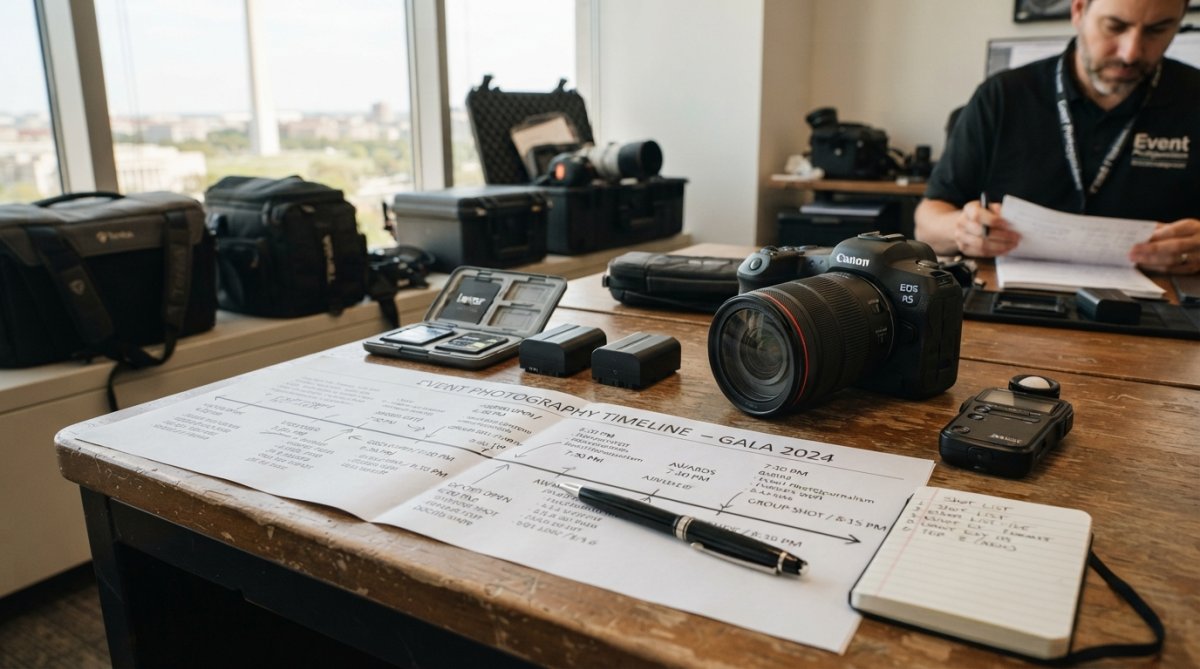
Start with your preliminary run-of-show from your event planner. Map it out hour by hour, then break it into 15-30 minute segments. Include exact start and end times for each phase, key moment timing, location changes, photographer positioning, and lighting conditions.
For galas with a red carpet or formal arrival sequence, allocate 15-30 minutes of dedicated coverage. Position your photographer at the entrance to capture guests arriving. Red carpet moments are highly valuable for marketing and donor recognition.
Speeches and keynote moments demand specific positioning. Your photographer should have a clear sightline to the speaker and audience reaction. Discuss with your AV team whether the speaker will remain at a podium or move around the stage.
Live auctions are chaotic and fast-moving. Your photographer should position themselves to capture the auctioneer, bidders’ excitement, and the winning bid moment. If you have only one photographer, prioritize the auctioneer and major bid moments.
Incorporating Buffer Time and Schedule Flexibility
Events never start exactly on time. Speeches run long. Auctions attract more bidders than expected. Build buffer time into your timeline. If cocktail hour is 6:00-7:00 PM, plan for it to actually run 6:00-7:20 PM. If the keynote is scheduled for 9:15 PM, assume it might start at 9:20 PM or 9:30 PM.
Include flexibility instructions in your timeline. For example:
"Keynote speaker scheduled 9:15 PM. If running late, photographer remains positioned at stage capturing audience anticipation. If running early, photographer pivots to capturing auction momentum. Photographer checks in with event coordinator at 9:10 PM for real-time timing confirmation."
Create contingency positioning. If your photographer is capturing cocktail hour and the event runs ahead of schedule, identify a secondary location where they can capture meaningful moments.
Step 4: Develop Your Event Photography Planning Guide
With your timeline template built, create a comprehensive photography planning guide that your photographer can reference throughout the event.
Managing Guest Flow and Portrait Sessions
Determine whether you need formal portraits and, if so, when they’ll happen. Some organizations schedule portraits during cocktail hour at a designated location. Others capture candid portraits throughout the evening. If you’re doing formal portraits, allocate 15-30 minutes and identify a specific room or backdrop location. Communicate with your event planner about guest flow during portrait time.
If you’re capturing candid portraits throughout the event, your timeline should include specific moments when your photographer should pursue individual or small-group shots.
VIP and Donor Recognition Photography Priorities
Create a tiered shot list:
- Tier 1 (must-capture): Executive director, board chair, major gift donors, keynote speaker
- Tier 2 (should-capture): Board members, mid-level donors, event committee members
- Tier 3 (nice-to-capture): General guests, volunteers, staff
Provide your photographer with names and photos of Tier 1 and Tier 2 individuals. Include specific moments tied to VIP recognition. For example:
"7:30 PM: Board chair expected to move through dining room greeting tables. Photographer shadows board chair, capturing interactions with major donors at each table. Prioritize tables 1-5 (Tier 1 donors)."
Step 5: Optimize Your Gala Photography Timeline for Success
With your detailed timeline and planning guide complete, optimize it for actual execution.
Equipment Requirements and On-Site Setup
Gala environments demand specific equipment choices. Your photographer should arrive with backup gear and be prepared for the lighting challenges you identified during venue assessment.
Essential equipment for gala photography:
- Two camera bodies (backup if one fails)
- Fast lenses: 24-70mm f/2.8 and 70-200mm f/2.8 minimum
- High-speed memory cards
- External flash or off-camera lighting (if venue permits)
- Tripod or monopod for stability in low light
- Backup batteries
- Lens cleaning supplies
Arrive at least 90 minutes before the first guest to test camera settings in the actual venue lighting. Take test shots in the cocktail area, dining room, and stage area. Confirm ISO, aperture, and shutter speed settings that produce clean, sharp images in each lighting zone. Discuss positioning with your event planner before guests arrive.
Second Shooter Coordination and Role Assignment
Most galas benefit from a second photographer to cover simultaneous moments. Define clear role assignments:
Primary Photographer:
- Captures keynote and program moments
- Follows VIP guests and major donors
- Manages overall event flow and shot list prioritization
- Communicates with event coordinator about timing changes
Secondary Photographer:
- Captures cocktail hour and networking moments
- Documents silent auction and bidding action
- Captures table shots during dinner
- Supports primary photographer during high-action moments
Establish a communication protocol. Define moments where both photographers should be in the same location to ensure coverage from multiple angles.
Failing to coordinate second shooter roles creates duplicate coverage of unimportant moments and missed coverage of critical ones. Assign specific areas and moments to each photographer.
Common Mistakes to Avoid When Creating Your Timeline
Mistake 1: Treating the preliminary run-of-show as final. Build flexibility into your photographer’s positioning so they adapt when timing changes.
Mistake 2: Assuming your photographer knows your organization’s priorities. Provide a specific list of people and moments that matter.
Mistake 3: Underestimating lighting challenges. Give your photographer 90 minutes to assess the venue and prepare, not 15 minutes.
Mistake 4: Scheduling too many coverage hours without a second shooter. One photographer cannot simultaneously cover the cocktail area, dining room, and stage.
Mistake 5: Forgetting to communicate the timeline to your photographer. Send your timeline at least one week before the event and conduct a pre-event call to review it together.
Mistake 6: Not accounting for post-event deliverables in your timeline. If you need edited images by 9:00 AM the next day, discuss this during planning.
Post-Production and Delivery Timeline Expectations
Establish clear expectations about image delivery. Will you receive full-resolution RAW files or edited JPEGs? What’s the turnaround time for full delivery?
Many organizations need highlights within 24 hours for press releases and social media. Discuss with your photographer whether they can deliver a curated selection of 50-100 edited images within 24 hours, with full delivery following later.
Create a post-event delivery timeline:
- 24 hours: Preliminary selection of best moments (50-100 images) edited and ready for press release and social media
- 1 week: Full event coverage edited, organized by moment/person, and delivered
- 2 weeks: All images fully edited, color-corrected, and organized for annual report and donor recognition use
Creating a gala photography timeline removes chaos from your event coverage. You’re ensuring that the moments that matter to your organization are captured with intention and clarity. Event Photojournalism understands that galas demand precision planning, flexible execution, and a photographer who can adapt when reality diverges from the schedule. When you invest time in a detailed timeline before your event, your photographer arrives prepared, positioned correctly, and ready to capture the images that will serve your organization’s mission for years to come. CONTACT US to discuss how we build customized gala photography timelines that ensure your event is documented beautifully and strategically.
Frequently Asked Questions
What should be included in a gala photography timeline?
A comprehensive gala photography timeline should include arrival and setup times, red carpet coverage hours, cocktail hour, keynote speaker moments, live auction segments, donor recognition opportunities, and key group photo sessions. Your timeline must account for the run-of-show provided by your event planner and identify critical moments requiring your second shooter's presence. Include buffer time between scheduled events and note any special VIP appearances or fundraising activities unique to your specific gala.
How do you handle gala-specific lighting challenges in your timeline?
Gala environments present unique ambient lighting issues, often dim ballrooms with theatrical stage lighting, spotlights during speeches, and variable lighting during transitions. Your timeline should include dedicated setup time to scout lighting conditions and test flash photography settings before guests arrive. Plan for a second shooter to manage candid coverage in darker areas while your primary photographer captures stage moments. Account for post-production time to address lighting inconsistencies, and communicate these technical realities to your event planner during pre-event coordination so they understand why certain moments may require adjusted positioning.
What's the turnaround time for delivering gala photos after the event?
Turnaround time depends on your total coverage hours, number of images, and desired deliverables. For a typical 4-6 hour gala with 1,000-1,500 images, expect 5-7 business days for initial proofs and 2-3 weeks for fully edited, high-resolution files suitable for annual reports, press releases, and donor communications. Many nonprofits need highlights within 24-48 hours for immediate social media and press use. Clarify these expectations in your pre-event client communication and event photography package details to ensure your timeline aligns with your nonprofit's fundraising ROI metrics and promotional deadlines.
This article was written using GrandRanker