Last Updated: November 16, 2026
Quick Summary
Selecting the right conference photography style means scoring four drivers: intended image use, brand personality, audience sensitivity, and stakeholder obligations. Map your two highest scores to a primary style, let the rest set a secondary style, then allocate roughly 60 percent of shooting time to the primary and 25 percent to the secondary.
- Seven styles cover most needs, including documentary, photojournalistic, editorial, traditional, promotional, candid, and posed.
- Lean candid for the program and networking, and posed for the ten minutes reserved with each keynote speaker.
- Include at least one marketing person and one sponsorship or partnerships person in the scoring session.
- Allocate about 15 percent of shooting time to stakeholder obligations, adjusting when sponsor contracts specify deliverables.
- Measure success by image usage rather than gallery size, since 300 published images beat 2,000 nobody uses.
Table of Contents
- Why Your Conference Photography Style Decides What You Get
- The Main Conference Photography Styles Compared
- Candid vs. Posed Event Photography: What Each Style Delivers
- A Style-Selection Framework Built Around Brand and Event Goals
- Conference Photography Examples: Matching Styles to Real Moments
- Building a Conference Shot List That Covers Every Must-Have
- Conference Photography Tips for Hybrid Events and Privacy
- Book a Conference Photographer Who Matches Your Style
- Frequently Asked Questions
Why Your Conference Photography Style Decides What You Get
Conference photography is the deliberate visual approach used to document a corporate event, and that choice determines whether your images look like a brand asset or a folder of forgettable snapshots.
Photography style is not a decoration you pick at the end. It shapes what your marketing team can use after the event, from press releases to next year’s sponsorship deck.
The Main Conference Photography Styles Compared
Seven styles cover nearly every conference need, and each one trades control against authenticity.
| Style | What It Looks Like | Best For | Trade-Off |
|---|---|---|---|
| Documentary | Unposed, observed moments | Storytelling and post-event content | Less control over framing |
| Photojournalistic | Narrative sequence, discreet | Galas, summits, press use | Requires skilled timing |
| Editorial | Clean, magazine-style | Marketing and annual reports | Some direction needed |
| Traditional | Organized group shots | Records and archives | Feels stiff in candids |
| Promotional | Sponsor and logo focused | Sponsor deliverables | Can look staged |
| Candid | Natural, unguarded | Audience and networking | Unpredictable coverage |
| Posed | Directed portraits | Speaker and VIP headshots | Slower pacing |
Documentary and Photojournalistic Coverage
Documentary coverage observes rather than directs. The photographer moves through the room and captures what happens without arranging it, which produces a genuine record of the day. For a fuller explanation of how this style works and how to hire for it, see our guide to documentary style event photography.
Editorial, Traditional, and Promotional Coverage
Editorial coverage sits between observation and direction: polished enough for a magazine spread while still feeling real. Traditional coverage prioritizes organized group shots and formal records, which boards and archives often require. Promotional coverage serves sponsors through logo visibility, branded backdrops, and clean stage shots that satisfy contract obligations.
Candid vs. Posed Event Photography: What Each Style Delivers
The candid versus posed decision comes down to use. Candid photography captures unguarded moments and audience reactions, while posed photography delivers controlled, consistent images of speakers, VIPs, and groups.
Candid coverage wins for social media, storytelling, and donor relations because the images feel honest. Our breakdown of candid versus posed event photography covers technical requirements and how to direct authentic moments.
A practical default: lean candid for the program and networking, lean posed for the ten minutes you reserve with each keynote speaker.
A Style-Selection Framework Built Around Brand and Event Goals
A scored framework can help you choose a conference photography style in a single planning meeting, with a worked example, so the choice is defensible to finance, marketing, and leadership.
Step 1: Score the four selection drivers
Rate each driver from 1 (low priority) to 5 (critical) for your event, with the people who will actually use the images.
- Intended image use. Press releases, annual reports, and investor decks reward editorial polish. Social, email, and recruitment content reward candid energy. Rate higher when the primary use is polished and external.
- Brand personality. A formal financial brand and a scrappy startup need different visual voices. Rate higher when brand guidelines are strict and public-facing.
- Audience and attendee sensitivity. Board meetings, closed-door summits, and sessions involving minors or confidential content call for discreet coverage. Rate higher when privacy risk is real.
- Stakeholder obligations. Sponsor contracts, speaker agreements, and leadership portrait requests create hard deliverables. Rate higher when contractual logo or portrait coverage is required.
Step 2: Map the highest scores to a primary style
Use the two highest-scoring drivers to pick a primary style, then let the remaining drivers set the secondary style.
| Highest-scoring drivers | Primary style | Secondary style |
|---|---|---|
| Intended use + brand personality | Editorial | Posed portraits |
| Audience sensitivity + brand personality | Photojournalistic | Documentary |
| Stakeholder obligations + intended use | Promotional | Editorial |
| Intended use + audience sensitivity | Documentary | Editorial |
| Stakeholder obligations + audience sensitivity | Traditional | Photojournalistic |
If the top two drivers tie with a third, that is your signal to budget a hybrid plan rather than force a single style.
Step 3: Run a worked example
Suppose a 600-attendee B2B software conference scores intended use at 5 (press push and sales deck), brand personality at 4 (clean, modern, not stiff), audience sensitivity at 2 (public event, standard consent signage), and stakeholder obligations at 4 (three platinum sponsors with logo deliverables). Editorial becomes the primary style with posed speaker portraits as secondary, while stakeholder obligations earn promotional coverage a dedicated block. The brief: editorial for the program, posed for the eight speakers, promotional for sponsor stage moments and booth visits.
Step 4: Convert the score into a coverage allocation
A score alone does not tell a photographer where to stand, so translate it into time and shot volume.
Watch out: teams often score drivers with the events lead alone and discover after the event that marketing needed a different mix. Include at least one person from marketing and one from sponsorship or partnerships in the scoring session.
Step 5: Set the tie-breakers before the event
When two drivers score equally, resolve the tie with three questions: Which stakeholder complains loudest if the images miss? Which channel publishes first? Which images are hardest to recreate after the event ends?
This framework turns a subjective argument into a scored, documented brief rather than an opinion.
Conference Photography Examples: Matching Styles to Real Moments
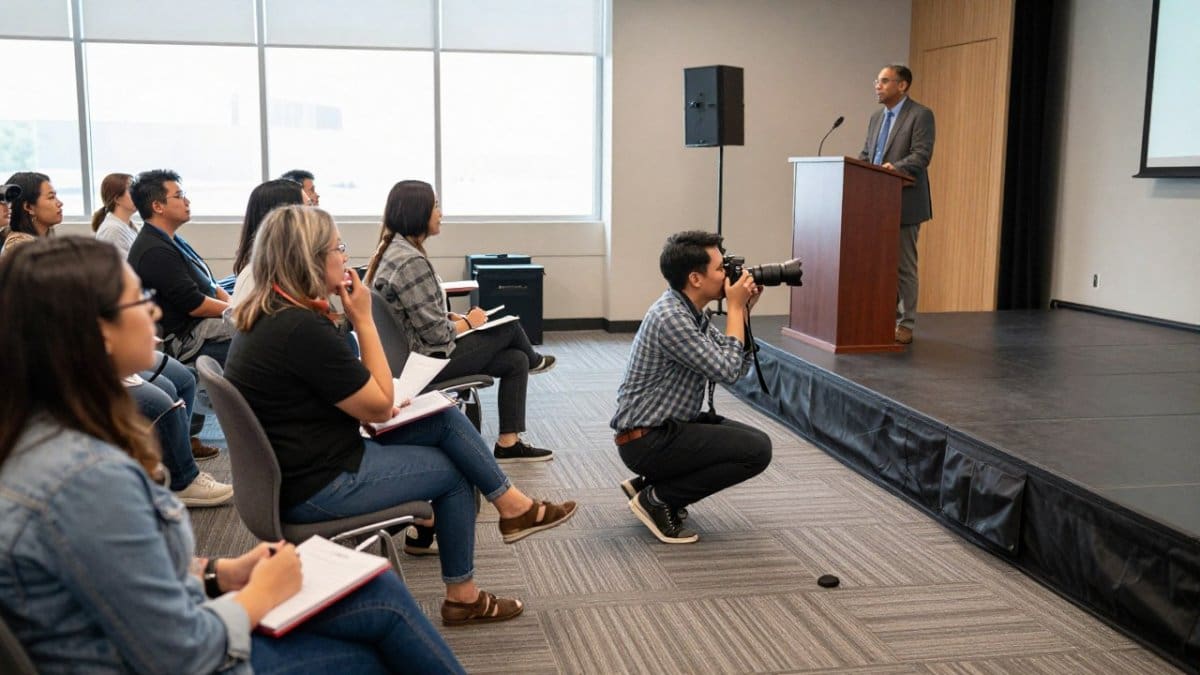
The fastest way to understand the difference between styles is to see the same moment rendered three ways. Each common conference moment below is paired with the style that serves it best, what the image looks like in practice, and the deliverable it feeds. Use this as a working reference when you brief a photographer or review a gallery.
Keynote and speaker moments
A keynote produces three distinct images, each belonging to a different style. The editorial portrait is a clean, well-lit frame of the speaker at the podium, composed for a press release or annual report. The documentary frame catches the speaker mid-gesture, showing energy rather than polish. Briefing all three frames also means deciding how each should express the event’s identity, a choice that connects naturally with HillaryMoorePhotography and the role of authentic brand imagery.
Panel discussions
Panels reward a two-angle approach. A wide editorial frame shows the whole table, the moderator, and the room context, which is what program pages and recap articles need. Tight documentary frames of the person speaking capture expression and engagement. Panels are also where hybrid coverage pays off: the wide frame often doubles as the only usable image of a sponsor-branded stage set.
Audience reactions
Audience reactions are pure documentary and candid work, and they are the most underrated images of any conference. A room laughing, leaning forward, or taking notes tells the story better than any stage shot, and these images feed social, email, and recruitment content because they show what attending actually feels like.
Networking and attendee interactions
Networking coverage is candid by nature: small clusters, handshakes, business cards exchanged, people deep in conversation. The style choice here is less about direction and more about discretion. A discreet approach that moves through the room without interrupting tends to produce usable frames.
Sponsor recognition and logo moments
Sponsor recognition blends promotional and editorial. The goal is legible logos without an advertisement feel: a clean frame of a sponsor booth with attendees engaged, a stage shot with the backdrop visible, a handshake at a branded activation. These images feed sponsor recap decks and renewal conversations, so shoot them to a sponsor’s deliverable list.
Group shots and VIP portraits
Group shots and VIP portraits belong to the posed and traditional styles. Schedule them at a fixed time, keep the list short, and confirm who needs to be in each frame before the event. Posed portraits of speakers and executives feed leadership pages, press kits, and board records, and they are the images most often requested after the event with no usable frame on file.
Allocating styles across the event day
A hybrid plan works best mapped to the schedule rather than left to the photographer’s judgment. A common pattern is documentary and candid coverage through registration, the opening keynote, and networking breaks; editorial and promotional coverage during sponsor stage moments and panel wide shots; and posed portraits in a reserved window during lunch or a scheduled break.
Connecting style to deliverables and measurement
Style choices should connect to what you actually publish: editorial images suit press releases, annual reports, and investor decks; candid and documentary images suit social, email, and recruitment; promotional images suit sponsor recaps.
Watch out: teams often judge coverage by volume and discover too late that the images they needed for a morning press release were shot in a style that did not fit.
Building a Conference Shot List That Covers Every Must-Have
A conference shot list is a written inventory of the images your team cannot leave without, organized by time and location. Start with our corporate event photography shot list as a base, then trim it to your event’s priorities.
- Venue exterior and signage before doors open
- Registration desk and first arrivals
- Opening keynote, wide and tight
Share the list a week ahead and flag your VIPs by name and photo. A photographer who knows what your sponsors and board members look like will not miss them.
Conference Photography Tips for Hybrid Events and Privacy
Hybrid conferences split the camera’s attention between the room and the stream, so plan for both. Capture the speaker and the screen showing remote participants, and grab a few frames of the production setup to prove the hybrid element worked.
Privacy and consent deserve equal planning. Our techniques for staying unseen while shooting candid conference photography cover positioning and etiquette that keep coverage unobtrusive for private board members.
Book a Conference Photographer Who Matches Your Style
Matching a photographer to your chosen style matters more than matching on price. Explore our photojournalistic event coverage to see how discreet observation translates into usable images.
The wrong style produces images nobody can use, and no amount of editing fixes a missed moment. Choose the style around your goals, brief the photographer on your VIPs and sponsors, and confirm delivery timelines before the event.
Frequently Asked Questions
Should conference photos be candid or posed?
Most conferences need both. Candid photography captures genuine audience reactions, networking exchanges, and speaker energy that posed shots cannot replicate, which makes it stronger for social media and press use. Posed photography guarantees clean group shots of board members, sponsors, and award winners for annual reports and donor materials. A common split is roughly 70 percent candid and 30 percent posed, adjusted for how private your attendees are and how much formal recognition your event includes.
What types of photos should a conference photographer capture?
A complete conference shot list covers keynote and panel speakers, audience reactions and questions, networking and attendee interactions, sponsor signage and branding, group shots of your team and board, venue details, and any awards or announcements. Build the list around where each image will be used: press releases need speaker portraits and stage shots fast, while fundraising appeals lean on candid donor and attendee moments. Share the list and a VIP briefing with your photographer before the event.
How do I choose a photography style that fits my brand?
Start with how the images will be used and who will see them. A nonprofit gala raising donor money usually needs candid, documentary-style conference photography that shows emotion and mission in action. A corporate product launch or government-adjacent summit often calls for a cleaner editorial look with controlled lighting and structured group shots. Review full event galleries, not just portfolio highlights, and confirm the photographer can deliver a hybrid plan if you need both.
How can I balance candid moments with posed group photos?
Schedule the posed shots instead of hunting for them. Put board and sponsor group photos in a fixed window, such as right after the opening remarks or during a reception lull, so they do not compete with candid coverage. Give your photographer a short list of must-have groupings and a VIP photo sheet with names and faces. Outside those windows, ask for unobtrusive coverage so the rest of the event stays natural.